
Idea 1
Healing from Emotionally Immature Parenting
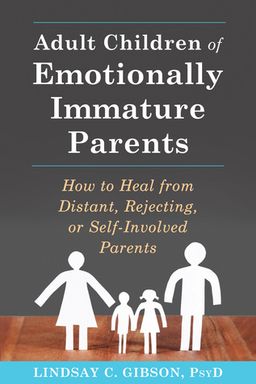
Have you ever wondered why your relationships feel lopsided, why emotional closeness seems so hard, or why you keep trying to fix people who don’t seem to change? In Adult Children of Emotionally Immature Parents, psychologist Lindsay C. Gibson offers a compassionate and deeply illuminating answer: many adults carry invisible scars from being raised by parents who could meet their physical needs but not their emotional ones. Gibson contends that emotional immaturity—not malice—is often the unseen force behind lifelong patterns of loneliness, confusion, and over-responsibility.
Gibson’s core argument is simple yet profound: it’s not your fault if you grew up feeling unseen or unloved emotionally. Emotional immaturity in parents means they lacked the self-awareness, empathy, and flexibility to connect deeply with their children. These parents may have looked normal from the outside—providing food, shelter, and education—but they were inwardly too self-preoccupied or frightened of real emotion to nurture their children’s inner world. As a result, their children grew up feeling invisible, empty, or perennially responsible for keeping relationships afloat.
What Emotional Immaturity Really Means
Emotionally immature parents look like adults but interact emotionally like children. They resist self-reflection, avoid uncomfortable feelings, and use defense mechanisms to deny reality. When stressed, they regress—reacting impulsively, withdrawing affection, or demanding compliance instead of talking things through. Gibson identifies four main types: the emotional parent ruled by instability, the driven parent obsessed with control and success, the passive parent who avoids all conflict, and the rejecting parent who simply doesn’t want emotional contact at all.
These parents fear emotional vulnerability and see authentic feelings as dangerous. Rather than nurturing their child’s spontaneity, they teach shame, duty, and suppression. Growing up under such conditions often leaves children confused about their own worth and constantly chasing approval that never comes. Gibson argues that healing begins when you identify these patterns and stop trying to get deep love from people incapable of giving it.
The Cost of Emotional Neglect
Gibson calls the pain caused by emotionally immature parenting emotional loneliness—a deep, aching emptiness born from not being understood or emotionally responded to. David, one of Gibson’s clients, described his childhood as “floating alone in the ocean.” Rhonda, another client, remembered standing with her family during a move and feeling utterly alone though they were next to her. This emotional isolation becomes the blueprint for adult relationships: you might find yourself drawn to distant partners, working too hard to earn love, or feeling guilty for being unhappy despite having everything you “should.”
Emotional loneliness isn’t weakness or personal failure—it’s a predictable result of growing up unseen. Gibson shows how emotional neglect rewires your sense of safety. You learn that it’s safer to please, fix, or appease others than to express needs. You may either become hyper-responsible (internalizers) or blame everyone else (externalizers). Both styles are attempts to survive childhood without true emotional security.
From Understanding to Healing
The beauty of Gibson’s message is its balance of realism and hope. She doesn’t promise that emotionally immature parents will transform—but she does promise that you can. Healing, she writes, means seeing your parents accurately and reclaiming your “true self”—the part of you that knows what you feel and what you need, even if you learned to hide it. Instead of trying to change your parents, you begin to observe them objectively, protect your boundaries, and stop being “hooked” by their reactions.
This transformation involves awakening from old family roles. You might realize you’ve been playing the selfless caretaker, the fixer, or the quiet achiever in hopes that someone will finally love you as you are. Gibson describes this awakening as both painful and liberating—a breaking down of illusions followed by a rediscovery of emotional clarity. It’s the moment when, as one client said, “I’m not the bit character in someone else’s novel—I can step off the page.”
Why This Approach Matters
Understanding emotional immaturity does more than heal family wounds—it reframes how you see relationships, work, and even self-worth. You learn that empathy doesn’t mean servitude, that self-care isn’t selfish, and that emotional depth is a strength, not a liability. Gibson’s approach bridges classic attachment theory (Mary Ainsworth, John Bowlby) with contemporary emotional intelligence research (Daniel Goleman), integrating psychology and compassion into practical everyday healing.
Ultimately, Gibson teaches that when you stop trying to be loved by emotionally immature people, you free the space within you for emotionally mature ones. Through understanding, observation, and boundaries, you replace fantasy with truth and reclaim the confidence to seek real connection. Healing doesn’t mean rejecting your parents; it means releasing the need for them to be different so you can finally become yourself.