
Idea 1
America Adrift: The Fraying of the Middle Class
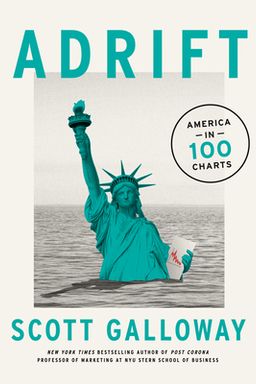
What happens to a nation when its pursuit of prosperity leaves behind the very people who built it? In Adrift: America in 100 Charts, Scott Galloway paints a vivid, data-driven portrait of a country that has lost its ballast—the broad, thriving middle class that once kept the ship of state steady through every storm. The book’s premise is simple yet devastating: America isn’t short on ambition or innovation, but it’s become untethered from the shared economic and social purpose that once united its citizens.
Galloway contends that our nation’s progress has historically followed one clear pattern—when America invests in its middle class, everyone prospers. When it doesn’t, inequality balloons, culture fractures, and democracy teeters. Through 100 striking charts, he chronicles how Reagan-era policies, globalization, financialization, and technological obsession shifted wealth and influence upward, hollowing out the center. Behind the data is a moral argument: the health of a society isn’t measured by how many trillion-dollar companies it births, but by how well ordinary people can buy a home, educate their kids, and build meaningful lives.
From Ballast to Drift
In the years following World War II, America had ballast—a strong, equitable middle class stabilized by job growth, unions, public education, and ambitious government investment. The G.I. Bill sent millions to college, Eisenhower’s highways knit the country together, and progressive taxes funded infrastructure and opportunity. People joined civic organizations, played Little League, and felt a shared stake in the American dream. Yet by the 1970s, cracks began to appear. Economic stagnation and widening inequality bred frustration, paving the way for a new creed: shareholder capitalism. Milton Friedman’s gospel of maximizing shareholder value replaced collective good with individual wealth. Reagan’s tax cuts slashed top rates from 70% to 28%, favoring capital over labor and ushering in four decades of trickle-down myth.
The Rise of the Shareholder Class
Under Reagan, Galloway explains, government became the villain and Wall Street the savior. Regulations weakened, unions collapsed, and infrastructure spending plummeted. Corporate raiders and leveraged buyouts rewarded short-term profits over long-term innovation. Productivity soared—output per hour skyrocketed—but pay for workers stagnated. Between 1973 and 2014, productivity grew 72% while worker compensation rose only 9%. The result: a widening gulf between those with assets and those without. The wealthiest 10% came to own nearly 90% of all stocks; half of Americans held none at all. Economic dynamism didn’t just slow—it was captured.
Global Gains, National Losses
To be fair, Galloway acknowledges that globalization lifted billions out of poverty and connected the world in ways once unimaginable. Between 1980 and 2020, the share of humans living in extreme poverty dropped from over 40% to under 10%. Democracy spread, life expectancy rose, and literacy became nearly universal. But those global wins came alongside domestic losses: American industry declined, offshoring exploded, and financial incentives rewarded tax havens over towns. China and other rising economies invested in infrastructure and R&D while America outsourced production and cut back mental health care, housing, and oversight.
Idolatry of Innovators and the Tech Faith
As inequality deepened, America found a new mythology. Galloway calls it the “gross idolatry of innovators”—a faith in charismatic tech leaders who replaced astronauts and civil rights heroes as cultural messiahs. Jobs and Gates were once icons of ingenuity; now billions worship Musk and Bezos, mistaking market power for moral worth. Tech’s influence grew from invention to domination, fueled by yoga-babble mission statements and stock valuations that reward hype over substance. Private R&D eclipsed public funding, putting humanity’s future—AI, genetics, energy—in the hands of a few unelected billionaires. Meanwhile, the nation’s civic muscles atrophied as people swapped Rotary meetings and church gatherings for Twitter threads and dating apps.
A New Feudal Order
By the 2000s, America’s wealth pyramid had hardened into a feudal order. The top 1% owned nearly a third of the country’s riches; the bottom 50% owned 2%. CEOs made 350 times the pay of average workers. Home prices ballooned to four years’ worth of annual income, and a college degree became both more essential and more expensive than ever. Add to that an attention economy that monetizes outrage, turning users into addicted products rather than empowered citizens. Politics polarized, trust evaporated, and millions of young Americans found themselves broke, lonely, and furious—what Galloway calls “the most dangerous cohort in America.”
Threats and Possibilities
Internationally, as America navel-gazes, China rises. Galloway outlines how the U.S. still dominates global finance, tech, and culture but invests poorly in health, infrastructure, and energy. We spend 100 times more on defense than on disease prevention. China, meanwhile, builds high-speed rail and refines the minerals needed for clean energy. Yet amid crisis, Galloway finds hope: recessions foster innovation, immigrants drive entrepreneurship, and moments of instability—like Covid and the digital revolution—offer chances to rewrite the social contract. But that requires leadership willing to rebuild public trust, restore deterrence against corporate misconduct, and reallocate capital from billionaires to children.
The Way Forward
In the book’s closing chapters, Galloway becomes prescriptive. He lays out a ten-point plan: simplify the tax code; rebuild regulation; enforce meaningful punishments for corporate wrongdoing; reform Section 230 to make tech accountable; rethink mass incarceration; impose a one-time wealth tax; rebrand nuclear energy; support family formation and children; reform higher education; and invest in national service. These steps, he argues, would restore America’s ballast—a fair start, a level playing field, and enough security for its people to take risks again. As he concludes, America isn’t lost—it’s adrift. But the charts point the way back to land.