
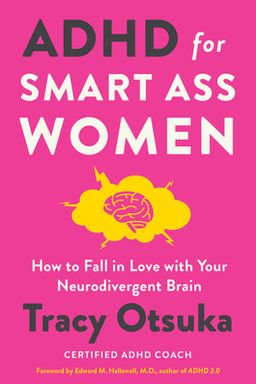
ADHD for Smart Ass Women cover

ADHD for Smart Ass Women

by Tracy Otsuka

ADHD for Smart Ass Women offers a transformative guide for neurodivergent women to understand and embrace their ADHD. Through engaging insights and practical strategies, Tracy Otsuka empowers readers to manage challenges, enhance relationships, and harness their unique strengths to live fulfilling lives.

Redefining ADHD: A Strengths-Based Revolution for Women

Have you ever wondered if the very things that make you feel “too much” might actually be your greatest assets? Tracy Otsuka’s ADHD for Smart Ass Women turns that question on its head. Instead of seeing ADHD as a disorder or deficit, Otsuka argues that it’s a misunderstood way of being—a powerful, creative, and high-energy variation of human wiring. Her message is clear: women with ADHD aren’t broken; they’re brilliant. What they need isn’t fixing, but reframing.

Drawing heavily from her personal story—how a psychologist once told her to lower her son’s expectations, only for both of them to later be diagnosed with ADHD—Otsuka makes a radical case for optimism. She teaches readers to stop pathologizing themselves and start embracing their unique neurology as a source of gifts. (Note: Her approach parallels Dr. Edward Hallowell’s and John Ratey’s model in ADHD 2.0 that treats ADHD as potential, not pathology.)

Breaking the Old Paradigm

Traditional views of ADHD center on deficits—distraction, hyperactivity, disorganization, and impulsiveness. But Otsuka dismantles this narrative. She explains that ADHD isn’t about a deficit of attention but a regulation of attention. Women with ADHD don’t fail to focus; they focus too intensely on things that interest them and struggle with those that don’t. This “surplus of attention” manifests through hyperfocus—a state of deep immersion that can produce extraordinary creativity and productivity when properly directed.

And yet, Otsuka highlights how this same brain often gets mislabeled or dismissed, especially in women. Because girls tend to internalize their symptoms—appearing dreamy or anxious instead of disruptive—they go undiagnosed or are misdiagnosed with anxiety or depression. The resulting shame and confusion lead many women to believe their difficulties stem from moral failings rather than neurobiology.

Why Women Have Been Overlooked

Otsuka spends considerable time unpacking the gender bias behind ADHD diagnoses. Much early research was done exclusively on young boys exhibiting hyperactive behavior, creating a diagnostic model that excluded women’s quieter, more internal struggles. This bias persists today, leaving millions of women undiagnosed, misunderstood, and underserved. She shares stories of women who were told they couldn’t have ADHD because they were too successful, too organized, or too calm—showing how stereotypes continue to distort recognition.

Through her Facebook group and top-ranked podcast, Otsuka built a massive community of women who identified with her reframed approach. She discovered that when these women finally learned about ADHD’s strengths, rather than its shortcomings, their shame dissolved. They realized they weren’t failures; they were simply playing by neurotypical rules that never suited them.

Turning Weaknesses into Superpowers

The heart of Otsuka’s work lies in showing how traits traditionally seen as liabilities can become advantages. Impulsivity becomes creativity gone right. Hyperactivity turns into entrepreneurial drive or deep curiosity. Emotional intensity evolves into empathy and justice sensitivity. Her coaching and programs revolve around transforming these raw traits into directed energy—what she calls “ADHD superpowers.”

She shares real stories: Fran, an artist whose distractibility fuels creative bursts; Rene, a dog trainer who turned impulsivity into fearlessness; and Jayne, a hairstylist who transformed school failure into international success. Each woman learned to channel her traits rather than suppress them. The implication is profound—you don’t heal ADHD by minimizing yourself; you thrive by magnifying your strengths.

From Shame to Self-Discovery

Otsuka positions ADHD not as a limitation but as the starting point for authentic self-understanding. She introduces her six-step program designed to help women find their values, strengths, skills, passions, and purpose, culminating in a personalized “Intelligence Report.” This self-mapping tool helps ADHD women make decisions aligned with their true interests rather than external expectations—a radical act in a world that defines success through linear logic.

Her philosophy resonates throughout the book: start with curiosity, build positive emotion, and trust your intuition. While traditional therapy and medication can help, Otsuka argues that genuine transformation comes from self-recognition. Once women realize their ADHD brains are designed for creativity and meaning, not conformity, their confidence—and competence—skyrocket.

The Larger Mission

Ultimately, ADHD for Smart Ass Women is both manifesto and method. It’s a call to rewrite the narrative surrounding neurodivergence and femininity. Otsuka wants women to see themselves as successful because of ADHD, not despite it. Her holistic approach blends neuroscience, psychology, coaching, and lived experience. She reframes ADHD as a source of power—the ability to think differently, act boldly, and question conventional systems.

For any woman who has ever been told she’s “too chatty,” “too intense,” or “too much,” Otsuka’s message is liberation: those qualities are not flaws but facets of genius. The book matters because it replaces pathology with possibility, turning ADHD from a diagnosis into a declaration—of creativity, courage, and unapologetic authenticity.


Why Women Get Misdiagnosed and Missed

Otsuka devotes deep attention to explaining why women remain the most underdiagnosed group in ADHD research and treatment. The issue, she insists, isn’t women’s symptoms—it’s cultural blindness. For decades, studies built diagnostic criteria around hyperactive boys bouncing off classroom walls, ignoring the quieter, inward turmoil of girls. This single oversight created generations of women who struggle in silence, confused about why they feel overwhelmed yet driven, sensitive yet disorganized.

Gender-Biased Research and Stereotypes

ADHD diagnostic criteria come from data built almost exclusively on young boys exhibiting externalized behaviors—rule-breaking, constant motion, and verbal impulsivity. As a result, anyone displaying internalized symptoms like daydreaming or overthinking often slipped through the cracks. Teachers and parents usually notice disruptive kids, not the quiet girl staring out the window. “The mommy factor,” Otsuka writes, captures the reality that many women only discover their ADHD after their children—especially sons—are diagnosed.

Otsuka shows that even medical professionals perpetuate these biases. One woman she worked with was told she couldn’t have ADHD because she “wasn’t fidgeting.” Another was deemed too educated and organized. Many women were given antidepressants for years before learning that ADHD, not depression, was the root cause.

The Hidden Symptoms of Female ADHD

Women tend to internalize hyperactivity—ruminating thoughts, restless minds, or chronic anxiety—rather than displaying overt motion. They also struggle with time blindness, emotional intensity, and perfectionism. These hidden patterns lead to overcompensation. Many ADHD women become high achievers who hide behind color-coded planners and sleepless nights. They work twice as hard to manage the chaos others don’t see.

Key Observation

Women with inattentive ADHD often appear dreamy, perfectionistic, or anxious rather than disruptive, which makes them less likely to trigger concern from teachers or doctors.

Breaking Through Misdiagnosis

Otsuka advises women to seek specialists who understand ADHD in adults and in females specifically. She details how psychologists, psychiatrists, and neurologists can diagnose ADHD but emphasizes that few receive adequate training. Ninety-three percent of adult psychiatry programs include no ADHD instruction. The result? Women get blank stares or mislabeling instead of help.

She outlines practical steps: prepare symptom lists; research diagnostic guidelines; bring related studies; and trust your intuition if a provider dismisses you. “We’re intuitive,” she writes. “Trust that voice.” Her mantra turns diagnosis into self-validation rather than a passive process led by experts.

Medication Myths and Realities

Medication, Otsuka explains, can transform lives—but she cautions against blind dependence. Twenty percent of women with ADHD find stimulants ineffective or intolerable. Her own two-year trial of Adderall, Ritalin, and others left her anxious and disoriented. She learned that medication alone rarely solves underlying self-belief issues; success requires integrating physical, emotional, and lifestyle-based strategies—exercise, sleep, diet, and coaching.

Through these deeply personal anecdotes, Otsuka reframes diagnosis from an act of labeling into one of discovery. For many women, finally understanding they have ADHD ends decades of guilt. The misdiagnosed “defects” reveal themselves as misunderstood brilliance waiting to be properly named and nurtured.


The Gender Scripts That Shape ADHD Struggles

Why do ADHD women face steeper battles in daily life? Because society still scripts women’s roles around organization, calmness, and compliance. Otsuka argues that ADHD collides head-on with these expectations, making every undone chore or impulsive comment feel like a moral failing instead of a neurological variation. The cultural norms that dictate what a “good woman” should look like—neat, punctual, caretaking—become traps for those whose brains aren’t wired that way.

Gender Roles and Domestic Overload

ADHD women often hit their biggest wall after marriage or motherhood. Suddenly, they’re responsible not only for themselves but also for partners, children, and homes—a logistical nightmare for any brain with impaired executive function. Modern equality hasn’t erased outdated gender norms. Studies still show women handle most household chores and caregiving duties. For ADHD women, the double burden intensifies guilt and exhaustion.

Emerald, a marriage and family therapist and mother, embodies this conflict. Brilliant at work and deeply loving, she nevertheless felt inadequate because the laundry piled up and dinner was late. Otsuka coached her to reframe her identity: instead of measuring herself against domestic efficiency, she identified her true strengths—empathy, creativity, and fearless activism. That shift transformed her self-worth from failure to power.

Gender Norms and Emotional Cost

Cultural norms punish women for traits that ADHD enhances. Interrupting becomes “rude,” impulsivity “unladylike,” and intense emotions “too much.” These judgments generate chronic shame. Courtney, for example, was mocked for her messy room while her equally disorganized brother was excused because “boys are just that way.” The same mess signified giftedness in him and dysfunction in her. Decades later, this double standard still haunts professional women expected to be polished and restrained.

Hormones: Nature’s Complicating Factor

Otsuka adds another layer: biology. Female hormones profoundly affect ADHD symptoms. Estrogen boosts dopamine and serotonin, improving focus and mood, while its decline—before menstruation, during perimenopause, and post-menopause—worsens disorganization, forgetfulness, and emotional volatility. She calls this “midlife onset ADHD,” where symptoms explode just as women juggle careers, aging parents, and shifting identities.

Her experience—visiting five doctors before discovering her ADHD and hormonal connection—illustrates medicine’s failure to study women. She encourages readers to treat hormonal changes as biological, not personal flaws, and to experiment with interventions like exercise, nutrition, mindfulness, or hormone therapy under professional guidance.

By analyzing gender and biology together, Otsuka exposes a system that leaves women extra burdened yet extra capable. Her message: drop cultural guilt and treat your ADHD as power disguised as deviation. You’re not failing to meet expectations—you’re rewriting them.


Transforming Traits into Superpowers

What if your restlessness is ambition, your impulsivity is creativity, and your chatter is connection? Otsuka’s favorite mantra—that ADHD can be an advantage or a curse depending on how you manage it—anchors this uplifting section. Here, she catalogs the remarkable strengths ADHD women possess once they stop fighting their natural wiring and start steering it deliberately.

Creativity and Innovation

Because ADHD brains thrive on novelty, women like Fran channel their mental fireworks into creative brilliance. Studies confirm that impulsivity correlates with divergent thinking—the ability to generate multiple solutions (a finding echoed by researchers in the Journal of Attention Disorders). Fran, once dismissed as hopelessly distracted, became an award-winning filmmaker. Her ADHD wasn’t a barrier—it was her engine.

Hyperfocus and Drive

When interest sparks, ADHD women can enter near-superhuman states of focus called hyperfocus. Raquel, for instance, started as a college student looking to fund travel. Within weeks, she organized a music festival with 21 bands and MTV coverage. Her restlessness translated into entrepreneurial energy. Otsuka calls this “drive masquerading as hyperactivity”—an endless motor propelling achievement when passion is present.

Risk Taking and Fearlessness

Impulsivity has a bad reputation, but Otsuka reframes it as guts. Rene, a military veteran, became an expert dog trainer after surviving a pack fight in her living room. Her willingness to dive headfirst into danger transformed fear into mastery. Studies show that ADHD risk-takers often overestimate payoff, but that same confidence births innovation, leadership, and resilience.

Empathy, Justice, and Intuition

ADHD heightens emotional sensitivity, which can hurt in criticism but shine in compassion. Taylor, an immigration attorney, channels her empathy and justice sensitivity into fierce advocacy for clients. ADHD women, Otsuka argues, feel more deeply, notice social injustice faster, and intuit unspoken cues that others miss. Instead of suppressing emotion, they can use it to lead and connect. (Note: This concept echoes psychologist Elayne Daniels’s research on sensory sensitivity and intuition in neurodivergent adults.)

In every example, Otsuka reminds you that ADHD traits are magnifiers. They amplify what matters most. Once you stop apologizing for your mind’s speed and intensity, you can transform distraction into direction—and live as the “smart ass” visionary you were always meant to be.


Finding Purpose Through Your Values and Passions

After reimagining ADHD as strength, Otsuka introduces a practical roadmap for harnessing it. Her six-step program guides women from confusion to clarity by aligning their daily choices with their deepest values, strengths, skills, passions, and purpose. This process—patented as her “Your ADHD Brain Is A-OK” method—helps you uncover who you are and how to live a life that feels meaningful rather than merely manageable.

Step 1: Identify Your Values

Values are the compass points of an ADHD life. Because those with ADHD often adopt others’ expectations, they lose sight of their own. Otsuka encourages journaling to rank values such as freedom, creativity, connection, and authenticity. Tonya’s story illustrates this perfectly—raised in a religious family hostile to science, she rediscovered her childhood love of astronomy after recognizing that curiosity and nature were her true values. Once she honored them, she pursued a new degree and a fulfilled life.

Step 2: Know Your Character Strengths

Character strengths—your innate traits that generate positive emotion—must be distinguished from values. Otsuka recommends taking the VIA Character Strengths Survey to get objective feedback. Creativity, humor, and kindness tend to rank high for ADHD women, because their brains are wired for emotional resonance and flexible thinking.

Steps 3–6: Build a Life Around Your Talents, Passions, and Purpose

Talent becomes skill when practiced. Alicia, convinced she was mediocre, realized through reflection that she had published four novels, raised three children, and excelled as a researcher. ADHD women downplay success because inconsistency masks achievement—but formalizing talents restores pride. Otsuka then leads women to identify passions (“what you could do all day joyfully”) and translate at least one into purpose: helping others through that passion. Katelyn turned her learning struggles into advocacy for ADHD kids, proving that purpose often grows from past pain.

The ultimate exercise is mapping the overlap among all five categories onto an “Intelligence Report,” a one-page visual snapshot of selfhood. This becomes a decision filter: any new idea or project must align with your top values, strengths, and passions. Otsuka even laminates hers. By doing so, she resists impulsive distractions—a creative technique to tether a fast-moving mind to long-term meaning.

Through this structured curiosity, Otsuka turns ADHD’s unpredictability into purpose. You learn that meaning doesn’t require linear progression; it emerges from reflection, self-trust, and embracing your nonlinear brilliance.


Managing Emotions, Overthinking, and Self-Doubt

Emotional intensity is one of ADHD’s most misunderstood dimensions. Otsuka names this reality with humor and compassion: “We feel big because we think big.” But unchecked, big emotions lead to overthinking, overwhelm, and shame. This section dives into her toolkit for transforming emotional dysregulation into emotional intelligence—learning to pause, reframe, and act intentionally rather than react impulsively.

Big Emotions and Trauma

ADHD brains experience stimuli like earthquakes—quick, intense, and lasting. Because the same circuits that control attention regulate emotions, women may spiral from joy to devastation rapidly. Otsuka links this to trauma, noting that childhood stress or neglect magnifies adult ADHD symptoms. Untreated ADHD can even create trauma via constant criticism and failure conditioning. Emotional freedom, she argues, begins with understanding that dysregulation isn’t character weakness—it’s neurobiology.

Practical Tools for Regulation

Otsuka curates diverse methods backed by neuroscience: cognitive behavioral therapy (challenging distorted thoughts like “I’m always late”); dialectical behavior therapy (accepting emotions before changing them); and Emotional Freedom Technique or tapping (physically activating calming meridian points). She also recommends grounding exercises—naming what you see, feel, hear, and smell—to return your mind to the present, and chewing gum to reduce anxiety through rhythmic movement.

Ending The Big O (Overwhelm) and Overthinking

The “Big O” is Otsuka’s playful term for emotional paralysis caused by overstimulation. ADHD brains register everything as important and get stuck deciding what matters. She teaches “The Plan”: set a personal intention (why you’re doing something), simplify tasks into microsteps, and add fun or challenge. Cecilia, overwhelmed by cleaning out a storage unit, conquered it by breaking the job into 25-minute tasks, playing Sinatra’s “Nice ’n’ Easy” to keep mood light, and celebrating small wins daily.

Shifting from Imposter Syndrome to Self-Trust

Many ADHD women, despite success, feel fraudulent. Otsuka explains that this stems from years of inconsistency and societal conditioning. The cure: evidence and celebration. Each task completed—no matter how trivial—proves reliability. Kristen, a doctor who once doubted every acceptance letter, learned to track accomplishments and pause to acknowledge pride. Positive emotion, Otsuka insists, is fuel for progress. Celebrate your strengths often enough, and your self-doubt transforms from question to conviction.

By merging psychology with pragmatism, Otsuka transforms overwhelm and insecurity into actionable confidence. Her message: Your emotions aren’t obstacles—they’re proof that you care deeply. The goal isn’t to shrink them but to channel their energy toward grounded, joyful living.


Thriving in Work, Relationships, and Daily Life

Having ADHD can complicate connections—both romantic and professional—but Otsuka’s relational strategies turn chaos into communication. She reminds readers that ADHD may make you forgetful but also makes you fiercely loving, charismatic, and passionate when you feel understood.

Love and Partnership

Marriage with ADHD requires radical honesty. Otsuka tells her own story of proposing to her husband by hiring a plane to fly a “Rich, Marry Me!” banner—bold, impulsive, joyous. Yet she admits hyperactivity also brings lateness, lost keys, and misunderstandings. To balance passion with peace, couples must translate ADHD differences into teamwork. She suggests making explicit agreements: decide what “clean” or “on time” means, divide tasks by strengths, and celebrate daily wins. If partners both have ADHD, empathy increases but planning decreases—so structure matters even more.

Parenting with ADHD

Motherhood, a 24/7 executive-function marathon, challenges ADHD women profoundly. Otsuka advocates negotiating division of household labor early, automating chores like bill payments or grocery deliveries, and asking for support shamelessly. Her own household thrived thanks to a nanny who provided structure—proof that help isn’t failure, it’s strategy. “It takes a village,” she writes, echoing sociologist advice seen in Fair Play by Eve Rodsky.

Friendships and Fitting In

Socializing can be tricky for ADHD women who are “too intense” or struggle with consistency. Otsuka saw that she dreaded spa weekends not because she disliked her friends, but because sitting still felt unbearable. The lesson: honor how your brain enjoys connection. Plan dinners instead of massages. Online friends count too—structure matters more than setting. Build relationships around shared curiosity and humor. And don’t dim your light; true friends love your sparkle.

Across every sphere, Otsuka challenges the trope of ADHD as relational dysfunction. The same energy that forgets birthdays also fuels empathy, creativity, and leadership. Her relational philosophy boils down to this: when you communicate your wiring with confidence, love becomes collaboration rather than correction.


Harnessing Movement, Nutrition, and Sleep

In a final sweep through ADHD’s physical dimensions, Otsuka reveals that lifestyle factors—movement, food, and sleep—can transform the brain as much as any therapy or medication. Her scientific grounding makes these sections a practical manual for cognitive self-care.

Movement as Medicine

Exercise, she says, is “Miracle-Gro for the brain.” It floods the body with dopamine and serotonin, improving mood, attention, and memory. She cites Harvard psychiatrist John Ratey (Spark) in comparing exercise’s effects to both Prozac and Ritalin. Morning workouts yield the strongest results, resetting circadian rhythms and generating momentum for the day. Whether it’s ballet, hiking, or yoga, movement should be joyful. Structured, complex activities like martial arts or dance stimulate multiple brain regions—ideal for ADHD’s restless energy.

Eating for Focus and Energy

Nutrition plays a parallel role. ADHD brains, low in dopamine, crave sugar and carbs for quick hits—hence common overeating cycles. Otsuka flips this dynamic by emphasizing nourishment and mindfulness over restriction. She highlights probiotics and omega-3 fatty acids as essential—probiotics for gut-brain balance and emotional calm; omega-3s for memory and lower inflammation. Intermittent fasting, she notes, may boost clarity and brain-derived neurotrophic factor (BDNF), though it requires care for those with disordered eating. Hydration, often ignored, also affects cognition. Dehydration literally shrinks brain tissue, impeding focus.

Rest as Restoration

Sleep completes the triad. Up to 80% of ADHD adults face insomnia, restless legs, or revenge bedtime procrastination. Otsuka explains that delayed circadian rhythms and mental hyperactivity make bedtime resistance biological, not lazy. Her fixes are playful yet effective: do a “brain dump” of worries before bed, set fun alarms (her “Cinderella before midnight” routine), cool your room, skip caffeine after 4 p.m., and exercise earlier. She also advises treating sleep hygiene as neurobiology—honoring your natural rhythm whether you’re a night owl or morning lark.

By reconnecting body to brain, Otsuka closes her framework with empowerment. Your ADHD isn’t just mental—it’s physical, energetic, and emotional. Movement, nourishment, and rest aren’t chores—they’re your brain’s love languages.


Building Hope and Finding Your Community

Otsuka ends where she began—with hope and belonging. Her podcast and coaching community turned isolation into fellowship, illustrating her belief that awareness breeds empowerment. Hope, she writes, “is the bridge to success—it fuels our determination.”

The Power of Connection

ADHD women flourish together because shared experience neutralizes shame. Seeing your traits mirrored in others validates your worth. Through her Facebook community of 90,000 members, Otsuka watched transformations happen simply through story-sharing. Validation becomes therapy—what she calls “reclaiming brilliance through belonging.” (Comparable communities are explored in Divergent Mind by Jenara Nerenberg.)

Coaching and the New Model of Support

ADHD coaching, she argues, fills the gap left by traditional therapy. Coaches don’t fix clients; they collaborate. They break down big goals into micro-actions tailored to neurodivergent minds. A great coach helps you design systems that suit your brain, not a prescription pad. Otsuka’s own journey through coach training illuminated how guidance rooted in compassion and curiosity catalyzes change.

Why Hope Matters

Hope makes effort meaningful. It replaces the old mantra “try harder” with “trust yourself.” Otsuka reminds us that no one else is the expert on your mind—you are. ADHD women aren’t late bloomers because they’re slow; they bloom when they finally find environments that honor their pace and passion. Her closing story about her son Markus—once told to lower his ambitions, later thriving at NYU—embodies her belief that expectations must be raised, not reduced.

Connection, coaching, and hope form Otsuka’s trinity of empowerment. The takeaway: your difference is not a disorder, but a design—and when joined with others who think like you, that design becomes destiny.

Dig Deeper

Get personalized prompts to apply these lessons to your life and deepen your understanding.

Go Deeper

Get the Full Experience

Download Insight Books for AI-powered reflections, quizzes, and more.