
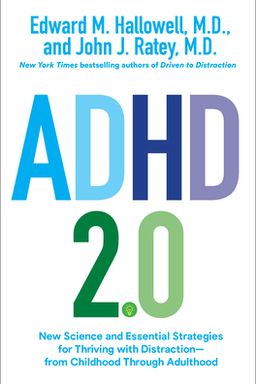
ADHD 20 cover

ADHD 20

by Edward M Hallowell and John J Ratey

ADHD 2.0 offers groundbreaking insights into the brains of those with ADHD, revealing how to transform its challenges into a superpower. Through practical strategies and inspiring stories, the authors guide readers to harness their unique strengths, fostering success and happiness from childhood through adulthood.

ADHD 2.0: Transforming Chaos into Strength

Have you ever found yourself racing through thoughts, full of ideas yet unable to slow down enough to finish one of them? In ADHD 2.0, Edward Hallowell and John Ratey—two psychiatrists who both live with ADHD—argue that this experience need not be a lifelong curse. Instead, it can become your greatest source of creativity and vitality once you learn how to manage it. Their premise is radically hopeful: ADHD isn’t just a disorder; it’s a complex mix of neurological features that, when understood and supported, can turn into a genuine superpower.

Hallowell and Ratey contend that we’re living in a new era of understanding—one shaped by neuroscience. The book redefines ADHD as an interplay of brain circuits rather than a simple deficit. The authors call this “ADHD 2.0,” a version of the disorder that recognizes its paradoxes, harnesses its strengths, and adapts to the high-stimulation world we live in. The message: once you learn to strengthen your brakes—the metaphor they use for self-regulation—your high-powered mental engine can take you anywhere you want to go.

The Evolution of Understanding ADHD

When Hallowell and Ratey first published Driven to Distraction in 1994, few people understood ADHD. Since then, awareness has exploded, yet misconceptions persist. Many still think ADHD is limited to restless children. Hallowell and Ratey dismantle these myths early in the book, showing that ADHD spans all ages and life stages. Adults, too, struggle when the demands of life outpace their coping mechanisms—when the Ferrari engine of their mind overpowers their bicycle brakes.

Through stories of patients like Hank, a salesman tormented by ruminating thoughts, and Allen, a teen entrepreneur who turned distractions into business brilliance, the authors reveal both sides of the ADHD coin. This duality is central to their vision: every symptom carries an upside. Where others see impulsivity, they see creativity; where others see distractibility, they see breadth of focus. ADHD 2.0 emphasizes re-framing—seeing strengths in what was once perceived solely as weakness.

A New Biological Framework

One major breakthrough the book introduces is neurological. The authors unpack research on networks within the brain—the Task Positive Network (TPN) that governs focus and the Default Mode Network (DMN) that handles imagination and reflection. In ADHD brains, these systems toggle irregularly, creating periods of intense focus followed by rumination and chaos. Understanding this “glitchy switch” explains why people with ADHD can feel both brilliant and trapped within the same hour.

They also dive into the cerebellum connection, a region often smaller or less active in ADHD individuals. Because the cerebellum regulates both balance and emotional rhythm, physical exercises that challenge coordination—balancing on one leg, yoga, or martial arts—can fortify attention as well as mood. This physiological perspective transforms treatment from mere medication management into something dynamic and empowering.

Connection, Structure, and Lifestyle as Medicine

Beyond brain science, ADHD 2.0 advocates lifestyle changes that act like neurochemical balancers. Connection—what Hallowell calls “Vitamin Connect”—is the single most healing force in human life. Drawing on pioneering research like the ACEs (Adverse Childhood Experiences) study, they show how love, empathy, and social bonding can literally rewrite the effects of trauma and stress on the brain. Their story of Samuel, a child in Shanghai whose life was changed by compassion and simple balance exercises, is a testament to this principle.

The authors also explore environmental design, recommending routines and “stellar environments” that replace chaos with structure. Daily organization, nutrition, sleep hygiene, and joyful movement all serve as natural stabilizers. They even advocate play and laughter as crucial forms of therapy. Discipline, in their view, should mean designing systems that build comfort and predictability—without suppressing spontaneity and creativity.

Medication and Beyond: From Fear to Effectiveness

Perhaps the most controversial yet illuminating discussion is around pharmaceuticals. The authors insist that ADHD medication is not an act of surrender but of empowerment. Stimulants, they argue, remain psychiatry’s most effective treatment, correcting dopamine and norepinephrine imbalances that drive attention problems. But drugs are only a piece of the puzzle; understanding your brain, creating the right environment, and practicing healthy habits are what sustain success long-term. They back this up with rigorous evidence, demolishing myths of over-prescription and addiction.

Turning Struggle into Superpower

ADHD 2.0 culminates in a resounding affirmation: no brain is the same, and none is the best. Once you learn your own “feel”—the way your mind truly works—you can make it real. The authors use golf as metaphor: success lies not in perfection but in staying present. Find your rhythm, swing freely, and stop obsessing about the hole. This message applies to work, relationships, and self-understanding alike.

Ultimately, Hallowell and Ratey’s work challenges shame with science and transforms frustration into purpose. ADHD, they say, doesn’t have to be fixed—it has to be understood, harnessed, and celebrated. The book is both a neuroscientific guide and an emotional manifesto, written with compassion and practicality to help you drive your Ferrari brain with confidence rather than fear.


A Spectrum of Traits: Revealing the ADHD Mind

The authors begin with a vivid portrait of the ADHD personality: restless, imaginative, inconsistent, but extraordinarily inventive. They argue that ADHD isn’t one disorder—it’s a spectrum of traits associated with a particular kind of mind, thriving on stimulation and novelty but faltering under monotony. To capture its depth, they borrow from Shakespeare: the lunatic, the lover, and the poet—a triad that embodies risk, passion, and creativity.

The Paradoxical Nature of ADHD

ADHD behaviors are defined by paradoxes. You can be distractible yet super-focused, impulsive yet astonishingly empathetic, dreamer and doer all at once. This contradiction often confuses outsiders, who mistake inconsistency for laziness. But the ADHD brain doesn’t suffer from a deficit of attention—it suffers from an overabundance. The real challenge is steering that torrent of awareness in a useful direction.

Hallowell and Ratey’s examples make these paradoxes tangible: the hyperactive executive missing deadlines yet capable of genius insight; the dreamy child shamed for forgetfulness yet brimming with imagination. They remind you that “unexplained underachievement” might be a sign of hidden potential, not failure.

Emotional Sensitivity and Creativity

Emotions in ADHD are amplified. The same intensity that sparks creativity can also lead to despair when expectations aren’t met. This is why Hallowell introduces “rejection sensitive dysphoria” (RSD)—the tendency to overreact to criticism—and its twin, “recognition sensitive euphoria” (RSE)—the ability to thrive on encouragement. Patients who receive even small doses of affirmation can perform miracles.

At the heart of this emotional spectrum lies curiosity, the perpetual need to explore, understand, and invent. This curiosity fuels creativity across domains: the ADHD mind is restless because it seeks new connections, new stories, and new possibilities. Many innovators, entertainers, and entrepreneurs share these traits. (Elon Musk and Richard Branson, though not mentioned by name, embody the restless invention the authors describe.)

Born or Made?

The authors differentiate between biologically rooted ADHD and environmentally induced versions of it. True ADHD is genetic, running in families, yet modern life—with its endless pings and pressures—creates ADHD-like symptoms in everyone. They coin “VAST,” short for Variable Attention Stimulus Trait, to describe this cultural cousin. Whether you have inherited ADHD or developed VAST from constant overstimulation, the same principles apply: understanding yourself and designing life around your patterns prevents burnout.

“We do not suffer from a deficit of attention. We suffer from an overabundance of it.”

This central idea reframes ADHD from pathology to possibility. By acknowledging that every apparent disorder hides a form of brilliance, Hallowell and Ratey give readers permission to stop apologizing for how their minds work and start mastering it instead.


Understanding the Demon of the Mind

In Chapter 2, Hallowell and Ratey take readers inside the ADHD brain—physically and emotionally—using vivid case studies and cutting-edge neuroscience. They explain how the mind toggles between two networks: the Task Positive Network (TPN), which enables focus and productivity, and the Default Mode Network (DMN), which drives imagination and reflection. In people with ADHD, the switch between them malfunctions, producing what they call the “glitchy switch.”

The Angel and the Demon

To make this understandable, the authors personify these networks as the Angel and the Demon. When the TPN is active, you’re immersed in tasks, present, and confident. When the DMN hijacks your thoughts, you fall into rumination, anxiety, or self-criticism—the Demon’s realm. Hank, the salesman introduced earlier, shows what happens when ADHD’s Demon dominates: his brilliant mind churns with worry until he feels paralyzed.

The authors draw on MIT neuroscientist John Gabrieli’s research, showing that the ADHD brain’s DMN and TPN operate out of sync. Instead of shutting one off when the other starts, they overlap chaotically, pulling you between imagination and obligation. This explains why creative people with ADHD can feel euphoric one moment and hopeless the next.

Managing the Glitchy Switch

You can learn to “outsmart the Demon,” the authors promise. The solution lies in shifting attention deliberately into action—engaging the TPN. When you catch yourself ruminating, do something external: walk, breathe in rhythmic patterns (they suggest a 6-3-8-3 breathing cycle), sing, or physically change your posture. Action pulls your focus out of self-absorbed thinking and back into reality.

“Don’t feed the Demon. Shut off its oxygen by denying it your attention.”

They also stress balance: some people get stuck permanently in the TPN, becoming rigid bureaucrats—what they jokingly call those with “attention surplus disorder.” True balance means learning to toggle between creativity (DMN) and concentration (TPN) intentionally.

The Power of Engagement

Hallowell and Ratey recommend activities that strengthen the toggle naturally: meditation, exercise, and connection with others. Oxytocin—released from social bonding—helps stabilize neural gears. Love, conversation, or pet ownership can be as therapeutic as medication in restoring calm focus. As they conclude, the ADHD brain doesn’t need to be fixed—it needs fuel, guidance, and balance. Once you redirect your energy outward, your imagination stops being a source of torment and becomes the Angel it was meant to be.


The Cerebellum Connection: Balancing Body and Mind

One of the book’s most surprising insights is the cerebellum’s role in emotional regulation and attention. Traditionally viewed as the brain’s motor-control center, new neuroscience (pioneered by Harvard’s Jeremy Schmahmann) shows it also moderates thought and feeling. Hallowell and Ratey translate this breakthrough into practical therapy for ADHD and VAST.

The Gyroscope of the Mind

The cerebellum acts like an internal gyroscope, keeping both body and thoughts balanced. When it’s underactive or small—as MRI studies show in many ADHD brains—life feels unstable. People lose track of time, emotions, or even physical space. Schmahmann calls this “dysmetria of thought,” meaning you overshoot or undershoot mental and emotional targets. If your cerebellum’s brake system falters, your Ferrari brain spins out.

Training the Cerebellum

Rather than resorting only to drugs, Hallowell and Ratey suggest training the cerebellum like a muscle. Balance exercises—standing on one foot, walking heel-to-toe, using wobble boards—stimulate the vestibular system and can improve focus. Programs like Zing Performance and Brain Balance centers use these movements therapeutically. Their case study of Samuel, the seven-year-old boy from Shanghai whose ADHD improved through daily coordination tasks, exemplifies how emotional and cognitive balance can literally be built through motion.

Exercise doesn’t just strengthen the body—it grows connections in the brain. The cerebellum is the most plastic region, capable of reshaping its neural networks throughout life.

Integration Through Movement

By stimulating the vestibulocerebellar system, patients often find better control over emotions, attention, and even language. The book recounts educators and therapists around the world who implement similar programs—from American innovators like Frank Belgau to Japanese researcher Tatsuo Okada, who created ‘Spark Centers’ using playful motion to transform children’s focus.

For readers, the takeaway is clear: physical balance training isn’t just good for coordination—it’s mind-balancing medicine. Whether you juggle, dance, or do yoga, every act of balanced movement strengthens the neural circuits ADHD most needs. The brain can always learn new tricks; it simply requires the right kind of challenge.


The Healing Power of Connection

Emotional connection, Hallowell and Ratey argue, is not a luxury—it’s a form of medicine. In ADHD, isolation magnifies stress and drives self-recrimination, while relationships literally heal the brain. Drawing on landmark studies such as the Adverse Childhood Experiences (ACE) research and George Vaillant’s Harvard Grant Study, they show how love and belonging extend lifespan and repair emotional wounds.

Loneliness as Disease

Surgeon General Vivek Murthy calls loneliness “the most common pathology.” People with ADHD are particularly vulnerable because impulsivity and social misunderstanding often isolate them. Disconnection, the authors explain, breeds shame and leads to addiction, depression, and underachievement. Children labeled “problem kids” may simply be suffering from lack of psychosocial integration—what researcher Bruce Alexander calls “dislocation.”

Vitamin Connect

Love, compassion, and friendship activate neural circuits that counter stress hormones and improve emotional regulation. The authors call this “Vitamin Connect”—the missing nutrient in modern life. Dr. Hallowell shares deeply personal stories, such as his grandmother Gammy, whose empathy protected him from the trauma of an abusive childhood and allowed him to thrive. Her hugs were not decoration—they were neural therapy.

“Fear is the major learning disability; love is the cure.”

Practicing Connection

The authors present practical steps for building a connected life. Have daily family meals, adopt pets, keep close friendships, forgive regularly, and never worry alone. Even casual interactions—saying hello at a coffee shop—can lift mood and ground attention. For children, finding charismatic mentors is crucial: one affirming adult can change the trajectory of an ADHD child’s life.

Connection is both prevention and cure. When understood as fuel for mental stability, it becomes clear why isolation devastates those with ADHD. Healing doesn’t start in the doctor’s office—it begins with others.


Find Your Right Difficult: Turning Challenge into Purpose

If boredom is kryptonite for ADHD, challenge is its antidote. In this chapter, the authors propose a transformative idea: success for an ADHD individual depends on finding the “right difficult”—the kind of challenge that excites rather than overwhelms. It’s where enthusiasm meets capability, where creativity finds its true work.

Discovering Your Superpower

Hallowell and Ratey describe ADHD not as disability but as uneven ability. You may be bad at organization but exceptional at problem-solving. Your job is not to fix weaknesses but to unwrap strengths. The story of Allen, the teenager who turned wrong-number phone calls into a rug-cleaning business, captures this principle beautifully. His impulsivity became innovation; his curiosity, entrepreneurship.

Assessing Strengths

They offer practical tools for identifying strengths: a ten-question inventory asking what you do best, what you love, and what earns you praise. This self-knowledge becomes leverage in designing your life. Better yet, they recommend the Kolbe Index—a psychological test that measures how you take action rather than how smart or agreeable you are. Understanding your “conative style”—your instinctive way of exerting effort—unlocks your productivity profile.

Avoiding the Wrong Difficult

Too often, people with ADHD stubbornly pursue challenges that don’t fit their strengths, mistaking grit for virtue. “I’d rather fail my way than succeed with help,” one patient says—a mindset the authors warn against. True independence comes from interdependence: learning to collaborate, hire help, and focus on what you do uniquely well.

“Why waste your time doing what you’re bad at? Hire someone else to do that so you can do what you’re good at.”

Finding your right difficult means identifying problems whose solutions energize you. It’s the crucible of invention; the arena where ADHD’s restlessness becomes resourcefulness. Once you align your natural engine with the right terrain, work ceases to feel like struggle—it becomes flow.


Create Stellar Environments: Engineering Daily Structure

ADHD thrives or withers depending on its surroundings. In this chapter, Hallowell and Ratey stress environmental design—creating stellar environments that support attention, comfort, and belonging. Your surroundings can either trigger chaos or serve as protective scaffolding. From homes to schools to workplaces, structure is medicine.

Structure Equals Safety

Structure doesn’t mean restriction; it means clarity. For adults, that could be habitual scheduling and digital boundaries—turning off devices before bed, using to-do lists, setting predictable routines. For children, it means consistent schedules, clear classroom rules, and opportunities for creative play. Predictability builds calm, allowing the ADHD mind to focus.

Nutrition, Sleep, and Lifestyle

The authors detail how diet affects cognition. Whole foods, minimal sugar, healthy fats, and omega-3s support brain function. They champion supplements like OmegaBrite (pharmaceutical-grade fish oil) and describe emerging interest in CBD for anxiety relief. Sleep hygiene is equally vital—dark rooms, cool temperatures, and device-free evenings reboot the brain’s equilibrium.

Positive Populations

The social environment matters as much as the physical one. Choose friends and partners who inspire rather than drain you. At school or work, advocate for low-fear, high-trust cultures that reward initiative and honesty. The authors outline blueprints for “stellar workplaces”: clear expectations, flexible collaboration, respect for individual style. ADHD, they remind us, isn’t managed through punishment—it’s supported through design.

When you engineer an environment that amplifies your strengths and minimizes chaos, you transform everyday survival into sustainable thriving. You don’t need discipline—you need systems.


Move to Focus: The Brain-Body Connection

Exercise, says Hallowell and Ratey, is the closest thing we have to a natural ADHD medication. Moving physically alters brain chemistry: it raises levels of dopamine, norepinephrine, and BDNF—brain-derived neurotrophic factor, the “Miracle-Gro” for neurons. In short, movement is focus.

Exercise as Neurotherapy

The story of David, a professor who lost his focus after a knee injury stopped him from running, illustrates the link. Once he resumed running, his depression lifted, and his attention returned—proving that physical activity activates the same circuits that stimulants target. Research supports this: even twenty minutes of moderate exercise can improve planning and reaction time in ADHD individuals.

Innovative Movement Methods

Teachers like Alison Cameron in Canada are proving this principle in classrooms. By turning discipline into physical engagement—having students run on treadmills or bikes before lessons—she saw reading scores skyrocket and behaviors improve. Exercise doesn’t just burn energy; it restores emotional control. Likewise, programs like Japan’s Spark Centers, inspired by Ratey’s work, use active play and obstacle courses to transform learning for ADHD children.

Balance, Yoga, and Meditation

The most holistic forms of movement—yoga, martial arts, balance training—add discipline and coordination to the mix. Studies show that yoga improves attention and reaction time while meditation dampens the default mode network’s rumination. Breath-focused techniques, especially the “ha” exhalation method, calm ADHD’s quicksilver mind.

Ultimately, motion transforms emotion. When you move, your focus stabilizes, your anxiety lowers, and your motivation rises. The authors advise: move for at least twenty minutes a day, and do it joyfully. Movement isn’t punishment—it’s alignment.


Medication Reimagined: Healing Without Fear

Despite cultural resistance, Hallowell and Ratey argue that medication—particularly stimulants—remains the most powerful and well-studied tool for managing ADHD. Properly prescribed, these drugs are safe, effective, and life-changing. The fear surrounding them, often inflamed by misinformation, denies millions the help that could transform their lives.

Science Over Stigma

Decades of research, summarized in Samuele Cortese’s massive 2018 meta-analysis, show 70–80% efficacy rates for stimulant treatments. Stimulants like methylphenidate (Ritalin) and amphetamine salts (Adderall, Vyvanse) correct dopamine and norepinephrine imbalances, helping the Ferrari brain access its braking system. Adults, the authors note, tend to respond slightly better to amphetamines; children often do better on methylphenidates.

A Rational Approach

Medication isn’t a moral decision—it’s a practical one. The authors encourage families to think in terms of risk versus benefit: what damage is untreated ADHD already doing? If functioning collapses at home, work, or school, the greater risk lies in not intervening. They compare resisting medication to “choosing to squint for a year instead of trying glasses.”

“Medication properly prescribed can turn suffering into success, health, and joy.”

Beyond Pills

Hallowell also discusses newer stimulants and alternatives such as guanfacine (Intuniv) for emotional regulation and Amantadine for smoother dopamine flow. Long-acting delivery systems reduce misuse and maintain stable mood. Importantly, they emphasize that stimulant use in childhood reduces addiction risk later—a fact that contradicts public fear.

Medication, when understood as one part of a holistic plan alongside exercise, structure, and connection, is not dependency—it’s liberation. The right dose can help an ADHD mind experience stillness for the first time, freeing it to create without chaos.


Find Your Feel and Make It Real

The book ends not with a prescription but with philosophy: learn to trust how your mind feels when it’s functioning well. Hallowell’s brother-in-law, a golf professional, tells him, “Find your feel and make it real.” This becomes the ultimate ADHD mantra. Your goal is not flawless control but present-moment mastery—the capacity to direct your attention without fear or shame.

Attention as Art

Like golf, mental focus isn’t achieved by force—it’s cultivated through rhythm, patience, and practice. When you stop obsessing whether your shot lands perfectly—whether your work, parenting, or relationships succeed exactly—you perform better. ADHD minds thrive in creative engagement, not in self-monitoring. Success requires stepping into flow.

Reframing Failure

Flubbed shots, missed deadlines, or impulsive decisions aren’t moral failings—they’re opportunities to adjust. “Cherish the flub,” the authors advise; failure teaches calibration. What matters is staying in the game, experimenting until rhythm returns. This attitude replaces shame with curiosity.

The Symphony of Individuality

No two ADHD minds are alike. “No brain is the best—each brain finds its own special way,” Hallowell wrote for his daughter, summarizing the book’s ethos. Once you discover your signature rhythm—the way your creativity, restlessness, and focus interact—you can design life accordingly. The Ferrari brain isn’t a problem to fix; it’s an instrument to tune.

The final message of ADHD 2.0 is radical hope. Each mind can grow stronger with understanding, connection, and compassion. The science proves it; the stories live it. The task now is yours: find your feel, make it real, and drive forward into the world with joy.

Dig Deeper

Get personalized prompts to apply these lessons to your life and deepen your understanding.

Go Deeper

Get the Full Experience

Download Insight Books for AI-powered reflections, quizzes, and more.