
Idea 1
The Art of Winning in an Age of Uncertainty
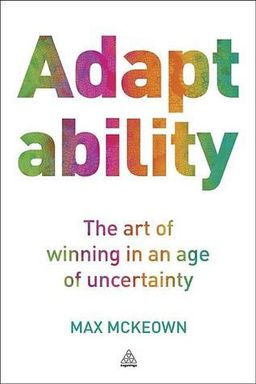
How do some people flourish while others falter when the world changes around them? In Adaptability: The Art of Winning in an Age of Uncertainty, Max McKeown takes this question head-on, arguing that our greatest human strength is not power, intelligence, or even resilience—it’s adaptability. McKeown contends that in a world of volatility, disruption, and relentless change, survival depends not on rigid plans but on the ability to recognize when the game has shifted and to reinvent yourself to play it better.
At its core, McKeown’s argument is that all failure is a failure to adapt and that all success—whether in business, politics, or personal life—comes from effective adaptation. Through memorable case studies ranging from Ford’s preemptive turnaround to Nelson Mandela’s political genius, the book explains how individuals and organizations can develop what McKeown calls “super-adaptability”—the habit of continual renewal beyond mere survival.
Three Steps to Survival and Success
McKeown structures his whole framework around three essential steps of adaptive mastery. First, you must recognize the need to adapt—to sense shifting realities before crisis strikes. Second, you must understand the kind of adaptation required—to distinguish between superficial fixes and deep systemic change. And third, you must act to make the necessary adaptation, transforming knowledge into motion. Every chapter in the book explores these steps in different contexts, from global warfare to Silicon Valley innovation, from ants and algorithms to Broadway fiascos.
Adaptability Across Scales
The beauty of McKeown’s book lies in its scope. Adaptation operates on every level of life: genetic, technological, and behavioral. He moves seamlessly between examples as diverse as Toyota’s long-term foresight in developing the Prius, the town of Filettino rebelling against the Italian state by declaring independence, and the “Nazi Zombies” video game invented by rogue developers. For McKeown, these stories illustrate that adaptation is both an individual art and a group performance. The best companies and societies share a culture that encourages playful experimentation, generosity of ideas, and rebellion against conformity.
He contrasts adaptive systems with maladaptive ones—organizations and governments that cling to stability, hierarchy, or nostalgia. When we mistake consistency for competence, he warns, we become like the Easter Islanders who cut down every tree or executives at HP who keep buying companies rather than rejuvenating their own. The message is clear: stability is a dangerous illusion, and complacency is the death of potential.
From Surviving to Thriving to Transcending
McKeown presents adaptation as a continuum with four levels: collapse, survival, thriving, and transcendence. Collapse is failure—organizations or societies that cannot respond at all. Survival means coping but staying stuck in mediocrity. Thriving happens when you outperform within existing rules. But transcendence—the ultimate adaptive victory—occurs when you redefine the game itself, creating new rules that benefit more players. Think of Mandela dismantling apartheid, Nike inventing new materials through street-level observation, or Apple turning a series of product flops into a design revolution.
Why This Matters Now
In an age of global upheaval, McKeown’s work resonates far beyond management theory. His writing belongs beside thinkers like Charles Darwin and Clayton Christensen (author of The Innovator’s Dilemma), yet it feels more urgent and human. He argues that adaptability is the ultimate survival advantage and the foundation of progress—whether you’re running a company or just navigating your own personal reinvention. You can’t control uncertainty, but you can control how you respond to it. Learning to adapt doesn’t just help you win; it helps humanity evolve.
Ultimately, McKeown calls adaptability “the art of winning.” It is not blind flexibility nor reckless change—it’s the intelligent balance between curiosity and courage, imagination and discipline. By understanding the science and stories of those who’ve adapted well, you can train yourself and your organization to anticipate, absorb, and transcend uncertainty. As the book concludes, adaptation is never over—it is, and always will be, the beginning.