
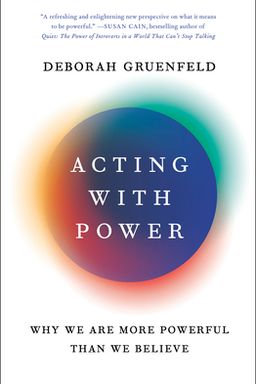
Acting with Power cover

Acting with Power

by Deborah Gruenfeld

Acting with Power demystifies the concept of power, offering practical strategies to harness it effectively. Drawing from acting techniques, it guides readers in embracing powerful roles and building trust, helping them navigate social dynamics with confidence.

Acting With Power: Redefining Strength Through Role and Responsibility

What does it really mean to be powerful? Is power something we possess, or is it something we perform? In Acting with Power, Stanford psychologist Deborah Gruenfeld suggests that true power isn’t a personal attribute—it’s a social act. Her argument overturns the popular idea that power resides in charisma, dominance, or personal ambition. Instead, she contends that power arises from how we play our roles in the lives of others and how responsibly we use those roles to serve collective goals.

Drawing on decades of research and classroom experience, Gruenfeld merges psychology with theatrical principles. She teaches that every moment of influence is a performance. To act with power means mastering role awareness, learning when to step up and when to step back, when to command and when to connect. Power, she claims, is most sustainable when it’s used to make others feel safe, valued, and capable—an idea aligning with David McClelland’s “mature power” concept (first noted in his work on leadership motives).

Power as Relationship—not Possession

Gruenfeld redefines power as “the capacity to control others and their outcomes,” but she emphasizes that this capacity is granted by others, not owned outright. In other words, power lives in relationships, not in individuals. We are powerful whenever others depend on us—whether as parents, friends, mentors, or leaders. The power dynamic remains fluid, context-dependent, and reciprocal. A CEO might rule the boardroom but lose authority at home, where family roles invert.

This social view of power explains why feeling powerful does not always mean being powerful. Overconfidence can lead people to misread situations and overstep boundaries. Likewise, underestimating one’s own influence can make leaders avoid decisions that only they have the right—or duty—to make. As Gruenfeld writes, “Power is not a feeling; it’s a fact of the social contract.” When that contract is violated—through arrogance, abuse, or neglect of responsibilities—power evaporates.

Control and Connection: The Two Faces of Power

Contrary to popular belief, power doesn’t have to be hostile. Gruenfeld cites Harvard scholar Joseph Nye’s “hard” and “soft” power framework to show that effective influence blends control (authority, assertiveness) with connection (respect, empathy). These two faces of power—what Gruenfeld calls playing power up and playing power down—mirror the complementary dance between dominance and deference found both in human society and animal behavior.

Learning to shift gracefully between these modes is crucial. Power up behaviors include establishing authority, setting direction, and making decisions without apology. Power down behaviors involve showing vulnerability, asking for input, and empowering others to act. Together, they build trust. Leaders who rely only on one face—especially the domineering one—risk isolation or backlash. The most admired figures, from Sheryl Sandberg to Nelson Mandela, succeed because they alternate skillfully between these modes depending on what their group needs.

Acting as Responsibility, Not Ambition

Gruenfeld’s concept of “acting” draws heavily from theater. Being authentic, she argues, doesn’t mean doing what feels natural—it means committing to the truth of the story and playing your assigned role wholeheartedly. Like actors, leaders must understand the script. They must adapt rather than react. This approach transforms power from a personal weapon into a relational art form.

“Acting is purposeful self-expression,” Gruenfeld writes. “It’s how we bring discipline to our impulses and make others feel secure in our presence.”

The book’s theater metaphor also solves the problem of imposter syndrome—the fear of not being “enough.” Gruenfeld’s answer: you already have the role, so perform it. Integrity comes not from being your comfortable self but from being your complete self—the one who can stretch into what the moment demands. As she shows through stories about executives, teachers, and even baboons (referencing biologist Robert Sapolsky’s work on hierarchy stress), the ability to adapt roles calmly under pressure defines real power.

Why This Shift Matters

In a world obsessed with status and dominance, Gruenfeld’s reframing offers an antidote. Power doesn’t corrupt inherently—it merely amplifies what’s already there. When driven by compassion and role awareness, it can transform organizations and relationships. But when fueled by insecurity and ego, it leads to abuse. Learning to act with power—literally performing the part with conscious intent—bridges this divide between authority and responsibility.

Throughout the chapters that follow, Gruenfeld expands this paradigm: how to play power up to lead courageously (Chapter 2), how to play power down to connect (Chapter 3), how to get in character without losing authenticity (Chapter 4), and how to wield influence even while playing supporting roles (Chapter 5). Together, these lessons teach us that power is not the privilege of a few—it’s a role inhabited by all who dare to care.


The Two Faces of Power: Playing Up and Down

Gruenfeld emphasizes that mastering power means learning how to play it both ways—to step up and take command when needed, and to step down to connect when required. Drawing from theater director Keith Johnstone’s ideas of “playing high” and “playing low,” she explains that each approach sends distinct social signals: dominance evokes control, while deference invites trust.

Playing Power Up

Playing power up means asserting authority or confidence intentionally. Gruenfeld illustrates this through Zhu Rongji, the former Premier of China. At a meeting of international CEOs, Zhu balanced formality—a regal entrance, deliberate calm—with humor, joking about Coke versus Pepsi executives to neutralize rivalry while retaining full authority. His command of the room didn’t come from aggression but from poise and timing. He was both dignified and disarming.

Playing power up can involve gestures like taking up physical space, slowing speech, using decisive endings, or choosing silence to signal control. Even whispering, used strategically, demonstrates composure. These moves help leaders stabilize environments and convey reliability, especially in crisis (as seen with Rudy Giuliani’s calm presence after 9/11).

Playing Power Down

Equally essential is the ability to play power down—to use deference, humor, and humility to bring others closer. Gruenfeld recalls how venture capitalists at Sequoia Capital dressed in cartoon costumes to recruit a new partner, Jess Lee, signaling openness and respect instead of intimidation. This act of vulnerability built trust faster than any negotiation could.

Classic power-down cues include asking for help, admitting uncertainty, smiling genuinely, and physically lowering oneself (as actors do to appear nonthreatening). Such behaviors don’t indicate weakness; they convey security. A strong leader can apologize or play the fool, because true confidence doesn’t require constant domination.

Smart Power: When to Switch

Gruenfeld borrows Nye’s concept of “smart power,” urging fluency between the two modes. You play up to protect or lead decisively; you play down to connect or defuse tension. Leaders who can shift depending on circumstances—like Sheryl Sandberg, who balances assertiveness with warmth—earn stronger loyalty than those who rely on dominance alone.

“Deference is how you earn the right to lead,” Gruenfeld writes. By showing respect before claiming authority, you build a foundation that makes authority legitimate.

Power Up transforms chaos into order. Power Down transforms order into trust. Together, they define artful leadership—the rhythm between control and connection that turns authority from domination into collaboration.


Getting in Character: The Art of Authentic Performance

Gruenfeld reveals that authenticity isn’t raw emotion—it’s disciplined performance. Drawing on Erving Goffman’s The Presentation of Self in Everyday Life, she explains that “being yourself” always involves acting. Life is theater, and every role carries expectations. When you internalize your role—teacher, parent, CEO—you stop reacting from insecurity and start responding from purpose.

From Imposter to Actor

The author recounts how teaching theater-trained professors transformed her worldview. By imagining themselves as “characters”—the sheriff, the village elder, the stand-up comic—they played their roles with conviction. Success came not from being spontaneous but from preparing, rehearsing, and aligning inner truth with external responsibility. The takeaway: integrity means being fully present in the role, not half-authentic and unprepared.

The Magic ‘If’ and the Power of Imagination

Using Konstantin Stanislavski’s “Magic If,” Gruenfeld shows how imagination helps leaders embody power. Before a hostile deposition, she imagined herself as Daenerys Targaryen, “Mother of Dragons,” channeling regal calm and protection for her team. This visualization reframed fear into confidence. Likewise, Oprah Winfrey enters male-dominated rooms reminding herself she “stands as ten thousand”—a spiritual army of ancestors behind her. Such mental reframing converts vulnerability into grounded presence.

Props, Costumes, and Space

Even physical choices reinforce power. Clothing, gestures, and setting affect perception. A priest’s collar, a CEO’s suit, or even deliberate movement around the room (“owning the turf”) signals authority. For example, a young female manager used waffle breakfasts to connect with her staff while leading—turning ‘hospitality’ into leadership presence. Hosting, Gruenfeld suggests, makes others feel seen and turns awkward power differentials into mutual respect.

Ultimately, “getting in character” is not faking—it’s aligning inner values with social context. When you stop clinging to your insecurities and start owning the role, power feels authentic and generous.

Key takeaway:

True authenticity lies not in spontaneity but in integrity—the disciplined art of performing the role responsibly and truthfully.


Riding Shotgun: Mastering the Supporting Role

Everyone answers to someone, Gruenfeld reminds us. Learning to act with power means knowing how to wield influence even from subordinate positions. Playing a smaller role doesn’t mean being small—it means wielding authority through presence, reliability, and humility.

Changing Hats

Power doesn’t transfer automatically from one context to another. Gruenfeld recounts the story of an ex-CEO who failed after becoming someone else’s employee because he “was still in CEO mode.” Forgetting to “change hats” leads to friction and resentment. Acting with power means recalibrating—learning to support your new lead.

Avoiding the Superhero Trap

Psychologists Delroy Paulhus and Oliver John describe people with “Superhero complexes”—those who seek constant validation by rescuing others. Gruenfeld warns that this insecurity-driven need to prove importance undermines teamwork. Trying to “save the day” when it’s not your job alienates colleagues and bosses alike.

Focus on Contribution, Not Glory

The author celebrates figures like Lisa Fischer, the Rolling Stones’ backup singer, who said, “I just wanted to sing.” Her focus was craft, not fame. Similarly, Sheryl Sandberg joined Google after Eric Schmidt told her, “When you get offered a seat on a rocket ship, you don’t ask which seat, you just get on.” Commitment to mission over status is what gives roles meaning.

Gruenfeld’s unforgettable MBA story proves the point: during a high-stakes exercise, a student claimed responsibility after a risky proposal by simply saying, “You come to me.” That line transformed her from quiet subordinate to trusted leader. Sacrifice and accountability are the highest forms of power.

“Riding shotgun,” Gruenfeld writes, “requires confidence to sit quietly while someone else gets applause—and pride in helping them succeed.”

Sidekicks matter as much as heroes. Playing a smaller role with grace, discipline, and full presence makes you indispensable—and an actor worthy of bigger roles to come.


When Power Corrupts—and How It Can’t

Gruenfeld navigates power’s dark side, explaining why good intentions can warp into abuse. Power doesn’t inherently corrupt—it frees us to act on whatever motives dominate us. If insecurity or self-interest drives us, abuse follows; if empathy or purpose drives us, integrity grows.

Disinhibition and Objectification

Power removes inhibitions. Drawing from Dacher Keltner’s famous “cookie experiment,” Gruenfeld shows that people given authority act impulsively—they eat the last cookie, ignore etiquette. From there, disinhibition spirals into objectifying others, as seen in Silicon Valley scandals or the college admissions fiasco, where status anxiety led parents to treat their children as trophies rather than humans.

Three Archetypes of Abuse

  • The Bully: Uses power to intimidate and disempower others, creating fear-based control.
  • The Megalomaniac: Obsessed with ego and status, like Elizabeth Holmes at Theranos, who turned deceit into empire.
  • The Don Juan: Seeks sexual validation through dominance—a desperate form of insecurity disguised as desire.

Why Fear Drives Corruption

Gruenfeld links all abuses to fear—fear of insignificance, rejection, or weakness. Those hungry for respect exploit others rather than earn it. Yet even monsters act from human motives. Understanding that power magnifies insecurity helps us prevent corruption by fostering self-awareness and compassion instead of punishment alone.

“Power doesn’t make people bad—it makes them more themselves,” Gruenfeld asserts. “Our job is to make sure we like who that is.”

Knowing how power distorts self-perception allows leaders to stay grounded—choosing purpose over pride and responsibility over impulse.


Wrangling Bullies and Acting Without Fear

Gruenfeld offers practical strategies for reclaiming power from bullies and abusers. Her message is clear: being victimized doesn’t mean playing the victim. You always have choices—press the lever, take action, rewrite the script.

Recognize the Pattern

Bullies thrive on fear and reaction. Gruenfeld recounts stories of abusive bosses who humiliate subordinates over trivial details. Their power depends on emotional response. Refusing to play that game—by staying calm or disengaged—starves them of oxygen.

Exit, Stage Left

Sometimes, leaving is the most powerful act. Like Tom, the mediator who quit after enduring endless humiliation, you can reclaim control by choosing your ending. Leaving is not weakness—it’s authorship. Gruenfeld reminds us that psychological power stems from action, not endurance.

Strategic Responses

  • Refuse emotional engagement—be boring, unreactive, professional.
  • Maintain visible boundaries; say “no” with a smile.
  • Use calm questions like “Did you really just say that?” to make perpetrators accountable.
  • Find allies—collective action turns isolation into strength.

Gruenfeld even cites hostage negotiation tactics: show empathy to disarm rage. Paradoxically, acknowledging emotions—without surrendering control—reduces harm. The goal is not revenge but restoring balance.

“Do no harm, but take no crap,” Gruenfeld teaches. Acting with power means resisting abuse with dignity.

Whether dealing with a tyrant boss or aggressive partner, power manifests through disciplined composure—the choice to protect yourself without mirroring the cruelty you face.


The Bystander Role: From Witness to Actor

Why do good people stay silent when bad behavior unfolds? Gruenfeld explores the psychology of bystanders and introduces a new script: become an upstander. Power isn’t just stopping harm—it’s deciding to act.

Breaking the Bystander Effect

Drawing on research from Kitty Genovese’s infamous case, she highlights how social diffusion—a sense that “someone else will do it”—kills moral action. Yet small interventions matter. When one person speaks or even signals disapproval, others follow, reshaping collective norms.

How to Act

  • Notice and name inappropriate acts early—small infractions normalize big abuses.
  • Use humor or questions to defuse misconduct: “What year is this?” can end a sexist remark.
  • Join a posse—collective action multiplies courage.
  • Leverage social power—use status to protect others, as seen in Green Dot and gender-bias interventions.

Acting Like You Care

Gruenfeld’s closing stories underscore humanity. When male colleagues at her university subtly guarded female students’ safety, they modeled beneficent use of power—protection without dominance. Caring visibly is not weakness; it’s leadership. “Abuse thrives in silence,” she warns. “Action is contagious.”

Standing up is risky—but silence is costlier. Each time you intervene for others, you redefine what power looks like.

To act with power is to bring others into the story. The moment you stop being a spectator and start playing your part, you become part of the solution.


Playing the Lead: Beneficence, Maturity, and Legacy

In the final act, Gruenfeld asks: what standard should power-holders follow? Her answer—beneficence, the commitment to use power for others’ welfare. The best leaders care more about their legacy than their spotlight. They serve through maturity, accountability, and compassion.

Beneficence Over Bravado

Using the story of psychologist Joe McGrath, Gruenfeld shows how true mentors wield influence gently. McGrath’s steady encouragement shaped generations without exploiting authority. Beneficence asks, “How can my power make others stronger?” That question, she says, defines ethical leadership far better than ambition does.

Casting for Character, Not Ego

Organizations, she argues, suffer from “typecasting”—privileging dominance and charisma over maturity. Traits like empathy, commitment, and developmental stability predict effective leadership better than aggression or charm. Eisenhower, for instance, didn’t seek the presidency; he accepted it out of duty. Obligation, not ego, distinguishes leaders who unite rather than exploit.

Creating a Culture of Care

Lieutenant General Jay Silveria’s speech at the U.S. Air Force Academy exemplifies beneficent power. Confronting racism head-on, he reaffirmed community values and demanded dignity: “If you can’t treat someone with respect, then get out.” Beneficence transforms authority into protection—leaders become secure bases that foster risk-taking and moral courage.

Legacy of Hope

Gruenfeld ends with a universal truth: power stories are not about perfection but growth. Every hero is flawed, yet purposeful. Acting with power, she concludes, means shifting from fear to hope—from self-protection to collective elevation. “The only way to create the world we want,” she writes, “is to act as though we already live there.”

Power well used is beneficent, mature, and generous—it makes others feel safe enough to lead.

In Gruenfeld’s vision, acting with power isn’t theater—it’s legacy. You perform for a purpose larger than yourself, ensuring the story continues long after the applause fades.

Dig Deeper

Get personalized prompts to apply these lessons to your life and deepen your understanding.

Go Deeper

Get the Full Experience

Download Insight Books for AI-powered reflections, quizzes, and more.