
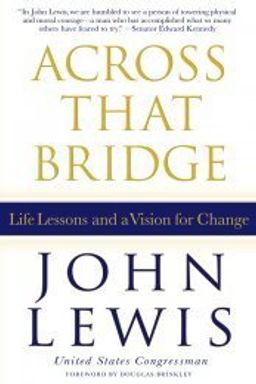
Across That Bridge cover

Across That Bridge

by John Lewis

Across That Bridge is John Lewis''s inspiring guide for activists seeking to create lasting change. Through personal stories from the civil rights movement, Lewis imparts lessons on nonviolent protest, patience, and the transformative power of faith and love in activism.

Love as the Transformative Force of Human Unity

How do you confront hatred without becoming part of its cycle? In Across That Bridge, John Lewis argues that love—radical, sacrificial, and courageous—holds the power to transform not only the oppressed but the oppressor, to heal both sides of human conflict, and to build what he calls the Beloved Community. Lewis contends that the Civil Rights Movement was not merely political resistance but a spiritual crusade, a nonviolent uprising driven by love’s insistence that we are one human family.

Lewis’s message is both historical and timeless. He revisits the violent, soul-testing days of the Freedom Rides, the marches from Selma to Montgomery, and the long nights of prayer and training in nonviolence that prepared activists to face death without retaliation. But more importantly, he draws upon those moments as lessons for anyone today seeking to create change—from personal relationships to national politics. His claim is profound: real change begins within. To revolutionize society, you must first revolutionize yourself, grounding your strength in faith, patience, truth, peace, and above all, love.

The Bridge as a Metaphor for Inner and Outer Change

Across That Bridge is both literal and symbolic. Lewis’s crossing of the Edmund Pettus Bridge in Selma—where he was beaten nearly to death—becomes the book’s enduring metaphor. The bridge represents the gap between what humanity is and what it must become. To cross it requires “life lessons and a vision for change” rooted in discipline, forgiveness, and creative nonviolence. Each chapter—Faith, Patience, Study, Truth, Peace, Love, and Reconciliation—maps part of that journey from fear to enlightenment.

The movement’s purpose wasn’t simple activism; it was a spiritual awakening aimed at the redemption of a nation. Lewis writes that their protests weren’t meant to defeat the enemy but to redeem him. Every act of nonviolence, every refusal to strike back, was a living sermon—proof that love is not weakness but power.

Why This Message Still Matters

Lewis’s lessons reach far beyond 1960s America. He warns against replacing one form of violence with another—”an eye for an eye” that leaves everyone blind. Today, whether you’re angry about injustice, betrayed by politics, or disillusioned by human cruelty, his wisdom feels revolutionary. He calls love “a discipline and a way of living,” rooted in truth and sustained by patience. His ideas echo the teachings of Gandhi, King, and Mandela, but they’re grounded in lived experience—the bruises, arrests, and acts of forgiveness that proved love’s durability under fire.

“We are one people, one family.”

Lewis’s mantra captures the book’s heartbeat: no individual or group wins freedom alone. The Beloved Community is a collective awakening grounded in love’s recognition of unity.

The Structure of Spiritual Activism

Lewis organizes his philosophy into seven pillars, each representing a quality humanity must master to cross the “bridge” from division to unity:

  • Faith – The confident knowing that truth and justice will prevail, even when unseen.
  • Patience – The ability to persist through the long road of change without losing hope.
  • Study – The discipline of learning history and strategy to guide moral resistance.
  • Truth – The light that destroys deception and reveals our shared humanity.
  • Peace – Not the absence of tension, but the presence of justice and harmony.
  • Love – A sacrificial force that redeems both victim and aggressor.
  • Reconciliation – The rebuilding of community and human relationship after struggle.

These pillars serve as moral architecture—a framework for anyone seeking to build a life of purpose and compassion. Lewis shows how each one was practiced in the movement and how you can apply them to your own life today—whether fighting injustice, managing conflict, or healing division.

The Enduring Legacy of Radical Love

Lewis’s life stands as living proof that love outlasts violence. The same man beaten in Rock Hill, South Carolina, later forgave his attacker, Elwin Wilson—a former Ku Klux Klan member who sought reconciliation decades later. For Lewis, this was not naivety; it was grace and realism. “Darkness cannot overcome darkness, only light can do that,” he writes, echoing Martin Luther King Jr. To you as a reader, Lewis leaves a challenge: let your inner love become the bridge, linking personal transformation to social renewal. When you do, you embody the power that changed America—and can still change the world.


Faith That Defies Fear

Lewis begins with faith—the invisible but unbreakable foundation of change. Faith, he writes, is knowing in your soul that the work is already done, even when the world seems otherwise. It’s the belief that justice and truth will prevail because they align with divine principles. Without this conviction, no one could have endured the violence, arrests, or humiliation of the Freedom Rides and sit-ins.

Faith in Action

During the 1961 Freedom Rides, Lewis and others prepared for death. They were beaten, jailed, and threatened by mobs, yet never retaliated. Their stance symbolized complete faith in the divinity of human dignity. They believed that “no weapon formed against you shall prosper,” and that the moral force of love would dismantle segregation’s illusion. This kind of faith transforms fear into freedom—Lewis says that by the time he stood on the Edmund Pettus Bridge, he had no fear of death.

Faith as a Collective Force

Faith united people across race and religion—black and white, Protestant and Jewish, Catholic and Muslim. Lewis calls this a “circle of trust,” a spiritual communion powered by shared belief in nonviolence. In modern activism, he reminds you that faith isn’t about comfort—it’s about conviction. As Mother Teresa once said, “To keep a lamp burning, we have to keep putting oil in it.” Faith is the oil, sustaining light through darkness.

(Context: Similar themes appear in Viktor Frankl’s Man’s Search for Meaning, which asserts that survival under oppression depends on inner conviction rather than circumstance.) Faith, for Lewis, is both the seed and the engine of transformation. You act not because victory is certain, but because righteousness already guarantees it in spirit.


The Sacred Power of Patience

Patience, Lewis explains, is not resignation—it is strategic endurance. In the struggle for voting rights in Selma, protesters waited outside courthouses for years, knowing full well the registrars would never open the doors. That waiting itself became a protest, a mirror reflecting the brutality of injustice. True patience, according to Lewis, recognizes that transformation takes time.

Waiting as Resistance

When Lewis and others stood for hours beneath the Alabama sun, Sheriff Jim Clark called them “outside agitators.” Hundreds were arrested merely for standing still. Yet Lewis saw this endurance as potent symbolism—their quiet, unwavering presence demonstrated moral strength. Over time, “waiting” forced America to face itself. It culminated in the Voting Rights Act of 1965, which President Lyndon Johnson called one of the most significant pieces of legislation in over fifty years.

Patience in Modern Movements

Lewis connects patience to contemporary activism: the slow, often frustrating process of political change. Real reform, he writes, demands consistent presence—reading bills, writing letters, forming relationships, and turning setbacks into learning. Just as seeds cannot bloom overnight, justice can’t emerge from instant outrage. Every delay tests resolve and deepens faith. His advice: never confuse speed with effectiveness.

(Comparison: This aligns with spiritual author Pema Chödrön’s idea that patience softens the heart, making peace possible.) Lewis’s form of patience is not passive waiting—it’s active endurance, an elegant tool that can “break down doors of resistance.”


Study as the Blueprint for Change

Lewis contends that study—rigorous preparation—is an act of love and respect. Change begins when you understand not just injustice but the lineage of ideas that sustain freedom. Nonviolent activists trained deeply in philosophy and history, learning from Thoreau, Gandhi, and Emerson. They practiced role-playing and studied the psychology of hate, so that when beaten or insulted, their responses would remain disciplined and grounded.

Mentors and Legacy

Reverends Jim Lawson and Kelly Miller Smith taught Lewis nonviolence as both science and spirituality. Lawson had studied Gandhi in India and introduced “satyagraha”—holding fast to truth—as a sacred practice. Lewis sees study as preparation for calling—a way to let your intellect and spirit fuse into wisdom. He also recounts Martin Luther King Jr.’s academic rigor, tracing how King’s education at Morehouse, Crozer, and Boston shaped his leadership. It took patience and scholarship to build someone capable of leading a national revolution.

Learning as a Lifelong Revolution

To Lewis, ignorance is complicity. Studying history—whether of segregation or contemporary movements—prepares the mind to command truth and empathy. He points to the Arab Spring and Occupy movements as evidence that learning spreads change globally; Egyptian activists even translated a Civil Rights comic book into Arabic to teach nonviolence. Education, both spiritual and academic, is humanity’s most potent weapon against oppression.

(Note: Mandela echoed this belief, calling education “the most powerful weapon used to change the world.”) Lewis reminds you that real leadership emerges from the soil of study, not ambition.


Truth as the Light That Liberates

Truth, Lewis writes, is incontrovertible. You can obscure or deny it, but never destroy it. The Civil Rights Movement was ultimately a struggle to reveal truth—to expose the falsehood that some humans are of lesser worth. He recalls his childhood realization of injustice when seeing segregated signs in Troy, Alabama. Even as a boy, he sensed that the world’s cruelty was rooted in a lie.

Truth as Moral Compass

Lewis insists that truth is the foundation of democracy. Politicians who obscure reality betray the people’s trust, but citizens also share responsibility for remaining informed. He urges you to study, research, and “stay engaged” in civic life. Honest awareness dissolves division, because truth always leads to unity. Injustice thrives on ignorance; truth ends it.

Living in the Light of Truth

Nonviolent activists “stood in truth” even as they were attacked, showing that physical strength pales before moral clarity. Lewis describes truth as a sword that pierces hypocrisy and awakens conscience. When citizens see injustice televised—dogs, fire hoses, mobs—they begin to perceive the truth of their society’s sickness. That revelation becomes reform.

(Context: In comparison, Winston Churchill’s quote, used by Lewis, encapsulates this: “Malice may attack it, ignorance may deride it, but in the end, there it is.”) Truth, when seen clearly, organizes love into action.


Peace as Courageous Justice

Peace, for Lewis, is not the silence that follows submission—it is justice realized in motion. He distinguishes between the absence of tension and the presence of harmony. The twentieth century, he reminds us, was the “age of hate.” From wars to genocides, humanity proved its destructiveness. Yet Lewis insists that peace is possible, but only through honest reconciliation with truth.

Rejecting the Illusion of Militarism

Lewis draws on Martin Luther King Jr.’s warning that “a nation spending more money on military defense than on programs of social uplift is approaching spiritual death.” The United States’ wars mirrored inner spiritual wars—gang violence, racism, fear. Real peace requires disarmament of the mind as well as the military. The first act of peace is to silence the inner war of fear and hate.

The Peaceful Warrior’s Path

Lewis calls nonviolence a “creative maladjustment” to evil. Peace demands confrontation with injustice, not avoidance. He recounts how protesters accepted beatings at Selma or imprisonment at Parchman Farm as offerings to peace. Their suffering exposed society’s sickness and compelled reform. In modern life, he says, peace means living in truth—honoring your conscience even against convention.

(Reflection: Like Buddhist teacher Pema Chödrön, Lewis views peace as softening what is rigid within us.) Nonviolence is courage; peace is the victory beyond fear.


Love That Heals and Redeems

Love, Lewis declares, is the supreme weapon. It is the willingness to sacrifice, to be jailed, even killed, for the betterment of all humanity. Nonviolent confrontation was not weakness—it was strength born from compassion. Participants refrained from hate because their aim was not victory, but redemption.

From the Violence at Rock Hill to Reconciliation

Lewis recounts being beaten in Rock Hill, South Carolina, by a mob who screamed racial slurs. Decades later, his attacker, Elwin Wilson, a former Klansman, approached him seeking forgiveness. Lewis embraced him without hesitation. That moment proved love’s transformative power. Had Lewis retaliated, Wilson’s soul might never have awakened; his apology might never have come.

Love as the Engine of Human Evolution

Lewis frames love as the cohesive force of human existence—our shared divine spark. To hate others is to hate yourself. Even enemies are victims of indoctrination. Forgiveness is not dismissal—it is liberation. “Darkness cannot overcome darkness, only light can do that,” King said; Lewis echoes that light through every act.

(Note: Mother Teresa’s quote in the book—“Not all of us can do great things. But we can do small things with great love”—sums up Lewis’s practical philosophy.) Whether confronting racism or everyday cruelty, love disarms brutality and restores integrity.


Reconciliation as the Final Bridge

The final lesson in Across That Bridge is reconciliation—the process of reuniting humanity after division. Lewis reminds readers that even in battle, enemies remain family. After hostility ends, healing must begin. The movement’s greatest triumph was not legislation, but reconciliation between hearts once separated by hate.

Forgiveness in Political Life

Lewis writes that even as a congressman, he greets political adversaries with “Hello, brother.” This acknowledgment of common humanity transcends partisanship. Love and forgiveness restore dignity to civic life, making democracy possible. Nonviolence allows nations to correct moral errors without inflicting further wounds.

The Beloved Community

At the book’s end, Lewis defines the “Beloved Community”—a society built on simple justice, valuing the worth of every human being. In personal terms, reconciliation means forgiving those who hurt you and releasing bitterness. Collectively, it means dismantling systems of exclusion and recognizing God’s infinite imagination expressed in human diversity—differences of race, gender, and identity as reflections of divine love.

(In comparison, theologian Howard Thurman also envisioned a “common ground of love” within diversity.) For Lewis, reconciliation is the bridge’s far side—the place where justice meets compassion and humanity finally rests in peace.

Dig Deeper

Get personalized prompts to apply these lessons to your life and deepen your understanding.

Go Deeper

Get the Full Experience

Download Insight Books for AI-powered reflections, quizzes, and more.