
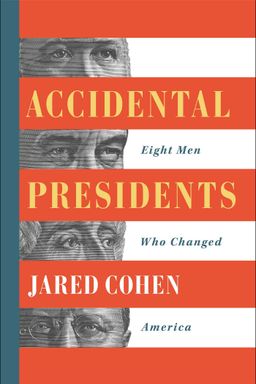
Accidental Presidents cover

Accidental Presidents

by Jared Cohen

Accidental Presidents by Jared Cohen delves into the surprising ascensions of eight vice presidents who assumed the U.S. presidency under extraordinary circumstances. Their unexpected leadership during critical junctures redefined the nation''s trajectory, from annexing Texas to advancing civil rights, illustrating how chance can alter the course of history.

When Fate Chooses the President

Imagine waking up one morning as vice president and ending the day as the nation's leader. This is the central thread running through Accidental Presidents—how unexpected deaths, assassinations, and illnesses thrust ordinary politicians into extraordinary roles. The book argues that America’s constitutional design, built on ambiguity and political improvisation, forced the country to rely on personality and precedent more than planned procedure. As you trace the stories from John Tyler to Lyndon B. Johnson, you see how contingency, character, and constitution intertwine to shape the nation.

The Fragile Design of the Constitution

The framers left Article II vague. What does it truly mean for power to "devolve" upon the vice president? John Tyler’s boldness after Harrison’s death in 1841 created precedent before law. Until the Twenty-Fifth Amendment, America survived on personality rather than policy when a president died or was incapacitated. Each crisis tested whether continuity depended on written text or political will.

Vice Presidents Chosen for Politics, Not Readiness

Vice presidents, you learn, were often tokens—added to tickets to balance geography or party factions. Tyler was meant to lure southern votes; Andrew Johnson symbolized Union unity; Chester Arthur soothed New York’s political machine. None were chosen for presidential aptitude. Yet when fate intervened, these men carried the republic’s continuity on their shoulders, often defying the expectations of those who picked them. This recurring theme exposes how partisan calculation eclipsed succession preparedness well into the twentieth century.

Crisis as a Test of Character

In every chapter, moral courage meets political chaos. Tyler defied his own party to claim legitimacy; Fillmore, stepping in for Taylor, chose compromise over confrontation; Johnson squandered Lincoln’s legacy by equating leniency with unity. Later, Arthur transformed from spoilsman to reformer, and Truman—briefed for only minutes on the Manhattan Project—made civilization-altering decisions within weeks of assuming office. Circumstance gave them power; temperament defined their impact.

From Accidents to Institutions

The narrative shows how each unplanned presidency nudged constitutional evolution. Tyler’s claim became the default rule; Garfield’s drawn-out death prompted reflection on disability and medical delegation; Wilson’s stroke inspired the later drafting of the Twenty-Fifth Amendment. Lyndon Johnson’s mastery of Congress, following Kennedy’s murder, illustrated how experience could finally merge readiness with destiny. These successions forced America to reform its continuity systems—from the Secret Service to disease disclosure to the amendment process itself.

Why the “Accidents” Still Matter

You might think of vice presidents as ceremonial, but history proves otherwise. Accidental presidents ended wars, annexed territories, signed monumental laws, and reinvented the presidency. Tyler’s annexation set up the Mexican War; Fillmore’s compromise delayed civil conflict; Johnson’s leniency hardened racial hierarchy; Arthur reformed civil service; Roosevelt expanded executive power; Truman reshaped geopolitics; Johnson enacted civil rights. Each story underscores how fortune and flaw define government more than design.

The Core Argument

The presidency’s durability has often hinged on improvisation. America’s stability came not from perfect foresight but from individuals who interpreted silence as authority and turned emergency into order. This book invites you to see succession not as an arcane clause, but as the hinge on which democracy repeatedly swings—and survives.


Constitutional Gaps and the Tyler Precedent

Before 1841, no one truly knew what happened when a president died. Article II’s phrase about powers “devolving” on the vice president was poetic ambiguity, not procedural clarity. When William Henry Harrison died after a month in office, that vagueness became crisis. John Tyler insisted he was the president, not an “acting” placeholder, and his self-assertion forced Congress, the courts, and the public to accept precedent over textual certainty. You can trace the survival of every later succession—from Garfield to Kennedy—back to this political gamble.

Language and Power

Tyler, called “His Accidency,” faced a cabinet that tried to fence him with semantics. Letters addressed him as “Vice-President, acting President.” He refused the title. By swiftly taking the oath, asserting signature rights, and wielding vetoes, he transformed grammar into governance. The House endorsed it, setting constitutional muscle memory that endured until the Twentieth and Twenty-Fifth Amendments codified the rule a century later.

Succession, Accident, and Legitimacy

Every later emergency echoed Tyler. After Lincoln’s assassination, Johnson did not hesitate; after Garfield’s drawn-out death, Arthur followed precedent; after McKinley’s murder, Roosevelt did the same. The pattern built inertia: the nation treated the vice president automatically as president, though law lagged behind practice until 1967. That institutional leap—from improvisation to instruction—traces directly to Tyler’s stubbornness in a candlelit chamber over two words in Article II.

Insight

Constitutional ambiguity can collapse or strengthen democracy depending on who interprets it. Tyler’s audacity turned confusion into continuity—proof that political will sometimes writes law faster than legislatures do.


When Political Pawns Become Presidents

Vice presidents are often chosen for what they deliver electorally, not for what they could do in crisis. Through Tyler, Johnson, and Arthur, you see how political calculation collided with mortality. The office was a balancing act—a northern reformer paired with a southerner, or a machine operative added to appease factions. These arrangements looked rational in party rooms but reckless on Inauguration Day when death struck.

Symbolic Selections

Tyler was a states’ rights Virginian added to Harrison’s ticket to soften sectional divides. Johnson, a War Democrat, helped Lincoln project Union inclusiveness. Arthur placated Roscoe Conkling’s Stalwart machine under Garfield. None were policy soulmates of their presidents—and that mismatch erupted as soon as they took command. The Whigs disowned Tyler; Radical Republicans impeached Johnson; Arthur had to reinvent himself to overcome scandal inherited from a patronage culture that made his nomination possible.

Consequences of Accidental Elevation

Once elevated, these “placeholders” became transformers. Tyler secured Texas annexation; Johnson derailed equitable Reconstruction; Arthur seeded reform. Their tenures expose a fundamental truth: campaign pragmatism can predetermine crisis because political expedience rarely produces capable successors.

Lesson

When voters and parties treat the vice presidency as accessory rather than apprenticeship, they gamble with the republic’s stability.


Power, Policy, and Personality in Transition

Succession isn’t just legality—it’s personality unleashed under pressure. Each accidental president redefined the balance between conviction, compromise, and chaos. You can study four vivid case studies: Tyler’s assertiveness, Fillmore’s accommodation, Johnson’s regression, and Arthur’s redemption. Together they reveal how character traits translate into shifts of national policy far beyond constitutional text.

From Annexation to Compromise

John Tyler turned accident into expansion. Spurned by Whigs, he pursued Texas annexation with secrecy and audacity—events so layered with tragedy (like the USS Princeton explosion) that they changed territorial destiny. A decade later, Zachary Taylor’s abrupt death let Millard Fillmore piece together the Compromise of 1850, momentarily welding a Union destined to fracture. The deaths of presidents transformed agenda and ideology; the Constitution offered no plan for emotional or political continuity, so personal temperament substituted for policy clarity.

Reconstruction’s Lost Opportunity

Lincoln’s assassination gave Andrew Johnson authority he was unequipped to wield. His racial prejudice and loyalty to states’ rights reversed wartime advances and inflamed congressional clashes. His impeachment showed the dangers of interpreting “Union” as restoration without justice. In contrast, his predecessor’s selection—meant to symbolize unity—produced its opposite: disunion by policy.

Redemption through Reform

Chester Arthur’s presidency reversed cynicism into reform. Once a machine boss, he embraced the Pendleton Civil Service Act, ended coerced donations, and modernized the navy. Under illness and scrutiny, he showed how moral prompting and public pressure can recalibrate power. Each of these presidents demonstrates a common truth: when succession combines moral trial with political vacuum, individual ethics become national doctrine.


Assassination, Crisis, and Reform

America’s institutional maturity often followed violence. The deaths of Lincoln, Garfield, McKinley, and Kennedy each forced crisis management, spawning reforms from civil service to succession law. You learn how chaos begat stability, one tragedy at a time.

Garfield to Arthur: Death and Reform

The Garfield assassination exposed how the spoils system could turn lethal. Guiteau’s delusions about patronage linked murder to corruption, jolting the nation into reform. Arthur—once emblem of that machine—responded with moral awakening, backing the Pendleton Act and professionalizing the bureaucracy. Reform, in that sense, was born of guilt and survival instinct.

Evolution of Protection

Early presidents walked informal halls of access; only after McKinley’s murder did Congress assign protective duty to the Secret Service. Even so, performance was inconsistent. Near-misses—from Pavlick’s aborted car bombing of Kennedy to the Tbilisi grenade attack on George W. Bush—show that secrecy and luck often guarded the executive as much as policy. Each attempt pushed procedural upgrades yet revealed enduring fragility.

Core takeaway

Security and succession both evolved reactively. American resilience often arrived only after bloodshed forced its hand.


From Roosevelt’s Energy to Coolidge’s Restraint

In the 20th century, accidental presidencies expanded in meaning. Theodore Roosevelt turned succession into ambition; Calvin Coolidge turned it into caution. Their contrasting styles bookend an era of transformation—showing how personality could expand or contract the presidency itself.

Roosevelt: Kinetic Government

Ascending after McKinley’s assassination, Roosevelt exploded executive boundaries—trust-busting, conservation, and global expansion became moral crusades. His charisma redefined leadership as action, inventing the modern bully pulpit. His succession proved that charisma could be constitutional power by other means.

Harding to Coolidge: Scandal and Stability

Harding’s cronyism—Teapot Dome, the Ohio Gang, Forbes’s theft—exposed the rot of unchecked friendship politics. Coolidge inherited a tarnished White House and cleansed it by quiet discipline. His faith in markets brought prosperity, yet his silence fostered the speculative bubble that burst after his time. You learn how passivity, like activism, can shape outcomes decades later.

Observation

In shifting from Roosevelt’s roar to Coolidge’s whisper, the presidency refined its dual identity—moral theater and caretaker office—each a response to the accident that delivered it.


War, Death, and the Atomic Age

The Roosevelt–Truman transition showed the global stakes of unplanned succession. FDR’s secretive decline, the convention intrigue over Henry Wallace and Harry Truman, and Roosevelt’s death in April 1945 thrust Truman into atomic decision-making he barely comprehended days earlier.

Political Chess before Catastrophe

Democratic bosses replaced Wallace with Truman to avert radicalism, unaware they were choosing the man who would end a world war. Roosevelt’s secrecy left Truman unbriefed on the Manhattan Project, illustrating why informational continuity is as critical as constitutional continuity. Within months, Truman authorized the atomic bombings of Japan—a decision framed by urgency, limited knowledge, and heavy moral calculus.

Enduring Lesson

Succession is not only legal; it is moral apprenticeship. The Truman case underscores why vice presidents must be informed and ready. The cost of opacity is measured in lives and geopolitics, not just domestic transition.


Lyndon Johnson’s Triumph and Tragedy

Lyndon B. Johnson’s presidency encapsulates the dual potential of accident. Elevated by Kennedy’s assassination, he converted mourning into momentum for civil rights while sowing America’s deepest foreign policy quagmire. His mastery of the Senate gave him domestic triumphs; his insecurity about Vietnam yielded historical tragedy.

Domestic Mastery

Johnson wielded legislative power as moral force, pushing the Civil Rights Act, Voting Rights Act, and Great Society programs. His empathy for the marginalized fused with procedural genius—a rare alignment of purpose and power rarely matched by accidental successors.

Foreign Misjudgment

Yet Vietnam exposed the limits of that same decisiveness. Driven by Cold War anxiety and fear of appearing weak, he escalated intervention into catastrophe. The lesson is sobering: competence in domestic politics does not ensure wisdom in foreign war. Even well-intentioned presidents can be trapped by inherited commitments and emotional burdens of legitimacy.

Dual Legacy

Johnson’s accident produced both the most transformative civil rights era and one of America’s most divisive wars—proof that power gained by tragedy can amplify both virtue and error.


Modern Continuity and the Twenty-Fifth Amendment

The century-long struggle to codify succession culminated in the Twenty-Fifth Amendment (1967). After generations of improvisation, America finally scripted what Tyler improvised. It clarified succession, enabled vice-presidential replacement, and prescribed procedures for temporary incapacity—bridging lessons from Wilson’s stroke, Eisenhower’s illness, and Kennedy’s death.

Practice and Reluctance

Still, practice lagged. Reagan’s team hesitated to invoke it after his 1981 shooting; later presidents invoked Section 3 only for surgeries. Dick Cheney’s meticulous planning, including temporary transfers during Bush’s colonoscopies, signaled cultural progress—a willingness to treat continuity as professionalism, not panic.

Preparedness as Governance

Continuity is now a discipline: brief the vice president, rehearse transfers, and normalize succession. The amendment shows how law matures from experience, but it still depends on political courage to declare incapacity. As the author proposes, we must also reform how vice presidents are chosen—less as electoral tools, more as trained stewards. In other words, constitutional mechanics mean little without human readiness.

Dig Deeper

Get personalized prompts to apply these lessons to your life and deepen your understanding.

Go Deeper

Get the Full Experience

Download Insight Books for AI-powered reflections, quizzes, and more.