
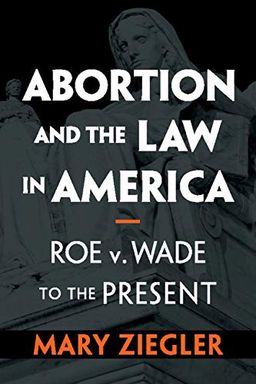
Abortion and the Law in America cover

Abortion and the Law in America

by Mary Ziegler

Abortion and the Law in America offers a thorough exploration of the legal history of abortion rights in the US. Author Mary Ziegler examines the evolving debates, from cultural shifts to legal arguments, providing a nuanced understanding of this complex issue and its future implications.

Reproduction and the American Constitution: How Law Shapes Life

How do laws about reproduction reflect the deepest questions of freedom, equality, and personhood in America? Mary Ziegler’s Reproduction and the Constitution in the United States argues that debates about abortion and birth control are not just skirmishes over medical procedures—they are struggles over the meaning of constitutional rights, social justice, and the boundaries of government itself. From the 19th-century criminalization of abortion to the 21st-century battles around Roe v. Wade, Ziegler shows how reproduction has mirrored every major transformation in U.S. politics and law.

Ziegler contends that the story of abortion in the United States is really a story about the evolution of constitutional interpretation. When the Supreme Court decided Roe v. Wade in 1973, it drew on a right to privacy first articulated in the 1960s case Griswold v. Connecticut. But privacy—seemingly neutral—quickly fractured along lines of politics, morality, and religion. Over decades, this conflict became a proxy war for deeper questions: Who counts as a person under the Fourteenth Amendment? What does equality for women mean if pregnancy and motherhood remain governed by the state? And can science or religion supply the legitimacy that constitutional interpretation often lacks?

From Crime to Right

Before the mid-1800s, abortion was widely accepted up to the stage of “quickening”—the point when fetal movement could be felt. But Horatio Storer and the newly formed American Medical Association argued otherwise. They pressed lawmakers to criminalize abortion throughout pregnancy, claiming moral duty and scientific authority. This shift, entangled with anti-immigrant racism and patriarchal anxiety, set the stage for viewing reproduction as a matter of state control. By the early 20th century, birth control was equally stigmatized under laws like the Comstock Act, which labeled contraception “obscene.”

Ziegler connects these early moral crusades to the logic that still divides Americans today: the state’s authority to define life. Physicians, theologians, and legislators debated not only when life began but also whose life mattered. The shadow of eugenics looms large here—Margaret Sanger’s birth control movement grew partly out of the same scientific culture that justified coercive sterilization and racial hierarchy.

Roe and Beyond: The Myth of Settling the Debate

Roe v. Wade, Ziegler argues, was both a legal milestone and a cultural lightning rod. The decision redefined privacy as bodily autonomy and the right to choose—but it also intensified divisions. Antiabortion advocates mobilized around fetal personhood; feminists reframed choice as equality; politicians weaponized Roe in elections. Far from resolving the conflict, the Supreme Court transformed abortion into a perpetual symbol of judicial activism and moral decline, especially after conservatives began using originalism to challenge Roe’s foundations.

When Planned Parenthood v. Casey (1992) introduced the “undue burden” standard, it reshaped the battlefield again. The Court preserved the right to abortion but lowered the bar for state restrictions. Ziegler calls this the hinge of modern reproductive politics: legal rights remained, but access diverged dramatically along racial, economic, and geographic lines.

Religion, Science, and Political Realignment

Ziegler’s deeper insight is that the abortion debate has never been purely legal—it’s a contest over national identity. In the late 20th century, the rise of the Religious Right and the “politics of science” shifted the fight from abstract rights to empirical claims. Antiabortion leaders began asserting that abortion harmed women’s health or violated medical ethics. Meanwhile, pro-choice advocates increasingly invoked science to defend safe procedures and contraceptive access. Each side used expertise to claim moral legitimacy.

At the same time, religious liberty emerged as a new front. Battles over contraception in the Affordable Care Act and cases like Burwell v. Hobby Lobby reframed the question of choice as one of conscience. In Ziegler’s telling, the modern divisions between “pro-life” and “pro-choice” parallel those between “religious liberty” and “civil rights.”

Why It Matters

For anyone trying to understand why American politics seem locked in endless cycles of polarization, Ziegler offers an explanation: Roe did not create the abortion wars—it exposed longstanding constitutional tensions over freedom, morality, and democracy. Even if Roe is overturned, she argues, the struggle will not end. The constitutional questions surrounding reproduction—life, equality, faith, and science—are woven into how Americans imagine justice itself. Reading Ziegler, you realize that arguments about reproduction are arguments about the nation’s soul.


Criminalizing Reproduction

Ziegler begins where few histories do—by treating the nineteenth-century criminalization of abortion and birth control as a foundational constitutional turning point. Before the 1850s, abortion was rarely prosecuted; it was considered a private matter between a woman and her healer. That changed when Dr. Horatio Storer and the American Medical Association launched a campaign to outlaw abortion throughout pregnancy, arguing that life began at conception. This moment merged scientific ambition with moral crusade, as doctors sought legitimacy and power by displacing midwives and 'irregular' healers.

The Politics of Purity and Power

Anthony Comstock, a postal inspector and pious moral reformer, turned moral anxiety into national law. His 1873 Comstock Act banned mailing 'obscene materials,' including information on contraception or abortion. Ziegler describes this era as a peculiar blend of public health rhetoric and Protestant fear—medical men claiming science while moralists invoked sin. Both sought control over women, sexuality, and the growing immigrant population. Abortion became a lever to reinforce social hierarchy and racial purity.

Eugenics and the Birth of Modern Control

The early twentieth century layered another ideology onto reproductive control: eugenics. Figures like Charles Davenport and Harry Laughlin blended genetics with social policy, promoting sterilization laws and immigration restrictions to improve 'American stock.' Courts upheld these measures in cases like Buck v. Bell, declaring 'three generations of imbeciles are enough.' (This chilling phrase became shorthand for how pseudoscience merged with constitutional law.)

Margaret Sanger—often celebrated for championing birth control—appears here in complex light. Ziegler shows that Sanger’s advocacy was simultaneously feminist and eugenic. She argued for 'voluntary motherhood' but often justified contraception as a means to prevent 'defective' births. The overlap between progressivism and prejudice reveals how reproductive debates have long been entwined with class, race, and notions of national perfection.

Medicine Takes Over Morality

By the mid-20th century, medicine had successfully claimed authority over reproduction. Hospital 'therapeutic committees' decided which abortions were legally justified, often restricting them to wealthy and white women who could argue dire health threats. These practices, Ziegler notes, transformed moral policing into institutionalized inequity. Doctors became gatekeepers to reproductive autonomy, and clinics evolved into battlegrounds of class and gender.

Ziegler’s key takeaway: criminalization was never only about protecting life—it was also about controlling who could reproduce. By tracing this trajectory, she reframes abortion laws not as isolated moral debates but as deeply constitutional questions about public versus private authority, scientific expertise, and the uses of law to shape social order.


The Reform Battle and the Right to Privacy

Ziegler shows how, during the 1960s, a cultural upheaval—the sexual revolution, civil rights, and the rise of feminist activism—challenged the old moral regime. Griswold v. Connecticut became the turning point. When the Court struck down laws banning contraception for married couples, it recognized an implied 'right to privacy.' This notion would soon underpin Roe v. Wade. Privacy, however, meant more than secrecy—it meant self-determination.

From Health Reform to Feminist Repeal

Alan Guttmacher, Larry Lader, and other reformers pushed to liberalize abortion laws based on a model from the American Law Institute. These laws allowed abortion only in limited cases: rape, incest, serious health risks, or fetal abnormality. Ziegler notes that reformers framed this as a public health issue, not a feminist cause. Yet these early reforms failed—the processes were cumbersome, class-bound, and inaccessible to poor women. Feminists like Pat Maginnis, Lana Clarke Phelan, and Betty Friedan took the baton and demanded full repeal: abortion as a fundamental right, not a regulated privilege.

Privacy Turns Political

The 1965 Griswold decision inspired activists to extend the privacy argument to abortion. When Bill Baird distributed contraceptives to unmarried people and was arrested, the resulting case—Eisenstadt v. Baird—expanded privacy from marital to individual autonomy. As Justice Brennan wrote, ‘the right of the individual, married or single, to be free from unwarranted governmental intrusion.’ These words became the backbone of future abortion litigation.

Simultaneously, the antiabortion movement grew more sophisticated. Catholic lawyers reframed the issue as one of 'fetal civil rights,' arguing that constitutional protections applied from conception. Groups like the National Right to Life Committee linked abortion to slavery, claiming it denied personhood to the most vulnerable. By doing so, they shifted their appeal from theology to constitutional morality.

Political Realignment

Ziegler’s account of the late 1960s captures a political crossroads. Both parties were divided—Democrats and Republicans had pro-choice and pro-life factions. But President Nixon saw abortion as a wedge issue to lure Catholic and working-class voters to the GOP. His 1971 directive against military-base abortions became a moral message: the Republican Party would become 'the party of life.'

Ziegler treats this as the moment when reproductive rights ceased being a purely legal question. Privacy now meant ideology. By 1972, as Roe was reaching the Supreme Court, abortion had become a test of what kind of nation America wanted to be—individualist or moralist, libertarian or patriarchal.


Roe v. Wade and Its Aftershocks

In January 1973, Justice Harry Blackmun issued Roe v. Wade, the ruling that would define American constitutional law for decades. Ziegler examines Roe not as a static text, but as a historical force—both landmark and lightning rod. The Court found that abortion fell under a broad right to privacy and devised the trimester framework: first-trimester abortions free from restriction, second regulated for health, third for fetal viability. The decision was sweeping, but Ziegler notes that it sowed the seeds of enduring conflict.

Legal Victory, Political Explosion

Blackmun had imagined Roe as a settlement—a medicalized compromise based on expert consensus. Instead, it became the battle cry for Americans who felt democracy had been hijacked by judges. Antiabortion activists condemned it as moral tyranny; feminists embraced it as liberation. Congress responded with incremental pushbacks like the Hyde Amendment (1976), denying abortion funding to Medicaid recipients. Courts upheld these measures, gradually stratifying access by income, race, and geography.

Reframing Rights and Narratives

Abortion opponents shifted strategy from rhetoric to law. Americans United for Life began defending restrictions as protections for women—asserting that abortion caused trauma, depression, and regret. Ziegler sees this as the turning point: a movement once focused on fetal life now claimed to defend women’s health. This 'woman-protective' logic would later underpin cases like Gonzales v. Carhart.

Meanwhile, the abortion-rights movement fractured. Feminists of color, such as Helen Rodríguez Trías, exposed forced sterilizations and demanded broader reproductive justice. They argued that 'choice' meant little without access, safety, and freedom from coercion. Groups like CARASA merged abortion rights with anti-racist and anti-poverty agendas, pioneering what we now call intersectionality in reproductive politics.

From Roe to Reagan

By the 1980s, the abortion debate was central to party identity. Ronald Reagan’s alliance with the Religious Right solidified the GOP’s 'pro-life' platform, while Democrats leaned into feminism and civil rights. Ziegler’s analysis of this era shows how abortion became a symbolic shorthand for moral order and judicial philosophy. Originalism—championed by judges like Robert Bork and Antonin Scalia—offered conservatives a way to frame Roe as unconstitutional judicial activism.

In short, Roe didn’t just define abortion—it transformed the architecture of American ideology. From medical debate to political creed, it turned a private decision into the central battlefield of constitutional identity. Ziegler’s historical reconstruction is meticulous, showing how this single case spawned an entire political culture of moral constitutionalism.


Planned Parenthood v. Casey: Redefining the Boundaries

Ziegler treats the 1992 Planned Parenthood v. Casey decision as a pivot point—the moment Roe’s legacy was rewritten for modern America. The Court upheld the right to abortion but replaced Roe’s trimester framework with an 'undue burden' test. This shifted the focus from legality to accessibility: the state could impose restrictions as long as they didn’t create substantial obstacles. On paper, abortion rights survived. In practice, they weakened.

The Logic of Reliance and Equality

The Casey opinion, co-authored by Sandra Day O’Connor, Anthony Kennedy, and David Souter, framed abortion as integral to women’s freedom and equality. It introduced the idea of societal 'reliance interests'—the notion that women had structured their lives around access to abortion. Ziegler highlights this as the first time the Supreme Court linked reproductive choice directly to gender equality, anticipating Ruth Bader Ginsburg’s later scholarship on the issue.

Compromise or Hollowing?

Under the undue burden standard, states passed waves of new restrictions: waiting periods, spousal notifications, biased counseling, clinic requirements. Many survived judicial scrutiny. Ziegler calls this era 'rights in theory, obstacles in practice.' Abortion was legal—but geographically and economically segmented. Urban clinics thrived; rural states effectively outlawed access. The Supreme Court’s compromise fed the illusion of consensus while eroding actual equality.

Seeds of Polarization

Ziegler connects Casey to the rise of post-abortion trauma rhetoric. Antiabortion groups like Women Exploited by Abortion argued that Casey’s emphasis on regret legitimized laws requiring mandatory emotional disclosures. The Court’s language—protecting women from poor decisions—became a template for paternalistic regulation. Meanwhile, violence against providers surged, prompting the Freedom of Access to Clinic Entrances Act (FACE) in 1994. Far from ending conflict, Casey deepened it, polarizing science, religion, and feminism into separate systems of truth.

Ziegler’s conclusion is sobering: Casey preserved the symbol of choice but changed its substance. By grounding abortion in liberty rather than equality, it left space for endless reinterpretation—and for the next generation of restrictions masquerading as protections.


Science, Uncertainty, and the Politics of Truth

One of the book’s most original insights is how scientific authority replaced moral rhetoric as the battleground of abortion politics. In the 1990s and 2000s, conservatives reframed abortion debates around health risks and uncertainty. The controversy over 'partial-birth abortion' epitomized this shift. What began as a technical term—dilation and extraction—was rebranded to evoke horror. Congressional hearings spotlighted gruesome diagrams and emotional testimony, claiming scientific justification for bans.

The Rise of 'Woman-Protective' Science

Activists like David Reardon and endocrinologist Joel Brind advanced research linking abortion to trauma and breast cancer. Though medical consensus disputed these claims, the arguments influenced legislation and public opinion. Ziegler calls this the emergence of 'politicized science'—research used less to discover truth than to validate ideology. By 2007, Gonzales v. Carhart upheld the federal partial-birth abortion ban, explicitly citing scientific uncertainty as grounds for deference to lawmakers. This reinforced the idea that doubt itself was a conservative asset.

Technology and New Frontiers

The arrival of RU 486, emergency contraception, and assisted reproductive technologies introduced new gray zones. Was a morning-after pill abortive if it prevented implantation? Was selective reduction during IVF a form of abortion? Ziegler shows that these questions blurred boundaries between reproduction and medical innovation. Antiabortion leaders responded by branding uncertainty as moral danger, demanding restrictive regulations on drugs and telehealth abortions.

Science as Weapon and Shield

For Ziegler, this period reveals a deep constitutional tension: when science becomes politics, facts lose authority. In the wake of Gonzales, lawmakers could treat contested evidence as justification for almost any regulation. The abortion debate, once about constitutional rights, became a struggle over epistemic legitimacy—who gets to define truth. In many ways, Ziegler argues, this mirrors wider American phenomena like climate denial and anti-vaccine movements. The abortion conflict was no longer only moral; it had become a referendum on reality.


Religious Liberty and the New Culture Wars

Ziegler ends her narrative in the twenty-first century, where abortion law intersects with another volatile issue: religious freedom. Following the rise of the Tea Party and the passage of the Affordable Care Act, the question shifted—could individuals or corporations claim exemptions from laws on religious grounds? In Burwell v. Hobby Lobby (2014), the Court said yes, allowing family-owned businesses to refuse contraceptive coverage based on faith. This decision, Ziegler argues, redefined the relationship between religion and citizenship.

Faith Meets Commerce

Using Hobby Lobby as her case study, Ziegler demonstrates how the mantle of religious liberty became a tool for resisting not only contraception but broader civil rights mandates. Where Roe had framed the right to choose as autonomy, Hobby Lobby reframed religious conscience as autonomy—moving moral authority from women to employers. The logic of 'substantial burden' under the Religious Freedom Restoration Act allowed claims of complicity even for distant connections to reproductive services, expanding exemptions across American life.

Polarization and Political Identity

Ziegler situates these changes within broader partisan realignment. As same-sex marriage moved from controversy to constitutional recognition in Obergefell v. Hodges (2015), conservative Christians reframed themselves as a persecuted minority defending faith against secular tyranny. Abortion, contraception, and marriage equality became linked under the banner of 'religious liberty.' This fusion set the stage for Donald Trump’s presidency, where judicial appointments became the primary instrument of political credibility among evangelicals.

Post-Roe Legislation and the Future

By the 2010s, states began passing 'heartbeat bills' banning abortion at six weeks, often inspired by activist Janet Folger Porter’s strategic testimony. These laws capitalized on new conservative majorities in the Supreme Court—especially after the appointments of Neil Gorsuch, Brett Kavanaugh, and Amy Coney Barrett. When Mississippi advanced its 15-week ban in Dobbs v. Jackson Women’s Health Organization (2021), Ziegler notes that the Court faced an unavoidable reckoning: whether to erase Roe entirely.

Ziegler’s conclusion is powerful and unsettling: overturning Roe will not end America’s reproductive conflict. It will multiply battlefields—state by state, case by case—because the argument has always been larger than abortion. At its core, she writes, this is about constitutional identity: who gets to define freedom—individuals, experts, or believers. Religious liberty, like Roe’s privacy, now stands as the new language of moral legitimacy. And once again, the law of reproduction reflects the story of America itself.

Dig Deeper

Get personalized prompts to apply these lessons to your life and deepen your understanding.

Go Deeper

Get the Full Experience

Download Insight Books for AI-powered reflections, quizzes, and more.