
Idea 1
The Rise of a Whole New Mind in the Conceptual Age
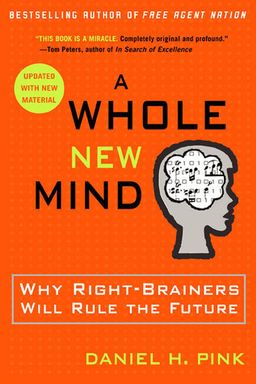
Have you ever wondered why technical skills and logical intelligence aren’t enough anymore to guarantee career success or personal fulfillment? In A Whole New Mind, Daniel H. Pink argues that the world has shifted from the Information Age—dominated by left-brained, linear, analytical thinking—to what he calls the Conceptual Age. In this new era, right-brain abilities—like design, empathy, storytelling, play, and meaning—are becoming the keys not only to thriving economically but also to leading richer, more satisfying lives.
Pink contends that traditional L-Directed Thinking—logical, sequential, and detail-oriented—has powered progress since the Industrial Revolution. It built our factories, fueled the rise of computer code, and made knowledge work the hallmark of success. But the forces of Abundance, Asia, and Automation have rewritten the rules. Abundance has made material needs easy to satisfy, Asia now performs routine intellectual labor more affordably, and automation replaces repetitive logic-driven tasks. The consequence? What economists once called 'knowledge work' is being commoditized, and what's left is what humans can do best: create, empathize, connect, and find meaning.
From Left Brain Dominance to Whole-Minded Thinking
Pink grounds his case in neuroscience, explaining how our left and right brain hemispheres interact. While both sides work together, they specialize: the left focuses on sequence, logic, and text; the right on context, emotion, and synthesis. The problem is not that the left brain is bad—but that we’ve overvalued it. Now, the world demands integration. The goal is a whole new mind, capable of balancing both halves—what he calls 'high concept' (creativity, pattern recognition, and innovation) and 'high touch' (empathy, storytelling, and meaning-making).
In the Conceptual Age, success no longer comes to those who crunch the most data or memorize the most facts, since those can be automated or offshored. Instead, it rewards people who can connect seemingly unrelated ideas, forge deep relationships, and create beauty or joy that a machine cannot reproduce. The future belongs, Pink says, to creators, empathizers, symphony-makers, storytellers, caregivers, and meaning-seekers—people who use these uniquely human abilities to interpret and connect rather than compute.
High Concept and High Touch
Pink calls these two pillars 'high concept' and 'high touch.' High concept refers to the ability to synthesize ideas, see patterns, create artistic beauty, and invent something new by combining existing elements. High touch is the capacity to empathize, understand human motivation, and infuse daily life with significance. He argues that while logic and technical skill can be outsourced, creativity and emotional intelligence cannot. The artist, the designer, the teacher, and the caregiver now share equal—or even greater—economic importance with the engineer and the analyst.
To thrive in this environment, Pink identifies six essential aptitudes—what he calls the 'Six Senses' of the Conceptual Age: Design, Story, Symphony, Empathy, Play, and Meaning. Each sense represents a core human capacity that complements—but does not replace—analytic reasoning. 'Left-brain' precision still matters, but it must now work in harmony with the right-brain’s big-picture imagination.
Why the Six Senses Matter Now
Each of these six senses responds to one of the three great forces shaping modern life. Design answers abundance: when we already have enough goods, aesthetics and experience become the differentiators. Story answers automation: while machines can deliver data, only humans can weave it into meaning. Symphony answers globalization: connecting across disciplines and cultures creates innovation. Empathy becomes vital in a world of automation and outsourcing because emotional intelligence cannot be replicated by a machine. Play counters the fatigue of overwork and logical rigor by reintroducing creativity and humor. And Meaning addresses the hunger for purpose that wealth and technology cannot satisfy.
Pink’s message is both a warning and an invitation. He warns that jobs based solely on logic and analysis—like programming, finance, or data processing—will be increasingly vulnerable. But he also invites every reader to cultivate the right-brain aptitudes that make life richer and work more human. This transformation isn’t only economic—it’s existential. As abundance grows and tasks get outsourced, the strongest competitive advantage is not efficiency, but humanity.
“We’ve moved from an economy built on people’s backs, to an economy built on people’s left brains, to one built on people’s right brains.” —Daniel Pink
Throughout A Whole New Mind, Pink blends neuroscience, economics, and storytelling to show that the future will belong to those who think contextually, act creatively, and empathize deeply. This is not a rejection of analytical intelligence—it’s an evolution toward a whole-minded human intelligence that unites logic and inspiration, reason and emotion. By exploring and mastering the six senses, you can develop the balanced, inventive, and compassionate mindset required to succeed—and to live fully—in the Conceptual Age.