
Idea 1
A Mile-Deep Worldbook
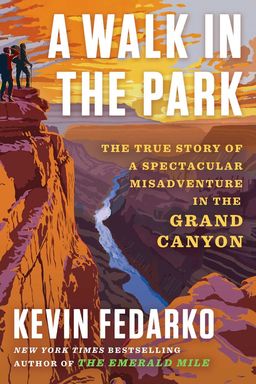
How do you come to know a place that collapses two billion years of time and a thousand miles of climate into a single mile of depth? In this book, Kevin Fedarko argues that the Grand Canyon is best understood as a living, vertical library where geology, ecology, culture, and human character interlock. He contends that you cannot grasp its meaning by one mode alone or by a checklist of feats; you have to read across layers: stone to spring, river to rim, story to sacrifice.
You move through three intertwined threads. First, the canyon as a stacked biography of Earth and life, where a thousand feet of descent equals roughly a 5°F rise and a wholesale biome shift. Second, the ways of knowing it: by water and by foot, plus a third, more secret pathway down the slots. Third, the moral terrain: indigenous continuities, rescue ethics, industrial tourism, fatal missteps, and a final ethic of humility that refuses to treat the canyon as a finishable prize.
Reading stone, reading life
Fedarko keeps returning to the idea that the walls are pages. Twenty-seven formations span eight periods; the Kaibab caps the rim at roughly 270 million years old, while the Vishnu Schist at river level approaches two billion. As you descend, climates compress: rim fir and spruce yield to cottonwoods, willows, and searing rock, and with them the canyon’s 373 bird species, 90-plus mammals, and exquisite endemics. This compressed ladder explains why water, plants, and animals appear in bands and pockets, not evenly spread across a map.
Two public doors, one hidden staircase
You learn two classic ways to know the canyon: by river and by foot. The river world brings dories, coolers, and legends like Kenton Grua’s Emerald Mile run; it reveals the green corridor of life but keeps you far from cliff-country secrets. The footpath world, as Colin Fletcher and Harvey Butchart modeled, trades comfort for intimacy: Redwall breaks, fossil ledges, and springs that decide whether you move or stop. Then Rich Rudow adds a third way: the slot canyons, vertical arteries that braid the benches to the river, combining cathedral-scale beauty with exacting ropework and stark commitment.
Risk, water, and the body
The canyon punishes shortcuts. Fedarko and Pete Mortimer learn this when heat and poor planning trigger hyponatremia, infections, and near-evacuations. The Redwall band becomes a geography lesson in survival: you cannot always descend to the river, and springs may be tinajas just an inch deep. Syringes become lifelines; calories become math; hours become heat windows. Dr. Tom Myers’s medical clarity and mentors like Kelly McGrath and Mathieu Brown turn suffering into know-how: lighter loads, disciplined packing, and electrolyte plans transform range and safety (note: this echoes the ultralight revolution chronicled by Ray Jardine, adapted for desert geology).
Community, catastrophe, and choice
A winter storm and Amy’s dislocated patella distill the book’s ethics: when helicopters cannot fly, you become your own rescue. The group stabilizes, ration-paces, and threads between caches while snow loads tents and wind closes the sky. Another thread runs darker: Ioana Elise Hociota’s fatal fall near Owl Eyes Bay and Floyd Roberts’s disappearance in the Sanup remind you that even strong partners and good plans can be undone by hidden chutes or 110–120°F heat. These stories are not cautionary scolds so much as a ledger of costs the canyon demands for intimacy.
People, power, and the sound of rotors
If the canyon is sacred ground for many tribes, it is also contested terrain in the present. You meet Renae Yellowhorse and Dianna Uqualla fighting the Escalade proposal at the Confluence, a place of emergence in multiple traditions. You also walk into Helicopter Alley, born of the Hualapai’s Skywalk development and an FAA carve-out that enabled low, frequent tourist flights. The soundscape turns to a conveyor belt of rotors—250 flights in a day—forcing you to hold two truths: tribal sovereignty and economic need on one hand, and the public’s stake in natural quiet on the other (compare to the Overflights Act debates at Haleakalā and Yosemite).
A governing ethic
"There’s no substitute for the months and years of experience that we’d skipped." The canyon, like any stern teacher, folds humility into every lesson.
Finishing by not finishing
Fedarko closes with a Navajo weaving metaphor: the ch’ihónít’i, or spirit line, a deliberate imperfection that lets humility and life escape the pattern. He leaves a purposeful gap in his traverse. That refusal to complete becomes his argument against conquest thinking and in favor of pilgrimage: choose relationship over record, cooperation over claim, and stewardship over spectacle. Policy gestures—Park Service apologies, Desert View co-stewardship, and the Baaj Nwaavjo I’tah Kukveni monument—hint at a future shaped by that ethic.
By the end, you hold a new map: a vertical worldbook, three ways of knowing, a body-smart survival playbook, a community of mentors and mourners, and a spirit line that keeps hubris in check. The canyon is not finishable. It is legible—if you learn how to read.