
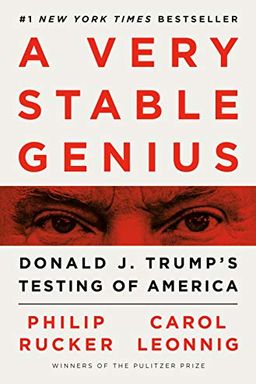
A Very Stable Genius cover

A Very Stable Genius

by Philip Rucker, Carol Leonnig

A Very Stable Genius provides an unprecedented look at Trump''s tumultuous presidency. Through firsthand accounts from officials and insiders, authors Philip Rucker and Carol Leonnig reveal the chaos, controversies, and defining moments that have shaped America''s political landscape.

Power, Loyalty, and the Loss of Process

What happens when a leader governs by instinct and brand rather than by institution? The book traces how Donald Trump’s presidency—built on loyalty, improvisation, and spectacle—reshapes the machinery of governance. You see a White House that prizes personal trust over competence, performance over process, and image over substance. That pattern, visible from transition staffing to foreign summits, leads to a near-continuous cycle of crisis and self‑protection.

The personnel principle: loyalty over qualification

From the outset, staffing decisions embody the governing style. Trump treats hiring like brand selection—Michael Flynn, Jared Kushner, Ivanka Trump, and Steve Bannon form a cast of loyalists rather than experienced administrators. Pompeo and Mattis are chosen as much for “the look” as for expertise. That television‑based logic weakens the guardrails of national security vetting, and Flynn’s appointment becomes emblematic: his unvetted foreign contacts trigger early crises and seed mistrust that will later expand into a full counterintelligence probe.

Early paranoia: Flynn, Russia, and the spiral

Flynn’s secret conversations with Russian ambassador Sergei Kislyak and the subsequent lies to Pence create the first major fracture. When leaks expose the truth, institutional actors like Sally Yates and James Comey wrestle over disclosure, while the president perceives betrayal rather than oversight. That moment births the White House’s paranoia toward intelligence and law enforcement—a mindset that will color later episodes like Comey’s firing and the Mueller investigation. Each attempt at control deepens institutional decay.

Governing as spectacle

Trump’s showmanship becomes a method of governance. Executive orders are unveiled as television events; major policy shifts, such as the travel ban, are announced and implemented before agencies are ready. You see governance reduced to improvisation—an East Room declaration of success ends a week marked by chaos. Staffers scramble to spin events rather than shape policy. (Note: It parallels themes in Richard Neustadt’s Presidential Power, but inverted—power used for presentation, not persuasion.)

Foreign policy by rapport and tweet

Diplomacy follows the same pattern. Summits with Putin, Kim Jong‑Un, and NATO leaders unfold like episodes of a reality show—Trump prioritizes optics and one‑liners over strategic coherence. At the G20 in Hamburg he accepts Putin’s denials, at Singapore he praises Kim’s talent, and at Helsinki he publicly sides with Putin against U.S. intelligence assessments. Each event erodes alliance confidence while reinforcing Trump’s identity as a disruptor. Officials like Mattis and Tillerson struggle to correct or slow these moves, only to be marginalized or dismissed.

A government in reaction mode

Across domestic policy, legal maneuvering, and foreign affairs, the administration operates reactively. Tweets drive decisions, aides manage fallout, and communications teams wage daily battles over framing. Leaks, memos, and partisan maneuvering—Nunes’s document release, the Porter scandal, and the Cohen raid—underscore an enduring fragility. Institutions respond defensively while the president interprets oversight as attack, transforming bureaucratic procedures into loyalty tests.

What the book reveals

Taken together, these chapters reveal a presidency defined by insecurity masquerading as strength. The refusal to delegate or trust institutions forces improvisation; each stage of governance—from the Flynn crisis to Syria withdrawal—shows how personal loyalty dictates national decisions. For you, the narrative functions as both chronicle and caution: when television logic invades public administration, governing and storytelling blur until truth itself becomes negotiable. The author’s portrait is detailed, sometimes cinematic, and the insight is direct—chaos isn’t an accident of Trumpism; it is its operating system.


From Flynn to Mueller: How Crises Evolve

The chain linking Michael Flynn’s conduct to Robert Mueller’s appointment crystallizes how loyalty-driven decisions cascade into constitutional consequences. You watch a simple misjudgment—a phone call with a Russian diplomat—expand into institutional confrontation, mistrust, and ultimately a special counsel investigation.

Flynn’s deception and fallout

Flynn’s intercepted December 2016 conversation about Obama’s sanctions remains pivotal. His subsequent false statements trigger alarm in the intelligence community. Sally Yates, then acting attorney general, warns the White House that a compromised adviser poses a national security risk. Trump’s impulse is to view loyalty as more valuable than transparency—he briefly defends Flynn, then grudgingly dismisses him. But the episode deepens suspicion of institutional motives and primes the administration to see oversight as sabotage.

Firing Comey as inflection point

When Trump fires FBI Director James Comey in May 2017, frustration over the Russia probe becomes personal. He demands public declarations of innocence, solicits affirmations from intelligence heads, and ultimately dismisses Comey—an act lawful on its face but perceived as obstruction. Rod Rosenstein’s memo about the Clinton-email episode provides a nominal reason; the real irritant is Comey’s unwillingness to end the “cloud” over the presidency. The aftermath ignites a crisis of legitimacy and directly triggers Mueller’s appointment.

Why Mueller mattered

Robert Mueller inherits dual responsibilities: investigate Russian interference and examine possible obstruction of justice. His credibility—Republican, ex-FBI director, Marine veteran—makes his authority nearly unassailable. For you, the dynamic is elementary but powerful: the harder a leader pushes against procedural norms, the stronger institutions reassert themselves. Mueller’s probe transforms the president’s political grievances into formal legal scrutiny.

The psychological shift

Once under investigation, Trump’s worldview refines into paranoia: the intelligence community is “out to get him,” leaks are “treason,” and every procedural act becomes a headline battle. The administration turns inward—lawyers, spokespeople, and aides prepare for siege. You see the paradox: a pursuit of loyalty leads to structures that magnify insecurity. Each firing or leak generates new inquiries, ensuring that the presidency remains trapped inside its own defensive loop.

Core takeaway

In this sequence—Flynn’s call, Comey’s firing, Mueller’s appointment—you see how personal impulse and institutional integrity collide. A system built for rule of law turns self-preserving when tested by rule of personality.


Lawfare and the Battle for Control

Once Mueller’s investigation is underway, the White House faces a new phase: survival through law and media. The legal strategy evolves from confusion to counterattack, revealing the limits of political improvisation when pressed by procedural rigor.

The hunt for defense counsel

Finding legal representation proves formidable. Elite Washington attorneys decline, fearing reputational and client volatility. Trump cobbles together a rotating team—Marc Kasowitz, John Dowd, Jay Sekulow, Ty Cobb—often feuding over tactics. Cobb favors cooperation to end the probe quickly; Dowd and others prefer defiance. The lack of unity mirrors the broader chaos of governance: loyalty trumps coordination, and communication breaks down among counsel, press, and staff.

The Mueller interview dilemma

Mueller’s insistence on an in‑person presidential interview forces a stark choice: engage and risk perjury or resist and appear obstructive. Trump’s lawyers negotiate furiously across sessions culminating in the April 24, 2018 meeting with Mueller’s team (Quarles and Zebley pressing for testimony). Ultimately Trump submits written responses laden with “I do not recall.” Mueller cites Office of Legal Counsel precedent (1973 and 2000) barring indictment of a sitting president—a constraint that compels investigation without direct judgment.

The Cohen raid and Giuliani’s arrival

The April 9 FBI search of Michael Cohen’s office catalyzes transformation. Giuliani joins as media general, while Jane and Marty Raskin handle forensic defense. Their tandem roles—spectacle and substance—illustrate Trump’s dual strategy: fight investigation publicly while managing exposure privately. Giuliani’s TV offensives keep the base energized; the prosecutors negotiate ground rules with Mueller. The raid personalizes the threat, formalizing Trump’s perception of institutional hostility.

A fractured response

The White House vacillates between cooperation and combat, unable to synthesize approaches. Its statements contradict filings; lawyers leave abruptly; and aides struggle to reconcile media spin with courtroom reality. You learn that communications cannot substitute for legal coherence—a principle as old as crisis management itself. The episode teaches that once spectacle invades law, facts themselves become contested terrain.


Leaks, Institutions, and Internal Resistance

As investigations intensify, the administrative machinery fractures from within. Leaks proliferate, whistleblowers document misconduct, and formal dissent emerges from both career officials and appointees. You witness an ecosystem of self‑defense—bureaucrats and generals attempting to restrain presidential excess.

Information wars

Events like the Nunes memo release and Trump’s “Spygate” tweets weaponize classified material. Declassification becomes political theater. The administration attempts to undermine institutions—FBI, DOJ—by framing oversight as espionage. Yet these maneuvers damage credibility, alienate allies in Congress, and accelerate internal distrust. Personnel scandals (Rob Porter, clearance issues) reinforce perceptions of dysfunction.

The bureaucratic resistance

Inside government, figures like Rod Rosenstein and Chris Wray resist partisan intrusion. The August 2018 clearance revocations for critics like John Brennan provoke backlash—William McRaven’s public defense of Brennan symbolizes institutional conscience. The anonymous "Resistance Inside the Administration" op‑ed confirms what insiders already suspect: senior aides occasionally act to curb presidential impulses, slow policy rollouts, or conceal documents. This underground safeguarding mirrors the concept of “gatekeeping” seen in bureaucratic studies (compare with Graham Allison’s Essence of Decision).

Costs and consequences

Resistance carries personal costs—clearance revocations, threats, paranoia about authorship. Yet each act of dissent restores small pockets of normalcy. When Rosenstein defends classified integrity and notes threats against his family, it signals how extreme polarization has become. For you, the pattern clarifies a simple truth: in systems under stress, professionals anchor norms through documentation and restraint. The leaks and protests are not rebellion but radiographs of institutional survival instincts.


Spectacle Abroad: Diplomacy as Theater

Abroad, the administration’s style mirrors its domestic chaos—foreign policy becomes performance art. Summits, showdowns, and symbolic acts replace deliberation. Cameras matter more than cables, and relationships matter more than treaties.

Staging international relations

The 2018 G7 in Quebec illustrates this shift: Trump throws candies at Merkel, calls Trudeau “weak,” and tweets insults mid‑conference. The intent is dominance through spectacle. The following Singapore summit with Kim Jong‑Un transforms diplomacy into cinema—custom film presentations, exaggerated flattery, and photo choreographies. These events rewrite traditional metrics of success: optics beat substance, and handshake replaces strategy.

NATO and alliance distrust

At Brussels and later Helsinki, unpredictability alarms allies. Trump threatens withdrawal from NATO, pressures members about spending, and later sides publicly with Putin against U.S. intelligence. Jim Mattis and Dan Coats attempt damage control, but reactions from figures like John McCain frame Helsinki as “disgraceful.” The pattern—favoring strongmen and belittling partners—alters America’s geopolitical identity from leader to contrarian.

Syria withdrawal and Mattis’s resignation

The sudden December 2018 order to leave Syria, delivered after a phone call with Erdoğan, reveals the strategic cost of impulsive policymaking. Mattis and envoy Brett McGurk warn of catastrophic fallout. Within days Mattis resigns, emphasizing alliance integrity in his letter—a rare act of principle amid disorder. His exit marks the decline of moderating influence and confirms that emotion, not coordination, drives foreign decisions. (Note: The book connects this to declining deterrence credibility and rising Russian leverage.)

For you, the foreign policy chapters demonstrate how personal image politics can reshape entire global architectures. When diplomacy becomes theater, allies hedge, adversaries exploit, and long-term strategy dissolves under the glare of momentary applause.


Domestic Unrest and Political Calculation

At home, spectacle manifests in crisis governance. The immigration “zero tolerance” policy and the 2018 midterm battles showcase how emotional narrative replaces planning. Media outrage and campaign strategy merge, feeding political success at moral cost.

Zero tolerance and its collapse

Attorney General Jeff Sessions’s announcement of universal prosecution for illegal crossings ignites family separations without logistical readiness. Audio of children crying in shelters becomes national trauma. DHS Secretary Kirstjen Nielsen’s legalistic defenses fail to contain outrage. Trump vacillates between compassion tweets and hard-line rhetoric, exposing incoherence. The humanitarian spectacle erases policy nuance and damages international reputation.

Midterms and judicial showdowns

By late 2018, immigration morphs into campaign tool. Trump brands caravans as “invasions,” energizing his base and helping maintain the Senate while losing the House. Concurrently, the Brett Kavanaugh confirmation fight reveals the same logic—attack to rally, provoke to polarize. Trump’s mockery of Christine Blasey Ford at a rally cements tone: performative aggression substitutes persuasion. Don McGahn’s departure and Pat Cipollone’s accession pivot the White House counsel’s office toward legal defense in anticipation of congressional oversight.

Barr and the report: victory by framing

Attorney General Bill Barr’s March 2019 summary of Mueller’s findings reframes the narrative. “No collusion, no obstruction” becomes a political mantra even as Mueller’s text is more nuanced. Mueller’s protest letter notes his work was mischaracterized, but Barr’s framing dominates airwaves. Trump declares “total exoneration,” proving that communication timing can outweigh content. The episode reinforces a meta-lesson: in the modern presidency, perception management eclipses institutional accountability.

You conclude these chapters with a clear inference: crises, whether humanitarian or judicial, become stages for reaffirming brand identity. Effective policy, ethical judgment, and legal accuracy all yield to optics—the presidency as campaign without end.

Dig Deeper

Get personalized prompts to apply these lessons to your life and deepen your understanding.

Go Deeper

Get the Full Experience

Download Insight Books for AI-powered reflections, quizzes, and more.