
Idea 1
A New Theory of Human and Machine Intelligence
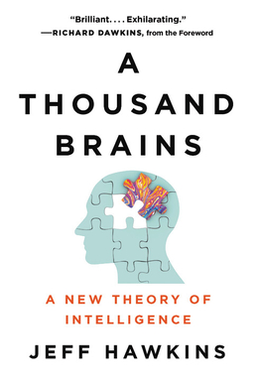
How do a few pounds of gray matter inside your skull create imagination, reasoning, language, and technology? In A Thousand Brains: A New Theory of Intelligence, technologist and neuroscientist Jeff Hawkins argues that intelligence—whether human or artificial—depends on one powerful mechanism: the neocortex’s ability to build and use thousands of separate models of the world. Each model, or cortical column, operates semi-independently, learning through movement and experience, then voting and cooperating to create perception, knowledge, and thought.
Hawkins contends that the key to understanding both natural and artificial minds lies in what he calls the Thousand Brains Theory of Intelligence. Rather than containing a single centralized model of reality, our brains host hundreds of thousands of overlapping map-like reference frames—internal coordinate systems that track objects, concepts, and ideas. These frames allow us not just to perceive reality, but to predict it—and, by predicting, to think ahead. Every object, from a coffee cup to a concept like democracy, becomes a learned model that your brain references through sensory and motor experience.
The Journey from Curiosity to Theory
Hawkins’s journey began decades ago, inspired by Francis Crick’s 1979 essay, which noted that neuroscience had data but no unifying framework. As the cofounder of Palm Computing and creator of the first handheld computer, Hawkins left Silicon Valley to answer one of science’s biggest questions: how do simple neurons generate intelligence? His “gentleman scientist” path (as Richard Dawkins calls it in the foreword) led him to found both the Redwood Neuroscience Institute and Numenta, where his team studied the neocortex’s internal patterns for over fifteen years.
In 2016, Hawkins’s group had a breakthrough: they realized that almost every cortical column in the neocortex encodes knowledge using reference frames—the same system you’d see on a map, where coordinates define relationships and locations. Just as you can navigate a town by understanding how streets relate to each other, your brain navigates reality by anchoring its sensory experiences within internal reference frames. These frames, stored in the structure of neurons themselves, explain how diverse senses—touch, vision, language, and thought—can be united under one algorithmic principle.
From Cortical Columns to Conscious Machines
Hawkins takes this discovery much further. In A Thousand Brains, he argues that the same principles that create human intelligence will one day enable conscious machines. He distinguishes between two layers of the brain—the old brain, which drives primitive emotions and survival instincts, and the neocortex, which learns and reasons. Machine intelligence, he claims, should emulate only the neocortex, not the old brain’s cravings or fears. That insight overturns much of today’s AI research, which focuses on mathematical optimizations rather than biological learning. True AI, Hawkins suggests, will require machines capable of building their own internal reference frames—like digital cortical columns—that can learn through interaction, movement, and prediction.
But this theory is not just about smarter robots. Hawkins weaves his scientific model into a larger philosophical question about humanity’s future. If intelligence arises from models of the world, then our species’ destiny depends on how accurately those models reflect reality. His final chapters explore the existential threats not from machines, but from our own cognitive limitations—our false beliefs, emotional biases, and the genetic drives that can overpower reason.
Why It Matters
Hawkins’s work matters for two reasons. Scientifically, it offers a plausible bridge between neurons and high-level cognition, uniting decades of disjoint neuroscience data. Philosophically, it redefines intelligence as model-building, making thought a physical process that evolved to simulate the world. Practically, his vision sets a roadmap for brain-inspired computing, one that connects sensory movement and abstract reasoning into a cohesive theory that could transform AI and neuroscience alike.
“We don’t just perceive the world—we predict it. And those predictions, embedded in reference frames across thousands of cortical columns, are what make us intelligent.”
By the end of A Thousand Brains, Hawkins delivers more than science. He proposes a moral challenge: as our understanding of intelligence deepens, will we let the primitive parts of our brain control our future—or choose to be defined by knowledge itself? The book moves from neurons to nations, from the architecture of memory to the dangers of false belief, urging you to see that understanding your own brain may be the only path to ensuring humanity’s survival.