
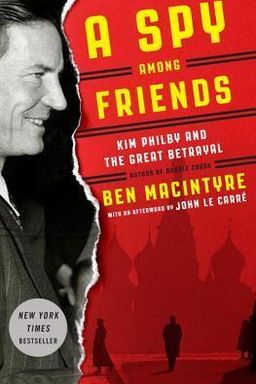
A Spy Among Friends cover

A Spy Among Friends

by Ben Macintyre

A Spy Among Friends by Ben Macintyre unveils the astonishing life of Kim Philby, a British intelligence officer turned Soviet double agent. Through gripping narrative, explore Philby''s rise through MI6, his covert operations for the KGB, and the profound betrayals that altered the course of Cold War espionage.

Trust, Treachery, and the British Spy Myth

How can the very bonds of friendship, class, and trust that make a society strong also become the instruments of its undoing? In this book, you walk through the intertwined lives of Kim Philby and Nicholas Elliott to explore how personal loyalty, institutional blindness, and cultural myths allowed one of the twentieth century’s greatest betrayals to unfold within Britain’s intelligence community. The book argues that espionage is not only a trade of secrets but also a theatre of relationships: a performance of trust and faith where affection becomes the perfect cover for deceit.

Through reconstructed conversations, debriefs, and letters, you see how Philby — an urbane, charming product of the same elite world he would later betray — lived a double life so carefully cultivated that even those closest to him could not see the fault lines. The story is not told merely to chronicle a spy’s deception, but to ask a moral question that echoes through institutions everywhere: how do you weigh loyalty to a friend against duty to truth?

From Cambridge Ideals to Cold War Damage

You begin with Philby’s ideological formation at Cambridge, where leftist debate met privileged self-confidence. In Vienna he links his romantic and political life through marriage to Litzi Friedmann, who connects him to Soviet recruiter Arnold Deutsch. Deutsch’s lesson — that the best spy is the one who looks entirely like the enemy — shapes Philby’s persona forever. He reinvents himself as an establishment man, cultivating credentials, contacts, and charm, the outward image of what Moscow needed: a mole lodged at the heart of the enemy’s organs of power.

The book details how Philby’s duplicity endures purges, wars, and reorganisations. When his Soviet handlers vanish during Stalin’s terror, he stays loyal, rationalising their deaths as the price of a greater mission. His career ascends even as friends disappear: his true faith lies in a political abstraction rather than human attachment. Yet it is precisely his mastery of human sympathy — the way he mirrors other people’s trust — that lets him succeed.

A Culture of Trust and the “Old Boy” System

British intelligence, the book shows, functioned less as a bureaucracy than a gentlemen’s club. Entry was eased by pedigree, not scrutiny, and officers viewed recruitment as an extension of social life. Etonians sponsored Etonians; White’s Club gossip shaped appointments. This network provided stability in wartime but would prove disastrously naïve in the Cold War. Philby exploited it expertly, using club lunches, Harris’s salons, and cricket matches to gather confidences. Colleagues presumed that anyone of their own background was beyond suspicion — a presumption Philby turned into armour.

Nicholas Elliott personifies this culture. Intelligent, dutiful, and loyal, he mentors Philby as a younger brother. Their friendship becomes both weapon and shield: Elliott’s advocacy preserves Philby through multiple inquiries. Institutional loyalty — the sense that “one of us” cannot possibly be one of them — becomes invisible scaffolding for treason.

The Cost of Betrayal

The narrative also insists on consequences beyond bureaucratic humiliation. The Vermehren defection of 1944 and Operation Valuable in Albania, both compromised by Philby, lead to human tragedy: anti-Nazi dissidents executed, Albanian insurgents massacred, families destroyed. Each death ripples out from drawing-room conversations and coded cables, revealing the moral inversion at the heart of espionage. Philby would later claim ideological justification — that he fought imperialism and fascism — but those defenses crumble under the weight of their toll.

When Burgess and Maclean escape to Moscow, Philby’s protection collapses. Suspicion spreads across Whitehall; Venona decrypts expose leaks; American anger mounts. Yet even then, MI6 resists confrontation, constrained by its own culture and the fear of scandal. The book thus becomes as much about institutions as individuals — about how reputation can outweigh truth. MI6’s reticence, MI5’s frustration, and political caution from men like Harold Macmillan show a government paralysed by its own myths.

Beirut and the Endgame

The moral climax comes not in a courtroom but in a Beirut flat in 1963, where Nicholas Elliott confronts the man he has defended for decades. Their conversation — half confession, half duel — embodies the paradox of friendship and treason. Elliott offers immunity for truth; Philby offers deflection wrapped in politeness. Within weeks, Philby vanishes to Moscow. Whether his escape is sanctioned negligence or official collusion remains ambiguous, leaving Elliott tormented by the possibility that he facilitated his friend’s flight. In later life he admits he still feels haunted — not by anger, but by grief.

Ultimately, you come to see that this story is not merely an espionage chronicle but a meditation on trust itself. The same affection that makes human cooperation possible also enables betrayal on a grand scale. Through Philby and Elliott, the book traces how ideology, class, faith, and love can coexist with deceit — and how, in the genteel world of Britain’s secret service, national security was undone less by enemies than by the failure to suspect friends.


The Making of a Double Life

You watch Kim Philby’s dual identity take shape long before he enters MI6. At Cambridge, debate clubs and political societies teach him how to charm and persuade. His marriage to Litzi Friedmann, an Austrian communist, provides not just companionship but access to revolutionary networks. Through her, Philby meets Soviet recruiter Arnold Deutsch, who indoctrinates him into the art of deep cover. Deutsch’s rules — conceal ideology, blend in, rise through trust — dictate Philby’s life to the end.

Becoming “Sonny”

Deutsch names him “Sonny,” treating him as a protégé whose mission is to infiltrate Britain’s ruling class. Philby fabricates a pro-fascist front, joins the Anglo-German fellowship, and writes sympathetic pieces for right-wing audiences. The performance reverses his true loyalty: by looking rightist, he secures leftist credibility with Moscow. This early contradiction — ideological zeal clad in aristocratic polish — defines his espionage strategy.

During the 1930s and war years, this persona expands across borders. He reports from Spain, befriends journalists and diplomats, and gradually becomes a fixture of establishment respectability. MI6 recruitment follows naturally: the Service values initiative and charm more than procedural vetting. Once inside, Philby’s correspondence with Moscow shifts from covert reports to structural diagrams of British intelligence.

Faith Under Fear

The Soviet purges threaten his network: Deutsch and Theodore Maly both vanish into Stalin’s prisons. Yet Philby remains undeterred, interpreting their fate as necessary purification. This psychological rationalisation — that betrayal within a righteous cause is acceptable — is a recurring theme. It allows him to survive politically and emotionally through every turn of totalitarian suspicion.

By the time he commands counter-Soviet operations in Section IX, Philby’s transformation is complete. He is both British officer and Soviet agent, a man who believes he is saving the world from imperial decay even as he cripples his country’s defences. His duplicity is not mechanical; it is moral theatre. Every smile, every toast at White’s Club, every joke at the bar below headquarters becomes a line in the largest role of his career.


Class, Culture, and Institutional Blindness

MI6 in the mid‑century emerges as a mirror of British upper‑class culture — self‑confident, insular, and powered as much by manners as by merit. You learn how the old‑boy system transforms intelligence into a gentleman’s enterprise rather than a disciplined profession. Entry depends not on clearance or background checks, but on who vouches for you over lunch. This system rewards continuity, but it leaves the organisation defenceless against a spy who embodies its ideals better than anyone else.

How the Network Operated

Officers gravitate around familiar institutions — Eton, Cambridge, White’s Club, Harris’s salon — spaces where subtle nods and private jokes signal belonging. Social rituals double as informal vetting; an invitation implies clearance. Philby immerses himself fully in this world, building credibility by mimicking its speech, humour, and etiquette. His success depends less on skill than on cultural fluency.

When suspicions arise, this cultural reflex — trust your own — turns lethal. Colleagues defend Philby not because evidence exonerates him, but because disbelief is psychologically easier than betrayal of one’s class. MI6’s internal notes admit this: “for centuries the Office had operated on trust.” That centuries‑old confidence becomes its greatest vulnerability.

Contrast With Modern Intelligence

Modern services rely on systematic vetting, counter‑intelligence audits, and polygraph programs; post‑Philby reforms introduce bureaucratic rigor meant to neutralise personal bias. The irony, of course, is that such mechanised suspicion sacrifices the human trust that once defined service camaraderie. The book thus captures a transitional moment in Western intelligence — from a world of toasts and cricket to one of files and surveillance. Philby’s treason becomes the inflection point that forces that painful evolution.

By the end of this section, you sense that the so‑called “gentleman spy” is less a relic than a warning: sentiment and privilege can blind even the most seasoned institutions. Espionage, the book reminds you, thrives wherever trust is automatic and scrutiny optional.


Friendship as the Weapon

Of all the weapons Philby deploys, none is more powerful than friendship. His bond with Nicholas Elliott — forged through school, war, and shared code of honour — becomes both his cover and his protection. You see how that closeness, which once felt like moral ballast, gradually turns into an emotional snare that shields him from exposure. In the world of MI6, affection is currency; Philby spends it lavishly.

A Relationship of Mirrors

Elliott idolises Philby’s mixture of wit and composure. He lends him money, finds schools for his sons, and crafts defences when scandal looms. When the press attacks in 1955, Elliott helps orchestrate the statements that clear Philby’s name. You sense a pattern common throughout the Service: friendship not only informs but overrides professional judgement. The epigraph from E.M. Forster — choosing friendship over country — hovers like prophecy above their story.

The Beirut Reckoning

In 1963 Elliott faces the unbearable task of confronting Philby in Beirut. The conversation in the wired flat plays like a tragedy of manners: civility concealing devastation. Elliott offers a gentleman’s deal — cooperation for leniency — and Philby returns signed half‑truths. Days later, he disappears aboard the Dolmatova, bound for Moscow. Whether negligence or quiet consent enabled that escape remains unresolved. What is undeniable is Elliott’s ruinous recognition that his friendship had been the perfect mask for treason.

The book uses this relationship to dissect how trust itself can become ideological — a creed that forbids doubt. Elliott’s loyalty embodied Britain’s post‑imperial self‑image: restraint, belief in honour, preference for discretion. When those virtues meet duplicity, the result is moral implosion. You feel the human cost in Aileen Philby’s breakdown, in Elliott’s later confession that he might have shot Philby himself, and in the lingering question that outlives them both: can intimacy and duty ever coexist in the realm of secrets?


Mechanisms of Betrayal

Philby’s genius lies not in cloak‑and‑dagger theatrics but in bureaucratic leverage. He gains proximity to the Central Registry at Prae Wood, where MI6 stores details of agents and operations. By befriending officials like Captain William Woodfield, he borrows top‑level volumes and transcribes them for Moscow. His intelligence to the Soviets includes assessments of Britain’s agent networks, operational plans, and even the admission that Britain has virtually no spies inside the USSR — information the Kremlin mistakenly reads as disinformation.

Information as Power

Every access point doubles as an opportunity to redirect strategy. When placed in charge of Section IX, tasked with countering Soviet espionage, Philby attains the ultimate irony: a Soviet agent controlling Britain’s anti‑Soviet division. His reports effectively neutralise Western attempts to penetrate communist satellites and compromise joint operations with the Americans. This manipulation reshapes the Cold War’s early years more than any battle or treaty.

Understanding these mechanisms reframes espionage as a feat of logistics and persuasion rather than gadgets. What destroys the Service is not infiltration through walls but infiltration through relationships — through the thousand small kindnesses that make bureaucracies porous. Every “favour” Philby requests, each lunchtime conversation about registry files, contributes to a strategic haemorrhage that lasts decades.


Allies, Angleton, and the Amplified Leak

Anglo‑American collaboration, built on mutual victory in war, becomes a fresh target for exploitation. Philby’s friendship with James Jesus Angleton — the young, poetic OSS officer who idolises him — transfers British methods directly into American hands. What nobody realises is that those hands include Moscow’s. Over lunch at Harvey’s in Washington, over bourbon and cigars, secrets flow conversationally. Allied trust magnifies the damage one spy can do.

The Angleton Paradox

Angleton, later famed for his paranoia as CIA counter‑intelligence chief, originally models himself on Philby’s quiet authority. Philby, in turn, feeds him both flattery and misinformation. The intimacy creates a mirrored tragedy: the American who learns suspicion from the very man he should have suspected. When operations in Eastern Europe collapse — particularly Project Valuable in Albania — the line between Allied cooperation and self‑sabotage blurs completely.

Through Angleton, you glimpse the broader pattern: espionage is trans‑national diplomacy conducted through friendship. Whether between MI6 and the CIA or Elliott and Philby, each act of comradeship carries the potential for betrayal. The story thus expands from British class structures to a universal insight about trust among allies: shared secrecy binds, but it also blinds.


Collapses, Inquiries, and Institutional Rift

By the 1950s the edifice begins to shake. The Burgess–Maclean defections expose fractures across Britain’s intelligence community. American analysts uncover “Homer” through Venona decrypts, prompting quiet outrage. MI5 detects patterns pointing towards Philby, but MI6 refuses to believe. The problem is no longer just one man; it is the collision of two institutional cultures.

Different Missions, Different Minds

MI5 defines itself as a police‑like agency focused on evidence, surveillance, and prosecution; MI6, by contrast, prizes discretion and networks. When Dick White’s investigators push for an inquiry, Chief Stewart Menzies and later Sir John Sinclair retreat from confrontation. The result is paralysis: neither exposure nor exoneration, only rumours and white papers that obfuscate. Politicians like Harold Macmillan prefer scandal management to truth, publishing sanitized statements while journalists and MPs like Marcus Lipton demand accountability.

Structural Consequences

These divergences embody the “MI5–MI6 rift,” a cultural war that repeats the book’s central theme: institutions betray themselves when loyalty outweighs logic. The 1955 non‑interrogation that publicly absolves Philby proves this perfectly. By protecting dignity, MI6 imprisons itself in denial. The rift also corrupts Anglo‑American trust, as the CIA questions Britain’s competence and withholds secrets in retaliation. By the time Elliott finally confronts Philby, the Service’s credibility is already broken.

Institutional Lesson

Allowing sentiment, secrecy, or hierarchy to eclipse transparency invites disaster. The Philby affair thus becomes a case study not just in espionage but in organisational psychology: how structures built on trust must also design for doubt.

You close this part of the book aware that the true wound of betrayal lies less in loss of information than in erosion of confidence. Nations, like people, survive deception by learning to balance loyalty with suspicion — a capacity MI6 learned too late.

Dig Deeper

Get personalized prompts to apply these lessons to your life and deepen your understanding.

Go Deeper

Get the Full Experience

Download Insight Books for AI-powered reflections, quizzes, and more.