
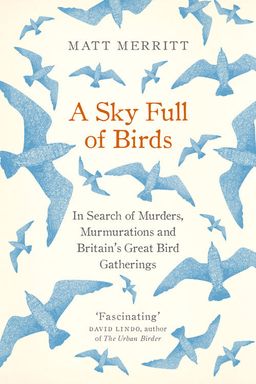
A Sky Full of Birds cover

A Sky Full of Birds

by Matt Merritt

A Sky Full of Birds takes you on a captivating journey through Britain''s vibrant avian life. From mesmerizing murmurations to fascinating mating rituals, this book uncovers the rich cultural tapestry and ecological significance of birds across seasons, offering new perspectives on nature''s wonders.

A Sky Full of Birds: Seeing Wonder in the Everyday Wild

When was the last time you stopped mid-walk, looked up, and noticed birds filling your sky? What if the secret to experiencing awe and rootedness in modern life lies not in remote wilderness but in watching what wings past your window every day? In A Sky Full of Birds, writer and Matt Merritt—poet, editor of Bird Watching magazine, and lifelong birder—argues that Britain’s natural world offers constant, breathtaking spectacle right before our eyes. By observing birds closely, we don’t just understand nature better—we re-enter a profound relationship with time, season, and place.

Merritt’s central idea is deceptively simple: the greatest wildlife experiences don’t demand distant travel or heroic endurance. Britain’s skies and fields themselves hold grandeur—the swirling murmuration of starlings over Somerset, the Arctic terns’ world-spanning migrations, or a pair of peregrines hunting above York’s medieval cathedral. These ordinary moments are sacred ceremonies of adaptation, survival, and grace. The author’s journey across the UK, chapter by chapter, mirrors a year of the nation’s birds—from January’s flooded Levels to May’s bustling seabird cities and winter’s vast blizzards of wings. Each scene becomes an invitation to see everyday landscapes anew.

Rediscovering the Magic of British Birdlife

At its heart, Merritt’s book is an antidote to indifference. He asks why we underestimate our own habitats compared to exotic destinations abroad. His chapters remind you that Somerset’s starlings are as majestic as Africa’s flamingos; that the ravens of Anglesey or the red kites of the Chilterns deserve the same reverence as eagles or condors. He bridges science and poetry, describing how species like the skylark depend on human-shaped farmland, creating what he calls a “symbiotic landscape.” We are not separate from Britain’s birds—we are co-authors of their environment.

Every chapter is a meditation on seasons, migration, and change. Merritt writes as both naturalist and philosopher: winter’s floods reveal the resilience of fieldfares and redwings; spring’s dawn chorus becomes a metaphor for rebirth; and summer colonies of gannets resemble vibrant metropolises, reminding us that even seabirds live in societies that mirror our own. His prose carries both wonder and melancholy—celebrating natural abundance while lamenting human negligence and loss.

Bridging Science, Story, and Spirit

Merritt’s voice combines factual insight with lyrical reflection, blending the precision of an ornithologist with the reverie of a poet. The author rarely gives manual-like instruction; instead, he narrates encounters that function as living metaphors. When a barn owl glides ghostlike over English marshes, Merritt sees in it our own intuition for silence. When a waxwing appears in a supermarket car park—a Siberian migrant seduced by the berries of a British rowan—he shows that beauty coexists with urban mundanity. These paradoxes define his worldview: wildness survives because we notice.

Why This Matters Now

In an age of ecological anxiety, A Sky Full of Birds offers hope rooted in attention. Merritt contends that caring about small spectacles—the song thrush’s repetition, the communal roosting of ravens—creates emotional and moral continuity. You don’t have to be a scientist or traveler; by stepping outside, listening, and standing still, you step into nature’s ongoing story. This awareness may be the first step toward conservation, empathy, and—ultimately—the rediscovery of wonder.

Across twelve major scenes, Merritt draws together four threads: how birds tether us to cyclical time, how landscape and life are intertwined, how adaptation mirrors resilience, and how watching birds is an inward journey of perceiving beauty. His message is simple, but profound: the sky is never empty. To see it full of birds is to see ourselves—fragile, migratory, and magnificent.


The Rhythm of Seasons and Song

Each year’s rhythm of light and sound, Merritt explains, is measured not by a calendar but by birdsong. He experiences dawn choruses as spiritual symphonies—moments when creation renews itself daily. Through robins, blackbirds, and warblers, he reveals how song becomes both survival mechanism and art form. The British dawn chorus, he writes, is one of the world’s richest precisely because our climate compresses breeding into a few months of urgency. That urgency creates music.

Every Bird a Musician

From the silver threads of a robin’s song to the jazzy riffs of the song thrush, the countryside becomes an orchestra. Merritt notes how males perform not merely to attract mates but to claim their existential significance. Listening to these competing songs, he feels that each bird announces, “I’m here.” It’s an assertion of identity, a declaration of joy against impermanence. He links the creativity of these melodies to human culture, recalling poets like Browning and Keats who turned bird music into metaphor for fame and fleeting rapture.

Listening as Awakening

For Merritt, learning to identify songs is akin to learning mindfulness. He recounts walking through Gracedieu Woods before sunrise and distinguishing the layers of sound—robin first, then blackbird, then the more hesitant chiffchaff and garden warbler. Standing still becomes meditation. You, too, can experience this: step outside before dawn, close your eyes, and listen instead of looking. In that moment, he says, the “forest speaks multiple dialects of joy and belonging.”

The Nightingales of Hope

Later in spring, Merritt journeys to Knepp Castle Estate in Sussex to hear the vanishing nightingale. Few experiences move him more: its voice carries centuries of poetic legacy, from Homer to T.S. Eliot. Yet the bird’s fading numbers remind him that beauty can disappear while we sing its praises. He contrasts this with the robin’s urban midnight music, lit by streetlamps. Where nightingales sing to attract lost mates, robins sing through sleepless streetlight haze. One expresses longing; the other adaptation. Together they show how nature changes but persists.

Merritt insists that listening is not passive—it’s participation in the turning of the world. He invites you to treat birdsong as both soundtrack and teacher. The birds sing because life insists on being heard, even in cold mornings. Hearing them properly is how you reconnect to the rhythm beneath routine.


Journeys of Migration and Mystery

Migration fascinates Merritt because it embodies life’s persistence through peril. Watching a lone wheatear arriving at Swithland Reservoir after crossing from Africa, he sees courage distilled into feathers. Migration, he explains, defines most British species: swallows, warblers, godwits, and even tiny willow warblers travel thousands of miles, some guided only by instinct and starlight. Each crossing is a miracle you can witness just by pausing long enough in the right season.

Britain as a Global Crossroads

Merritt calls the British Isles “an avian airport,” where Arctic, African, and European paths intersect. For six weeks each spring, the coastline becomes an arrival hall of exhausted travelers—sand martins, redstarts, yellow wagtails—each testing the resilience of its body against time and wind. He recounts seeing trees “shivering” with willow warblers at Pagham Harbour, their whispers blending with the rustle of new leaves. To witness migration, he argues, is to see motion itself as sacred: living things follow invisible maps written by seasons.

Technology Meets Wonder

Merritt bridges romantic awe with scientific progress. He describes how ringing and satellite tracking have uncovered astonishing distances—like British cuckoos traveling 56,000 miles annually or house martins disappearing to mysterious African forests. These discoveries show both how connected and how fragile migration systems are. (He references projects by the British Trust for Ornithology that use tiny geo-locators, echoing Rachel Carson’s reminder in Silent Spring of how science must serve empathy.)

Reflection on Movement

For Merritt, migration mirrors human longing. He likens the birds’ journey to our own need to belong and wander: “Each flight is a leap of faith from certainty into possibility.” When he hears cuckoos echo across Leicestershire, he feels part of this circuit. You can too, he suggests, simply by noticing when the seasons migrate through you—the first swallow’s shadow on a streetlight or the last flock of geese disappearing into grey sky. Seeing them leave reminds you how nothing, not even loss, is final—because every departure begins a return.

Merritt’s meditation on migration combines biology with metaphor. It teaches patience, humility, and marvel: small creatures cross oceans, and we can cross distances in our perceptions. Watch a bird arrive, and you glimpse eternity in motion.


Landscapes of Flood and Renewal

Merritt turns floods and tides into parables of endurance. Standing on Somerset Levels or the Wirral’s saltmarshes, he sees water as both destroyer and deliverer. When winter rains transform fields into mirror lakes, birds thrive—fieldfares feeding on softened soil, marsh harriers gliding over temporary seas. For residents, floods mean hardship; for migrating birds, they mean abundance. This duality teaches you how devastation can nourish life if seen with wider eyes.

Predators and Survival

At Parkgate, Merritt witnesses nature’s raw theatre: foxes, stoats, and raptors hunting as the tide drives prey inland. Water rails scurry into human shelters; owls hover for voles escaping rising seas. It’s unsettling—“like watching survival in real time,” he writes—but necessary. The spectacle reveals an ancient rhythm where predator and prey sustain equilibrium. He confesses the temptation to intervene, then realizes compassion must include both hunter and hunted. Everything feeds something else, and empathy means acknowledging that cycle.

The Human Role

Merritt connects these floods to mankind’s reshaping of Britain’s wetlands—from the seventeenth-century drainage of the Fens by Dutch engineers to modern marsh conservation. He observes ravens, owls, and harriers reclaiming habitats once lost. Nature, he argues, doesn’t vanish under human pressure; it improvises. And every restoration effort—RSPB reserves, tidal management, reed-bed recovery—is a redemption story where science, patience, and poetic wonder merge to restore balance.

Lessons in Acceptance

Floods remind us of impermanence. Merritt’s reflection suggests a spiritual analogy: we cannot always control what rises around us, but like the birds, we can adapt, float, and find nourishment in the temporary. Watching marshland sink beneath the tide, he sees not tragedy but renewal—the world’s capacity to begin again. To stand beside a washed field, then notice birds thriving above it, is to find meaning in resilience itself.


Cities as Modern Sanctuaries

In one of the book’s most surprising chapters, Merritt explores how urban landscapes have become nature’s new frontiers. High-rise ledges host peregrines, river bridges cradle kittiwakes, and office blocks echo with gulls’ cries. Cities, he says, are not devoid of wilderness—they’re vertical cliffs with their own seas of light. Watching Newcastle’s kittiwakes nesting under the Tyne Bridge, Merritt finds astonishing beauty amid steel and glass. These birds, once ocean wanderers, now thrive beside human traffic.

How Wildlife Adapts to Urban Life

Urban adaptation shows nature’s resilience. Kittiwakes follow fishermen for scraps; peregrines hunt pigeons above cathedrals; red kites circle motorways living off carrion. Merritt mixes history and contemporary ecology, recounting how Victorian hat-makers once killed thousands of gulls for fashion, while today councils and citizens debate cohabitation. He convinces you that coexistence—the birds adjusting to buildings, humans adjusting to noise—is an ecological conversation rather than a conflict.

City Birds as Symbols

For Merritt, urban parrots, owls, and peregrines express hope in adaptation. Standing beneath the Tyne Bridge, he hears kittiwakes cry “K-wake!” like a chorus reclaiming space from neglect. Their story parallels post-industrial renewal: regeneration isn’t just human; it’s ecological. He sees information boards educating passersby and poems written for these gulls—proof that culture expands when nature returns. In this way, city wildlife teaches that progress and preservation can coexist.

Seeing the Sacred in the Urban Ordinary

Merritt urges you to notice birds even amid concrete noise. Every pigeon, sparrow, or gull embodies persistence. Watching a peregrine glide above crowds, he feels the profound irony: civilization’s monuments now serve nests for wild hearts. Just as cities once erased wilderness, they now provide refuge. This reversal becomes emblematic of our time—the possibility that beauty can rebuild even where it was broken.


Spectacle and the Art of Attention

Merritt devotes significant chapters to Britain’s grand bird spectacles—events that blur boundaries between science, art, and worship. The sky-filling starlings’ murmuration in Somerset, the raven roosts of Anglesey, or the blizzards of knots at Snettisham: each scene reveals what he calls “a bridge between two worlds.” When thousands of birds move as one, you glimpse a collective intelligence larger than individuality.

Murmurations as Living Metaphors

Standing among hundreds watching starlings twist across dusk skies, Merritt hears spontaneous poetry from strangers—“a whale,” “a storm,” “a galaxy.” Their interpretations show how nature reawakens imagination. Scientists explain the flock’s physics—the coordination based on nearest-neighbor alignment—but Merritt prefers the mystery. These “dark stars,” as he calls them, represent unity through multiplicity—each tiny bird surrendering to pattern. (He likens it to Coleridge’s description of starlings as “smoke, mist, or any thing misty without volition.”)

Learning to Pay Attention

Spectacle trains observation. Merritt insists that noticing patterns requires stillness. At Spurn Point, he learns to lie down in dunes and wait; the less he moves, the closer birds approach. “Sometimes,” he writes, “motionlessness is the best way to witness motion.” This practice becomes a metaphor for life’s pace: slowing down reveals hidden phenomena, while constant rush blinds us to wonder. Watching 14,000 geese lift at dawn, he realizes scale isn’t separate from simplicity—it’s the amplification of small miracles.

Finding the Infinite in the Finite

Each spectacle—whether the Bass Rock’s gannets or a river’s winter swans—shows how ordinary geography can hold transcendence. Merritt calls these events “Britain’s cathedral moments,” places where seeing becomes devotion. You feel it too: the emotional awe of scale reminds you not how small you are, but how connected. Attention, he writes, is the purest form of love; when you give it to the sky, the sky gives itself back—full of birds.


Conservation, Connection, and Hope

Underneath all wonder runs Merritt’s plea for conservation rooted in emotion. He argues that saving birds is not only ecological duty but a matter of cultural soul. Stories like the reintroduction of ospreys to Rutland Water or the revival of red kites in the Chilterns prove that repair is possible. Human care has caused damage—but also restoration. He describes how volunteers, ornithologists, and ordinary citizens create a network of compassion across nations, from Leicester to Senegal.

From Awareness to Action

Merritt celebrates institutions and individuals—BirdLife International, Wildfowl & Wetlands Trust, the RSPB—who channel fascination into funding and habitat protection. Yet he cautions: activism must begin with personal observation. “Nobody protects what they fail to see,” he writes, urging readers to look, listen, and document their own local skies. He likens citizen science to faith—each recorded sighting a prayer of attention.

Ecology as Empathy

His vision extends beyond Britain. Migration links continents like moral threads; protecting wetlands here safeguards lives thousands of miles away. Merritt’s poetic language collapses distance: swans from Iceland, waxwings from Siberia, and chiffchaffs from Africa make every garden global. (He echoes Aldo Leopold’s idea in A Sand County Almanac that ethics must enlarge to include land, water, and all its creatures.)

A Future Full of Flight

Despite acknowledging decline—the lost nightingale, the vanishing starling—Merritt ends with optimism. Birds adapt, people learn. Each successful nesting, each restored habitat, proves resilience. Hope, he concludes, is not naive; it’s migratory. Like the birds, it travels across hardship and returns renewed. All you must do to join it is look up, see the sky full of birds, and remember that each wingbeat is an act of survival—and an invitation to protect what remains.

Dig Deeper

Get personalized prompts to apply these lessons to your life and deepen your understanding.

Go Deeper

Get the Full Experience

Download Insight Books for AI-powered reflections, quizzes, and more.