
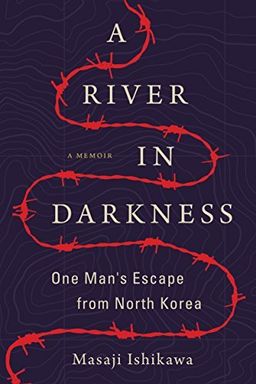
A River in Darkness cover

A River in Darkness

by Masaji Ishikawa

A River in Darkness is Masaji Ishikawa''s gripping memoir, detailing his life in North Korea''s oppressive regime and a daring escape. Through his story, uncover the stark realities, resilience, and relentless human spirit amidst one of history''s darkest chapters.

A Life Between Two Worlds: Hope Amid Despair

What happens when a dream of paradise turns into a nightmare you can’t escape? In A River in Darkness, Masaji Ishikawa tells the harrowing true story of leaving one oppressive country for another — from postwar Japan’s discrimination to North Korea’s dictatorship — and the lifetime of suffering caught between both worlds. His memoir forces readers to ask: what does it mean to survive when survival itself feels like betrayal?

Ishikawa was born in 1947 to a Korean father and Japanese mother, part of a marginalized group of Koreans living in Japan. In 1960, his family fell victim to North Korean propaganda promising a socialist utopia — a “paradise on earth.” What awaited them, however, was decades of hunger, repression, and unimaginable despair. Ishikawa’s account describes how he endured starvation, violence, and loss before making a desperate escape forty years later. The book is at once a personal testament and a scathing indictment of political cruelty, state deception, and human complicity.

The False Promise of a Better Life

At the heart of the story lies an agonizing irony: Ishikawa’s family fled discrimination in Japan only to land in a society far worse. His father, manipulated by the General Association of Korean Residents in Japan, believed North Korea would offer dignity to displaced Koreans. Instead, they arrived in a wasteland of poverty where “paradise” meant forced labor and surveillance. This betrayal — by both the Japanese government that allowed the exodus and the North Korean regime that orchestrated it — sets the emotional tone of the book. It highlights a major theme: how political lies destroy ordinary lives.

Throughout the narrative, Ishikawa’s memories expose the steady annihilation of hope. The family that once dreamed of prosperity in the “promised land” is reduced to scavenging for food, losing loved ones to starvation, and fearing a word spoken out of turn. Yet amid all this horror, the author’s commitment to his mother and children becomes an unbreakable thread keeping him alive. His survival isn’t heroic in the traditional sense—it’s stubborn, rooted in love and the refusal to die forgotten.

Five Decades of Disillusionment and Endurance

The book spans Ishikawa’s entire lifetime: from his childhood in postwar Japan, through the propaganda-driven mass “repatriation” to North Korea, to the 1990s famine that triggered his escape. Each chapter peels back a deeper layer of oppression. In Japan, Ishikawa was the child of two hated identities — Japanese by birth yet branded “Korean,” Korean by blood yet rejected by Koreans for being too Japanese. In North Korea, this outsider status became lethal. His family was classified as “hostile” in the rigid songbun caste system, condemning them to lives of manual labor and poverty—reminders that in totalitarian systems, bloodline defines destiny.

In his lyrical yet unflinching prose, Ishikawa moves from scenes of boyhood wonder to the bleak monotony of communist indoctrination: reciting slogans about Kim Il-sung, rationing pitiful scraps of corn, and learning to hide his thoughts to survive. Death and hunger become constants. He watches his mother die of exhaustion, his wife starve after giving birth, and his children waste away because love cannot fill empty stomachs. It’s this fusion of the personal and political — the private pain rendered by public systems — that makes A River in Darkness so powerful.

Escape, Return, and the Price of Freedom

In 1996, driven by desperation, Ishikawa made a final gamble: crossing the Yalu River into China under the cover of storm and night. He succeeded, becoming one of the few Japanese-Korean defectors to escape North Korea alive. Yet his return to Japan was no triumph. The land he had dreamed of for decades received him with bureaucratic indifference. His family remained stranded in the North; his pleas for help went unanswered. Freedom came at the immense cost of loneliness and guilt. Ishikawa ultimately concludes that survival without justice — or reunion — is its own form of exile.

As with works like Viktor Frankl’s Man’s Search for Meaning or Elie Wiesel’s Night, Ishikawa’s memoir asks not only what humans can endure, but what they become when enduring replaces living. His story reveals how politics corrupts compassion, how oppression thrives on obedience, and how even survival itself can feel like moral failure. Yet it’s also a story of love’s endurance — of one man’s desperate hope to save his children no matter how broken the world becomes.

Why This Story Matters

Today, A River in Darkness stands not just as a memoir but as historical testimony. It’s a rare firsthand account of life under one of the world’s most secretive regimes, exposing the decades-long consequences of propaganda, isolation, and the human capacity to believe in false paradises. Ishikawa forces readers to confront uncomfortable truths: that freedom is fragile, that survival carries guilt, and that political abstractions—utopia, nationality, ideology—mean nothing when a child starves in front of you. Ultimately, the “river in darkness” is both literal and symbolic: the Yalu River he crosses to live, and the moral current that sweeps through the human heart between despair and hope.


From Home to Hell: The False Repatriation

Ishikawa’s journey to North Korea began with a lie — one of massive proportions. In the late 1950s, the governments of Japan and North Korea, aided by both nations’ Red Cross organizations, orchestrated the so‑called “repatriation” of Korean residents in Japan. North Korean leader Kim Il‑sung promised full employment, free education, and equality in a socialist utopia. Japan, eager to rid itself of the impoverished and marginalized Korean population, was only too happy to cooperate. For roughly 100,000 people — and 2,000 Japanese spouses — this seemed like salvation.

Political Opportunism Disguised as Humanitarianism

Ishikawa, at thirteen, didn’t understand the geopolitics behind his family’s departure, but he felt the tension. His violent father, a proud Korean nationalist; his mother, terrified and reluctant; and his own Japanese relatives, appalled. When the family boarded the ship from Niigata in 1960, a brass band played as if they were heading to paradise. Yet that optimism masked a cynical truth — Japan wanted to erase a “problem population,” and North Korea wanted free labor. This was less migration than mass deportation with good publicity.

First Glimpses of the 'Promised Land'

When the Ishikawas reached the North Korean port of Chongjin, they saw what awaited them: barren hills, ghost ships rusting in an empty harbor, and schoolgirls forced to play an off‑key orchestra in the freezing wind. The “welcome ceremony” was as bleak as the landscape. Within hours, they were stripped of passports, interrogated by officials, and informed they could never leave. Ishikawa’s first meal — dog meat that made him gag — shattered any illusion of prosperity.

That arrival sequence mirrors countless accounts by defectors who describe an immediate sense of betrayal. As journalist Barbara Demick similarly reported in Nothing to Envy, newcomers were shocked by the poverty of a country that claimed to outshine the South. For Ishikawa, this was the moment his childhood ended and his sentence began.

The Machinery of Deception

Ishikawa’s father initially embraced their new home, buoyed by the intoxicating freedom of finally speaking his mother tongue. For weeks, party officials paraded them as proof of North Korea’s generosity. Locals ogled the newcomers’ Japanese clothes and bicycles with envy. But soon, those same possessions marked the family as potential enemies — corrupting influences from a capitalist world. The secret police followed them; neighbors reported on them. The family was classified as songbun—“hostile class.” It was a designation from which no one ever escaped.

The Anatomy of a Lie

The “repatriation” movement continued for twenty‑five years, lauded by politicians as humanitarian triumph. In reality, it was a human‑trafficking operation legitimized by ideology. Ishikawa’s memoir peels away the propaganda, revealing the collusion between governments, the Red Cross, and journalists too blinded by postwar guilt to see what they were enabling. His bitter observation captures the heart of this betrayal: both nations used people like tools — Japan to cleanse itself of shame, North Korea to build its myth. Ordinary families paid the price.

For you as a reader, Ishikawa’s early chapters work as a cautionary tale about belief — how yearning for dignity can make people vulnerable to manipulation. Propaganda weaponized hope, not ignorance. And that, Ishikawa reminds us, is the most unforgivable kind of cruelty.


Survival in the Socialist Prison

Imagine living where every sentence must praise a dictator, every neighbor could betray you, and every meal might be your last. That was everyday life for Ishikawa’s family in North Korea. The nation’s rigid hierarchy — dictated by songbun, the three‑tier caste system — trapped them in perpetual servitude. His father toiled as a farmer under constant scrutiny; his mother, a Japanese outsider, was barred from employment. Survival, not ideology, became their religion.

The Poverty of Promised Equality

Food shortages were immediate and unrelenting. Though the state promised fair distribution, the reality was “no work, no dinner.” Even the sick and elderly labored until they collapsed. The family’s yearly ration contained more husks and corn meal than rice; their livestock was confiscated; and hoarding anything—grain, clothes, soap—was illegal. Ishikawa recounts one chilling episode when a few stray rice grains in pig feed triggered a beating by police. Violence wasn’t random; it was deliberate humiliation, a reminder of powerlessness.

Psychologically, he learned to perform loyalty. As a schoolboy, he repeated lies about Kim Il‑sung’s greatness while being called “Japanese bastard” by his peers. Joining the Democratic Youth League seemed a path to acceptance, but it only deepened the surveillance. Every person reported to their “group of five,” an informant network dividing even families. Thought itself became dangerous — “a free thought could get you killed if it slipped out.”

Faith Through Fear

The regime weaponized belief. Religious devotion was redirected toward the Great Leader. The Ten Commandments of Kim Il‑sung, which Ishikawa quotes in full, replaced moral law with political worship: “Thou shalt honor the Great Leader… Thou shalt make his ideology thy faith.” This transformation of faith into ideology mirrors themes seen in Orwell’s 1984 — absolute power demanding not mere obedience but love. Ishikawa observed this indoctrination with both terror and grim humor; later, he writes that “God could learn a thing or two from Kim Il‑sung.”

Work Without Purpose

From farming to building, his work life was defined by futility. Agricultural policy was dictated by bureaucrats who ignored basic science: rice seedlings planted too close, nighttime harvests lit by burning tires, “mountains transformed into terraced farms” only to wash away with the first rain. When crop failures followed, the farmers were blamed for “lack of loyalty.” Through this systemic madness, Ishikawa masterfully shows how totalitarianism corrodes not only freedom but efficiency itself — how fear replaces skill, and slogans replace sustenance.

Yet amidst this misery, a change occurred: his brutal father softened. Violence lost meaning in a country that already beat everyone down. Ishikawa’s compassion for his father’s brokenness brings rare tenderness to an otherwise dark portrait, reminding readers that even cruelty is shaped by circumstance, and that survival sometimes transforms monsters into men without redemption.


Family Bonds and the Cost of Love

If there’s a heartbeat in A River in Darkness, it is Ishikawa’s family — shattered yet bound by fierce love. Their relationships tell a second, more emotional story: about what happens when affection is tested by despair. Through his mother’s endurance, his father’s collapse, and his own determination to protect his children, Ishikawa shows that love can survive even when everything else disintegrates.

A Mother’s Suffering

Miyoko Ishikawa, his Japanese mother, is the memoir’s moral axis. Once beaten nearly to death by her husband in Japan, she sacrificed her safety to follow him into North Korea — and paid for that loyalty with a lifetime of degradation. Barred from work, mocked by neighbors, and too kind to survive in a world ruled by cruelty, she still became a midwife, quietly delivering babies while starving herself to feed her children. Her death, at only 47, occurs quietly beside Masaji as she whispers her last wish: “Take my ashes back to Japan.” This moment, intimate and devastating, encapsulates the novel’s central tragedy — her dream of home dies before she can return.

Fathers and Sons

Ishikawa’s relationship with his father, once defined by fear, transforms slowly under the strain of poverty. In Japan, “the Tiger” ruled by violence; in North Korea, stripped of status and power, he becomes gentle, remorseful. The scene where father and son eat muddy rice balls in the forest — sharing tears instead of anger — marks reconciliation born of shared humiliation. Yet the father’s final years, beaten by police over a farcical misunderstanding about a “seal penis,” show how systemic brutality breaks even the proudest spirits.

Love Amid Ruins

Masaji’s own attempts at forming a family mirror his parents’ doomed search for connection. His arranged marriages, first to a woman who abandons him and later to a fellow returnee who dies giving birth, reveal how intimacy cannot flourish under famine. Still, his devotion to his children is unwavering. When his infant son starves, he buries him with his bare hands. When his wife sells her blood to feed their kids, he rages at a world that forces love to become literal sacrifice. These scenes, though excruciating, humanize a story often dominated by politics.

Through family, Ishikawa grounds horror in the universal. His love for his children — especially his haunting promise to “bring them to Japan someday” — is what propels him to escape. Every act of endurance becomes paternal devotion in disguise: each theft of food, each humiliating job, each breath held underwater is an act of fatherhood. Love, in this sense, becomes resistance.


The Collapse: Famine and Desperation in the 1990s

By the time Kim Il‑sung died in 1994, North Korea was already decaying. Ishikawa witnessed the collapse firsthand: factories silent, fields barren, and whole families dying in plain view. The irony of official slogans — “Eat roots and prevail!” — would be comedic if it weren’t lethal. The famine that followed was one of the worst in modern history. Ishikawa called this period simply “the nightmare.”

The Anatomy of Starvation

Rations dwindled from one pound a day to three days’ worth for half a month. People ate bark, acorns, and weeds that poisoned them. The only food Ishikawa recalls tasting vividly is pine bark boiled into bitter paste. The description — cooking toxins until “the oil stinks like hell” then scooping them out with your fingers to unclog your own bowels — is among the most shocking in survival literature. It’s not written for pity; it’s his attempt to record truth no history book would print.

Death Everywhere

Bodies in the streets, orphaned children scavenging for crumbs, rumors of cannibalism — Ishikawa recounts these scenes with haunting calm. Empathy, he says, itself became a luxury. You could not cry for others when dehydration made tears impossible. Love survived mostly as guilt: for still being alive when others were not. His narrative during this section resembles a faint heartbeat — measured, resigned, almost detached — a tone that makes it even more devastating.

The Death of Illusion

The people’s faith in Kim Il‑sung, cultivated for decades, finally fractured. Yet even then, rebellion never came. Ishikawa notes bitterly that propaganda works too well: when survival depends on obedience, defying leadership feels like suicide twice over. Fear had emptied people of imagination. As in Hannah Arendt’s concept of “the banality of evil,” cruelty had become routine — an everyday property of existence, not a moral aberration.

The famine transforms Ishikawa’s grief into decision. Watching his wife and children’s ribs bend like cages, he understands that staying means dying slowly. Leaving may mean dying quickly, but it’s at least action, choice, motion. “We’ll find each other again,” his wife says as he departs for the Yalu River — a farewell that might be love, hope, or tragic denial. That night’s storm, both literal and symbolic, becomes his last barrier between slavery and the slim chance of freedom.


Crossing the River: An Act of Rebirth

The river in Ishikawa’s title is both geographical and existential — the border between death and another kind of life. His escape in 1996 is the memoir’s climax, written with cinematic intensity. Exhausted, starving, and ready for death, he digs into the muddy bank of the Yalu River separating North Korea from China, staring across thirty yards that separate oppression from uncertainty. “Thirty yards—the distance between life and death,” he writes. That line captures the memoir’s entire emotional gravity.

Nature as Savior and Executioner

As a torrential storm transforms the shallow river into a raging torrent, Ishikawa sees both doom and opportunity. The downpour masks the guards’ sightlines. He dives into the black current, prepared to drown rather than be caught. The scene that follows blends realism with metaphysical symbolism — the current dragging him under, the sensation of floating outside his body, and finally awakening on a foreign shore. His first realization: the barking dog nearby is a pet, not food. That’s how he knows he’s in China.

The Kindness of Strangers

A Korean-Chinese man named Kim nurses him back to health, spooning rice gruel into his mouth. This simple act of care — the first he has experienced in decades — shakes Ishikawa to his core. From there, a network of underground traders hides him across villages. Each kindness contrasts painfully with the cruelty he fled; it reawakens his belief in human decency. When he finally contacts the Japanese Red Cross, his message is half-plea, half-accusation: “You supervised the migration that sentenced us. Now save me.”

A Reluctant Rescue

Even freedom comes wrapped in bureaucracy. The Japanese embassy debates his citizenship; Chinese authorities threaten deportation. Eventually, through a maze of covert negotiations, he’s smuggled to the Japanese consulate in Shenyang, then to Dalian, and finally home. His physical journey reads like a thriller, but psychologically, it’s an out-of-body existence — each checkpoint another test of whether humanity still recognizes him as one of its own.

He arrives in Japan after 36 years, carrying nothing but memory and melancholy. His river crossing is rebirth, but not redemption. The title’s metaphor becomes clear: even when you emerge from darkness, it flows inside you forever.


Freedom Without Belonging

The final chapter of Ishikawa’s life turns the illusion of rescue inside out. Returning to Japan — the country he never stopped calling home — he discovers he no longer belongs. Bureaucrats treat him like a curiosity; politicians use him for optics; and his relatives reject him. After decades of dreaming about freedom, he finds that liberty without recognition feels like another kind of prison.

The Barren Promise of Democracy

Settled in Tokyo in 1996, he becomes an invisible man. The Ministry of Foreign Affairs places him in a rehabilitation center for alcoholics, as if trauma were contagious. Officials forbid him from sharing his story, terrified of diplomatic repercussions. His appeals to parliament to rescue his family meet polite indifference. Even the media’s sudden interest is shallow — they want headlines, not truth. Ishikawa’s line, “Here I remain, in a place where I don’t belong,” echoes through the final pages with haunting restraint.

Haunted by the Ghosts of the Living

The letters that do arrive from North Korea break him anew. His wife dies of starvation. His daughter’s final plea — “Help me, I want to live with you” — arrives too late. His sons disappear into silence. Every yen he earns as a cleaner he spends sending money that cannot save anyone. The guilt of surviving becomes unbearable. He confesses that at times, he envies the dead, because they have stopped waiting.

Yet even in despair, his voice carries the fragile dignity of one who refuses to forget. He throws food to seagulls, imagining they carry it to his family across the sea. It is both madness and faith — a private ritual of mourning that keeps him tethered to love.

The Final Exile

Ishikawa ends his memoir with bitterness, yes, but also clarity. He understands the double betrayal of his life: first by the system that stole his freedom, then by the freedom that ignored his suffering. “A life of not living,” he calls it. Yet readers sense another message beneath his words — that to speak, to remember, is itself a victory over silence. His testimony ensures that even if nations forget, the river of darkness he crossed will not consume all its witnesses.

Dig Deeper

Get personalized prompts to apply these lessons to your life and deepen your understanding.

Go Deeper

Get the Full Experience

Download Insight Books for AI-powered reflections, quizzes, and more.