
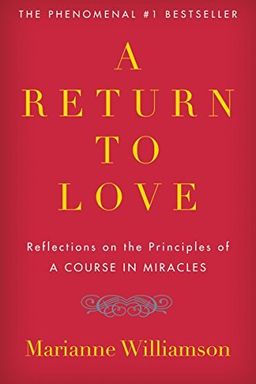
A Return to Love cover

A Return to Love

by Marianne Williamson

A Return to Love is a transformative guide to embracing a higher power, transcending ego, and inviting love into every facet of life. Marianne Williamson inspires readers to overcome fear and resentment, offering practical steps to enhance relationships, advance careers, and achieve lasting happiness.

Returning to Love: Healing through a Shift in Perception

What if everything that feels broken in your life—the pain, the chaos, the anxiety—was simply a symptom of forgetting how to love? In A Return to Love, Marianne Williamson argues that every problem we face comes from one root cause: our separation from love, which she identifies as the presence of God. Based on the teachings of A Course in Miracles, her central premise is profound in its simplicity: love is our natural state, fear is what we’ve learned, and spiritual healing means remembering love.

Williamson invites readers to shift from fear-based thinking to love-based awareness—a mental transformation she calls a miracle. This shift, she asserts, doesn’t just eliminate suffering; it realigns us with divine truth. To experience change in the outer world, we must first heal our inner perceptions. As she writes, “Miracles occur naturally as expressions of love.” Fear distorts, but love restores. Once we rejoin love, we experience not only peace within ourselves but also transformation in our relationships, work, and physical lives.

The Core of Williamson’s Vision

At its heart, A Return to Love is about practical spirituality—the application of sacred principles to everyday life. Williamson unpacks how judgment, anger, guilt, and defensiveness are simply masks for fear, while forgiveness, surrender, and acceptance are pathways back to love. Drawing on her own turbulent past, she shows how inner suffering often activates a breakdown that can become a breakthrough. Like other spiritual teachers—Eckhart Tolle in The Power of Now or Thomas Merton in New Seeds of Contemplation—Williamson offers not an abstract philosophy but a roadmap to freedom through consciousness.

Why We Forget Love

Williamson begins with the idea that you were born knowing what love is, but social conditioning and fear taught you to forget. Childhood innocence is equated with spiritual clarity: an awareness of perfect oneness with others and with God. Growing up, however, you were slowly taught to value performance over presence, comparison over compassion, control over trust. This “sleeping pill,” as she calls it, numbs your natural joy. Spiritual practice, then, becomes a journey of unlearning fear and reclaiming the truth that love is who you already are.

She challenges the modern obsession with achievement and self-loathing, suggesting that striving for success without love is a symptom of separation. Unlike self-help movements focused on personal control, Williamson calls for spiritual surrender: letting go of the ego’s constant manipulation and allowing divine guidance to realign your inner world. This surrender isn’t weakness—it’s the rediscovery of real strength.

The Power of Miracles

A miracle, Williamson insists, isn’t a supernatural event but a natural correction in your thinking. The universe is wired for love; fear is the distortion. By choosing love—through compassion, prayer, or forgiveness—you realign with reality itself. “Only love is real,” she reminds us; everything else is illusion. This idea makes her book less of a formal theology and more of an inner workshop on perception. Each person, she says, has the power to teach love in every encounter, not through preaching but through presence. In relationships, workplaces, families, even politics, our small acts of forgiveness become the architecture of a new world.

Williamson offers story after story—from quarrels with her mother in Venice to witnessing healing in those facing AIDS—demonstrating that love is the only force that truly heals. Forgiveness, she teaches, is “selective remembering”—a decision to see someone’s innocence instead of their guilt. Fear demands attack; love offers understanding. In that single perceptual shift, peace and power return to you.

A Modern Manual for Salvation

Throughout the book, Williamson translates the mystical principles of A Course in Miracles into everyday English, framing spirituality as psychological growth. Like Carl Jung’s notion of individuation, she describes enlightenment not as escape from life but as wholeness within it. “Our deepest fear,” she writes in her most famous passage, “is not that we are inadequate. Our deepest fear is that we are powerful beyond measure.” We shrink from our greatness because it frightens our ego, but God’s will is that we shine. Her call is both mystical and practical: stop shrinking. Love instead.

By the book’s end, Marianne Williamson has constructed a beautiful symphony of applied love: how to forgive others, how to reinterpret relationships as holy encounters, how surrender ignites creativity and renewal in our work, and how physical healing mirrors spiritual reconnection. For Williamson, love isn’t sentimental—it’s a radical reordering of human consciousness. In remembering it, you find peace, purpose, and the courage to let your light shine in a fearful world.


Fear as the Opposite of Love

Williamson opens her work with a piercing observation: humanity’s greatest problem isn’t sin or suffering; it is fear. Fear is our learned response to life once we forget who we are. She describes our internal dialogue—the anxiety, guilt, and mental chatter that sabotage success—as the voice of the ego. The ego, she explains, isn’t evil but mistaken. It is, as A Course in Miracles says, “a fearful thought”—a misperception of separation from God.

The Journey into Darkness

Early chapters depict her own descent into despair: failed careers, broken relationships, addiction, and profound self-loathing. These crises were the ego’s masterpiece—a world built on the illusion that we are alone and unworthy. Her story mirrors the “dark night of the soul” experiences described by mystics like St. John of the Cross. When fear dominates, you try to fix external problems—new job, new relationship, new diet—without addressing the underlying separation. The result is endless seeking and deeper emptiness.

Surrendering to Love

Her turning point came when she surrendered, saying, “Dear God, please help me.” This surrender cracked open years of self-reliance and delusion. Spiritual awakening, Williamson writes, doesn’t require perfection—it requires willingness. Faith is not blind belief; it’s a decision to trust that the universe is benevolent. In that surrender, fear begins to lose its grip. “Without faith,” she explains, “we’re frantically trying to control what it is not our business to control.” When you trust love, grace reorganizes your life in better ways than you could imagine.

Overcoming the Ego’s Hold

Williamson equates the ego with the biblical figure Lucifer—the fallen angel who sought to replace God. That impulse still lives in us when we choose judgment, attack, or superiority. Healing the mind means inviting the Holy Spirit—the voice of love—to reinterpret our perceptions. Instead of fighting evil, we correct it through love. “Darkness disappears not by attacking it,” she writes, “but by turning on the light.” In practice, this means forgiving ourselves and others, even when our ego demands punishment.

Williamson’s message is that fear is an illusion sustained by belief. The miracle is the shift away from fear’s narrative to love’s awareness. Once you realize that fear was never real—that it’s just the absence of love—your true self, radiant and powerful, begins to reemerge.


Forgiveness as Inner Liberation

To Williamson, forgiveness is the cornerstone of inner peace. Yet she doesn’t describe it as moral superiority or excusing wrongdoing. Instead, she reframes forgiveness as spiritual vision—“selective remembering”—where you choose to see love and let go of everything else. The act of forgiving does not release another person so much as it heals your own mind from resentment’s poison.

Seeing Innocence Instead of Guilt

In Venice, she recounts clashing with her mother—“I wanted a more enlightened mother, she wanted a more conservative daughter.” Opening A Course in Miracles, she read: “Think honestly what you have thought that God would not have thought.” That question reframed everything. Was God looking at her mother thinking, “What a terrible person?” Of course not. Williamson realized her pain came not from her mother’s flaws but from her own decision to focus on them. The instant she stopped seeing her mother through guilt, the dynamic dissolved in grace. Love returned the moment judgment was withdrawn.

Forgiving the Past

Forgiveness, she explains, means “letting the past go.” Carrying grievances only ensures we recreate them. By affirming guilt in others, we entrench it in ourselves. The ego insists we can be “right” or happy—not both. Forgiveness chooses happiness. This is not denial of injustice but a recognition that beyond the surface story, innocence remains. Like Nelson Mandela’s post-prison compassion, forgiveness refuses to let hate define you. “Only love is real,” Williamson reminds us; the rest is hallucination.

By practicing forgiveness, we remember that every person—no matter how afraid or unkind—is a soul calling for love. When we answer that call, we not only liberate them, we free ourselves. As she puts it, “To see as God sees, to think as God thinks, to love as God loves—this is what it means to accept atonement.”


Holy Relationships and Divine Connection

Williamson devotes a major portion of the book to relationships, calling them “assignments” arranged by the Holy Spirit for our healing. Each person we meet reflects where we either love or fear. Thus, every encounter is holy—a chance to see the divine in ourselves and others. Our relationships become sacred laboratories for learning forgiveness and compassion.

Special vs. Holy Relationships

In what she calls the “special relationship,” love is distorted by the ego’s hierarchy: we idolize one person as our salvation and judge others as less important. This keeps love conditional, fragile, and full of fear. The “holy relationship,” by contrast, is love purified of possession. It doesn’t mean loving everyone romantically—only that the content (spirit) remains constant while the form (body, circumstance) changes. When love’s purpose is mutual healing rather than need, the relationship becomes holy.

Transforming Romantic Love

Williamson challenges cultural myths of “Mr. Right” or “the one.” Romantic obsession, she argues, is often “specialness seeking its mirror.” Instead of looking for someone to complete us, she calls us to embody the love we seek. “Dear God, help me realize that I am someone wonderful,” she prays. When we stop demanding others fill our void, relationships evolve from codependency into genuine partnership. True intimacy arises from acceptance, not control; from spirit, not ego.

Relationships as Mirrors

She also reframes conflict: difficult people are your teachers showing “the limits to your capacity to love.” Enemies are angels in disguise, bringing hidden wounds to light so they can be healed. Like psychological projection in Jungian theory, our grievances simply mirror our unhealed selves. Each healed relationship ripples outward, contributing to collective redemption. As she writes, “The Holy Spirit uses relationships as classrooms where we learn the meaning of love.”

When you surrender a relationship to divine purpose—“Dear God, let me see this person through your eyes”—it transforms from drama to devotion. Even separation can then serve growth, for as Williamson reminds us, “Relationships never end; their form changes, but their content is eternal.”


Surrender and the Power of Faith

Williamson teaches that spiritual surrender—the willingness to trust divine intelligence—is the foundation of transformation. Faith, she explains, is not naive optimism but an alignment with love’s higher order. “There are laws of the inner world,” she says, “just as there are laws of gravity.” Surrendering doesn’t make life passive; it allows grace to operate. Trying to control everything is resistance; acceptance is power.

Letting Go of Results

In her metaphor, we are like bakers constantly opening the oven to check the bread—interrupting the process we’ve already started. When we surrender outcomes to God, life reorganizes around love’s natural flow. This requires humility: acknowledging our plans are limited compared to divine intelligence. Instead of demanding specific outcomes (“Let this relationship work”), she suggests praying, “May your will be done.” What follows is deeper peace, not necessarily less challenge, but greater grounding amidst uncertainty.

Surrender as Strength

Working with paradox, Williamson notes that surrender is the opposite of weakness. The ego equates control with strength, but true power is receptivity. Drawing parallels to Taoist yin-yang philosophy, she describes spiritual maturity as balancing masculine action with feminine trust. “Passive energy without active energy becomes lazy,” she writes, “but active energy without receptivity becomes tyrannous.” When both align, life flows easily. As Gandhi said, “In surrender lies victory.”

Ultimately, faith means trusting that even painful events serve our evolution. The universe, she reminds us, “works by design.” To rest in that awareness is the beginning of peace—and the end of anxiety’s tyranny.


The Healing of the Mind and Body

One of the book’s most compelling sections explores the link between inner peace and physical health. Williamson teaches that sickness is not God’s punishment but a reflection of mental separation—“disease is loveless thinking materialized.” The body, she argues, mirrors the state of the mind. Healing occurs when we invite love to replace the fear that manifests as illness.

Mind-Body Holism

She illustrates this with the true story of an Ohio University study on heart-diet experiments with rabbits. The group of rabbits that had been tenderly petted by a researcher showed dramatically less disease. “Love was the immunity,” she concludes. Miracles of healing are expressions of restored connection. Borrowing from Deepak Chopra’s Quantum Healing, Williamson emphasizes that our cells respond to consciousness; love strengthens life’s natural intelligence.

Healing Through Perception

She recounts personal illness stories, such as repeated car accidents followed by a sore throat. Realizing she was using sickness to attract sympathy, she chose a new thought: “I am not vulnerable.” Instantly, peace returned. The body, when aligned with divine purpose, becomes an instrument of communication rather than conflict. Healing isn’t physical correction but remembering truth: you are spirit, eternally whole.

In her support groups for AIDS and cancer patients, Williamson saw that those who embraced love lived longer and freer. Death, too, becomes redefined—not as loss but as transition. She writes, “The spirit does not die when the body dies. We are thoughts of God that cannot be uncreated.” Healing, then, is any shift that brings us closer to love, whether the body lives or dies.


Work, Abundance, and Service

Work, in Williamson’s framework, is a ministry—a platform for expressing love, not a pursuit of mere success. “Your job isn’t what you do,” she says, “your job is what you are: the presence of love.” When you approach work with the intention to serve, you align with divine abundance.

Surrendering Ambition

Early in her career, Williamson oscillated between artistic dreams and despair until she prayed, “God, I surrender my career to you.” Once she stopped trying to make success happen, opportunities flowed. This echoes the biblical parable of the lilies—effortless flourishing comes from trust. “Don’t ask God to send you a brilliant career,” she quips. “Ask Him to show you your brilliance.”

Money as Energy

Williamson defies the idea that spirituality and prosperity are at odds. Money, she insists, is “nothing” until love gives it meaning. She recalls running a bookstore where she silently blessed every customer, calling it “my church.” Sales soared—not because of strategy, but because of service. The shift from sales to service consciousness turns work into worship and abundance into a byproduct of giving.

Love as Business Strategy

Her message echoes spiritual entrepreneurs like Wayne Dyer and more recent mindful business figures. When love becomes the core motive—whether leading, teaching, or selling—the universe conspires to support you. “Seek ye first the Kingdom,” she reminds, “and the Maserati will get here when it’s supposed to.” The point isn’t wealth itself but the spirit that flows through it: love as the highest form of efficiency.


Heaven as Present Awareness

In Williamson’s conclusion, Heaven isn’t an afterlife fantasy but a state of consciousness available now. “Heaven is here. Heaven is now,” she writes, echoing the Course’s message that joy is a decision, not a destination. When you shift perception from fear to love, you awaken to Heaven on earth.

Choosing Happiness

Happiness, she explains, is a spiritual responsibility: an alignment with divine will. Cynicism may feel sophisticated, but “faith is realism.” Like Viktor Frankl’s insight in Man’s Search for Meaning, we can always choose how we see circumstances. “Heaven is a decision I must make,” she emphasizes. That choice invites grace to reshape perception, revealing beauty even in adversity.

Resurrection and Renewal

Throughout the text, Williamson reimagines biblical narratives—Christmas as divine birth within us, Easter as resurrection of consciousness. The crucifixion, she clarifies, symbolizes the ego’s fear-driven patterns; resurrection is the decision to let love triumph. Every act of forgiveness is a personal Easter, every healing a rebirth. In awakening, we collaborate with God to co-create Heaven here and now.

The book ends in prayer: “May we return to love. May our minds be healed. May we find our way home, from fear to love, from hell to Heaven.” For Williamson, salvation isn't distant—it’s a moment away, every time you choose love over fear. That, she says, is the only miracle that truly matters.

Dig Deeper

Get personalized prompts to apply these lessons to your life and deepen your understanding.

Go Deeper

Get the Full Experience

Download Insight Books for AI-powered reflections, quizzes, and more.