
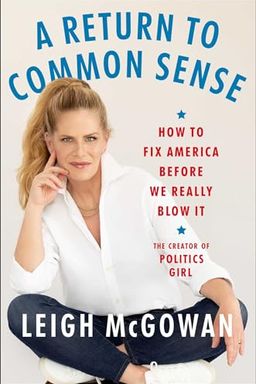
A Return To Common Sense cover

A Return To Common Sense

by Leigh Mcgowan

The social media and podcast host prescribes ways to reinvigorate American principles.

Bring Back Common Sense

How do you keep a self-governing nation from drifting into minority rule and cynicism? In this book, Leigh McGowan argues that the answer starts where America once started: with plain, practical judgment—common sense—applied by engaged citizens to laws, leaders, and institutions. Like Thomas Paine writing for ordinary colonists (and in the spirit of Harriet Beecher Stowe’s moral clarity), McGowan urges you to see things as they are and do what ought to be done. That means judging politics by outcomes that expand freedom, opportunity, and democratic accountability, not by slogans or tribal identity.

McGowan frames the choice starkly: we can either continue to favor the wealthy and influential while stripping rights and entrenching minority rule, or we can get serious about the ideals we sell to the world. She opens with a metaphor you’ll recognize: a hoarder’s house. Problems pile up—disinformation, money in politics, gerrymandering, court capture—until you can barely move. Burning the house down isn’t an option; you have to roll up your sleeves and clear room by room. Common sense is that civic habit of steady, collective cleaning.

What common sense means now

Common sense is not vibes. It’s a standard you can apply: Does a policy increase people’s real freedom (speech, press, bodily autonomy), expand broad opportunity (healthcare, education, housing), and make every vote count equally? If not, who benefits and who pays? The book urges you to move beyond personality politics and demand clear language, transparent goals, and measurable results. (Note: This echoes Paine’s method—write for everyone, insist on first principles, and expose the cost of muddled thinking.)

The framework you need to use it

You first learn how the system is designed: a living Constitution that can be amended, a federal government with three branches, and a process for making laws that requires winning many steps, not just election nights. You see how amendments—from the Bill of Rights to the Thirteenth, Fourteenth, Fifteenth, Nineteenth, and Twenty-Sixth—expanded freedom when citizens organized. You also see how structural compromises (the Senate’s equal state representation, the Electoral College, early concessions to slavery) still shape power and representation.

Understanding government basics is part of common sense. There are only 535 people who can make federal law. Presidents appoint judges and agency heads; the Senate confirms them; courts interpret statutes and the Constitution. Executive orders are temporary; lifetime judicial appointments are not. Committee chairs decide whether bills ever see daylight. If you want policy to happen, you have to win the math, the calendar, and the committees.

The threats that fog your judgment

McGowan catalogs how disinformation and media consolidation warp reality. The end of the Fairness Doctrine, the rise of partisan talk radio and cable news (Rush Limbaugh, Fox News), and social platforms created parallel fact-worlds; it’s no accident that roughly 30% of the electorate believes falsehoods about the 2020 election. Wealth concentration and legal changes (Buckley v. Valeo, Citizens United) flood campaigns and courts with dark money, shifting incentives away from constituents and toward donors. A coordinated legal-political project (Federalist Society, Leonard Leo, Judicial Crisis Network/Concord Fund, Project 2025’s Mandate for Leadership) reshapes the judiciary and executive branch to centralize power and roll back modern rights.

Freedom, opportunity, and votes—your nonnegotiables

Freedom is not just a bumper sticker. It includes First Amendment protections alongside limits on incitement and threats; a free press that can investigate power; religious liberty without government endorsement; and bodily autonomy robust enough to resist state control (the book calls for a constitutional amendment after Dobbs overturned Roe). Opportunity is the practical side of freedom: universal or hybrid healthcare that covers everyone; public schools funded to equalize, not stratify; housing policies that undo redlining and build wealth across communities. And voting is the mechanism that makes the first two possible. After Shelby County v. Holder gutted Voting Rights Act preclearance, states rushed to pass restrictions (446 restrictive bills proposed since 2021; 119 enacted). Gerrymanders pack and crack voters to lock in minority rule. The Electoral College skews presidential campaigns toward a few states and can override the popular vote (2000, 2016). January 6 showed how fragile even the vote count can be when a faction refuses to lose.

Core claim

“Stop being satisfied with slogans. Use common sense to test whether policies expand freedom, opportunity, and equal votes. Then vote like your democracy depends on it—because it does.”

What you can do this year and beyond

McGowan is blunt: democracy is not automatic; you must vote every cycle, help administer and defend elections, and elect majorities willing to pass structural reforms. That list includes voter protections (Freedom to Vote Act, John R. Lewis Voting Rights Advancement Act), House expansion (e.g., H.R. 622) to restore representation, Senate rules reform to end weaponized obstruction, campaign-finance transparency, antitrust enforcement, tax fairness, and Supreme Court reforms (ethics, term limits, even expansion into rotating panels) to restore legitimacy. Government can and does deliver—think the Affordable Care Act’s preexisting-condition protections, the 2021 Infrastructure Investment and Jobs Act, CHIPS, and the Inflation Reduction Act—when you choose leaders who govern.

The book’s promise is modest but profound: if enough of you ask for the same practical things, the country’s direction changes. That’s how Paine moved a nation in 1776; it’s how you do it now—by applying common sense to power, and by acting together, again and again.


A Living Constitution

McGowan asks you to treat the Constitution as a toolkit, not scripture. The Framers built a framework with seven articles and a mechanism to amend because they expected change. That design—federalism’s tension, separation of powers, checks and balances—only works if each generation updates the system to match new realities. Reverence without repair turns a living charter into a deadweight.

Structure you can use

Article I establishes Congress—the House (435 members, two-year terms, population-based seats) and the Senate (100 members, six-year terms, two per state). Article II creates the presidency and the executive branch, where the president appoints cabinet secretaries and agency heads (with Senate confirmation) and oversees the Department of Justice (a design feature that creates tension during politically sensitive investigations). Article III creates the judiciary, with lifetime-appointed judges whose rulings are final in actual cases or controversies. Article VI’s Supremacy Clause makes federal law supreme over conflicting state law. Understanding these basics arms you to follow the action: who controls the House agenda, which committee chairs can bury a bill, why judicial nominations are generationally consequential.

Compromises with long shadows

The Framers cut deals to secure ratification—allowing slavery to persist (the Three-Fifths Compromise), granting small states equal Senate representation, and inventing the Electoral College. None were moral absolutes; all were pragmatic to the moment. Later amendments—the Thirteenth (abolishing slavery), Fourteenth (birthright citizenship and due process), Fifteenth (Black male suffrage), Nineteenth (women’s suffrage), and Twenty-Sixth (voting age 18)—worked to repair the rot. The lesson is not to romanticize 1787, but to finish the work the Framers began by using the tool they left you: amendment and legislation.

Originalism versus a living charter

McGowan is wary of modern originalism and textualism when they freeze the Constitution at its founding moment. She reminds you that Jefferson contemplated revisiting the Constitution every generation to reflect “the progress of the human mind.” Recent Supreme Court rulings—Shelby County v. Holder (weakening the Voting Rights Act), Dobbs v. Jackson (overturning Roe v. Wade), curtailing Chevron deference (shifting authority from expert agencies to courts), and the 2024 presidential immunity decision (which Justice Sotomayor warned “makes a mockery of the principle that no one is above the law”)—illustrate how interpretive choices restructure liberty and power now, not in 1787.

Key Idea

“When jurists act as if 1787 rules are timeless, they ignore the Framers’ true genius: they built a system designed to evolve.”

How laws actually move

Common sense requires procedural literacy. Bills start in either chamber, head to committees and subcommittees for hearings and markups, and need floor time granted by leadership. If the House and Senate pass different versions, a conference committee reconciles them before the president signs or vetoes. Executive orders can act fast, but they’re reversible. Courts decide only live cases with standing. This is why durable change demands electoral wins, legislative craftsmanship, and coalition-building—one step at a time.

Action you can take with this toolkit

Use the Constitution as it was intended: push amendments that reflect today’s needs (bodily autonomy, campaign-finance transparency), elect representatives who understand oversight, and back legislation that enforces equal protection in practice. Track confirmations, because lifetime judges often outlast the presidents who appoint them. Learn your committees, because that’s where bills live or die. (Note: Think of this as civics as power literacy—like a handbook to the engine room.)

Treating the Constitution as living does not mean anything goes; it means everything must be justified by first principles and adapted to current facts. That’s the difference between worshipping parchment and using it.


Freedom With Guardrails

Freedom is the book’s first nonnegotiable, but McGowan asks you to define it precisely and defend it institutionally. She zeroes in on speech, press, religion, and bodily autonomy—the freedoms that structure all other debates—while warning how media capture and sectarian politics erode them in practice.

Speech isn’t a shield from consequences

The First Amendment protects you from government punishment for speech, but not from consequences in private life. True threats, incitement, and libel fall outside protection. Private platforms can de-platform without violating your First Amendment rights. That’s the common-sense boundary: protect open debate from state coercion while maintaining safety and accountability.

A free press or an echo chamber?

A functioning press is your check on power—think Ida B. Wells exposing lynching, Ida Tarbell busting Standard Oil, or Woodward and Bernstein on Watergate. But concentrated media ownership (roughly 90% controlled by six corporations) and the end of the Fairness Doctrine created a fragmented landscape where disinformation thrives. The rise of partisan media figures (Rush Limbaugh) and cable networks (Fox News) carved information silos that helped entrench falsehoods—like the persistent lie that the 2020 election was stolen. You can’t do self-government if you can’t share facts.

Illustration

“An ecosystem designed for outrage hardens beliefs faster than facts can travel. That’s not free speech; that’s paid manipulation.”

Religious liberty, not religious rule

The Establishment Clause bars government from endorsing religion; the Free Exercise Clause protects your practice. McGowan warns about efforts to fuse a particular Christian sect with state power and names institutional players—Project 2025, the Heritage Foundation, and the Federalist Society—pushing an executive-centric remake of government. Symbols like “In God We Trust” on money matter less than whether policy privileges one faith’s doctrine over pluralistic law. Common sense says: protect conscience, prevent theocracy.

Bodily autonomy is baseline freedom

After Dobbs v. Jackson overturned Roe, McGowan argues the only enduring fix is constitutional: enshrine bodily autonomy. The logic is straightforward—you can’t be forced to donate an organ even to save a life; by the same moral standard, government shouldn’t commandeer your body for reproduction. Without privacy and bodily control, other freedoms shrink to abstractions. (Note: This position echoes modern rights frameworks in other democracies that balance liberty with social support.)

What you can do

Defend press independence and transparency; reject outlets that monetize outrage over accuracy. Support whistleblowers and local investigative journalism. Oppose laws that privilege one religion in public institutions. Back statutory and constitutional protections for bodily autonomy. In everyday life, practice the freedom you claim to value: verify before sharing, argue policy not identity, and protect your neighbors’ rights so yours remain secure.

Freedom survives when you build sturdy guardrails—institutions, norms, and laws—that keep it from being co-opted by money, manipulation, or sectarian power.


Opportunity Is Policy

McGowan’s second pillar—opportunity—doesn’t float free of policy. It rests on three load-bearing walls: healthcare, education, and housing. When those walls are sturdy, you can rise; when they’re cracked by segregation, profiteering, and neglect, mobility becomes myth. The book’s common-sense test asks whether we finance these goods as shared investments or treat them as lotteries.

Healthcare: the unfinished moral project

Most developed nations guarantee universal coverage. The U.S. flirted with it—Truman proposed a plan in 1945—but Southern segregationists insisted that states control funds to maintain racial hierarchies, helping derail national coverage. The Affordable Care Act later expanded access, adding 20 million insured and protecting preexisting conditions (McGowan credits it with saving her life during a rare lung disease). Yet many states—often in the former Confederacy—refused Medicaid expansion, leaving millions in coverage gaps. Common sense says the world’s richest nation shouldn’t tie medical access to employer status or ZIP code.

Education: equalizer or sorting machine?

Public schools were never truly equal. Funding through local property taxes, coupled with redlining, entrenched disparities. Brown v. Board overturned Plessy v. Ferguson in law, but not in lived reality. The GI Bill opened college to millions, yet Black veterans were often excluded by segregation in admissions and lending. Today’s “school choice” and voucher pushes often skim resources from public systems rather than fix them. McGowan frames these fights as not just curricular but financial: who pays for excellence, and who gets it?

Housing: the engine of wealth—and exclusion

Homeownership builds intergenerational wealth, but federal policy long tilted the board. FHA underwriting and redlining maps fueled a white suburban boom while starving Black neighborhoods of credit. Highway projects bulldozed communities of color. The result is a durable racial wealth gap in which white households, on average, own far more wealth than Black households. When you see concentrated poverty and uneven opportunity, you’re seeing policy choices, not accidents.

Historical frame

“The Progressive Era and New Deal proved policy can rebalance power; Reagan-era deregulation and ‘trickle-down’ revived a New Gilded Age.”

What works and what to demand

Common sense pulls from successful models: universal or hybrid healthcare systems (learn from Europe and South Korea), robust public-school funding protected from unchecked privatization, and housing reforms that dismantle segregation and build equity (inclusionary zoning, down-payment assistance, fair lending). Pair these with antitrust enforcement to restore competition, progressive taxation (including windfall or wealth taxes), and full IRS funding to enforce the code.

Why this is about you

If you or your kids face medical debt, overcrowded classrooms, or impossible rents, you’re experiencing political economy up close. The book argues that opportunity is a collective project, not an individual miracle. When we invest together, more people can rise; when we privatize risk and socialize corporate gains, most people stall. (Note: This echoes Elizabeth Warren’s point that nobody builds success alone—public goods scaffold private effort.)

The practical takeaway is simple: vote and organize around the pillars that lift people. That’s not charity; it’s national strategy.


Make Every Vote Count

McGowan’s third pillar—votes that count—turns democratic aspiration into mechanics. You need both the right to vote and an electoral system that translates votes into power fairly. The book details the long fight for the franchise, the recent reversals, and the structural repairs that make representation real from your neighborhood to the presidency.

A hard-won right under assault

The Fifteenth Amendment promised Black men the vote, but states responded with literacy tests, poll taxes, and white primaries. The Voting Rights Act of 1965 finally put federal muscle behind protection—until Shelby County v. Holder (2013) gutted preclearance. Since then, states introduced 446 restrictive bills and passed 119 laws limiting access: purging voter rolls, reducing drop boxes, cutting early voting, and restricting mail ballots. These changes don’t ban voting; they target who finds it hardest to vote.

Maps and math that defy majorities

Partisan gerrymandering “packs” opponents into a few districts or “cracks” them across many to dilute their votes. North Carolina and Ohio offer textbook cases where legislative maps produced seats disproportionate to statewide votes. Independent redistricting commissions, where used, reduce the worst abuses. At the presidential level, the Electoral College lets candidates win without the national popular vote (Bush 2000, Trump 2016) and skews campaigns toward a handful of battlegrounds. The National Popular Vote Interstate Compact offers a workaround, but legal and political hurdles remain.

January 6 and election subversion

The January 6, 2021 attack interrupted the counting of electoral votes and previewed a broader strategy: seed distrust, empower state actors to contest certified results, and normalize challenges to lawful outcomes. Democracy depends on losers conceding; a faction now treats refusal as a tactic. (Note: Think of it as moving the contest from ballots to back rooms—unless you shore up the rules.)

Fix representation at the source

The House has been frozen at 435 seats since 1913. Today a single representative often serves 700,000–1,000,000 people, far beyond what early Congresses envisioned. H.R. 622 (Earl Blumenauer, 2023) would expand the House to 585 seats in 2030, shrinking district size by roughly 200,000 people and improving access and accountability. Larger states would gain multiple seats; smaller ones could add a voice; Electoral College votes would adjust proportionally if it persists. (Parenthetical comparison: the UK has 650 MPs—about one for every ~100,000 people—so the U.S. is an outlier in underrepresentation.)

Practical point

“Turnout is your leverage in skewed systems; structural reform is how you stop needing miracles.”

What to do right now

Register and vote in every election—primaries included. Help staff polling places and defend election infrastructure. Support the Freedom to Vote Act and the John R. Lewis Voting Rights Advancement Act. Back independent redistricting and modern equipment. Advocate House expansion and, if the Electoral College remains, reforms that reduce winner-take-all distortions. Your single vote matters because small margins, especially in gerrymandered or swing contexts, decide who draws maps, staffs elections, and appoints judges.

Democracy is a shared resource. If you don’t tend it, a small, organized group will seize it and lock the gate.


Money Power Warps Democracy

Follow the money and you’ll find the levers that move policy, courts, and public perception. McGowan braids two storylines: the reconsolidation of economic power since the 1980s and the judicial and political revolution unleashed by court decisions that made money speech. The result is a politics where a few donors and corporations can shout louder than millions of voters—and a judiciary increasingly aligned with those interests.

From robber barons to a new gilded age

The Gilded Age’s Rockefellers and Carnegies used monopoly power and political patronage to dominate markets. The Progressive Era and New Deal responded with antitrust (Sherman Act), regulatory bodies (FTC), and social insurance (Social Security, FDIC). Starting in the Reagan era, deregulation and weakening antitrust enforcement allowed reconsolidation across banks, tech, media, and pharma. Fewer firms control more markets; profits and lobbying budgets soar; workers and consumers lose bargaining power.

Court rulings opened the floodgates

Buckley v. Valeo (1976) equated spending with speech and limited how far Congress could restrict it. First National Bank of Boston v. Bellotti (1978) expanded corporate political speech. Citizens United (2010) then allowed unlimited independent expenditures by corporations and unions, birthing super PACs and supercharging outside spending. Dark money leapt from under $5 million in 2006 to hundreds of millions by 2012; super PACs spent about $3 billion from 2010–2018, much of it from a tiny donor class (74% of 2018 contributions came from donors giving at least $1 million). You now live in an election marketplace where disclosure is optional and influence is scalable by wealth.

Judicial capture is policy by other means

Networks linked to the Federalist Society and Leonard Leo, funded by dark-money groups like the Judicial Crisis Network (now the Concord Fund), built a pipeline to reshape the federal bench. All three Trump nominees—Neil Gorsuch, Brett Kavanaugh, Amy Coney Barrett—emerged from this machinery. The payoff appears in rulings that track donor priorities: weakening voting protections (Shelby County), overturning Roe (Dobbs), limiting regulatory authority (Chevron deference rollback), and a 2024 presidential-immunity decision that Justice Sotomayor calls a threat to the principle that no one is above the law. When justice looks like politics, legitimacy erodes—and with it, the rule of law.

Key Idea

“When candidates owe donors more than constituents, representation turns into return on investment.”

Rebalance the system

McGowan’s fixes are pragmatic: fund and modernize the IRS to enforce existing tax law; close loopholes; consider wealth and windfall taxes; revive strong antitrust to restore competition; pass transparency and small-donor public-financing reforms; and ultimately overturn or neutralize Citizens United. Pair campaign-finance reform with Supreme Court ethics rules, real-time disclosure, and recusals to prevent conflicts of interest. (Note: Several democracies cap spending and mandate disclosure—proof that money’s megaphone can be turned down without muting free speech.)

Your leverage

Support candidates who reject dark money, back disclosure laws, and commit to antitrust and tax enforcement. Donate small and local; volunteer time where money dominates. Push media to label super PAC and dark-money sources explicitly. If democracy is one person, one vote, then the project is to make policy, not price, decide outcomes.

This isn’t ideology; it’s maintenance. Clean the ducts where money hides, and the air of democracy gets breathable again.


Fix Rules, Prove Government Works

The book’s final move is institutional: change the rules that throttle majority governance, then deliver results that rebuild trust. McGowan counters the Reagan-era narrative that “government is the problem” with a record of programs that worked—while acknowledging that rules like the modern filibuster and a captured Court often block popular policy. The fix is to reform those chokepoints and then govern well.

The filibuster broke the Senate

Once a dramatic, exhausting floor speech, the filibuster is now a costless email that imposes a 60-vote threshold to move most legislation. Cloture fell from two-thirds to 60 in 1975; since then, routine obstruction became normal. Popular bills—like the Freedom to Vote Act—die despite majority support. Workarounds exist (budget reconciliation), but they’re narrow, policed by the Byrd Rule and the Senate parliamentarian (who blocked a $15 minimum wage in the American Rescue Plan as “merely incidental”). Some reforms would restore a “talking filibuster” or lower thresholds; others would abolish it with safeguards. The goal is accountability: let majorities govern and face voters on results.

A Court that earns legitimacy

Courts derive power from public trust and constitutional design, not from being above scrutiny. McGowan proposes ethics and disclosure standards for justices, term limits or rotations (e.g., 18-year terms), and even expanding the Court to 27 justices working in randomly assigned panels to reduce the sway of any single jurist. Congress has changed the Court’s size before; it can set ethics rules now. After Dobbs, the Chevron rollback, and the 2024 immunity ruling, such reforms read not as partisanship but as institutional repair.

Rule of law must be equal

Due process protections in the Fourth, Fifth, Sixth, Seventh, and Eighth Amendments intentionally slow punishment to prevent wrongful convictions. Yet mass incarceration, exploitative prison labor, and cash bail regimes punish poverty while privilege buys leniency. The pardon power can right miscarriages of justice but can also be abused for cronies; impeachment exists to check officers but requires two-thirds in a polarized Senate. Congress should define recusal rules, clarify “good behavior” standards, and legislate around bail and prison labor abuses. Equal justice is not self-executing; it must be enforced.

Prove it with governing

Government has delivered before: the New Deal’s Social Security, FDIC, and regulatory architecture stabilized capitalism; the ACA protected preexisting conditions and expanded coverage; recent laws—the Infrastructure Investment and Jobs Act (bridges, broadband, water systems), CHIPS (semiconductors, jobs), and the Inflation Reduction Act (climate investments, manufacturing)—show how public policy can rebuild supply chains, cut emissions, and create good work. These aren’t abstractions; they are the garbage trucks, vaccines, bridges, and jobs you see and use. Authoritarian shortcuts promise “efficiency,” but democratic competence is the only durable efficiency in a plural nation.

Key Idea

“Rules shape results. Reform the chokepoints, then govern so well that cynicism has nothing left to feed on.”

Your next steps

Vote in every election. Support Senate candidates willing to reform the filibuster responsibly. Back judicial-ethics legislation and thoughtful Court reforms. Demand investments in public goods—schools, healthcare, housing, climate resilience—and insist on measurable outcomes. Resist fear-based identity manipulation (“great replacement” rhetoric) that trades your long-term well-being for short-term outrage. Choose leaders who can do the work, not just perform it.

Fix the rules, and you can prove—again—that government by the people improves people’s lives. That is the most persuasive argument for democracy you can make.

Dig Deeper

Get personalized prompts to apply these lessons to your life and deepen your understanding.

Go Deeper

Get the Full Experience

Download Insight Books for AI-powered reflections, quizzes, and more.