
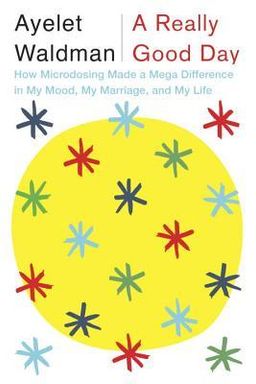
A Really Good Day cover

A Really Good Day

by Ayelet Waldman

A Really Good Day chronicles Ayelet Waldman''s daring exploration of microdosing LSD to combat depression. Through a 30-day experiment, she uncovers newfound serenity and a deeper understanding of LSD''s potential, challenging societal misconceptions and legal constraints.

Exploring Consciousness, Mood, and Microdosing

Have you ever wondered what it might feel like to wake up not just without anxiety, but with a deep sense of calm and connection to your daily life? In A Really Good Day, Ayelet Waldman invites you into her month-long experiment with microdosing LSD — a tiny, sub-perceptual dose of a Schedule I psychedelic that profoundly reshaped her experience of mood, creativity, and family life. Waldman contends that our emotional well-being is often held hostage by chemical imbalances, unhelpful cultural norms, and a criminalized approach to consciousness. Through microdosing, she seeks not euphoria or escape, but something deceptively simple: equanimity.

At first glance, Waldman’s premise sounds radical — a mother of four, former public defender, and law professor conducting a controlled experiment with LSD in the name of mental health. But the book transcends gimmickry. Using her daily journal entries, scientific research, and conversations with experts like psychedelic scholar James Fadiman, neuroscientist David Presti, and psychopharmacologist Louann Brizendine, Waldman transforms what might have been scandalous into a thoughtful, humane exploration of psychological healing and self-understanding.

From Desperation to Experimentation

Waldman begins the book in turmoil — unable to manage her perimenopausal mood swings after years of therapy and medication. Misdiagnosed with bipolar II disorder, she endures cycles of irritability, shame, and anxiety that damage her relationships. Conventional medicine has failed her. Antidepressants dull her senses, and therapy offers insight without relief. Discovering Fadiman’s work on microdosing, she encounters a glimmer of hope: reports that tiny doses of psychedelics could enhance focus, empathy, and stability without hallucination. Desperate yet methodical, she commits to a 30-day experiment, taking 10 micrograms of LSD every three days, tracking her mood, sleep, pain, creativity, and interpersonal conflicts.

Her structured journal entries—each noting her physical condition, conflict level, productivity, and emotional state—anchor the narrative. We witness how science and introspection unite to form a portrait of a woman exploring the limits of legality and self-care. For readers, it poses an implicit question: what would you do if standard medicine failed to help you feel whole?

Intersections of Science, Psychedelics, and Law

Beyond her personal story, Waldman unpacks the political and scientific history of psychedelic research. She recounts how LSD moved from legitimate research in the mid-20th century to prohibition under Nixon’s War on Drugs. Through interviews and studies from UCLA, Johns Hopkins, and European labs, she reveals that early experiments showed significant promise in treating depression, anxiety, and addiction. Yet the moral panic silenced decades of progress. Waldman, once a law professor teaching drug policy reform, reminds us that the criminalization of consciousness has filled prisons, destroyed families, and thwarted medical innovation. She argues that the freedom to experiment with one’s own mind—the same right championed by thinkers like Terence McKenna—is an extension of life, liberty, and the pursuit of happiness.

Why This Matters: Mindfulness Beyond Medicine

Waldman makes it clear: her story isn’t about rebellion against legality, but about reclaiming agency over her own mental health. She bridges neuroscience and daily life, translating technical details about serotonin receptors, neuroplasticity, and “brain-derived neurotrophic factor” into relatable insights about how we respond to stress and emotion. Her microdoses don’t transport her to alternate realities—they sharpen her ability to be present. As she says, “I felt mindful… as if my consciousness was hovering at a slight remove, watching me tap the keys on my keyboard.” Through this lucidity, she learns to slow down reactions, soften anger, and rediscover compassion, especially toward her husband and children.

Across the month, the book becomes a meditation on control, vulnerability, and self-forgiveness. Waldman’s vivid humor, self-deprecation, and candor make her journey accessible to readers who might never dream of breaking the law but understand the yearning for balance. She ultimately argues that microdosing is not about tripping—it’s about turning down the volume on the noise of self-criticism and fear so that a person can live her values.

A Study of Conscious Change

The book raises larger questions about what mental health recovery might look like in a culture anxious about pharmaceuticals but resistant to unconventional methods. Waldman’s playful, rigorous month-long journal offers a case study—a blend of experiment, memoir, and manifesto for self-awareness. While her results are far from definitive science, the narrative reveals how tracking and intention can themselves be healing. It invites you, the reader, to consider what “a really good day” means for you—and whether the journey toward it might require rethinking medicine, legality, and even your own perception of normal.

Waldman’s Central Insight

“Happiness, though delightful, is not really the point. The microdose lessened the force of the riptide of negative emotions... and made room in my mind not necessarily for joy, but for insight.”


Mood, Neuroplasticity, and the Science of Equanimity

One of the most illuminating sections of A Really Good Day explores how LSD acts not merely as a mood enhancer but as a cognitive amplifier. Waldman delves into the neurochemistry of psychedelics with curiosity and humility, translating medical jargon into practical human insight. Her investigation reveals how microdosing transforms emotional reactivity by reshaping the brain’s patterns—literally changing your mental architecture to cultivate calm and awareness.

The Brain’s “Miracle-Gro” Effect

Waldman’s psychopharmacologist friends explain that LSD acts as a serotonin receptor agonist, triggering the release of brain-derived neurotrophic factor (BDNF)—a growth compound sometimes called “Miracle-Gro for your brain.” This stimulation strengthens connections between neurons, boosting neuroplasticity, the brain’s ability to rewire itself after trauma or chronic stress. She connects this science to her lived experience: impulsivity softens, anger slows, and reflection expands. A woman who once reacted instantly now finds space—those crucial seconds between trigger and response—to breathe.

Reclaiming Emotional Balance

This scientific insight streamlines into emotional liberation. Waldman describes mornings that once began with irritability now unfolding more gently. She fights less with her husband, listens more to her children, even endures traffic without exploding. The LSD doesn’t erase emotion—it enhances her ability to choose her reactions. Equanimity, she realizes, isn’t the absence of feeling but the mastery of it. In one memorable line, she wonders whether microdosing is helping her “create the space in my mind to respond equanimously rather than irritably.”

Comparing Psychedelics and Antidepressants

Unlike SSRIs, which flood synapses with serotonin and often flatten emotions, LSD stimulates the same receptor system but in a dynamic way that enhances emotional nuance. While antidepressants often silence anger or joy, Waldman’s microdosing seems to restore the full spectrum. Psychiatrist David Presti confirms that psychedelics may carry fewer long-term risks than conventional antidepressants—potentially less disruptive to serotonin production itself. This reframing helps readers consider whether our pharmacological culture prioritizes blunting over healing.

A Broader Philosophical Lesson

Through neuroscience, Waldman discovers a philosophical truth: emotional suffering isn’t a sign of weakness but a chance for reconfiguration. When LSD amplifies neuroplasticity, it mirrors what meditation and mindfulness attempt by training attention. Both methods cultivate awareness over instinct. In a way, microdosing becomes a chemical shortcut to learning how to pause—a bodily version of the moment when meditation teaches you to observe without judgment.

Key Reflection

Waldman recognizes that she cannot untangle mood without understanding the mechanics of the brain, nor can the brain heal without compassion and insight. Science and spirit, she concludes, are not opposites—they are two languages describing the same process of transformation.


Therapy, Love, and Learning to Be Human

At its heart, A Really Good Day is a love story—between Ayelet Waldman and her husband, but also between her rational mind and her tender heart. Through her therapy sessions, microdosed mornings, and marital improv, Waldman examines how emotional regulation affects intimacy and creativity. Her therapists, from cognitive-behavioral pragmatists to youthful optimists, become foils for her ego and her fear of not being loved enough.

The Therapist and the “Ayelet Robots”

One striking passage describes her therapist’s metaphor: a closet full of “Ayelet robots,” perfect replicas programmed to handle her tasks and relationships. Which duties would she delegate? Which would she keep because they bring joy? This imaginative exercise prompts Waldman to identify the aspects of life she truly values—time with family, creative writing, spontaneous connection. It reshapes her sense of purpose. She even jokes that microdosing might be turning her into Robot Ayelet: efficient, happy, and serene—but that isn’t the goal. The goal is insight, not perfection.

The Five Words of Healing

Her couples therapy session provides one of the most moving moments in the book. After years of assuming she was unlovable, Waldman is asked to tell her husband, “I know you love me.” It takes twelve attempts before she can say it without self-sabotage. Her tears and his response—“it makes me so sad to see how hard it is for you to say those words”—mark a profound shift. Microdosing doesn’t just stabilize her; it opens her vulnerability to receiving love without qualification. That simple sentence becomes a daily mantra.

Family, Parenting, and Patience

By quieting her reactivity, Waldman improves not only her marriage but her parenting. She shares breakfast peacefully, works without anger, listens with warmth—her children notice. Her daughter tells her, “You’ve been super chill.” For readers, these moments illustrate how emotional mastery ripples outward. She realizes that moods hold families hostage; healing one mind liberates the whole household. The experiment becomes as much sociological as psychological.

Therapeutic Lesson

Learning to love and be loved is inseparable from learning to regulate emotion. Healing, Waldman shows, requires not just drugs or talk therapy but courage to say the simplest truths aloud.


Microdosing and the Quest for Creativity

Many readers come to Waldman’s story drawn by one tantalizing promise: that LSD and other psychedelics can unleash creativity. Waldman explores this modern myth both skeptically and personally, situating her experiences in the lineage of scientific and artistic innovation—from Albert Hofmann’s bicycle ride to Silicon Valley engineers seeking flow.

Psychedelics and Flow

Waldman experiences what psychologist Mihaly Csikszentmihalyi called flow—the timeless, effortless absorption in creative work. On microdose days, she writes for hours, barely noticing time pass. Distracting impulses fade, and focus replaces anxiety. LSD, she suggests, enhances communication between disparate brain regions, unlocking “hyper-connectivity” and new associations. Yet it’s not about tripping—it’s about optimizing cognition. For readers frustrated by creative block, the connection between neuroplasticity and imagination feels revelatory.

From Hofmann to Fadiman

Drawing on James Fadiman’s experiments with engineers in 1960s Palo Alto, Waldman recounts how scientists dosed in search of novel technical solutions. Fadiman’s participants—architects, designers, Silicon Valley pioneers—created patents and breakthroughs after guided LSD sessions. Waldman contrasts this disciplined creativity with today’s tech entrepreneurs who microdose to boost productivity. She worries that the pursuit of performance might drown the drug’s therapeutic potential. “I hope the healing doesn’t get muffled beneath the hysteria to work better, stronger, faster,” she writes.

Performance vs. Presence

For Waldman, creativity isn’t about output—it’s about humanity. Her most productive month is also her most peaceful. She writes because the protocol forces her to show up. Microdosing becomes not a hack but a teacher, reminding her that consistent effort and compassion trump intensity. The irony of Silicon Valley’s LSD craze—using a consciousness-expanding drug for efficiency—illuminates a cultural tension between productivity and presence.

Creative Insight

Waldman learns that the deepest creative breakthroughs come not from escaping reality but from inhabiting it fully—writing, reflecting, and noticing when the world itself feels artful.


Law, Policy, and the Ethics of Consciousness

Waldman’s legal mind anchors her exploration with moral gravity. As a former federal public defender, she witnessed firsthand the inequities of drug enforcement. The book’s most sobering sections interrogate why harmless experimentation like hers could, for someone poorer or darker-skinned, lead to imprisonment rather than introspection.

The War on Drugs as Modern Injustice

Through stories of clients charged for minor possession and analysis of mandatory minimums, Waldman unveils how laws initially crafted under racial prejudice evolved into mass incarceration. She recalls defending a mentally impaired migrant entrapped into drug delivery—sentenced not for violence, but for desperation. These vivid stories expose the absurdity of punishing minds seeking relief. She cites Michelle Alexander’s The New Jim Crow to show how drug policy perpetuates racial control even under different guises.

Imagining a World Beyond Prohibition

Waldman interviews reformers like Neill Franklin and Carl Hart, constructing a vision of a world without punitive drug laws. Together, they imagine public health–based regulation, education, and legal psychedelics used safely. She references Portugal’s success in decriminalization and the Swiss heroin maintenance program that reduced deaths and crime. These glimpses suggest how society could responsibly embrace consciousness change rather than criminalize it.

Ethical Paradox

As her experiment succeeds, Waldman faces a moral dilemma: she has found relief, yet her method remains illegal. Should she continue breaking the law for mental health? “I’m a law-abiding citizen who prides herself on honesty,” she writes. “Do I spend the rest of my life committing a crime?” The paradox underscores the absurdity of criminalizing something with fewer side effects than antidepressants. Her question becomes an ethical koan for readers: when law denies compassion, what is moral?

Legal Reflection

Waldman’s career in law informs her conviction that true justice includes the freedom to explore consciousness—the right not just to live, but to live awake.


The Therapeutic Power of Psychedelics

In her broader exploration, Waldman immerses herself in contemporary psychedelic research—the studies at Johns Hopkins and NYU showing psilocybin alleviating end-of-life anxiety, addiction, and depression. She compares her microdoses to these transformative doses, revealing parallels between mystical enlightenment and subtle cognitive clarity.

Revisiting Psychedelic Therapy

She recounts how terminally ill patients described encounters with the divine after psilocybin sessions, losing their fear of death. Researchers concluded that mystical states—not chemical effects alone—were the source of healing. Waldman translates this into her own secular language: spiritual awakening isn’t about God but perspective—the ability to recognize beauty and gratitude amidst impermanence. Her newfound joy in simple sensations, like sunlight through redwood trees, mirrors those transcendent experiences in miniature.

MDMA and Connection

Waldman also discusses MDMA’s therapeutic role in couples therapy and PTSD. Her own “love drug” experiences with her husband yield six-hour conversations about empathy and connection, reminiscent of clinical trials led by Michael Mithoefer. The intimacy feels spiritual yet grounded—a fusion of heart and neurochemistry. She predicts MDMA will soon be FDA-approved, heralding a new frontier for relational healing.

Spiritual Skepticism to Wonder

As an atheist raised by rational parents, Waldman resists mystical interpretations. Yet her mindfulness experiment—culminating in her “butterfly meditation” at Esalen—cracks open awe. When thousands of monarchs take flight as she opens her eyes, she experiences what scientists might call heightened perception, but what she feels as grace. Through these reflections, she reframes spirituality as awareness itself: seeing the miraculous in the ordinary.

Key Understanding

Psychedelics may lead people not away from reality but deeper into it. Waldman discovers that the smallest shifts in consciousness can heal just as much as the grandest visions.


Redefining Happiness and Insight

By the end of her thirty-day protocol, Waldman arrives at a revelation: the goal of microdosing—and perhaps of any inner work—isn’t happiness. It’s insight. Joy is fleeting, but understanding transforms. This concluding message reframes the book from a diary into a philosophy.

From Relief to Realization

After the last dose, Waldman reports reduced pain, better creative flow, and improved relationships—but she is most struck by a deeper sense of perspective. She can now witness sadness without drowning in it. The microdosing didn’t erase suffering; it taught her how to watch it come and go. Even setbacks, like lingering pain or irritable days, lose their tyranny. “Families are hostages to the moods of their members,” she writes, and her healing frees everyone.

Living a Life of Insight

This new mindfulness shapes her understanding of what success means. During a rainy family trip, when their car breaks down, she chooses laughter and connection instead of frustration—joining her children in a spontaneous rap battle by the roadside. That moment crystallizes her transformation: awareness, presence, and love are now her default responses. The real happiness she now knows arises from attention, not control.

A Message for Readers

Waldman’s final insight echoes through every page: perhaps the best kind of day isn’t one without problems, but one lived awake. Her experiment demonstrates how small conscious shifts—chemical, emotional, or spiritual—can dissolve lifelong patterns of fear. Even if you never take LSD, her narrative offers the mindfulness of microdosing: subtle but profound awareness.

Final Reflection

A really good day, Waldman concludes, is not one where everything goes right—but one where you can see clearly, act kindly, and remain curious. It’s what happens when chemistry meets consciousness.

Dig Deeper

Get personalized prompts to apply these lessons to your life and deepen your understanding.

Go Deeper

Get the Full Experience

Download Insight Books for AI-powered reflections, quizzes, and more.