
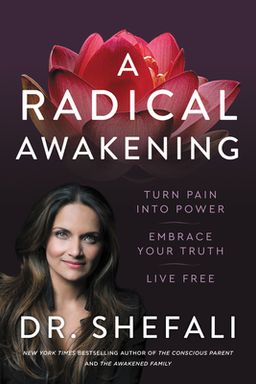
A Radical Awakening cover

A Radical Awakening

by Dr Shefali Tsabary

A Radical Awakening by Dr. Shefali Tsabary empowers readers to break free from societal conditioning and past traumas. It offers a transformative path to authenticity, fostering deep self-awareness and personal empowerment for both women and men.

From Erosion to Emergence: The Path of Awakening Woman

What happens when you spend decades silencing your truth, dimming your power, and living behind roles that others handed to you? Dr. Shefali’s transformative work argues that this slow unraveling—what she calls soul erosion—is the invisible epidemic of modern womanhood. Her message is radical yet restorative: to awaken, you must dismantle every inherited script—cultural, familial, sexual, and religious—and reclaim authorship of your own life story.

Across the book, Shefali draws from psychology, feminist critique, spiritual philosophy, and her own life, moving from the fog of patriarchy to the light of inner sovereignty. She guides you through seeing your conditioning, understanding relationship dynamics, healing the ego’s patterns, and embodying authentic power that no longer needs validation.

The Hidden Curriculum of Patriarchy

Every woman inherits a social contract before she can speak. You are taught to be nice, nurturing, compliant, and dependent on external approval. Dr. Shefali calls this the “Fog of Patriarchy”—a psychic smog that confuses fear for love and submission for safety. This fog teaches the emotional alphabet of fear → blame → shame, keeping women silent to preserve belonging. Over time, this produces soul erosion: the gradual loss of authenticity and the creation of a “good girl” persona that hides inner hollowness.

Examples like Trista, who froze in fear after childhood trauma and repeated emotional disconnection as a mother, reveal how early defense mechanisms calcify into adult disempowerment. Patriarchy’s greatest success, Shefali notes, is convincing women that their self-betrayal is virtue.

Ego and the Masks You Wear

The ego is born as armor—a survival construct created in childhood to secure love and safety. Over time, it develops faces: Victim, Martyr, Savior, Bleeding Empath. Each serves a psychological function but later becomes a barrier to genuine intimacy. Recognizing your mask—the behavioral pattern you slip into when triggered—is the first step in liberation. Awareness interrupts the automatic cycle of reacting, rescuing, or performing. From that pause, you begin the journey of reparenting: offering care, validation, and containment to the neglected child inside you.

Love, Need, and Co‑creation

Many relationships mirror internal wounds. Women like Amy reenact childhood longings—seeking fathers instead of partners—and attract men like Jacob who fit the old script. Shefali calls this the “Twin Beggars” dynamic: two incomplete people reaching toward each other to fill emptiness, calling it love. True intimacy begins when you own your part in co-created patterns without self-blame. Taking responsibility restores agency and turns need into conscious companionship.

(Comparable to Byron Katie’s invitation to dissolve stories and Eckhart Tolle’s emphasis on awareness, Shefali anchors transformation in radical accountability rather than victimhood.)

From Conditioning to Conscious Choice

The next phase of awakening involves unmasking inherited lies—about beauty, motherhood, marriage, and worth. Shefali illustrates this through generational portraits: her grandmother’s widowhood stripped of color and joy, the “Fair and Lovely” lotion that equated whiteness with virtue, and women binding themselves to expected roles of wife and mother. These cultural codes behave like software programs running unseen. To reboot your life, you must identify them, question their authority, and reprogram your choices according to personal truth.

Awakening as Rebirth

When old identities crack—as they did for Shefali during her divorce—you face fear, grief, and ambiguity. But the shedding of skin is necessary for regeneration. Saying “no,” holding boundaries, and reframing endings as spiritual divorces from fear become sacred acts of renewal. Through self-parenting, embodied sexuality, and sovereignty, the woman who once sought validation becomes her own source of wholeness. Awakening, therefore, is not rebellion against men but a revolution within women—transforming silent compliance into conscious creation.

This book’s arc—spanning ego, conditioning, sexuality, motherhood, and autonomy—forms a coherent path from disconnection to embodied power. Its call is simple but radical: awaken from ancestral hypnosis, reclaim your inner authority, and live as the author of your soul’s story.


The Conditioning of “That Woman”

You were taught early who “That Woman” should be—pretty, polite, deferential, and never too loud. Inherited archetypes from mothers, teachers, and media formed an unconscious identity script long before you chose one. Dr. Shefali dissects this formation as the product of patriarchy’s emotional training camp: a world that rewards female obedience with conditional love.

To maintain acceptance, you learned to trade authenticity for approval, crafting an ego that survives through adaptability. This explains why so many competent women still feel hollow: the outer success hides an inner counterfeit.

Approval as the Addictive Triad

Shefali defines the “Triple Threat”—approval, validation, praise—as the emotional junk food of the feminine psyche. Conditioned to equate love with pleasing, you modulate your voice, body, and ambition to maintain acceptance. Small acts of “goodness” pile into a mountain of self-erasure. Over time, hunger for recognition becomes dependency.

Internalized Rivalry

A tragic result of this programming is competition among women. When worth is scarce, solidarity collapses. Instead of empowering one another, women police each other’s confidence and beauty. Shefali recounts how lighter skin in her youth brought both admiration and alienation—a symbol of how patriarchy divides women by using desirability as currency.

Authenticity Over Goodness

Reclaiming selfhood requires rejecting the label of “good” in favor of being real. Authenticity may disappoint others, but it liberates you from the endless performance of perfection. Ask: which of your values are authentic, and which are inherited scripts for belonging? This inquiry begins the creation of a woman who acts from consciousness, not compliance.

As you dismantle “That Woman,” you make space for the one only you can design—whole, spacious, and unashamed.


Ego Masks and Emotional Patterns

The ego thrives on repetition. Every complaint, crisis, or heartbreak is rarely new—it is an echo of something unfinished in childhood. Dr. Shefali identifies these learned patterns as the “faces” of the ego: habitual emotional strategies once useful for survival, now preventing growth.

Recognizing the Mask

Whether you play the Victim waiting for rescue, the Martyr sacrificing self, or the Savior who fixes others, each identity protects an inner child frightened of abandonment. For example, Sasha—the overgiving Martyr—had to grieve her neglected past to stop over‑parenting partners. Awareness disrupts the trance of reenactment.

Reparenting the Inner Child

Healing begins when you treat those reactive parts as children in need of comfort, not as enemies to suppress. Reparenting involves naming the trigger, pausing before you act, and supplying the emotional safety you once sought externally. The 10‑second pause technique Shefali teaches—breathing before reacting—enables a shift from unconscious defense to deliberate choice.

From Reaction to Response

With practice, you move from reactivity to authorship. The ego loses grip as love and awareness replace fear. You no longer need to manipulate situations for control; instead, you respond from grounded authority. Emotional adulthood emerges when you can witness pain without performing the old mask.

Transformation, then, is not erasing the ego but educating it. You become both parent and protector to your inner self—and free to live patterns by choice rather than inheritance.


Owning Your Role in Co‑creation

Dr. Shefali reframes relationships as mutual ecosystems rather than one‑way streets of guilt and blame. While patriarchy creates clear power imbalances, healing demands that you explore how you unconsciously participate in the exchange. This stance is neither victim‑blaming nor self-shaming—it is empowerment through ownership.

The Power of Ownership

As Gandhi modeled in activism, internal sovereignty is more potent than external petition. When you stop waiting for others to change, you reclaim energy previously tied to resentment. Sarah—married to a narcissist—found freedom not by fixing her husband but by withdrawing from the role that kept the cycle alive.

Tools for Practicing Accountability

  • Identify recurring behavior loops (e.g., rescuing, silence).
  • Ask: “How have I invited this dynamic?” not as blame but inquiry.
  • Set one boundary that interrupts the pattern.

From Blame to Collaboration

Accountability stabilizes emotional swings and restores dignity. When women gather in sisterhood to model this—raising one another instead of competing—the “lion” of patriarchy loses its prey. Empowerment becomes contagious, turning isolated survival into collective evolution.

Owning your part does not mean excusing harm; it means ending unconscious participation in it. Once you do, love and respect flow from choice rather than dependence.


Unmasking Cultural Lies and Expectations

From the myth of the saintly mother to the idol of eternal youth, culture embeds deception into feminine identity. Dr. Shefali calls these inherited “lies” that masquerade as morality. They promise dignity through obedience but deliver invisibility instead.

Tradition’s Invisible Chains

Her grandmother’s white‑sari widowhood, devoid of color or self-expression, exemplifies how virtue can camouflage unworthiness. The belief that women earn love through sacrifice keeps generations bowed under ancestral pressure. Such scripts become emotional nooses tightening every time a woman chooses duty over authenticity.

Beauty as Colonization

The beauty industry reinforces colonial hierarchies—idolizing light skin, youth, and symmetry. Yet Shefali cautions women not just to criticize but to reflect on complicity: every filter, injection, or comparison unconsciously validates the same standard we resist. Modeling ordinary acceptance before children—playfully jiggling her arms for her daughter—subverts perfection culture with humor and love.

Choosing Conscious Continuity

Not all traditions are harmful; some are carriers of beauty and connection. Liberation is about choice. By questioning which customs nurture or shame you, and practicing small deviations, you evolve heritage into authenticity. This shift—from inheritance to authorship—is the essence of awakening culture itself.

When you rewrite tradition’s story, you pass freedom forward. The awakened woman honors roots without letting them strangle her growth.


Authentic Relationships and Conscious Love

Love, stripped of illusion, is not about possession but growth. Shefali dismantles common myths: that marriage guarantees safety, that dependency equals devotion, and that longevity proves success. Instead, she defines conscious love as two sovereign people sharing evolution rather than compensating for emptiness.

From Twin Beggars to Whole Partners

Amy and Jacob illustrate how unmet childhood needs deform adult intimacy. Each demanded from the other what they hadn’t received from parents—turning romance into re‑enactment. As Amy reparented herself, she transformed the dynamic from craving to choice, proving that love matures only when need dissolves into enoughness.

Reimagining Marriage and Divorce

Shefali punctures the myth of marital permanence. Historically born to guard property, marriage now often entraps emotional growth. She argues for a growth model: measure relationships by expansion, not duration. When separation becomes necessary, conscious divorce—anchored in integrity and mutual respect—turns ending into evolution.

Sexual Honesty as Liberation

Cultural silence around sex breeds guilt and deceit. Shefali reframes sexuality as sacred biology and agency: acknowledging desire without shame, discussing monogamy consciously, and aligning sex with authenticity over performance. Transparent dialogue, not repression, is the true safeguard of fidelity.

Relationships thrive when built on autonomy, clarity, and conscious choice—a trinity that restores both erotic vitality and emotional peace.


Motherhood, Boundaries, and Inner Reparenting

The cultural pedestal of motherhood often masks a subtle imprisonment. Dr. Shefali exposes how identity fused with mothering leads to enmeshment, guilt, and projection. You are taught that your child’s success defines you, but this belief distorts both parent and child.

Projection and the “Project Child”

When you unconsciously use a child to fill emotional gaps, parenting becomes performance. Zara’s despair when her son left for college revealed how losing her caregiving role collapsed her sense of self. Conscious parenting flips the focus: your reactions to your child reveal your unhealed inner child.

Reparenting as Daily Practice

Reparenting means becoming the adult your younger self needed. In moments of anxiety, self‑soothing with phrases like “I see you, you are safe” nurtures an inner foundation stronger than any external validation. Over time, this inner parenting dissolves guilt and restores agency.

Boundaries as Maternal Love

Setting boundaries models self‑respect for children and partners alike. Saying “no” without apology, taking pauses before reacting, and ending excuse‑making—all of these teach emotional maturity more powerfully than words. Sovereignty as a mother creates freedom for offspring to individuate rather than inherit codependence.

Motherhood, reclaimed as conscious choice, becomes creative stewardship instead of self‑sacrifice. It is not identity’s cage but an expression of integrated love.


Sovereignty and the Rebirth of Self

At the book’s heart lies the archetype of the sovereign woman—the one who governs her life from inner authority. Awakening culminates not in rebellion but in integration: balancing empathy with assertiveness, compassion with clarity, and softness with strength. This synthesis births emotional adulthood.

The Queen Archetype

Dr. Shefali invites you to step into “Queen” energy, where validation flows inward rather than outward. Criticism loses power because you no longer barter authenticity for approval. Each boundary you set—and enforce—becomes an act of coronation. Being called “selfish” or “bitch” by others is often confirmation that you’ve stopped being compliant.

Balancing the Inner Feminine and Masculine

Integrating healthy masculine traits—direction, assertion, structure—heals toxic niceness. Mandy’s descent into caretaking showed how suppressing assertive energy depletes vitality. Reclaiming balanced power allows you to give from fullness rather than from fear of disapproval.

Embodied Sovereignty

True sovereignty is felt through the body: awareness of cycles, sensual acceptance, and refusal of shame. From menstruation to sexuality, the awakened woman reclaims her biology as sacred ground. Living consciously in this body—without apology—anchors self‑trust deeper than any ideology.

The journey that began in soul erosion ends in embodiment. When you own your voice, history, and choices, you become the author of your destiny—and the living antidote to every silence that came before you.

Dig Deeper

Get personalized prompts to apply these lessons to your life and deepen your understanding.

Go Deeper

Get the Full Experience

Download Insight Books for AI-powered reflections, quizzes, and more.