
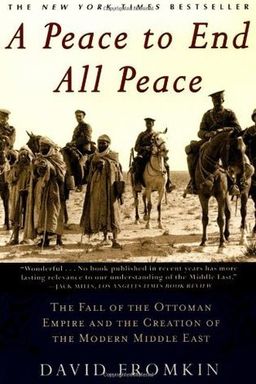
A Peace to End All Peace cover

A Peace to End All Peace

by David Fromkin

A Peace to End All Peace explores the dismantling of the Ottoman Empire by European powers during World War I and its lasting impact on the Middle East. With keen insights into political machinations and historical decisions, it illuminates the root causes of today’s regional conflicts.

Empire, War, and the Making of the Modern Middle East

How did a seemingly distant European conflict redraw the political map of the Middle East? In A Peace to End All Peace, historian David Fromkin shows you that World War I was not only the collapse of old empires but the birth of a new imperial order—one constructed through improvisation, miscalculation, and secrecy. His central argument is that the modern Middle East emerged not from a coherent Allied plan but from overlapping ambitions, half-baked promises, and the personality-driven politics of empire builders like Churchill, Kitchener, Lloyd George, and figures within the decaying Ottoman regime.

Fromkin threads together a web of intersecting stories: nineteenth-century imperial geography (the Great Game), Ottoman reform and disintegration, British strategic obsessions with India and Suez, the entry of the U.S. as moral arbiter, and the converging crises of nationalism, Zionism, and pan-Islam. You watch policymakers respond not to clear facts but to inherited anxieties and new temptations of power in lands they barely understood.

Imperial Logic and Strategic Geography

At the core of Britain’s Middle Eastern engagement lay the logic of the Great Game—protection of the Indian route from rival continental powers. This older geography, built on fear of Russia, shaped every wartime calculation: the Dardanelles, Suez, Mesopotamia, and Persia were not peripheral—they were lifelines. Churchill’s and Kitchener’s early decisions echoed Palmerston and Curzon’s doctrines of chokepoints and buffer states. Even new technologies like railways reinforced those assumptions, highlighting vulnerabilities across the Middle East.

(Note: Fromkin’s first chapters resonate with Halford Mackinder’s “Heartland” theory—where whoever controls the inner continent controls world power—but Britain approached it instinctively rather than analytically.)

Ottoman Breakdown and Wartime Realignments

Within the Ottoman Empire, the Young Turk revolution of 1908 promised reform but delivered authoritarianism and ethnic repression. Talaat, Enver, and Djemal each represented different strands of Turkish nationalism and paranoia. Their desperate alliance with Germany arose from fear of dismemberment as much as ideological sympathy. For Britain, their choices triggered a new scramble: seize the Straits, defend Egypt, and exploit Arab nationalism as a weapon. Yet these moves were less coordinated strategy and more reaction to crisis.

You see this improvisation vividly at Gallipoli, where Churchill turned strategic anxiety into doomed adventure, and later in Cairo, where Kitchener’s protégés built a parallel imperial machine centered on managing Islam and manipulating Arab loyalty. Britain’s men on the spot—Clayton, Storrs, Sykes—were improvisers-with-maps, creating policies that would outlast their superiors.

From Promises to Contradictions

Fromkin shows how wartime diplomacy created a triangle of contradictory commitments: the McMahon–Hussein correspondence (Arab independence), the Sykes–Picot Agreement (Allied division of spoils), and the Balfour Declaration (Zionist national home). Each scheme addressed one audience while ignoring others. Together they made postwar peace impossible. These entanglements arose from a deeper imperial assumption: that Britain could manage complexity through administrative skill alone.

Collapse, Revolution, and Rearrangement

By the war’s end, Lenin’s revolution, Lloyd George’s power grab, and America’s moral entry transformed diplomacy. Russia’s exit opened space for Ottoman counterplays and Soviet nationalist outreach; Britain’s overreach across Egypt, Iraq, and Arabia soon ignited rebellion. Fromkin traces how Allenby’s victories, Feisal’s Arab Revolt, and the theatrical alliance with Lawrence created “facts on the ground” that turned into bargaining chips at Paris and Sèvres. Meanwhile, Wilson’s Fourteen Points and The Inquiry’s idealism clashed with the habits of empire, producing the gap between principle and power that defines postwar politics to this day.

From “Victory” to Fragile Order

The peace that followed was, in Fromkin’s phrase, a “peace to end all peace”—an improvised respite that created brittle states and permanent grievances. As Britain tried to cut costs, Churchill’s 1921 Cairo Conference engineered cheap control through Hashemite monarchs, air power, and new borders. The same empire that claimed to be trustees of civilization ended up ruling by subsidy and surveillance. Palestine, Transjordan, and Iraq became laboratories of proxy empire, with contradictions built in from birth.

Across the region, revolt followed: Egyptians against occupation, Iraqis against new taxation, Afghans for sovereignty, and Turks under Atatürk against Allied dismemberment. In Persia, Soviet raids and British panic produced the rise of Reza Khan. Each episode underscored the same truth: Britain’s influence outran its means, and its fear of conspiracies blinded it to local realities.

Core insight

The modern Middle East was not designed; it was improvised by men acting under old imperial assumptions amid unfamiliar revolutions. Fromkin’s deepest message is that misunderstanding geography, culture, and agency transforms victory into vulnerability. Empires expire not because of enemies alone but because they mistake their maps for realities.


The Great Game and Ottoman Upheaval

Fromkin begins by showing how the nineteenth-century rivalry known as the Great Game still defined strategic thinking in 1914. Britain’s obsession with protecting India through control of Egypt, Suez, and the Persian Gulf made the Near East an extension of imperial defense. The empire’s ministers recited the same litany—Constantinople, the Straits, Mesopotamia—as justification for any move, even when conditions had changed.

Within the Ottoman Empire, however, another drama unfolded. The Young Turks, dominant after 1908, embodied the empire’s final attempt to modernize through nationalism and centralization. Enver Pasha’s ambition, Talaat’s administrative grip, and Djemal’s militarized regional control turned reform into paranoia. When war came, their desperation for an ally pushed them toward Berlin, binding Ottoman fate to Germany’s.

The Continuity of Imperial Logic

Britain’s decision-makers—Asquith, Grey, Churchill—still saw Turkey through nineteenth-century eyes: as a pawn in the Russian question. That mental map explains Britain’s aggressive seizure of Ottoman battleships in British shipyards and the Dardanelles campaign to force Istanbul’s surrender. Churchill’s gamble and Kitchener’s Eastern projects came from the same source: protect routes, secure chokepoints, and contain Russia. The result was policy continuity masquerading as innovation.

Factions and Misreading within the Porte

Fromkin highlights that Britain consistently misread the Ottoman political landscape. Ambassadors such as Lowther saw the Young Turks as conspiratorial Freemasons influenced by minorities rather than as Turkish officers with nationalist goals. This misperception skewed diplomacy and sowed mistrust. Inside the Committee of Union and Progress, rivalries made policy erratic—Enver’s disastrous Caucasus offensive at Sarikamish cost over 80,000 men, while Djemal’s failed Suez expedition threatened British Egypt but revealed logistical collapse. Yet the Ottoman state remained surprisingly resilient. It adapted, survived revolts, and prolonged the war far longer than expected.

Historical takeaway

The Great Game’s inherited geography made both British and Ottoman leaders fight the last war while living through a new one. Fromkin invites you to see continuity as both anchor and trap: strategy built on habit can outlast the empire itself.


Imperial Personalities and War’s Turning Points

Fromkin’s middle chapters follow personalities whose ambition redirected empires. Winston Churchill, Lord Kitchener, and David Lloyd George each exemplify a kind of imperial improvisation—the swashbuckling, the managerial, and the opportunistic. Their decisions, made under pressure, helped transform wartime chaos into long-term order and disorder.

Churchill’s Gambles: From Dreadnoughts to Gallipoli

Churchill’s seizure of Ottoman-built battleships in 1914 enraged Constantinople and triggered sympathy for Germany. His Dardanelles gamble a year later sought to reopen communication with Russia and break the deadlock but instead produced one of Britain’s costliest fiascos. Every stage reveals a mind that equated audacity with mastery. The failure at Gallipoli not only wrecked careers but reshaped allied politics, accelerating Lloyd George’s rise and Britain’s eastward turn in strategy.

Kitchener’s Vision and Lloyd George’s Power

Kitchener, by contrast, viewed the Middle East as an administrative whole. He imagined controlling Islam by relocating the caliphate to Arabia under British supervision and drew Cairo into Lordship over Arab and African provinces. This imperial rationalism—grand in design but hollow in resources—fed into the Arab Revolt project. Lloyd George’s later war dictatorship elevated such imperial technicians—including Milner, Sykes, and Curtises—into Downing Street’s “Garden Suburb,” where policy fused ideology, pragmatism, and haste.

Under this small War Cabinet, British Middle Eastern aims expanded even as resources dwindled. The new inner circle fashioned bold policies—Zionist commitments, partition plans, and mandate blueprints—through a closed decision-making loop that prized speed over consensus. Fromkin’s judgment is acute: centralization gave Britain power to act but robbed it of the wisdom of dissent.

Lesson in leadership

Great individuals can magnify a nation’s reach, but when their decisions rest on mythic geography or moral overconfidence, their legacies linger as mixed inheritance. Churchill and Lloyd George left not empire’s triumph but its mortgage.


Contradictory Promises and the Arab Revolt

By 1916 Britain had promised everything to everyone. The McMahon–Hussein exchange suggested Arab independence; the Sykes–Picot Agreement carved the same territory into Anglo-French zones; and the Balfour Declaration (1917) introduced support for a Jewish homeland in Palestine. Fromkin calls this diplomatic layering the seedbed of enduring conflict. Each promise was rational when made, but collectively they could not coexist.

How Illusions Begin

The Faruqi episode—an intelligence hoax claiming vast Arab armies waiting to rebel—pushed the British to act. Believing the fiction, Cairo spurred Sherif Hussein’s revolt, assuming a mass uprising would collapse Ottoman control. Instead, the rebellion stayed regional and fragile. Lawrence’s later romantic portrayal obscured its real scale: tribal, local, and subsidized by British gold. Yet politically, it gave Britain moral and diplomatic leverage to occupy Arab lands under the pretense of liberation.

Symbolic Victories and Later Claims

Allenby’s march to Jerusalem and Damascus entwined nationalist narrative and imperial ambition. Feisal’s entry into Damascus—staged and contested—became a claim of Arab self-liberation, though British and Australian units had led the assault. These contradictory memories shaped postwar negotiation. London’s policymakers could cite “Arab allies” to justify influence; Arabs could cite the same to claim independence.

Thus the gap between rhetoric and reality became permanent. The British achieved military success through local proxies but created a political expectation they never intended to fulfill.

Enduring paradox

From rebellion to promises, Britain discovered that moral instruments deliver imperial ends—but at the price of chronic legitimacy crisis. Words of liberation became chains of future grievances.


Zionism, Idealism, and Strategic Design

Among Britain’s wartime pledges, none proved more consequential than the Balfour Declaration. Fromkin shows you how this short letter evolved from private lobbying into imperial policy. It was both sentimental and strategic: biblical conviction fused with geopolitical design. For Lloyd George and Balfour, Zionism promised moral redemption and a British-aligned community in a vital corridor between Egypt and Mesopotamia.

Religious Sympathy and Realpolitik

Nonconformist piety imbued British leaders with scriptural geography; Palestine was less a territory than a chapter of holy text. Yet beneath spiritual rhetoric lay hard calculation. Control of Palestine secured flank protection for Suez and cemented the imperial line to India. Weizmann’s chemistry labs met Sykes’s cartographic imagination in a surprising alliance of science and empire.

Opponents like Edwin Montagu warned that political Zionism endangered Jewish citizenship and would inflame Arab hostility. Fromkin tracks this Cabinet clash to the final wording: vague enough to please Zionists, cautious enough to survive politics. But its ambiguity—“a national home” without defining sovereignty—became the hinge of decades of conflict.

From Declaration to Mandate

Once Britain occupied Palestine, rhetoric met reality. Administrators confronted tensions between Jewish immigration, Arab resentment, and limited funds. Fromkin’s later chapters reveal how incidents like the Jaffa riots (1921) and the appointment of Amin al-Husseini as Mufti transformed an imperial experiment into a nationalist struggle. Churchill’s subsequent defense—that economic progress and hydroelectric concessions would reconcile both peoples—proved well-intentioned but naive.

Crucial reflection

The Balfour Declaration exemplified empire’s double vision: moral language as means of strategic control. Fromkin teaches you to see ambiguity not as oversight but as instrument—useful for power, fatal for peace.


The Wilsonian Challenge and Fragile Peace

When the United States entered the war, its moral language transformed diplomacy. Woodrow Wilson’s Fourteen Points demanded open covenants, self-determination, and a League of Nations. For Europeans used to secret deals, this was revolutionary—and hypocritical. Fromkin contrasts America’s moralism with its ignorance. The Inquiry, Wilson’s academic think tank, drew maps of the Ottoman lands informed more by crusader history than contemporary ethnography.

Wilson restrained Britain and France rhetorically but lacked power to enforce ideals. The Allies signed Sykes–Picot and London Treaties behind his back, while accepting his principles in public. The result was diplomatic schizophrenia: the peace of Versailles justified empire by moral language, and the Near East settlement at Sèvres embodied the same contradiction.

Delay, Exhaustion, and Betrayal

Lloyd George sustained fragile coalitions through summitry and delay. Each secret concession—Mosul to Britain, Syria to France—traded long-term trust for short-term territorial gain. The Treaty of Sèvres (1920) partitioned Turkey on paper but lacked legitimacy or force. For Arabs, it confirmed betrayal; for Turks, it provoked nationalist resistance. Fromkin reminds you that timing betrayed as much as text: peace imposed after exhaustion but before reflection cements resentment.

Moral insight

When ideals outrun institutions, they breed cynicism. The Wilsonian moment offered a language of justice without machinery to realize it—leaving imperial powers to fill the vacuum under a flag of virtue.


Revolt, Overstretch, and Intelligence Failures

After the armistice, Britain stood at its widest reach and weakest capacity. In 1919–1920 revolts erupted from Egypt to Iraq. Fromkin organizes these crises as the empire’s bill for wartime improvisation. Promises made to Arab allies, to Zionists, to France, and to Parliament could no longer be honored simultaneously. Demobilization reduced forces; costs and public fatigue narrowed choices.

Patterns of Rebellion

In Egypt, Zaghlul’s arrest unleashed nationwide protest inspired by Wilson’s rhetoric. In Mesopotamia, British administrators faced revolt costing thousands of lives and exposing military overcommitment. Afghanistan’s Amanullah declared independence, and the House of Saud challenged Britain’s Hashemite allies. Each uprising came from local grievances but was read through the lens of global conspiracy.

Conspiracy Thinking and Consequence

Fromkin dissects British intelligence culture, which preferred neat external explanations to messy reality. Officials in London saw a Bolshevik–German–Jewish–Islamic plot behind everything from the Gilan revolt in Persia to riots in Iraq. The forged Protocols of the Elders of Zion and Major Bray’s “global chart of revolution” circulated at high levels. This paranoia justified coercion where reform was needed, widening the gap between ruler and ruled.

Reza Khan’s British-supported coup in Persia (1921) epitomized unintended consequence: designed to stabilize the frontier, it birthed a regime that soon leaned toward Moscow. Intelligence failure became structural—reading agency wrongly meant designing policy foolishly.

Analytical warning

Empires collapse less from defeat than from misinterpretation. When leaders replace local understanding with conspiracy, they choose fear over learning.


Retrenchment and the Hashemite Settlement

By 1921, economic crisis forced Britain to economize empire. Churchill, as Colonial Secretary, convened the Cairo Conference to reconcile commitments with austerity. The solution was ingenious and fragile: replace garrisons with airplanes and native dynasties. Feisal was crowned in Iraq, his brother Abdullah installed in Transjordan, and subsidies flowed to Ibn Saud to prevent further rebellion. The logic was Empire by Proxy—control through friendly kings and air control rather than soldiers.

Air Control and Pragmatic Empire

The Royal Air Force’s mobility allowed Britain to quell uprisings cheaply, dropping leaflets and bombs with equal ease. Administrators like Gertrude Bell and Sir Percy Cox drafted constitutions while RAF units enforced calm. Churchill boasted that he cut Middle Eastern costs dramatically. Yet the moral price was profound: ordered peace founded on fragile legitimacy, maintained by technology and subsidies.

Transjordan and Palestine’s Divergence

The Cairo solution tried to reconcile the Balfour Declaration with Arab discontent by dividing mandates: Zionist policy west of the Jordan, Arab governance east of it. Fromkin shows that this administrative tweak defined later borders and contradictions. The Hashemite arrangement seemed elegant in London but unstable on the ground—too artificial to endure without constant subsidy and military readiness.

Strategic insight

You learn here that imperial systems often survive decline by conversion—not withdrawal but franchising. The Cairo formula marked the shift from empire as occupation to empire as influence, a change that defines modern neocolonial patterns.


Shattered Alliances and Enduring Legacies

In Fromkin’s closing chapters, the coalition that had won the war disintegrates. France, Italy, and Britain pursue conflicting interests; the United States retreats; the Soviet Union signs separate treaties with new states on its frontier. Greek ambitions in Anatolia end in disaster, and Britain faces the Chanak crisis alone—an event that ends Lloyd George’s career and signals the exhaustion of traditional imperial confidence.

The Settlement of 1922

The year 1922 produces the architecture of the modern Middle East: Turkey emerges from Kemal’s victories; Iraq and Transjordan gain monarchies under British supervision; Palestine’s Mandate gains legal confirmation; Egypt receives nominal independence; and Persia pivots under Reza Khan. Yet no piece fits securely. Britain maintains commitments without coherence, France resents British dominance, and regional actors sense fragility.

Fromkin stresses that this was not the triumph of imperial design but the exhaustion of alternatives. What began as the defense of India ended as precarious control over restive mandates. What seemed a peace settlement became decades-long instability.

Final reflection

The Middle East’s twentieth-century turmoil is less a legacy of ancient hatreds than of modern misdesigns. Fromkin’s book leaves you with a striking idea: when empires impose order without understanding, they inherit disorder as their only continuity.

Dig Deeper

Get personalized prompts to apply these lessons to your life and deepen your understanding.

Go Deeper

Get the Full Experience

Download Insight Books for AI-powered reflections, quizzes, and more.