
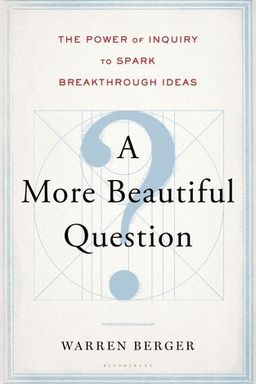
A More Beautiful Question cover

A More Beautiful Question

by Warren Berger

A More Beautiful Question delves into the art of asking the right questions to spark innovation and transformation. Warren Berger illustrates how curiosity-driven inquiry can unlock new opportunities, fuel creativity, and lead to personal and professional breakthroughs.

The Power of Asking Beautiful Questions

Why do some people and organizations continually innovate while others settle into routine? Warren Berger argues that the difference lies in their ability to ask beautiful questions—open, ambitious inquiries that spark discovery, connection, and action. A beautiful question reframes what you take for granted, imagines what hasn’t been done, and leads toward meaningful change. It’s the bridge between curiosity and creation. In his book, Berger shows how a life—and a company—can be reinvented through questions that challenge purpose, reveal deeper motives, and invite experimentation.

At its core, the book teaches a progression: start with Why questions to uncover context, move to What If to explore possibilities, and finish with How to act and learn through testing. This simple yet powerful loop threads through examples from inventors, educators, and entrepreneurs. Edwin Land invents the Polaroid when his daughter asks why she can’t see her photo instantly; Van Phillips changes prosthetics by asking why artificial feet don’t mimic nature; Nike, Intel, and Panera reinvent themselves through strategic questions of purpose and direction.

From Curiosity to Creation

Berger contends that good answers are plentiful, but good questions are rare. In an age of information abundance, the value of inquiry has never been greater. Machines like IBM’s Watson can produce millions of answers, but they depend on humans to pose meaningful questions. Questions, as Dan Rothstein and Luz Santana put it, are flashlights guiding you through uncertainty. They activate imagination, reveal hidden assumptions, and crystallize purpose.

Children excel at this, asking hundreds of questions a day before school and culture teach them that certainty is safer than curiosity. Berger examines how this decline happens—through standardized education, social hierarchies, and fear of failure—and then shows how individuals and organizations can revive the questioning habit. The evidence from neuroscience (John Kounios and Ken Heilman) reinforces that questions awaken associative thinking, connecting distant ideas until new insights emerge. Creativity blooms when inquiry precedes explanation.

Why–What If–How: The Architecture of Change

Berger’s central framework transforms questioning into an actionable cycle. You start by asking Why: Why does this problem matter? Why hasn’t anyone solved it? Why should I care? This reflective step breaks automatic assumptions and helps you see problems through fresh lenses (note: Einstein’s advice to spend most of your time defining the question perfectly reflects this spirit).

Next, you stretch imagination with What If. This phase invites hypotheticals that suspend constraints. Intel escaped a failing product line by asking, “If we were kicked out and replaced, what would the new CEO do?” Pandora’s Tim Westergren imagined “What if we could map the genome of music?” What If encourages connective inquiry—cross-domain borrowing, metaphors, and serendipitous mashups.

Finally comes How—the stage of experimentation and realization. How do you test this in real life? How do you turn a bold concept into a workable prototype? This stage blends design thinking’s emphasis on iteration with Lean Startup’s “build to learn” ethos. Berger emphasizes that prototypes are “questions embodied”: each one tests an assumption, surfaces flaws, and asks new Whys. Van Phillips built hundreds of prosthetic feet; Gauri Nanda evolved Clocky through many failed versions; each attempt generated learning instead of defeat.

Teaching and Living the Questions

Berger celebrates teaching people to question—from the classroom to civic life. The Right Question Institute’s Question Formulation Technique (QFT) trains students and citizens to generate, refine, prioritize, and act on their own questions. That act of ownership—the shift from being told to being curious—builds confidence and autonomy. Likewise, in organizations, leaders can become “chief questioners” who model curiosity instead of omniscience. Sheryl Sandberg, Jack Dorsey, and Jim Hackett show that culture transforms when leaders publicly ask instead of dictate. Inquiry becomes a leadership competency, not a weakness.

A Culture of Inquiry and Experimentation

At scale, Berger argues, you must design systems to protect questioning—structures like Google’s 20% time, LinkedIn hack days, Gore’s lattice system, or Steelcase’s Thinking 2.0 training. These create safe “Petri dishes” where experimentation and failure are rewarded. Cultures that measure learning rather than perfection are the ones that evolve. Eric Ries’s Lean Startup insights reinforce this idea: every initiative should answer “What will we learn?” rather than “What will we prove?”

Finally, Berger turns to personal transformation. He urges you to find and live your own beautiful question—the inquiry that energizes and organizes your life’s direction. Jacqueline Novogratz builds Acumen Fund around “What if we could invest patiently to tackle poverty?” Doug Rauch leaves Trader Joe’s to ask “Why do people go hungry when food is wasted?” These questions guide purpose over decades. By asking deeply, imagining freely, and experimenting persistently, you convert curiosity into contribution. The book teaches that living with questions—rather than rushing to answers—is not uncertainty; it is mastery in motion.


The Framework for Curiosity and Change

Berger’s Why–What If–How framework translates curiosity into a practical method for creativity and innovation. You can use it to reframe problems, open imagination, and channel learning into outcomes. It mirrors scientific inquiry (observe–hypothesize–experiment) but keeps emotional ownership and playfulness at its core.

Step 1: Why – Reframing

Start by zooming out. Asking Why moves you from automatic execution to deeper understanding. When Van Phillips asked “Why are prosthetic feet still primitive?” he stopped blaming “them” and took personal ownership—enrolling in prosthetics school and redefining the problem from inside. This act of reframing converts frustration into agency. Similarly, leaders like Keith Yamashita advise asking “Who were we when we were at our best?” to rediscover authentic purpose.

Step 2: What If – Connective Inquiry

Once clarity forms, imagination begins. What If lets you remove constraints and connect disparate domains. It’s the territory of combinatorial creativity. Berger offers examples: Tim Westergren merged biology’s genome mapping with music tagging to form Pandora; Joe Woodland transformed Morse code into barcoding while doodling on a beach. Incubation matters—step away, walk, rest, and allow subconscious connections (Heilman’s “neural forest” metaphor). This stage rewards play, not precision.

Step 3: How – Doing Through Experiment

The How stage converts questions into tests. Build quick prototypes, pilot programs, or small experiments. Failure becomes diagnostic, not fatal. Berger draws from design thinking: a prototype is a “question embodied” (IDEO). Diego Rodriguez and Eric Ries echo that progress depends on learning cycles, not winning bets. The marshmallow experiment (kindergarteners quickly testing structures outperform MBAs who overplan) encapsulates why fast feedback matters. The process helps you move from divergence to convergence—expand first, then narrow and act.

Insight

Ask, imagine, act. Every failure reopens a Why; every success poses a new What If. The framework never truly ends—it loops, teaching you to think and learn perpetually.

Practice this in any context: a student reframing an assignment, a team redesigning a product, or a citizen reconsidering social problems. The Why–What If–How habit turns inquiry into motion, curiosity into change, and learning into invention.


Reviving the Lost Art of Questioning

Children ask energetically, but adults often forget how. Berger examines why questioning declines—and how to rebuild that muscle. Preschoolers spark hundreds of questions daily, but by middle school, this drops drastically. The causes are structural, cultural, and neurological. Schooling rewards answers. Society rewards conformity. And fear of looking ignorant suppresses curiosity.

Breaking the Decline

Education systems, designed for the Industrial Age, prize efficient outputs over exploration. Tony Wagner and John Seely Brown point out that knowledge is now a commodity—our unique skill is adaptability through questioning. Yet standardized testing and authority norms discourage students from asking. Middle-class children may be trained to challenge; working-class students often learn deference for safety. Berger calls this the “student cliff”: curiosity falls as authority rises.

Teaching Inquiry

You can reverse the trend by teaching inquiry explicitly. The Right Question Institute’s Question Formulation Technique gives learners a structure: generate questions without judgment, categorize them as open or closed, prioritize, then act. In Boston classrooms, this method transformed passive students into analytic thinkers owning their inquiry. The same method empowers adults—in community meetings, hospitals, and workplaces—to articulate their needs and rights.

Rebuilding Permission

Rekindling curiosity means creating safe spaces—classrooms, maker spaces, team rituals—where asking is rewarded. Deborah Meier and Luz Santana emphasize that trust fuels questions. You must design freedom into education, not just facts. When people own their curiosity, they rediscover the habit of learning independently.

Core Idea

When you teach people to ask, you give them power—not just information. Inquiry builds agency, empathy, and resilience in every domain.

Curiosity must be protected early and practiced lifelong. The craft of questioning—once learned—becomes the foundation for creativity, collaboration, and critical thought.


Hypotheticals and Connective Thinking

Imagination expands through hypothesis and connection. Berger’s concept of connective inquiry shows that creative breakthroughs often come from mixing ideas that don’t seem to belong together. Instead of linear logic, this stage thrives on serendipity and cross-pollination. Asking “What If” triggers associations across disciplines and uncovers unseen angles.

Thinking Wrong

John Bielenberg’s workshops teach you to “think wrong”: pair random fields or words so your brain breaks predictable patterns. Edward de Bono calls it lateral thinking—forcing odd collisions until originality appears. Berger recommends techniques like dictionary-word prompts and mental mashups between biology and design, art and logistics. These exercises mimic how creators like Joe Woodland rewired Morse code into barcodes or how Westergren blended musical taxonomy with genetics metaphors.

Playing with Constraints

What If questions often suspend boundaries: “What if money were no object?” or “What if we couldn’t fail?” Regina Dugan’s teams at DARPA and Sebastian Thrun’s labs used such provocations to chase radical innovation. Later, they reintroduced real-world constraints to refine solutions. Intel’s leaders asked the contrarian “What if we were kicked out?” to reimagine their business. This dance—liberate imagination, then constrain—defines productive creativity.

Incubation and Neoteny

Connective thinking also depends on rest. Psychologists like Julia Zabelina find that adults who “think young” exhibit greater creativity. Berger calls this neoteny—preserving the childlike curiosity into adulthood. Incubation allows disparate ideas to attach spontaneously. Taking walks, dreaming, or pausing lets your brain’s associative networks quietly recombine data from diverse experiences.

Creativity Insight

You expand imagination not by adding more data but by connecting data differently. Diverse inputs and playful relationships build cognitive flexibility—the soil from which insight grows.

To practice connective inquiry, seek variety, allow incubation, and embrace wrong turns. Every What If opens a combinatorial door to invention.


Leading with Questions

Modern leadership, Berger says, requires humility and curiosity more than certainty. You lead by asking—by becoming the chief questioner whose inquiries guide others to think deeply and act boldly. Command-and-control organizations reward confident answers; adaptive ones reward reflective questioning. The shift is cultural and systemic.

Why Many Leaders Stop Asking

The corporate reward system favors polished plans and short-term results. Questioners disrupt those patterns, so they’re often seen as inefficiencies. Eric Ries and Tony Wagner note that this bias against uncertainty stifles innovation. Without mechanisms to protect inquiry, organizations drift toward risk avoidance.

Reclaiming Inquiry

To lead through questioning, model it publicly. Dev Patnaik urges leaders to ask Why, What If, and How in forums and meetings. Jack Dorsey questioned payments until he devised Square’s first smartphone reader. Sheryl Sandberg challenged Facebook to ask “What business are we really in?” to find its true mission. These examples show that questioning directs collective intelligence toward strategic clarity.

Building Safe Inquiry Systems

Curiosity can be institutionalized. Create rituals and rewards: town-hall Q&As, question-storming sessions, experimental budgets, and public postmortems that start with “What did we learn?” Tim Ogilvie’s “petri dish” metaphor reminds leaders to protect spaces for unorthodox thinking. When people see questioning as legitimate work, organizations evolve continuously.

Leadership Insight

Questions can be distributed. The best leaders invite everyone to own part of the exploration so that curiosity becomes collective capital.

Leadership by inquiry replaces the illusion of control with the discipline of learning. When you make it safe to ask, you make it possible to grow.


Purpose and Experimentation

Purpose anchors curiosity. Berger’s chapters on Purpose Questions First and Experimentation show how organizations and individuals can ask Why to rediscover values before daring new experiments. Asking foundational questions—Why are we in business? Who do we serve?—produces coherence in times of change.

Purpose Questions

Keith Yamashita recommends asking “Who have we been at our best?” Patagonia uses its founder’s environmental mission to ground choices between profit and preservation. Nike reframed its identity by asking “Why is running fragmented?” and “What if a shoe could connect digitally?”—resulting in Nike+. Ron Shaich’s question “What does the world need most that we can uniquely provide?” led Panera to create pay-what-you-can cafes. Berger advises turning declarative mission statements into mission questions—ongoing invitations, not final claims.

Experimentation Habit

Eric Ries and Herminia Ibarra expand the How phase with practical testing. Instead of big bets, run small, learn-focused experiments. Ask “What will we learn?” rather than “What will we prove?” Businesses like Panera used social initiatives as learning labs; innovators like A.J. Jacobs and Drew Houston used life experiments to refine identity and passion. The playful approach becomes rigorous because each trial clarifies purpose.

Scaling Meaning, Not Just Success

Berger’s insight: intentional questions and small tests combine into sustainable change. Failure becomes feedback. Success becomes refinement. The discipline is not just to act but to keep asking why and what next. Purpose provides the compass; experimentation provides motion.

Application Insight

In both business and life, build what teaches you the most; scale what aligns with purpose. Everything else is data for your next question.

Purpose Questions First ensures that you pursue innovation aligned with meaning. Experimentation converts vision into learning. Together, they fuse curiosity with coherence.


Living Your Beautiful Question

The book culminates in personal transformation. Berger invites you to find and live a beautiful question—a deeply meaningful inquiry that energizes and guides your life choices. Such a question isn’t easy or quick; it’s alive, evolving, and demanding. It becomes a compass rather than a goal.

Examples of Living Inquiry

Jacqueline Novogratz shaped Acumen Fund around one question: “What if we could invest patiently to tackle poverty?” Doug Rauch left Trader Joe’s with “Why do people go hungry when food is wasted?” Their questions became lifelong projects. Berger contrasts these with transient goals—showing that enduring questions motivate sustained commitment through difficulty.

Finding Your Question

Start by asking When do I feel most alive? What childhood passions do I miss? These appreciative inquiries reveal purpose sparks. Paul Bennett of IDEO asks “How do I stay inspired?” and designs daily rituals to collect insights. Drew Houston’s metaphor—find your “tennis ball”—describes this relentless pull toward what fascinates you.

Act and Iterate

Living your question means experimenting continuously. Herminia Ibarra recommends testing through short-term roles or side projects. A.J. Jacobs’s life experiments prove that transformation comes through doing, not planning. Jonathan Fields reminds you to imagine recovery before risk; this reduces fear and increases courage. Each small experiment reshapes your question and refines your understanding of meaning.

Final Insight

Your question chooses you as much as you choose it. Living with inquiry keeps purpose dynamic, creativity elastic, and progress authentic.

Berger’s legacy message is simple yet profound: build your life around a question worth pursuing. Keep asking, keep exploring, and let curiosity lead you into contribution and self-discovery.

Dig Deeper

Get personalized prompts to apply these lessons to your life and deepen your understanding.

Go Deeper

Get the Full Experience

Download Insight Books for AI-powered reflections, quizzes, and more.