
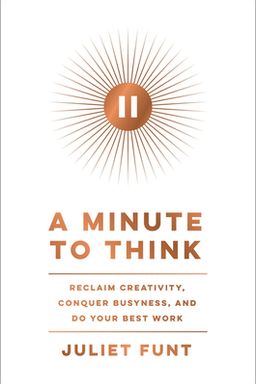
A Minute to Think cover

A Minute to Think

by Juliet Funt

A Minute to Think by Juliet Funt is a transformative guide for reclaiming creativity and conquering busyness. It reveals how strategic pauses can boost productivity and creativity, offering practical advice to navigate the modern work environment more effectively.

Reclaiming White Space: The Missing Ingredient in Modern Work

Have you ever ended your day exhausted but unable to answer what you really accomplished? In A Minute to Think, Juliet Funt argues that our modern obsession with busyness has stolen something we desperately need: white space — open, unstructured time that fuels creativity, clarity, and performance. In a culture where every pause is filled and every spare moment is crammed with productivity, Funt challenges us to rediscover the power of doing absolutely nothing for a moment. It’s not laziness; it’s strategy.

Funt contends that the lack of space in our calendars doesn’t just make us stressed—it makes us stupid. Constant motion blocks creative insight, obstructs reflection, and leads to what she calls the Age of Overload. Her remedy is deceptively simple: embrace strategic pauses that recharge our thinking and restore oxygen to our overworked minds. White space isn’t a luxury; it’s the essential nutrient that sustains good work.

The Problem: The False God of Busyness

From executives scarfing peanut butter at their desks to parents emailing while pushing kids on swings, Funt paints a heartbreaking portrait of how busyness has become a badge of honor—a “false god” we worship. We have equated activity with productivity, quantity with quality. But the more we do, the less we think. She writes about people like Mindy, the “Peanut Butter Manager” who worked through lunch, or Pete, the overburdened firefighter turned executive who ended up in the ER with stress-induced breathing problems. These stories aren’t exceptional—they’re universal.

Funt calls our compliance with this constant-motion culture an act of self-sabotage: “It’s our consenting that’s killing us.” We fill every moment not because someone makes us, but because it feels safer to stay busy than to risk pausing and confronting the void. This is what psychologist Juliet Schor calls “performative busyness”—performing productivity for others to feel worthy, even when it drains us.

The Solution: Strategic Pauses and the White Space Mindset

White space, Funt explains, is “time with no assignment.” It’s the intentional pause between meetings, tasks, or thoughts that lets our minds breathe. She compares it to oxygen feeding a fire. Without space, even the most gifted professionals can’t ignite their best ideas. A strategic pause may last a few seconds or several hours—it’s a moment of chosen stillness, not idleness. And this is the paradox: stepping back isn’t falling behind; it’s how we surge ahead with creativity, focus, and intention.

Research supports her claim. Neuroscientists like Adam Gazzaley (University of California, San Francisco) show that the brain’s frontal lobe—the epicenter of decision-making and creativity—requires downtime to regenerate. Without pauses, we fall into cognitive fatigue, making poorer decisions and losing perspective. Studies have found that even thirty-second micro-breaks can boost focus, and longer reflective periods lead to clearer insights. In short, your brain works better when it’s not constantly working.

Structure of the Book: From Awareness to Action

A Minute to Think unfolds in three parts. The first explores our culture of insatiability: why we keep saying yes, conforming to overwork, and tolerating wasteful habits. The second introduces The White Space Way—a practical system built around pausing, simplifying, and recalibrating our urgency. The third applies those tools to specific work challenges: meetings, email, communication, and team norms.

Throughout, Funt’s humor and real-life anecdotes make the philosophy come alive. Whether it’s Tony Calanca, an executive who saved millions by pausing to think before negotiating, or the father who tells his kids “one at a time” while triaging patients in the ER, these stories show that white space isn’t abstract—it’s a doable, life-changing behavior that works in boardrooms, classrooms, and kitchens alike.

Why It Matters: From Burnout to Brilliance

Busyness, Funt argues, is crowding out the human elements of work: creativity, strategy, empathy. We’ve traded depth for speed. But organizations that reintroduce space—like Southwest Airlines simplifying its fleet or Google’s 20 percent innovation time—prove that “less” truly can yield “more.” White space doesn’t just make work better; it makes life better. It returns our ability to feel joy, presence, and meaning.

“Thinking is time well spent,” Funt reminds us—a radical statement in an age that prizes doing over being. Taking a minute to think is not indulgence; it’s leadership in its purest form.

If you’ve ever felt like Wile E. Coyote—legs spinning midair after running off a cliff—Funt’s book is your call to scramble back. Through strategic pauses, simplification, and the courage to say no, you can replace chaos with clarity. A Minute to Think is ultimately about reclaiming humanity at work and turning space into strength. In doing so, we learn the modern paradox: the best way to move forward is to stop—just for a minute—and think.


The Culture of Insatiability

Juliet Funt identifies our modern workplace as caught in what she calls the Culture of Insatiability—a never-ending hunger for more. We are insatiable for productivity, recognition, and speed. But like athletes who never rest between sets, we’re burning out. This culture thrives on three intertwined forces: insatiability, conformity, and waste. Understanding them is the first step toward escaping their grip.

Insatiability: The Endless Climb

Funt likens insatiability to the futile cram sessions of college students cramming for tests—cramming knowledge, work, and success until nothing sticks. Like Craig, an executive commuting four hours a day to maintain a luxurious lifestyle, we’ve confused “having more” with “being more.” In organizations, this manifests as unmanageable workloads and goals that keep expanding. Gallup’s studies on burnout, which Funt cites, show that over 60% of employees feel overwhelmed—but few feel empowered to slow down.

Some companies break the cycle: In-N-Out Burger chooses reasonable profits over relentless maximization, and Basecamp famously built its entire culture around calmness and short workweeks. “Less,” Funt says, “liberates.” Fewer meetings, fewer products (Steve Jobs cut Apple’s lineup from 350 to 10), and fewer unexamined impulses create space for focus and quality.

Conformity: Following the Herd

To illustrate conformity, Funt recalls her father Allen Funt’s famous Candid Camera experiment “Face the Rear.” Participants in an elevator mimicked actors turning away from the door simply because everyone else did. That’s how overwork norms spread: when everyone checks email late at night or attends unnecessary meetings, we do too. Funt calls this positive conformity flipped on its head. Instead of mirroring sanity, we mirror exhaustion. The cure? Courageously model something different, and others will follow—Solomon Asch’s conformity studies showed even one dissenter can reduce conformity by 80%.

Waste: The Hidden Cost of Busywork

Finally, Funt exposes the epidemic of waste—redundant emails, unnecessary reports, and “reorgs” that rearrange chairs but not behavior. Using data from her consulting firm’s audits, she estimates companies lose over $1 million annually for every 50 professionals due to pointless busywork. Yet nobody tracks this loss because “there’s no line on the P&L for meetings-so-boring-I’m-playing-hangman.”

Her distinction between bricks (logistical improvements like new software) and mortar (behavioral changes like saying no) is crucial. Most organizations add bricks endlessly but lack the mortar to hold them together. Without addressing behavior, efficiency efforts collapse. She urges leaders to develop cultural mortar by teaching employees how to pause, think, and simplify. Only then can companies transform incessant busyness into sustainable productivity.

In the “Culture of More,” Funt notes, there’s no final victory—you just get faster at running in circles. White space is the off-ramp from that loop.

Funt’s conclusion is both sobering and hopeful: we’ve built a world where forward motion feels compulsory, but we still hold the key to release. By redefining value not as “more” but as “enough,” and by making behavioral shifts rather than superficial fixes, individuals and companies can reclaim meaning, calm, and intelligent work. True success, she says, isn’t doing everything—it’s choosing what matters most and giving it room to breathe.


Strategic Pause: Your Hidden Superpower

The cornerstone of Funt’s teaching is the strategic pause—a moment of chosen stillness that allows white space to appear. Far from laziness, it’s a performance enhancer for thinkers, creators, and leaders. As she quips, “Even boxers get a minute between rounds.”

What the Science Says

Neuroscience confirms that the brain needs pauses to function optimally. Adam Gazzaley’s research shows that cognitive fatigue depletes the frontal lobe’s resources, impairing decision-making and creativity. Studies published in Cognition demonstrate that introducing short breaks doubles attention spans. Even thirty-second “micro-pauses” can increase accuracy and focus. As Harvard’s Teresa Amabile observed, high creativity thrives under moderate—not extreme—time pressure.

Four Uses of the Pause

  • Recuperate: Pause to refresh your energy and focus. Like an athlete between sets, rest sustains peak performance.
  • Reduce: Pause to simplify workloads—cancel tasks, delegate, or shrink commitments.
  • Reflect: Pause to gain perspective, make better decisions, and avoid knee-jerk responses. Leaders like Jeff Weiner (LinkedIn) and Bill Gates use reflective pauses for clarity.
  • Construct: Pause to create—to strategize, plan, innovate. It’s how 3M invented Post-its and how John Cleese defines the creative “open mode.”

The Wedge: A Practical Tool

The simplest way to integrate white space into real life is through what Funt calls The Wedge—a brief gap you consciously insert between two actions. It might be three deep breaths before replying to an email, a one-minute walk between meetings, or a pause before reacting to criticism. This tiny space separates stimulus from response, granting freedom from reflex and clarity of thought. As network engineer Sean McDonald discovered when he solved a major outage by pausing mid-crisis, “The moment I stopped, the answer came.”

Dealing with Negativity Bias

One challenge in pausing is the mind’s negativity bias—its tendency to fill emptied moments with worry. Funt advises distinguishing between emotion (which must be felt) and worry (which must be contained). Her method: schedule your worrying. Set a daily appointment with your fears so they don’t hijack your white space. Contain the rumination, and you reclaim inner silence.

“Find one, make one, allow one,” she writes. “If you abandon every other tool and do nothing else but pause, you win.”

Whether you run a global company or a household, the same truth applies: Everything works better after a pause. The strategic pause is your hidden superpower—a tool so small it fits between breaths, yet powerful enough to change how you think, decide, and live.


The Thieves of Time

Why do we lose white space so easily? Funt identifies four internal culprits, the Thieves of Time: Drive, Excellence, Information, and Activity. Each thief begins as an asset but mutates into an overload when unchecked. Understanding them helps us reclaim control over our days.

Drive → Overdrive

Drive fuels achievement—but when unrestrained, it becomes overdrive. Ernest, a restaurant owner in Nashville, thrived on drive until he expanded too fast, demanding “half-baked” execution from his team. The thief of drive convinces high achievers that “more is always better.” It ignores rest, balance, and sustainability until collapse arrives.

Excellence → Perfectionism

Perfectionism masquerades as professionalism. Funt, a self-professed perfectionist, jokes that she finds aesthetic pleasure in “color-coded bookshelves and sharp pencils.” But excellence can eat time like a black hole. Her metaphor—a pouch of gold coins representing daily reserves of excellence—is unforgettable: spend them where they count or run out before day’s end. The key is knowing when “good enough” truly is good enough.

Information → Overload

The information thief thrives in data-heavy workplaces. Funt recalls Steve Martin (a real Microsoft data scientist, not the comedian) who hid a $50 gift card note inside official documents to see if anyone read them. No one did. Yet his team kept producing more reports the next year—proof that most of us confuse quantity of information with value. The cure is discernment: know what you truly need to know and delete the rest.

Activity → Frenzy

Funt’s thief of activity describes our compulsive need to do. Her favorite illustration is the mole—tunneling all day, aimlessly, just to stay busy. Research even shows people prefer giving themselves electric shocks over sitting silently for fifteen minutes. “Relaxation-induced anxiety,” she quips, is becoming a real diagnosis. Activity feels productive, but motion without meaning burns us out and blocks reflection.

“The thieves are sneaky,” says Funt. “They whisper success but steal your oxygen.”

To defeat them, you must name them. When you notice yourself racing, tweaking, reading too much, or overcommitting, label the behavior. Awareness is 80% of recovery. As her mentor said, “Every failing is just an overflowing cup of a virtue.” With balance, these strengths become allies again—but left unchecked, they rob you blind of time, energy, and joy.


Simplification: Reclaiming the Best by Removing the Rest

After diagnosing overwork, Funt offers her most actionable framework: The Simplification Questions. These four deceptively short prompts help you strip away waste and regain clarity. Her guiding metaphor? Michelangelo freeing David from marble—not by adding but by removing. “We chisel away the unnecessary to reveal our best work.”

The Four Simplification Questions

  • Is there anything I can let go of? (counters Overdrive)
  • Where is 'good enough,' good enough? (counters Perfectionism)
  • What do I truly need to know? (counters Information Overload)
  • What deserves my attention? (counters Frenzy)

Real Stories of Simplification

Donna, a marketing director obsessed with perfect spreadsheets, used “Where is good enough, good enough?” to stop overpolishing and gained back hours of focus. Mark, a business owner overrun by activity, used “What deserves my attention?” to mentor his staff instead of micromanaging them. Teams applying the framework even cut meetings, slide decks, and reports in half.

Funt teaches people to observe before cutting—her “Be Jane Goodall” method. Like the anthropologist, watch your workplace habits curiously before intervening. Once you understand the ecosystem, start reducing both “tuna” (major projects) and “krill” (small inefficiencies). Even deleting one report field for a sales team can save thousands of hours yearly.

Why Reduction Feels Hard

We resist simplification because of the IKEA Effect—our tendency to overvalue what we’ve built. Funt’s team watched executives defend pointless reports simply because they’d created them. Letting go feels like loss. Yet true leadership means “killing your darlings” so your best work can shine. As one executive told her after eliminating busywork, “We finally stopped mistaking motion for progress.”

Simplification, then, is not minimalism for its own sake—it’s a rediscovery of purpose. The fewer tasks you juggle, the more fully you can invest in each one. When you subtract the nonessential, you don’t get less—you get clarity, creativity, and joy.


Escaping Hallucinated Urgency

One of Funt’s most startling concepts is Hallucinated Urgency—the false belief that everything is equally urgent. This chronic fight-or-flight state, she argues, is the real addiction of modern professionals. We’re not just busy; we’re high on adrenaline. Every ping feels like a fire. Every reply, a lifeline. In reality, most “urgent” demands are emotional, not tactical.

Three Categories of Urgency

  • Not Time Sensitive: Can wait. Most tasks live here.
  • Tactically Time Sensitive: Truly impacts business results and deserves timely action.
  • Emotionally Time Sensitive: Feels urgent due to anxiety, curiosity, or ego—but isn’t.

ER nurse stories in the book reveal true urgency: “Is there blood? Is there a pulse?”—that’s urgent. Most of what fills our inboxes doesn’t qualify. The cure begins with adding The Wedge between impulse and response. Before replying to emails or jumping into crises, pause and ask: Which type of urgency is this?

Tools that Tame the Rush

Funt proposes the Yellow List—a simple running list (digital or handwritten) of nonurgent items to discuss later. Instead of spraying messages all day, you batch them, reducing interruptions by as much as 80%. She also encourages leaders to teach clients their “urgency ladder”—email for normal, call for pressing, text for critical. Small clarity shifts create big calm.

The payoff of slowing down is executive presence. Leaders who pause before reacting project confidence and authority. As radio host Ken Coleman said about Apple’s Angela Ahrendts, “She paused for two full seconds before answering—and 12,000 people waited in silence, captivated.”

“It’s not about your response time,” Coleman told Funt. “It’s about your response.”

Hallucinated urgency isn’t just a work ailment—it invades vacations, family dinner, and self-worth. Funt urges readers to reclaim leisure unapologetically. The companies with the healthiest cultures—like FullContact, which pays employees to disconnect—understand this truth: resting is not recovering from work; it’s part of work. Pausing, not racing, is the real competitive edge.


Redesigning How We Communicate and Meet

Funt’s later chapters turn from personal mindset to team culture, showing how white space transforms communication and meetings. She argues that the modern office is a swirl of unnecessary talking—emails, chats, meetings stacked without meaning. But through clear norms, shared language, and courageous “no’s,” teams can reclaim sanity.

2D vs. 3D Communication

Her simple test distinguishes messages that belong in 2D (email, text—data-driven) from those that require 3D (real-time conversation—emotion or complexity). If it involves tone, nuance, or creativity, it’s 3D. Moving 3D conversations out of email reduces confusion and deepens connection. This shift also prevents the invisibility that occurs when tone gets lost in text.

The 50/50 Rule and The Hourglass

Funt’s 50/50 Rule states: “Anything that bothers you at work is 50% your responsibility until you’ve asked for what you want.” Courageous communication ends silent resentment. Her four-step process—Vent, Empathize, Prepare, Share—turns complaints into requests. The Hourglass framework then helps decide when to say no. Before answering a request, pause at the neck of the Hourglass to examine motives, history, and future consequences. The result: fewer impulsive yeses, fewer regrets.

Reclaiming Meetings

Funt reimagines meetings using the acronym SBH—Shouldn’t Be Here. If you’re in a meeting wondering why, you probably shouldn’t be. Awareness alone begins change. She suggests four rightful responses to any invite: Accept, Decline, Send a Substitute, or Be On Call. This choice-based culture restores autonomy and trims wasted hours. Add Hall Time—5–10 empty minutes between meetings—to digest and mentally reset, and the clarity compounds.

Finally, she teaches “Phone Narration” to fix digital distractions—simply state aloud what you’re doing when you glance at your device. It sounds small, but it keeps relationships intact. Meetings improve when participants stay kind, honest, and necessary—the three filters she asks everyone to use.

Meetings, she reminds us, can again become “our favorite way to make magic together”—if we leave out the clutter and bring back intention.

These practical shifts turn white space from an individual habit into a team superpower. By building shared norms around how they talk, meet, and say no, teams move from chaos to coherence. It’s not just less noise; it’s more meaning.


Life Beyond Work: Don't Miss the Ride

In her final chapters, Funt widens white space beyond office walls. Without time to think, she warns, we risk missing life itself. Drawing on stories of overworked parents, disconnected families, and deathbed regrets, she writes: “Work is a desperate substitute for living.” The ultimate goal of white space is joy, presence, and enoughness.

Permission to Stop

Guilt, she observes, is the modern barrier to rest. In one story, a woman refuses a sailing invitation because her boss glorifies exhaustion. Funt reframes leisure as productivity for the soul—“Balanced people work harder, live longer, and inspire others by example.” She even offers “permission slips” for readers to stop multitasking at home, step outside, or watch their kids play without needing an excuse.

Taming Technology and Parenting with Pause

Funt’s fiercest critique targets our device addiction. With humor and dread, she calls the smartphone “the devil’s cleverest weapon,” eroding intimacy one swipe at a time. Her antidote: purposeful boundaries (like deleting apps temporarily) and scheduled disconnection. Parents, she urges, must model pauses at home—letting kids be bored, underscheduling them, and resisting the panic to optimize every moment. “Most kids,” she writes, “should be way more bored.”

Rediscovering Joy

White space ultimately exists to make room for joy—both high joy (thrilling moments of passion) and deep joy (quiet gratitude and contentment). Funt’s reminders echo positive psychologists like Mihaly Csikszentmihalyi and his theory of flow: meaningful absorption comes only through presence. To practice, she recommends the Italian ideal of dolce far niente—the sweetness of doing nothing.

“Don’t miss the ride,” Funt concludes, telling of a woman who declined a joyride with her husband and never saw him alive again. “Many realize too late they’ve missed it—but it’s never too late to catch tomorrow’s.”

Whether you’re leading a company, raising kids, or simply trying to breathe between emails, A Minute to Think ends where it began—with sacred permission. Pause to see your life while you’re still living it. Stop for a second, watch the sunlight on the water, and remember: that’s the meaning of white space.

Dig Deeper

Get personalized prompts to apply these lessons to your life and deepen your understanding.

Go Deeper

Get the Full Experience

Download Insight Books for AI-powered reflections, quizzes, and more.