
Idea 1
Building a Brain for Math and Science Mastery
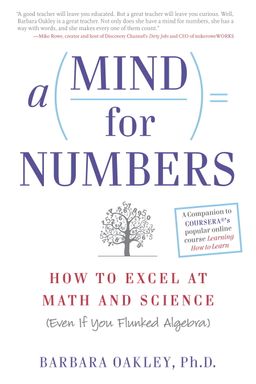
Have you ever stared at a math problem or scientific concept and thought, “My brain just doesn’t work that way”? In A Mind for Numbers, Dr. Barbara Oakley argues that anyone—no matter their background or supposed talent—can learn math and science effectively by understanding how the brain learns. Drawing on neuroscience, Oakley reveals that successful learners don’t rely on innate genius; they master the mechanics of learning, motivation, and memory. By retraining how you approach problem-solving, manage procrastination, and structure your practice, you can transform struggle into mastery.
Oakley’s central message is both simple and powerful: learning math and science isn't about raw intelligence—it’s about process. She divides thinking into two interacting mental states: the focused mode, used for active problem-solving, and the diffuse mode, which connects ideas and fosters insight. Most of us rely too heavily on focused thinking, assuming that grinding through problems leads to understanding. In reality, progress comes from alternating between focus and rest, effort and incubation—mirroring the creative rhythm of great scientists and inventors from Thomas Edison to Albert Einstein.
The Journey from Mathphobe to Engineer
Oakley’s story is the book’s emotional heart. Once a self-declared “mathphobe” who flunked geometry, she later became an engineering professor. Her life demonstrates that struggle with math isn’t a sign of stupidity—it’s a lack of mental tools. When she joined the U.S. Army and encountered real-world communication technology, she realized her limited skills restricted her options. Motivated to rewire her brain, she learned to study math using the same principles she later distilled in this book—breaking complex concepts into chunks, spacing practice, and letting her brain’s diffuse mode connect the dots while she rested.
Her transformation underscores one of her key findings: your brain is physically capable of change at any age. Like Nobel Prize–winning neuroscientist Santiago Ramón y Cajal’s “sculpting” metaphor, practice and persistence literally reshape your neural wiring. This message resonates with research from Carol Dweck’s Mindset: intelligence is malleable, not fixed.
Why Learning Feels Hard—and Why That’s Normal
In one of the book’s most reassuring insights, Oakley emphasizes that confusion, frustration, and temporary failure are not signs of incompetence—they are milestones of learning. Mathematics and science are difficult fields because they involve abstract, symbol-based reasoning. Our brains evolved for concrete tasks like navigation and conversation, not for manipulating calculus equations or electromagnetic fields. By acknowledging that discomfort is part of deep learning, you free yourself from anxiety and perfectionism. As psychologist Robert Bjork terms it, these “desirable difficulties” make knowledge stick long-term.
This mindset shift separates world-class problem solvers from frustrated students. When you hit a wall on a tough problem, your diffuse mode takes over, subconsciously rearranging ideas until the solution emerges suddenly—what Henri Poincaré called an “aha!” moment. In Oakley’s terms, this is the brain’s built-in magic: effort followed by release.
The Core Tools: Chunking, Spaced Practice, and Metacognition
At the foundation of Oakley’s system are three tactics that reshape learning habits:
- Chunking: Learning to group related pieces of information into unified mental concepts. For example, once you understand Newton’s second law (F = ma) conceptually, it occupies a single cognitive “chunk,” freeing mental space for advanced reasoning.
- Spaced repetition: Revisiting concepts over increasing intervals strengthens neural connections better than cramming. Like athletes building muscle, learners need rest and repetition to solidify skills.
- Metacognition: The ability to monitor your own understanding. Oakley warns of “illusions of competence”—when rereading notes feels productive but doesn’t create retention. Real learning involves retrieval and self-testing.
The takeaway is empowering: anyone can structure their study to align with how the brain naturally encodes knowledge. Instead of endless study marathons, Oakley champions 25-minute “Pomodoro” sprints of focused effort followed by restorative breaks. The balance of intensity and relaxation ensures both focused and diffuse modes contribute to learning.
Beyond Knowledge: Habits and Emotions
Oakley also teaches that mastering math and science is about mastering yourself. Procrastination, self-doubt, and fixed beliefs about intelligence sabotage learning more than lack of ability. Drawing from Charles Duhigg’s The Power of Habit, she reframes procrastination as a habit loop of cues, routines, and rewards that can be rewired. By shifting your emotional response from dread to curiosity—viewing study as a process, not punishment—you reprogram your brain’s approach to challenge.
Ultimately, A Mind for Numbers is not just a how-to manual; it’s a mindset revolution. Oakley fuses neuroscience, motivation psychology, and practical strategy to prove that persistence, structure, and playfulness can turn fear into fascination. Whether you’re a struggling student, a mid-career professional, or a lifelong learner, her message is universal: the human brain is not fixed—it’s fluid, adaptable, and infinitely capable of learning, one chunk at a time.