
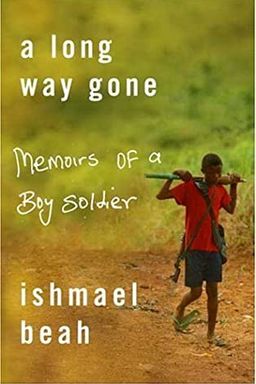
A Long Way Gone cover

A Long Way Gone

by Ishmael Beah

A Long Way Gone is Ishmael Beah''s gripping memoir of his harrowing experiences as a child soldier in Sierra Leone''s brutal civil war. Through his personal journey, Beah reveals the transformative power of kindness and resilience in overcoming unimaginable trauma and finding hope and redemption.

Surviving the Loss of Humanity

What happens when your childhood is stolen overnight? In A Long Way Gone, Ishmael Beah takes you on an unforgettable journey through survival, trauma, and redemption. He doesn’t just chronicle the atrocities of Sierra Leone’s civil war—he asks a deeper question about humanity itself: how do you reclaim it when you’ve been turned into a weapon? From innocent village boy to child soldier and finally to a survivor seeking peace, Beah’s memoir invites you to explore not only the horrors of war but also the remarkable resilience buried inside the human spirit.

Beah contends that war annihilates more than bodies—it dismantles identity, compassion, and memory. Through his firsthand account as a boy soldier, he illuminates how violence can become ordinary and how innocence can vanish in seconds. Yet, against the backdrop of unimaginable brutality, he uncovers the possibility of healing. This book asks you to consider whether forgiveness and love can truly coexist with the darkness of memory.

From Innocence to Chaos

When the civil war erupts in Sierra Leone, twelve-year-old Ishmael is more concerned with rap music and dance routines than with politics. His early chapters are filled with laughter, childish games, and a dream of performing American rap songs for his friends. But this innocence is swiftly shattered when rebels destroy his home village, forcing him to wander through forests and towns littered with corpses. The journey from village life to war becomes a symbol of what happens when normalcy collapses. The contrast between carefree boyhood and the chaos of war underscores the central tragedy: violence doesn’t just destroy lives—it corrupts the essence of childhood itself.

Descent Into Violence and Loss

Beah’s transformation into a soldier doesn’t happen overnight; it’s gradual, coerced, and manipulative. After losing his family and spending months starving and terrified, he’s recruited by the army under the guise of safety and revenge. The army becomes his surrogate family, feeding his pain with drugs, propaganda, and camaraderie. It’s easier to shoot when you’re numb, and the drugs—cocaine mixed with gunpowder—make killing mechanical. Beah shows you how trauma distorts morality; by the time he realizes what he’s become, he’s both victim and perpetrator. (Comparable to Viktor Frankl’s notion in Man’s Search for Meaning that survival can require suppressing one’s moral self.)

The Fragile Path to Healing

Eventually rescued by UNICEF, Ishmael arrives at a rehabilitation center where he must relearn humanity. Nurses, counselors, and friends like Esther offer unconditional kindness—but kindness hurts more than pain. It forces him to acknowledge guilt and loss. His journey to rehabilitation becomes a metaphor for rediscovering vulnerability. Esther’s repeated assurance—“It’s not your fault”—marks a turning point in Beah’s understanding of forgiveness. Healing, the memoir suggests, isn’t a single act but a series of small acceptances: of love, of sorrow, of memory.

Why This Story Matters

Beah’s memoir stands as a global mirror reflecting how easily humanity erodes under extreme circumstances. Wars may be fought differently, but their psychological consequences echo universally. His story doesn’t just belong to Sierra Leone—it belongs to anyone who has experienced trauma, displacement, or guilt. The book also offers a lens into child psychology under stress, the politics of humanitarian aid, and how storytelling itself becomes therapy. In the end, Beah’s survival—and his decision to write—is an act of defiance against silence. As readers, we are reminded that memory can both wound and heal; and that the most courageous act, perhaps, is the decision to remember.


The Shattering of Innocence

Beah’s narrative begins with a paradox: you can lose everything and not even realize it until it’s gone. In the early chapters, Ishmael is a boy obsessed with hip-hop music, American slang, and rap performance. He and his friends chase the sound of rhythm rather than the rumors of war. But when rebels invade, the familiar soundtrack of laughter is replaced by gunfire, and innocence evaporates. This loss of normalcy—the mundane joys of childhood—is the emotional entry point to his coming-of-age in a world where empathy becomes dangerous.

A Childhood Interrupted

The first rupture happens not with violence itself but with confusion. The boys watch refugees pass through their town long before they see a rebel. Their disbelief mirrors how faraway wars suddenly intrude into ordinary life. Ishmael’s experience becomes emblematic of countless child soldiers: violence begins as rumor, becomes spectacle, and ends as routine. When he returns to his village and finds corpses and blood-stained streets, there’s no space for mourning—only running. Childhood memories turn into survival mechanisms.

Fear Becomes a Way of Life

As Beah and his friends wander from village to village, starvation replaces schooling. Fear drives isolation—people mistake them for rebels and threaten to kill them. Innocence turns from virtue to liability. Beah’s sharp observation: the very qualities that once made him harmless now provoke terror in others. This inversion of social logic—children becoming feared—marks the true collapse of community. (In psychology, this correlates with how soldiers lose empathy through forced survival conditioning, seen in works like The Body Keeps the Score by Bessel van der Kolk.)

Beauty Amid Destruction

Even in fear’s shadow, Beah refuses to forget beauty. When he discovers the Atlantic Ocean for the first time, he marvels at the sheer vastness, describing the waves as both threat and comfort. The ocean’s immensity contrasts with human cruelty, reminding us that nature remains indifferent to war. In that moment, Ishmael glimpses an alternative to madness—a reason to keep living. This detail reveals Beah’s lifelong impulse toward wonder, even when surrounded by loss.

His walking and wandering offer a metaphor for identity shattered but not destroyed. Each landscape holds a memory, and each survival is an act of desperate preservation. The innocent boy who loved rap still exists somewhere, but now buried under trauma. Beah’s journey from innocence to terror is the clearest illustration of how easily youth can be manipulated yet how resolutely it can endure.


The Making of a Child Soldier

There’s a harrowing moment when Ishmael, no longer a fleeing boy, is handed a gun and told to kill. This is the pivot on which the memoir turns—the transformation of childhood into machinery. Beah’s recruitment into the army is carried out under the guise of safety. But what begins as self-defense against rebels soon devolves into addiction, violence, and numbness. It’s not only physical enlistment; it’s psychological captivity.

The Machinery of Manipulation

The soldiers feed the boys revenge as justification. They say the rebels killed their families—so shooting back becomes moral, even holy. This is a crucial sociological insight: trauma makes obedience effortless. The boys are given drugs, slogans, and camaraderie until killing feels like belonging. As Beah writes, after his first murder, “My mind snapped.” It’s this emotional break that turns a child into a soldier, not the gun itself. (Anthropologist Carolyn Nordstrom, in Shadows of War, describes similar psychological conditioning among combatants in Mozambique.)

Addiction and Annihilation

Mixed drugs—“brown brown,” a mixture of cocaine and gunpowder—become the fuel of Beah’s transformation. The substances suppress empathy and amplify aggression. Violence becomes mechanical; killing stops being a moral dilemma and becomes sensory excitement. Beah’s recollection of slaughtering rebels after losing friends reveals how vengeance erodes humanity. Soldiers become addicted not just to drugs but to control. The combination of substance use and propaganda distills trauma into action without conscience.

Identity in Uniform

Uniforms provide both empowerment and erasure. The military shorts, boots, and headbands symbolize entry into adulthood, but they also erase individuality. Beah loses his name, becoming “Green Snake,” his squad nickname. This duality—ownership and obliteration—illustrates how war devours identity to shape obedient killers. He belongs, yes, but at the cost of personal autonomy. The camaraderie among the boys masks the deeper horror: they’re not brothers in arms but children learning to erase their own compassion.

By exposing this process, Beah unmasks the machinery through which children are weaponized worldwide—from Sierra Leone to Sudan, Afghanistan, or Colombia. Every step in his “training” mirrors the systematic psychological manipulation that turns victims into instruments. It’s not war’s brutality alone—it’s its seduction, its ability to promise purpose where only trauma existed.


The Cost of Survival

Living to tell the story isn’t the same as surviving. Ishmael learns that staying alive in war means killing, but surviving afterward means remembering—and that’s harder. When he loses his family, his home, and later his own innocence, each act of endurance becomes both triumph and punishment. Survival, as Beah depicts it, demands the sacrifice of humanity itself.

Fleeing Is Not Freedom

In chapter after chapter, escape becomes a cycle, not liberation. Each village promises safety and then collapses into new horror. The repetition mirrors how trauma traps the mind: running never ends because danger becomes psychological. Even after he’s saved by UNICEF, Ishmael describes himself as “still running.” This realization redefines what survival means—it’s not about escaping death, but learning to bear memory.

The Body’s Betrayal

Walking for days without food, sleeping with bleeding feet, or sitting beside burning villages—Beah shows that the body eventually becomes an accomplice to trauma. Pain stops registering. Hunger replaces emotion. At one point, he describes how crying consumes too much energy to maintain. This psychological numbness is survival’s hidden cost. (Neuroscientist Dan Siegel notes that prolonged trauma can rewire the brain to suppress feeling—a process visible throughout Beah’s story.)

Finding Safety in Strangers

Even amid horror, human kindness flickers. The nameless fisherman who rescues Beah and his companions after they are attacked teaches that compassion often exists without identity. The man never gives his name—“It is not necessary,” he says—because anonymity protects both sides from betrayal. This simple encounter contrasts sharply with the faceless cruelty of the war. Such moments remind readers that survival in chaos depends not only on endurance but on unexpected empathy.

The paradox of survival threads the entire memoir: enduring violence requires forgetting, but escaping it requires remembering. When you’ve seen death too many times, memory itself becomes the battlefield. At the end, Beah acknowledges that telling his story is not closure—it’s continuation. To truly survive, he must make meaning out of pain, not erase it.


The Long Road to Rehabilitation

Rehabilitation, in Beah’s world, isn’t about fixing someone—it’s about rebuilding the ability to feel. After his rescue, he arrives at the “Benin Home,” a center for child soldiers in Freetown. There, medicines replace drugs, counselors replace commanders, and love replaces fear. But each substitution feels wrong at first. The children, conditioned for violence, attack staff, rebel against authority, and crave narcotics more than food. Healing is a war of its own.

Learning to Trust Again

The key figure in Beah’s rehabilitation is Esther, a nurse who becomes a surrogate sister. Her persistent kindness—listening without judgment, offering gifts like music tapes—breaks through his defenses. “It’s not your fault,” she tells him, and while the phrase infuriates him, it eventually reshapes his understanding of guilt. Esther doesn't try to erase Ishmael's past; she gives him permission to coexist with it. Through her, Beah discovers that healing begins with being seen, not cured.

Memory as Medicine

Telling his story becomes therapy. When Beah recounts killing rebels or being shot himself, Esther listens silently, resisting the urge to judge or rescue him. This silence mirrors the psychological concept of “bearing witness,” where the act of storytelling helps survivors reclaim agency. The transformation is gradual: nightmares persist, migraines continue, but exposure reduces their power. Beah replaces violence with language—a shift from action to articulation, from trauma to meaning.

What Forgiveness Really Means

Beah’s rehabilitation also teaches that forgiveness isn’t about forgetting—it’s about redefining self-worth. He learns to separate his victimhood from guilt, accepting that his violence was coerced. This process parallels Viktor Frankl’s belief that meaning can emerge even from suffering. When Beah begins to write and speak publicly about child soldiers, he transforms his pain into empathy. Rehabilitation, therefore, isn’t an endpoint—it’s a reclamation of narrative.

Beah’s time at Benin Home culminates in rediscovering music. When he plays reggae or raps again, the soundscape that once symbolized innocence becomes the soundtrack of recovery. Art, in his journey, is not escape—it’s remembrance. And through remembrance, he begins to rebuild trust one rhythm at a time.


Rediscovering Family and Hope

Family, in Beah’s memoir, is not defined by blood but by connection. After losing everyone he loves, he unexpectedly reunites with an uncle who offers him a home and the comfort of belonging. This moment reveals a central insight: healing doesn’t happen in isolation—it begins with relationship. Through his uncle’s humor, kindness, and persistence, Beah learns how ordinary affection can mend extraordinary wounds.

Finding Home After War

Living with his uncle’s family forces Beah to relearn everyday life—shared meals, chores, laughter. These simple acts evoke the “normalcy” war had erased. His cousins treat him as their brother, and his aunt’s cooking becomes symbolic of stability. But this domestic comfort is fragile. When a new coup erupts in Freetown, gunfire returns, reminding Beah that peace is always temporary. His uncle’s illness and death reopen the wound of loss, forcing him to confront how grief repeats itself even after survival.

Love as Resistance

What distinguishes this phase of Beah’s story is his willingness to seek love. His uncle’s embrace and his counselor Esther’s compassion show that affection itself can be revolutionary in a context of violence. Emotional bonds act as antidotes to trauma. Beah’s newfound family allows him to imagine a life beyond survival—to think, hope, and plan. Love becomes a form of resistance against despair.

Leaving Home to Save Himself

After his uncle dies, Beah decides to flee to Guinea and later, through Laura Simms—a storyteller he met at a UN event—to the United States. His departure is not escape but renewal. He chooses to live differently, not merely to survive. The act of migration transforms his grief into agency. When he sees snow for the first time in New York, feeling both freezing and awe, it’s as if the world is offering him a clean slate. Through chosen family and storytelling, Beah reclaims the right to imagine peace.

His journey reminds you that healing isn’t about returning to who you were—it’s about becoming someone new through connection. Family is the moral geography of recovery.


The Power of Storytelling and Memory

Beah’s final chapters shift from survival to storytelling. Writing itself becomes his salvation. In his postwar life, memory is both poison and medicine: remembering can rupture peace, but forgetting can erase identity. He writes to bridge those contradictions, transforming private trauma into collective testimony. His memoir redefines storytelling as activism—a way to turn silence into moral awareness.

Memory as Resistance

In his closing reflections, Beah argues that memory restores dignity to the voiceless. To forget atrocities is to risk repeating them. By narrating his experiences, he honors not only his survival but those who didn’t make it. His detailed recollections—blood on the sand, echoes of laughter amid ruins—turn horror into historical record. Storytelling becomes resistance.

Writing as Healing

In New York, Beah tells his classmates there was war “everywhere.” Their casual “cool” response pushes him to write. The act of writing translates unspeakable pain into universal empathy. Like memoirists Elie Wiesel or Primo Levi, Beah insists that bearing witness isn’t confession—it’s duty. His words invite readers to feel rather than judge, to imagine rather than distance. He doesn’t sensationalize death; he humanizes survival.

Global Voice, Personal Truth

Beah evolves from victim to messenger. His speech at the United Nations, where he proclaims that “children have the resilience to outlive their sufferings,” crystallizes his transformation. He speaks for those still trapped in wars. Through storytelling, he becomes not merely a survivor but a moral advocate. The book thus ends where healing truly begins: with empathy shared across borders.

Storytelling is Beah’s weapon against oblivion. By writing, he ensures that the child he once was—and the millions like him—will not disappear into the silence of history. His story reminds you that memory, when spoken with courage, can be both an act of mourning and of hope.

Dig Deeper

Get personalized prompts to apply these lessons to your life and deepen your understanding.

Go Deeper

Get the Full Experience

Download Insight Books for AI-powered reflections, quizzes, and more.