
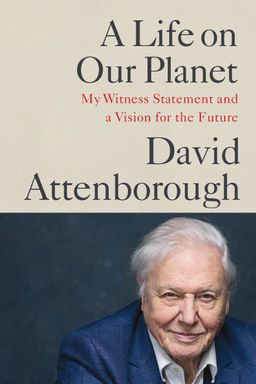
A Life on Our Planet cover

A Life on Our Planet

by David Attenborough

David Attenborough''s ''A Life on Our Planet'' is a compelling testimony of the wonders he has witnessed and a stark warning about the environmental catastrophes we face. Through urgent calls for clean energy, biodiversity restoration, and social equality, Attenborough offers practical solutions to secure a sustainable future.

Rewilding Humanity: David Attenborough’s Call to Restore the Planet

What would it mean to live in true harmony with the natural world again? David Attenborough’s A Life on Our Planet is both a personal testament and a universal call to action. Written as the 94-year-old naturalist’s witness statement, manifesto, and vision for the future, the book traces the history of humanity’s relationship with nature, documents the collapse of biodiversity during his lifetime, and presents a clear, science-based blueprint for restoring balance on Earth.

Attenborough contends that humanity’s “greatest mistake” has been living apart from nature rather than as part of it. We have built comfort and progress on the destruction of the very systems that make life possible. But his essential argument is one of hope: the same intelligence and collaboration that allowed us to alter Earth so dramatically can also be used to heal it. The key, he says, lies in rewilding the planet — restoring ecosystems, stabilizing population growth, transforming our economies, and learning to thrive without unchecked growth.

Attenborough’s Life as Witness

The book opens with Attenborough’s haunting visit to Pripyat, the abandoned city near Chernobyl — a carefully chosen metaphor for humanity’s own self-destructive trajectory. From there, he takes readers through the decades of his life, juxtaposing his personal experiences as a nature broadcaster with a data-driven record of human impact. As a boy in the 1930s, 66% of the wilderness remained. By 2020, only 35% was left. Each era — the 1950s exploration of untouched jungles, the 1970s industrial expansion, the 1990s coral bleaching, the 2010s climate tipping points — marks another chapter in nature’s decline.

These stories turn statistics into lived experience. In Africa’s Serengeti, Attenborough marveled at wildebeest herds that stretched to the horizon. Decades later, he filmed barren plains where biodiversity had been replaced by monocultures. By comparing ecological science with his own film archives, he embodies the “shifting baseline syndrome” — our collective forgetting of what abundance used to look like.

The Great Acceleration and Humanity’s Impact

The core of Attenborough’s argument revolves around what scientists call the Great Acceleration: the explosive growth of human activity since the mid-20th century. Population, resource extraction, and energy consumption surged exponentially, propelled by fossil fuels and industrial agriculture. This progress brought prosperity, medicine, and peace, but at the cost of biodiversity and climate stability. Earth, once a home in equilibrium — its air, oceans, and forests co-regulating life’s balance — became destabilized by one species’ insatiable demand.

Using the analogy of bacteria in a petri dish, Attenborough explains how exponential growth within a finite space always leads to collapse. The “sealed dish” of Earth is running out of food and filling up with waste. Our challenge, he insists, is to mature as a species — to stop growing and start thriving.

The Planetary Boundaries Model and the Missing Piece

Attenborough draws on the Planetary Boundaries model devised by scientists Johan Rockström and Will Steffen to describe nine limits within which life can safely operate — including biodiversity loss, climate change, and nutrient pollution. He warns that humanity has already breached four of these boundaries, putting the entire Earth system at risk. The richer 16% of humanity accounts for nearly half the damage, highlighting the moral obligation of wealthier nations to lead the transition.

He complements this scientific compass with economist Kate Raworth’s Doughnut Model, which defines a safe and just space between a social foundation (basic human needs) and an ecological ceiling. The combination, Attenborough argues, offers a roadmap to sustainability: one that is fair to people and to the planet.

From Despair to Renewal

While the first half of the book charts environmental collapse, the second half outlines a bold, achievable vision of renewal. Attenborough advocates restoring forests, rewilding oceans, transitioning to clean energy, reforming agriculture, adopting largely plant-based diets, and stabilizing human population through the empowerment of women and education. He presents examples — from Iceland’s 100% renewable grid to Costa Rica’s reforestation success and Singapore’s “city within a garden” — to show that sustainable living is not utopian, but already underway.

His message is both systemic and personal: each of us can influence change by how we consume, vote, and speak. But fundamental progress requires collective will — governments, corporations, and citizens aligned around rebalancing our relationship with the Earth.

Why This Matters Now

Attenborough’s book matters because it reframes the climate crisis as both ecological and civilizational. The planet will recover with or without us; it has done so after five mass extinctions. The question is whether humanity will remain part of its story. A Life on Our Planet is not just a memoir or environmental treatise — it’s a moral reflection on human wisdom. To be truly Homo sapiens, the wise species, we must learn to live within limits and restore what we’ve taken. As he writes, “We are the cleverest creatures that have ever lived, but if we are to continue to exist, we will require more than intelligence — we will require wisdom.”

In this sweeping vision, Attenborough offers both a warning and a map: if we can rewild the planet — and ourselves — we can build a world more abundant, equitable, and sustainable than ever before. The future, he concludes, is still ours to choose.


The Great Acceleration: Humanity’s Unsustainable Growth

Attenborough identifies the period after World War II as a decisive turning point in humanity’s relationship with the Earth. The mid-20th century ushered in unprecedented technological innovation, population growth, and economic expansion — a moment scientists now call the Great Acceleration. This surge brought comfort, peace, and prosperity to billions of people, yet also placed unbearable strain on Earth’s ecosystems.

Exponential Growth on a Finite Planet

Human population exploded from 2.3 billion in 1937 to nearly 8 billion by 2020. Energy use, industrial agriculture, transportation, and consumer production all multiplied exponentially. On graphs, these increases appear as hockey-stick curves — steep rises in consumption, pollution, and habitat loss. The metaphor Attenborough uses is microbial: humans have behaved like bacteria in a sealed dish, expanding until we hit the dish’s edges. As with any closed system, when growth outpaces regeneration, collapse follows.

The Costs of Progress

The book’s emotional power lies in Attenborough’s eyewitness testimony. He recalls pristine wildernesses now emptied of life — Africa’s plains that once pulsed with migrating herds, tropical forests felled for palm plantations, and coral reefs turned white by warming seas. Prosperity came at immense hidden costs: 90% of large oceanic fish gone, half the world’s forests cleared, and biodiversity diminished by more than half in his lifetime. Humanity has disrupted the delicate feedbacks between climate, soil, and species that once regulated the planet’s stability.

Crossing the Planetary Boundaries

Rockström and Steffen’s Planetary Boundaries model becomes Attenborough’s diagnostic for this crisis. Earth’s life-support system has nine key limits, from nitrogen levels and ocean acidity to land-use change and freshwater consumption. Humanity has already breached at least four — biodiversity loss, deforestation, the nitrogen-phosphorus cycle, and carbon overload — plunging the planet into an unstable state. If left unchecked, tipping points like Amazon forest dieback or permafrost thaw could trigger runaway feedback loops beyond our control.

In tracing this “great mistake,” Attenborough is not anti-progress. He values the advances that lifted billions from poverty — but insists that perpetual expansion on a finite planet is impossible. Like natural systems that grow, then mature, humanity must move from growth to balance. Only by ending the Great Acceleration can we avoid the “Great Decline.”


Switching to Clean Energy

The modern world runs on energy, and for two centuries, that energy has come from burning the death of ancient life — fossil fuels. Attenborough shows how this act of “digging up sunlight from the past” powered industrial civilization but now threatens planetary stability. The climate crisis, he explains, is fundamentally an energy crisis.

Solar-Powered Planet, Fossil-Powered Civilization

Every day, Earth’s living systems capture twenty times more solar energy than humans use. Plants, algae, and phytoplankton power life through photosynthesis — the ultimate renewable process. But instead of harnessing current sunlight, we tapped into ancient reserves of carbon: coal, oil, and gas. Burning them released greenhouse gases that now trap heat, acidify oceans, and destabilize weather systems. In essence, we have rewired the carbon cycle to run in reverse.

The Renewable Revolution

Attenborough emphasizes that the tools for transformation already exist. Solar, wind, hydro, and geothermal power can now outcompete fossil fuels on cost. Morocco’s Noor Solar Complex — the world’s largest — stores heat in molten salt to generate power day and night. Iceland, Albania, and Paraguay already run on 100% renewable electricity. The main obstacles are not technological but political and financial. Vast fossil fuel subsidies and vested interests resist change, while banks and pension funds remain entangled in carbon assets.

From Regrets to Transitions

The transition will involve temporary “bridges” — cleaner gases, nuclear energy, and biofuels — that carry environmental costs, but these should be short-lived. Most crucially, Attenborough advocates a global carbon tax to price pollution correctly and accelerate innovation. Sweden’s carbon pricing in the 1990s reduced emissions while preserving economic growth, setting a powerful precedent. He envisions a world of quiet cities, clear skies, and cheap, distributed renewable energy — a cleaner, fairer civilization powered by the same sunlight that sustains all life.

“We are the first generation to understand the problem,” he writes, “and the last that can do anything about it.” The energy choice we make this decade will determine whether we remain a thriving species — or become another entry in the fossil record.


Feeding the World Without Destroying It

Food production has shaped civilization more than any other human endeavor. Yet, as Attenborough makes clear, our current agricultural system — vast, fossil-fueled, and carnivorous — is the leading cause of habitat loss, greenhouse emissions, and soil depletion. To survive the century, we must radically change how and what we eat.

The Land Hunger of Meat

Today, nearly 80% of the world’s farmland is devoted to livestock and animal feed crops like soy. Beef alone uses 60% of global farmland but provides only 2% of calories. The conversion of wild land to fields is the single biggest driver of biodiversity loss. In South America, forests are razed to grow soy for European and Chinese cattle feed. This globalization of appetite links meat consumption in rich nations directly to deforestation in poorer ones.

The Promise of Plant-Based Diets and Technology

Attenborough presents a hopeful vision: a shift to largely plant-based diets — aided by alt-proteins, lab-grown “clean meat,” and microbial foods that require little more than air, water, and renewable energy. Early adopters in the UK, US, and Asia show change is already underway. If global meat consumption dropped significantly, studies suggest we could halve farmland use while improving public health and cutting carbon emissions dramatically. Future “plant-forward” diets would save trillions in healthcare costs and free up vast areas for rewilding.

Farms That Work With Nature

Beyond diet, food systems must become regenerative. Attenborough celebrates Dutch farmers who use geothermal energy, hydroponics, and natural pest control to grow ten times more food on less land. Regenerative agriculture — crop rotation, no-tilling, silvopasture — rebuilds soil carbon and restores fertility. Abandoned or degraded farms can be revived to capture 20 billion tons of carbon. The revival of old techniques with new science could feed humanity while repairing the planet.

Feeding ourselves sustainably, Attenborough argues, isn’t a sacrifice — it’s liberation. We gain healthier lives, cheaper food, and the return of wilderness where our dinner once grew.


Rewilding the Land and Sea

Attenborough’s most uplifting vision is the rewilding of the planet — the restoration of ecosystems that heal themselves. Land and sea, he insists, can recover astonishingly fast when left alone or managed wisely.

Regenerating Forests and Farms

Reforesting a quarter of the planet, he says, could absorb two-thirds of the carbon humanity has released. Nations like Costa Rica demonstrate this is possible: after losing three-quarters of its forest, it paid landowners to replant native trees, doubling forest cover in just 25 years. In the UK, the Knepp Estate turned bankrupt farmland into a “wildland farm” by letting grazers and trees return, creating a biodiversity haven. These models prove that rewilding and livelihoods can coexist.

Rewilding the Seas

The ocean, too, is poised for miracle recovery. Establishing networks of no-fish zones and marine protected areas (MPAs) allows ecosystems to rebound within a decade. Cabo Pulmo in Mexico, once barren, saw a 400% increase in marine life after local fishers banned harvests. Attenborough champions Palau’s visionary decision to ban 80% of fishing in its waters, showing that protecting nature can sustain economies through tourism and spill-over abundance. He envisions restoring kelp forests and sea meadows as powerful carbon sinks — true “blue forests” that reconcile fishing with climate action.

“Give nature space,” Attenborough writes, “and it will give us back stability.” Rewilding, in his vision, is not nostalgia for wilderness past — it is the smartest strategy for ensuring a livable planet.


Rethinking Growth and Redefining Success

At the heart of humanity’s ecological crisis lies one flawed assumption: that perpetual economic growth is both possible and desirable. Attenborough draws inspiration from nature’s laws to challenge this idea. In the living world, growth gives way to maturity; ecosystems flourish not by growing forever, but by thriving in balance.

From GDP to the Happy Planet

He critiques Gross Domestic Product (GDP) as a measure of success that excludes well-being and environmental health. The alternative is the “three Ps” of environmental economics: People, Planet, and Profit. Attenborough highlights the Happy Planet Index and New Zealand’s move to replace GDP with a well-being budget — a radical step prioritizing happiness, equality, and environmental sustainability. When citizens’ health and ecosystems are seen as capital, the goals of government and nature finally align.

The Coming Sustainability Revolution

Like previous industrial revolutions powered by water, coal, and computers, Attenborough foresees a new “sustainability revolution” — a wave of innovation focused on renewable energy, zero waste, and circular economies. Businesses shifting toward closed-loop production will profit most by building products designed for repair and reuse. He cites the Ellen MacArthur Foundation’s work on circular design, envisioning an economy modeled on nature’s cycles, where “waste equals food.”

The essential shift, he argues, is moral as much as economic. We must measure success not by what we accumulate, but by what we sustain. Growth must give way to maturity — an era where humanity, like a forest in full bloom, stops expanding outward and begins deepening its roots.


Population, Equality, and Education

Population growth, though often treated as taboo, is central to Attenborough’s map for a sustainable future. He presents a scientific and humane perspective: the world’s population will peak when global living standards rise and women gain education and autonomy.

Demographic Transition and Peak Human

Attenborough describes humanity’s four-stage demographic transition — from high birth and death rates to stability. Japan, for instance, moved from large families and resource scarcity in 1900 to population peak and decline a century later through education, healthcare, and urbanization. This pattern is now unfolding globally. Currently, humanity is in the latter half of Stage 3, with global fertility halved since the 1960s. “Peak human,” the moment when population stops growing, may come around 2060 if we fast-track global education and women’s rights.

Empowerment as Ecology

The single most effective environmental policy, Attenborough insists, is empowering women and girls. Access to education, contraception, and political voice correlates directly with smaller families. When women choose freely, they typically choose fewer children. This is both a moral and environmental victory — a reduction in population growth achieved not through coercion but opportunity.

In the end, population stabilization is not about control but fairness. A just world — one where every person enjoys security, education, and dignity — naturally balances itself. Attenborough’s vision is a world where compassion and sustainability are the same goal.


Building a Circular and Sustainable Civilization

How might our modern lives look if we truly imitated nature’s cycles? In his final chapters, Attenborough imagines a future in which waste no longer exists and cities become engines of regeneration rather than extraction.

The Circular Economy

In nature, one creature’s waste is another’s nourishment. Applying this principle, the circular economy replaces the linear “take-make-discard” model with continuous reuse. Materials are seen as nutrients passing through biological and technical cycles. Compostable waste becomes soil and energy; metals and plastics are endlessly repurposed. The Ellen MacArthur Foundation champions this transformation, while pioneers like Singapore have embedded it into urban design.

Cities as Living Ecosystems

By 2050, two-thirds of humanity will live in cities, making them the arenas for change. Attenborough highlights Singapore’s policy that every building must replace its lost greenery — creating a skyline of living towers. London aims for half its area to be “green space,” and Paris is covering rooftops with gardens. Designed to clean air, recycle water, and host biodiversity, such cities invert the logic of industrialization. They give back more than they take.

A sustainable world, Attenborough concludes, will not be one of deprivation but abundance: cleaner air, healthier food, and richer lives. Like a mature forest, humanity can thrive indefinitely — not by conquering nature, but by learning her rules.

Dig Deeper

Get personalized prompts to apply these lessons to your life and deepen your understanding.

Go Deeper

Get the Full Experience

Download Insight Books for AI-powered reflections, quizzes, and more.