
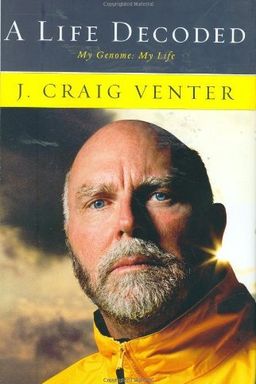
A Life Decoded cover

A Life Decoded

by J Craig Venter

A Life Decoded is the captivating autobiography of J. Craig Venter, a visionary geneticist who played a pivotal role in decoding the human genome. Discover how his relentless curiosity and innovative spirit led to groundbreaking achievements, sparking debates and reshaping scientific understanding. Venter''s journey continues as he explores synthetic biology and environmental solutions, offering readers an inspiring glimpse into the future of science.

Reading and Rewriting Life

How do you turn curiosity, risk, and technology into a revolution that changes how humanity understands life itself? J. Craig Venter’s life story traces that evolution—from a reckless kid on airstrips to a leader who reads, writes, and reimagines genomes. His work bridges science and biography: a living map of how experience shapes discovery and how discovery reshapes institutions, economies, and ethics.

At its core, this book isn’t just about sequencing—it’s about scaling curiosity. Venter’s insight is that every scientific problem hides an engineering problem: how to make the invisible visible, the complex automatable, and the slow scalable. By following his trajectory—from beads and receptors to automatic sequencers, gene politics, whole-genome assembly, and synthetic biology—you see how new tools transform questions and how daring execution changes what science can do.

From adrenaline to automation

Venter’s journey begins with small, tangible experiments—tethering adrenaline to glass beads to prove receptors live on cell surfaces. This deceptively simple experiment (co-developed with Kaplan, Jack Dixon, and others) exemplifies his lifelong pattern: ask a clear question, invent a clever tool, and follow the data across disciplines. The bead experiment foreshadowed how he would later use the same logic—immobilize, measure, automate—to decode vast genetic systems.

By the 1980s, he realized that biochemistry needed its own kind of industrial revolution. Manual Sanger sequencing was slow and fragile. By pioneering automation—introducing fluorescent-based, computer-read sequencing—he made data collection continuous rather than artisanal. The machines didn’t just accelerate output; they changed the culture of biology. Labs became factories, scientists became system designers, and data became infrastructure.

From individual genes to genomes

Automation set the stage for his next conceptual leap: Expressed Sequence Tags (ESTs). Instead of mapping the genome exhaustively before sequencing, he focused on reading expressed portions first—those that matter for function. ESTs were the beginning of large-scale discovery by sampling. Thousands of partial gene sequences yielded biological insight faster than entire chromosomal projects. They revealed disease genes (like DNA repair genes linked to cancer) and ignited fierce debates about patents, ownership, and open data.

Those same disputes became his pivot point. As open and commercial interests clashed—Watson and NIH on one side, venture capital and biotech firms on the other—Venter created new institutional structures: TIGR (The Institute for Genomic Research) and later Celera Genomics. These entities embodied his fundamental belief: if old systems can’t scale innovation, build new ones that can.

From projects to paradigms

The TIGR years birthed shotgun sequencing—the idea that you can sequence genomes by random fragmentation and use algorithms to reassemble them. This flipped the prevailing “map first” orthodoxy and depended on computation as much as chemistry. When TIGR sequenced Haemophilus influenzae in 1995, it proved that you could read an entire genome in one leap. Later, with paired-end strategies and improved algorithms, this logic scaled to whole organisms, and eventually to humans.

But sequencing wasn’t just speed—it was politics. As Venter’s Celera raced public consortia led by Francis Collins, the line between open science and proprietary data blurred. The Drosophila collaboration with Gerry Rubin and the fly genome “jamboree” became a model for open-private partnership: rapid industrial sequencing with community-driven annotation. It demonstrated that collaboration, not secrecy, wins legitimacy.

From genomes to environments—and design

After the Human Genome Project, Venter pushed the frontier outward and inward: outward into environmental genomics and inward into synthetic biology. On the Sorcerer II Expedition, his team sequenced ocean microbes and uncovered millions of new genes, revealing that life’s diversity—and the toolkit for bioengineering—was far larger than assumed. This birthed environmental genomics as both a scientific and ecological enterprise.

Then, turning inward, synthetic genomics asked whether reading life could lead to writing it. His teams synthesized known viral genomes (Phi-X174) and minimal bacterial genomes (Mycoplasma), leading to the first synthetic cell prototypes. These experiments blended chemistry, computation, and philosophy, raising profound questions about ethics, safety, and the future of biological design.

The enduring message

Venter’s life shows how intellect, tools, and audacity combine to expand the definition of science itself. He argues that biology advances fastest when you remove friction—when experimentation replaces tradition, when computation meets biology, and when institutions adapt to scale curiosity rather than suppress it. The challenge is not only to accelerate discovery but to govern it wisely.

Across the arc—from adrenaline receptors to genomes and synthetic cells—you witness a consistent rhythm: break paradigms, automate labor, integrate disciplines, and challenge authority. It’s the same discipline that took a nine-year-old boy tinkering with boats to a man reconstructing the genetic ocean of life. In the end, the narrative is less about one scientist’s ego than about a method of thinking—experimental, mechanistic, and relentlessly pragmatic—that has forever changed how we read and now write the story of life.


Risk, War, and the Making of a Scientist

You can trace Venter’s risk-tolerant, build-and-test mentality back to his early life. Growing up near the San Francisco airport, he built boats from scrap, raced bikes beside planes, and engineered rope pulleys in the backyard. That appetite for danger built the qualities later visible in his science: skepticism of authority, comfort with failure, and confidence in hands-on experimentation.

From hands-on curiosity to existential urgency

Vietnam was the crucible. As a Navy corpsman in Da Nang hospitals, Venter witnessed death’s randomness—soldiers surviving or dying from millimeters of difference in bullet paths. This taught him that life’s mechanisms were molecular and fragile. The experience converted adrenaline into a moral imperative: understand the physical code of life, not just its symptoms. Afterward, the GI Bill gave him a second life in science, turning his instinctive tinkering toward molecular biology.

Mentorship and the scientific transition

Teachers like Bruce Cameron and Kaplan nurtured his curiosity. Kaplan’s lab, where Venter investigated adrenaline’s mechanism, was the first professional space that rewarded improvisation and rigor in equal measure. Over several projects—adrenaline bead experiments, cardiac physiology, receptor purification—he began thinking like an engineer: isolate the problem, constrain it chemically, test it in multiple systems. The adrenaline-to-bead experiment became the metaphor for his scientific method: constrain variables physically, watch biology reveal its own logic.

Key lesson

A career can grow out of tinkering as much as theory. Venter’s pathway proves that innovation often comes from nontraditional experiences that cultivate resilience and mechanical creativity.

The biographical substructure of his science is clear: risk, repair, and refusal to wait for permission. Those three traits carried him from battlefield wards to the frontiers of biology, where risk meant challenging the consensus and troubleshooting the machinery of life itself.


From Beads to Genes: The Birth of Molecular Engineering

In the adrenaline receptor experiments, Venter developed more than results—he developed a philosophy. Physics and chemistry, properly aligned, could expose the machinery of life. He attached adrenaline to glass beads to prove that receptors lay on cell membranes, inventing an experimental logic that would resurface throughout his genome work: isolate, immobilize, measure, repeat.

Engineering curiosity

By attaching hormones to immobile structures and watching cells respond, Venter proved function without direct observation of molecules—a triumph of creative constraint. His collaborations across disciplines (Kaplan, Dixon, Goodman, Ross) show his ability to build tools by combining chemistry, physiology, and computation. What began as a question about cardiac response ended as a template for receptor and gene discovery pipelines.

Bridging molecules and information

When he eventually sequenced receptor proteins, the leap from biochemistry to information science began. Sequencing was manual, repetitive, error-prone—but for Venter it was also mechanical, and therefore improvable. He learned that biology is just chemistry constrained by information; master the systems, and you master the informational flow. That insight framed all that followed—from automation to genome-scale assembly.

Methodological transformation

He fused the scientific method with engineering design. Instead of polished theory first, he preferred working prototypes that invited iteration. That mindset—to build one working version and learn in loops—made sequencing scalable when others still treated it as craft.

Every advance that followed—the automation revolution, the rise of ESTs, and the sequencing factories—flows from this principle: constrain the biology, automate its response, and read what it tells you.


Automation and the Age of Big Biology

Automation was the hinge between molecular biology and modern genomics. In the 1980s, sequencing by hand meant radioactive gels, film scans, and subjective calls. Venter foresaw that real progress depended on transforming sequencing from art to industry. By adopting and perfecting fluorescent-based automated sequencers, he rendered high-throughput biology possible.

Getting machines to work like people

Most labs failed at automation because they treated instruments like black boxes. Venter’s success—partnering with Jeannine Gocayne—depended on molecular discipline: calibrate primers, stabilize dyes, and anticipate software imperfections. He showed that automation is not delegation; it’s amplification of human precision. He built a team structure merging chemists, programmers, and technicians, creating the world’s first integrated sequencing pipeline at NIH.

Parallelization as paradigm

Venter understood scaling through redundancies: add machines, balance throughput, pool data. Dozens of ABI sequencers running in parallel at TIGR turned data generation into routine production. Managing the data mountain required new software and bioinformatics groups, forerunners of today’s genomics labs. In short, he replaced ad hoc discovery with systematic production, building biology’s analog to a semiconductor fab.

Conceptual impact

Automation taught biology to think in terms of processes. It shifted focus from individual experiments to workflows. This change, mirrored later in Celera’s sequencing factories, allowed biology to evolve into an industrial and informational science.

By insisting “you can’t automate sloppiness,” Venter demonstrated that rigor scales as well as speed. The automated sequencer wasn’t just a tool; it symbolized a new scientific ethic: discipline in the service of data abundance.


Scaling Discovery: ESTs, TIGR, and the Gene Wars

Expressed Sequence Tags (ESTs) turned sequencing into rapid discovery. Instead of chasing the map of the entire genome, Venter targeted expressed portions directly—mRNA translated into cDNA and read in short bursts. The result: a flood of new genes, faster than the genome project’s years-long pace. This efficiency infuriated some academics, inspired others, and led directly to the founding of TIGR.

Accelerating gene finding

With automated sequencers and efficient cDNA library construction, Venter's team generated thousands of ESTs per week. Each sequence hinted at a distinct gene and its tissue expression. Collaborations with Bert Vogelstein linked ESTs to cancer-related DNA repair genes, silencing claims that the method was superficial. EST logic anticipated modern RNA-seq approaches: sample first, analyze later.

Institutional friction and invention

The EST patents filed by NIH stirred public outrage. Jim Watson denounced them as “lunacy.” Venter became the lightning rod for debates about privatizing public science. In response, he founded TIGR to separate open research from commercial exploitation, partnering with Human Genome Sciences (HGS). TIGR’s structure—nonprofit science backed by venture capital—was radical: centralized instruments, no tenure, open publication policies. It was also fragile, depending on constant negotiation between discovery, publication rights, and business imperatives.

Strategic takeaway

ESTs made genes discoverable at scale; TIGR made genomics organizationally scalable. Together, they illustrated that structure—technical and institutional—can either liberate or limit discovery.

The “Gene Wars” showed that science isn’t only about knowledge but control—legal, institutional, and moral. Venter’s response was not retreat but reinvention: if the old system couldn’t adapt to fast discovery, he would build one that could.


Shotgun Sequencing and Genome Assembly

Shotgun sequencing was Venter’s most disruptive idea: sequence first, organize later. Rather than spending years mapping genomes, he fragmented them randomly, sequenced thousands of pieces, and used algorithms to reconstruct the puzzle. Critics called it reckless, but TIGR’s Haemophilus influenzae genome (1995) proved it worked.

The algorithmic revolution

Shotgun required computation that biology barely understood. Granger Sutton, Gene Myers, and others created assemblers capable of handling millions of reads. The critical addition was paired-end sequencing: reading both ends of DNA fragments with known insert sizes, giving spatial anchors to otherwise random data. This innovation transformed chaos into solvable structure.

From smallpox to Mycoplasma and Methanococcus species, the TIGR pipeline became a proof of concept for comparative genomics. These projects demonstrated that randomness—handled by computational rigor—could outperform meticulously planned mapping efforts. Scientific orthodoxy gave way to algorithmic empiricism.

Industrializing the method

Celera Genomics applied whole-genome shotgun to humans. Its sequencing factory featured hundreds of ABI 3700 capillary machines, thousands of PCR amplifications, and robotic library handling. This was biology’s Fordist moment. Daily output targets mirrored manufacturing metrics; logistics mattered as much as science. Failures in machines or supply chains could derail momentum as easily as flawed hypotheses.

Conceptual depth

Shotgun sequencing reframed discovery as computation: biology became an information science. It transformed scientists into data engineers and made algorithms as critical as pipettes.

By bridging chemistry and computation, Venter turned the genome from a puzzle of clones into a problem of mathematics—and made reading life’s code an achievable industrial task.


Politics, Collaboration, and the Human Genome Race

Sequencing the human genome wasn’t purely a scientific feat—it was a political and ethical drama. As Celera’s industrial-scale sequencing collided with publicly funded consortia, debates erupted: Who owns data? Who gets credit? Who decides how knowledge enters medicine?

The public–private conflict

HGS’s aggressive patenting after TIGR’s H. influenzae work set off years of mistrust. When Celera formed with ABI support, critics feared privatization of the human genome. Venter fought for open release clauses, but commercial pressure for subscription databases persisted. Francis Collins and the Wellcome Trust accelerated public sequencing to maintain open access—culminating in the 2000 White House announcement, where both sides claimed victory.

Collaboration as redemption

The Drosophila collaboration with Gerry Rubin provided a model for truce through transparency. Celera sequenced; the public Drosophila team validated and annotated in an open jamboree. Forty scientists co-interpreted data in real time, producing fast, accurate gene calls and shared authorship. This experiment in cooperative openness built credibility and showed how private speed and public scrutiny could coexist.

Broader significance

The Human Genome Race revealed that scientific revolutions depend as much on cultural design as on technical breakthroughs. Open data norms, licensing strategies, and shared authorship now trace lineage to those fraught years of contest and collaboration.

By the end, the battle lines blurred: public and private databases cross-fed, and the human genome became a shared legacy. But the central question—how to balance openness, credit, and sustainability—remains biology’s enduring policy problem.


From Reading to Writing: Synthetic and Environmental Genomics

After sequencing everything from microbes to humans, Venter shifted focus from observation to creation. His next frontier was dual: use genomics to read ecosystems and then to write new life. Environmental genomics and synthetic biology mark the culmination of his principle that science evolves by extending the power of its tools.

The Sorcerer II expedition

By applying shotgun sequencing to seawater, the Sorcerer II project uncovered a genomic ocean: millions of novel genes and previously unknown metabolic systems, including light-driven proton pumps (proteorhodopsins). These findings doubled known genetic diversity and revealed how microbes modulate energy and carbon flows. Environmental genomics emerged as both climate science and biotechnology—a toolkit for biofuels, carbon sequestration, and ecological monitoring.

Synthetic genomics and minimal life

Synthetic genomics began with assembling known genomes (Phi-X174) and progressed to building minimized bacterial chromosomes. In transplant experiments, Venter’s team converted one species into another—proof that DNA alone carries identity. These feats raised hopes of engineered microbes for medicine and energy, alongside fears of misuse. His group engaged with the National Academies and biosecurity boards to design oversight models for synthetic research.

The new paradigm

Reading life led to building it. Synthetic and environmental genomics shifted science from decoding nature’s blueprint to designing its extensions. Biology became an engineering discipline capable of addressing planetary challenges—but also demanding new governance ethics.

Venter’s final legacy is a mirror: the capacity to manipulate life brings both creative promise and moral weight. Whether used to design sustainable fuels or rewrite evolution, the genome has become both text and toolkit for humanity’s next era.

Dig Deeper

Get personalized prompts to apply these lessons to your life and deepen your understanding.

Go Deeper

Get the Full Experience

Download Insight Books for AI-powered reflections, quizzes, and more.