
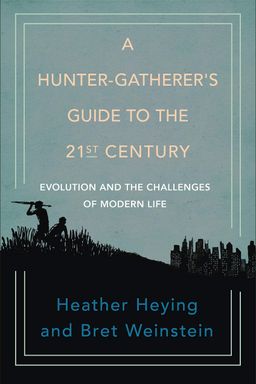
A Hunter-Gatherer''s Guide to the 21st Century cover

A Hunter-Gatherer''s Guide to the 21st Century

by Heather Heying and Bret Weinstein

Explore the fascinating disconnect between our evolutionary heritage and the modern world in ''A Hunter-Gatherer''s Guide to the 21st Century.'' Authors Heather Heying and Bret Weinstein reveal how our ancient instincts clash with contemporary life, offering insights to navigate today''s challenges. Enhance your understanding of health, diet, and personal development through the lens of evolutionary biology.

Human Evolution in a Hyper-Novel World

What happens when the world changes faster than the mind that evolved to navigate it? In their book, evolutionary biologists Heather Heying and Bret Weinstein argue that the modern human predicament—social anxiety, institutional fragility, ecological collapse—comes from hyper-novelty: a rate of environmental and cultural change too fast for our ancestral adaptations to track. Humans evolved as masters of niche switching, able to move between physical, social, and intellectual environments, but the speed and magnitude of modern transformation have overwhelmed that adaptability.

The authors propose an overarching framework they call evolutionary reasoning for a steady-state future. It applies ancestral logic—lineage persistence, trade-off awareness, precaution—to modern problems in medicine, economy, and education. If natural selection builds persistence, you must learn to think long-term and restore ancient balances between genes, culture, and consciousness.

Culture and Consciousness: The Human Toolkit

Humans are both specialists and generalists. Each person excels in some domain, yet our species uniquely thrives across habitats due to cultural sharing. Around ancient campfires, individuals pooled insights—hunters, observers, experimenters—and built collective intelligence. Culture stores and transmits those solutions; consciousness creates new ones when circumstances shift. The rhythm between the two—tradition and innovation—is what makes Homo sapiens distinct.

The book invites you to see culture as an evolutionary layer above genes. Rituals, cuisines, and moral codes adapt faster than DNA but exist to serve long-term lineage success. Modernity’s danger lies in severing this relationship—rapid novelty without time for cultural adjustment, producing isolation and fragility.

The Omega Principle and Lineage Thinking

Instead of survival of the fittest individual, the authors shift the lens to survival of the fittest lineage. Persistence, not reproduction rate, defines evolutionary success. They introduce the Omega Principle: treat costly, long-standing cultural traits as adaptive until proven otherwise. Lactase persistence after dairying or the appendix’s microbial safe house both show gene–culture coevolution, where inherited behavior and biology reinforce each other. Lineages that honor those slow feedback loops endure; those chasing short-term gains fade.

Trade-offs and Precaution in an Age of Hyper-Novelty

Every system faces trade-offs. The authors remind you to ask what each new technology or policy sacrifices—speed versus safety, liberty versus justice, short-term growth versus long-term resilience. Combined with Chesterton’s Fence (don’t dismantle a complex system until you know its purpose) and the Precautionary Principle (test before large-scale adoption), this evolutionary lens helps resist the Sucker’s Folly of pursuing steep, immediate benefits while ignoring hidden costs.

From Medicine to Markets: Evolutionary Diagnosis

Modern medicine and economics suffer from similar reductionist blindness—they fix proximate mechanisms while ignoring ultimate evolutionary causes. Overprescribed antibiotics, overengineered diets, or GDP-linked consumption metrics may seem successful but undermine systemic health. The authors urge integrating evolutionary diagnosis into every decision: what ancestral balance did this system once preserve, and what modern substitution undermines it?

Building the Fourth Frontier

After geographic, technological, and extractive frontiers have run their course, the next frontier must be cultural—redesigning civilization for indefinite persistence. The Fourth Frontier calls for durable systems that treat surplus as public investment, not fuel for exponential consumption. The authors advocate prototypes of antifragile institutions, distributed competence, and slow cultural iteration. A sustainable civilization isn’t static—it’s steady-state, adaptable, and humble before evolutionary constraints.

Core Message

Human success depends on remembering that we are products of slow adaptation navigating fast change. Only by integrating ancestral wisdom—trade-offs, precaution, collective consciousness—into technological and cultural design can we survive the hyper-novel era we have created.


Campfire Intelligence and Cultural Evolution

Imagine the ancient campfire—the original arena for problem-solving and cultural exchange. Around its light, diverse minds pooled specialization into collective cognition. Heying and Weinstein use this metaphor to show how human intelligence is not purely individual; it’s networked, iterative, and cumulative. Bem’s observation of fish, Soo’s experiments, and Gol’s mechanical tinkering collectively produced solutions beyond individual reach. Around the fire, you don’t just warm yourself—you forge meaning, innovation, and shared fate.

Culture and Consciousness in Oscillation

Culture becomes dominant when environments are stable; consciousness rises when conditions shift. The dynamic oscillation between inherited wisdom and fresh insight sustains human resilience. Modern societies often suppress consciousness (obedience, standardization) or discard culture (fashionable novelty). Rebalancing requires cultivating spaces—literal or metaphorical campfires—where thoughtful dialogue renews both. This interplay reveals why collaborative cognition has always been humanity’s superpower.

Literally False, Metaphorically True

Cultural practices often encode truth indirectly. A Guatemalan farmer’s lunar planting ritual may not alter moonlight yield, but synchronized planting reduces pest risk. Malagasy taboos protecting sacred groves act as ecological policies disguised as faith. The authors encourage humility when facing ancient rules—discard superstition only when you’ve tested its ecological or social function. (This echoes Chesterton’s Fence again: don’t remove the fence till you know why it was built.)

From Clan Fires to Global Networks

Today’s equivalent campfires—classrooms, labs, mentorship circles—extend the principle of linked minds. Consciousness should serve culture’s long-term wisdom, not destabilize it with constant novelty. As communication technologies accelerate idea flux, guarding against shallow imitation and misinformation becomes the new cultural challenge. The authors advise learning to distinguish sacred (stabilizing) values from shamanistic (exploratory) ones and knowing when to shift modes.

Key Lesson

You succeed not by being the smartest individual but by fostering thoughtful community. Innovation flourishes where conversation, respect, and humble testing replace isolation and certainty.


Trade-offs, Medicine, and Evolutionary Diagnosis

Trade-offs run through biological and cultural design. You can’t maximize all values simultaneously; you can only choose which to prioritize. Applying this logic to medicine reveals how well-intentioned fixes cause long-term damage. Antibiotics, sunscreen, and psychiatric drugs illustrate the harms of chasing proximate solutions (how) without understanding ultimate causes (why). Heying and Weinstein argue for an evolutionary diagnosis: a way to distinguish temporary symptom relief from sustainable harmony with how bodies evolved.

Chesterton’s Fence and Precaution

Before altering complex systems—gut microbiomes, immune cues, or ancient dietary habits—you must ask why those systems persist. The appendix, once dismissed as vestigial, now appears to serve microbial restoration. Similarly, cultural structures that seem outdated can encode deep adaptive value. Removing them blindly invites disaster, just as early surgeons excising intestines did. The Precautionary Principle turns this warning practical: slow down when effects are uncertain and stakes irreversible.

Medicine through Evolutionary Eyes

Evolutionary medicine treats the body as an ecological system shaped by ancient trade-offs. Limited sun exposure prevents cancer but increases cardiovascular risk; antibiotics fight infection but destabilize immunity. The solution is to rebalance lost ancestral inputs—movement, rest, whole food, light rhythms—before medicating. Scientism, the false worship of quantifiable metrics, disguises complexity as precision. Real science must listen to both mechanism and meaning.

Practical Restoration

Seek practices that restore ancestral rhythms: walking, sun exposure, variable diet, ecological context. Trust neither ancient purity nor modern science uncritically; integrate both through testing and iteration. In personal health, that means experimenting on yourself as a scientist would—change one variable at a time and observe outcomes thoughtfully.

Practical Maxim

Before adding a pill, ask what evolutionary mismatch caused the symptom. Often the cure is subtraction—less hyper-novelty, more ancestral balance.


Food, Childhood, and the Making of Minds

Your body and mind are built by culture, food, and risk. Cooking and child-rearing define how humans evolved as cooperative learners. Fire unlocked calories and time for storytelling; attachment and play wired children for exploration. The authors trace how dietary and developmental practices mirror the broader theme: deliberate exposure to manageable stress creates resilience.

Food as Cultural Biology

Cuisine is not mere taste—it’s encoded evolutionary strategy. Fire detoxifies plants, fermentation preserves nutrients, and shared feasts distribute surplus while strengthening bonds. Malagasy harvest ceremonies and Hadza honey traditions show food’s dual role as nourishment and signal. Modern processed diets hijack taste instincts once tuned for survival. Reintroducing ancestral complexity—varied, fresh, local foods—restores ecological balance within the body.

Childhood and Antifragility

A child’s brain is designed for exploration. Plasticity—the ability to sculpt neural architecture from experience—requires interaction and risk. Overprotective environments create fragility; calibrated challenges build antifragility. Attachment parenting establishes safety for boldness, while unstructured play teaches negotiation and self-regulation. Across cultures, developmental variation proves there is no single perfect system—only locally tuned adaptations.

From Play to Practical Skill

Tinkering translates childhood curiosity into lifelong competence. Repair cafes, maker spaces, and open-ended crafts mimic ancient apprenticeship. Mixed-age play nurtures social intelligence and leadership unseen in regimented schooling. The message is simple: competence grows through friction, not protection.

Enduring Truth

Secure attachment breeds confidence; exposure breeds wisdom; tinkering breeds antifragility. Childhood isn’t preparation for life—it is life’s evolutionary laboratory.


Learning, Adulthood, and the Testing of the Self

Education and adulthood continue the same trajectory begun in childhood—moving from dependence to experimental independence. Heying and Weinstein critique modern schooling as overly centralized and detached from authentic learning environments. Teaching, they note, is rare in nature; learning by immersion and feedback is far older and more effective. School should cultivate tools for reasoning rather than rote facts.

Education by Immersion

From abalone divers to meerkats, skill develops through practice, not instruction. Evergreen College fieldwork exemplified this principle—students learned evolutionary reasoning through direct observation, not lecture. Outdoor learning and first-principle thinking rebuild the reflective intellect that screens erode. The mantra becomes: "Tools outweigh facts."

Becoming Adults through Experiment and Close Calls

Modern society lacks rites of passage; people age without growing up. The authors propose merit and temporal rites to signal competence and accountability. You become adult by treating life as a laboratory—hypothesis, test, observe. Bret’s elimination of gluten curing asthma embodies scientific self-experimentation. Real maturity involves curiosity, humility, and responsibility for one’s own data.

Risk and Reflection

Close calls—whether a collapsing tree canopy in the Amazon or surviving an earthquake in Ecuador—teach judgment that cannot be learned from safety. The authors advocate safe exposure and collective processing of near misses to develop resilience. Education and adulthood converge when individuals use experience as feedback rather than trauma.

Guiding Principle

The true mark of adulthood is designing your own experiments—living consciously, learning iteratively, and turning close calls into wisdom.


Markets, Regulation, and the Fourth Frontier

The final chapters connect biology to economics. Just as organisms manage trade-offs for survival, societies must manage growth and regulation for persistence. Markets without foresight mimic evolutionary dead ends—favoring short-term consumption over long-term resilience. The authors call this the Sucker’s Folly: mistaking throughput for success. The corrective is redesigning civilization around durable value—the Fourth Frontier.

The Logic of Trade-offs

Economic systems that fetishize growth ignore biological constraints. Planned obsolescence inflates GDP while eroding durability. Negative externalities—pollution, biodiversity loss—are modern versions of ignoring ecological cost. Smart regulation, like aviation safety standards, internalizes long-term risk without suffocating innovation. Prototype small, measure carefully, iterate responsibly.

Designing the Fourth Frontier

Previous frontiers—land, technology, extraction—expanded capacity temporarily. The Fourth Frontier proposes continuous cultural engineering for balance and durability. Communities should invest surplus in public works, craftsmanship, and repair economies rather than endless consumption. The Maya model—converting abundance into enduring temples—becomes a metaphor for reinvesting surplus in resilience. Hyper-novel shocks like COVID show why steady-state thinking matters: rapid interconnections amplify systemic failure.

Humility in Hyper-Novelty

The pandemic becomes nature’s audit of human overdependence on artificial niches—buildings, vehicles, screens. Overcoming hyper-novel fragility requires designing institutions that anticipate surprise, favor outdoors and redundancy, and evolve precaution faster than catastrophe. The Fourth Frontier thus fuses economics with biology: treat civilization as an organism whose survival depends on stabilizing feedback and adaptive restraint.

Essential Insight

Progress worth keeping is that which can persist indefinitely without destroying its own foundation. True innovation serves lineage, not consumption.

Dig Deeper

Get personalized prompts to apply these lessons to your life and deepen your understanding.

Go Deeper

Get the Full Experience

Download Insight Books for AI-powered reflections, quizzes, and more.