
Idea 1
Hope, Survival, and the Power of the Human Spirit
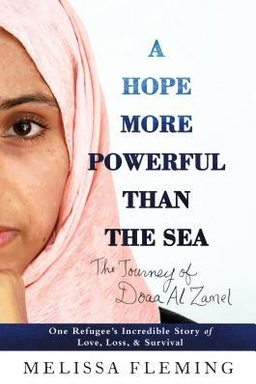
What does it mean to cling to hope when the world around you is collapsing? In A Hope More Powerful Than the Sea, Melissa Fleming tells the extraordinary and harrowing true story of Doaa Al Zamel, a young Syrian woman who survived both war and one of the deadliest shipwrecks in the Mediterranean. Fleming, the Chief Spokesperson for the United Nations High Commissioner for Refugees (UNHCR), uses Doaa’s life to offer a human face to a global crisis often reduced to statistics. Through Doaa’s journey—from an ordinary childhood in Syria to the chaos of displacement and the struggle for survival at sea—Fleming reveals a central argument: that hope, courage, and love can endure even amid unimaginable suffering.
The book explores what happens when humanity collides with catastrophe. It intertwines the personal with the political, showing how the Syrian civil war and global inaction forced millions, like Doaa, to choose between dying in war or risking death at sea. Fleming contends that to truly understand the refugee crisis, you must understand the people—their families, faith, fears, and unrelenting resilience. She also argues that compassion and justice are not independent virtues but moral imperatives shaped by personal stories. Doaa’s experience is a mirror reflecting both the best and worst of humanity: the brutality of conflict and the mercy of strangers.
From Daraa to Drowning: A Symbol of a Generation
Fleming opens by describing Doaa’s idyllic childhood in Daraa—a bustling agricultural town in southern Syria—where close-knit families lived under authoritarian rule yet nurtured dreams for their children. As political reforms never came and the Arab Spring ignited in 2011, Syria descended into chaos. Daraa, the cradle of the revolution, became a site of defiance and death. Doaa, once a shy girl who feared swimming, became an activist, marching in peaceful protests even as tanks rolled through her city.
This transformation from innocence to activism places her story within a broader historical arc. Like Anne Frank or Malala Yousafzai, Doaa represents the moral consciousness of her generation—a young woman unwilling to accept oppression, even when it costs her everything. Fleming uses this shift to explore how ordinary people become extraordinary under pressure.
War, Love, and Exile
As Syria’s civil war destroyed Daraa, Doaa’s family fled to Egypt, one of the few countries still open to refugees. What they found was not safety, but poverty, exploitation, and xenophobia. Amid despair, Doaa fell in love with Bassem, a barber who shared her yearning for freedom. Their romance—tender and defiant—symbolizes the persistence of life amid ruin. In exile, love became resistance. When Egypt turned hostile toward Syrians after political upheaval, the couple’s dream of starting anew in Europe seemed their only escape.
Fleming frames this love story as both intimate and universal. Bassem and Doaa’s decision to board a smuggler’s boat in 2014 was not about recklessness—it was about hope. The title’s metaphor, hope more powerful than the sea, takes on literal meaning as Doaa’s faith is tested by the vast, merciless waters that claim hundreds of lives every year. The sea becomes both antagonist and judge—a natural force exposing humanity’s indifference.
Witness and Voice: Why This Story Matters
Doaa’s survival—clinging to a float for four horrific days while holding two dying infants—is not just a tale of endurance; it’s a rebuke to global apathy. Fleming positions her story as testimony. In many ways, Doaa stands for the millions displaced by conflict whose names we never hear. By meticulously reconstructing her journey through interviews, documents, and UNHCR investigations, Fleming humanizes those statistics, forcing readers to confront what refugee life truly means.
The author’s deeper argument is also institutional. As a UN advocate, Fleming calls out bureaucratic failures, restrictive asylum policies, and the moral complacency of wealthy nations. She contrasts Doaa’s courage with Europe’s fear. Yet she also spotlights acts of compassion—from Egyptian neighbors who offered shelter to Greek sailors who rescued her from certain death. In doing so, the book becomes a manifesto of empathy. It insists that change begins not with policies, but with perception—with seeing refugees not as burdens, but as bearers of untold courage.
A Story that Demands Action
Ultimately, A Hope More Powerful Than the Sea asks readers a single haunting question: what would you risk for freedom? By the end of Doaa’s story—after losing her fiancé to the waves, rescuing a child, and enduring trauma—the reader is forced to recognize that refugees are not victims of fate but of human-made systems. Fleming leaves us with an ethical call to action: empathy must evolve into political will. Her narrative invites you to carry the image of a nineteen-year-old girl, adrift in a hostile ocean yet refusing to surrender, as both a warning and a promise of humanity’s potential.
In the pages that follow, we’ll explore how Doaa’s childhood shaped her strength; how war stole her home; how love and exile transformed her; and how survival at sea—literal and spiritual—became a symbol of endurance. Together, these themes illuminate Fleming’s central truth: that even in the darkest waters, hope—if fiercely held—can become the most buoyant force of all.