
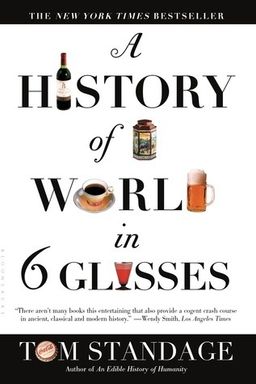
A History of the World in 6 Glasses cover

A History of the World in 6 Glasses

by Tom Standage

A History of the World in 6 Glasses offers a refreshing lens on history through six iconic drinks. From the agricultural roots of beer to the global influence of Coca-Cola, Tom Standage reveals how these beverages shaped civilizations, economies, and cultures. Discover the surprising connections between our favorite drinks and major historical events.

How Six Drinks Shaped the History of Humanity

Have you ever wondered how the simple act of sipping your morning coffee or sharing a beer after work connects you to thousands of years of history? In A History of the World in 6 Glasses, Tom Standage argues that civilization itself can be traced through the beverages we’ve created and consumed. From prehistoric beer to modern Coca-Cola, each of six drinks—beer, wine, spirits, coffee, tea, and cola—mirrors a profound shift in human society. Together, they provide a liquid lens through which we can understand the evolution of agriculture, religion, imperialism, industrialization, and globalization.

Standage, who writes for The Economist, proposes a daring idea: instead of viewing history through wars, kings, and politics, we can trace it through what people drank and why. In his telling, drinks are more than refreshments—they’re technological innovations, cultural symbols, and catalysts of global change. Every one of these six drinks reshaped the world by meeting a specific need of its time: beer provided nutrition and safety, wine embodied civilization and status, spirits fueled exploration and exploitation, coffee sparked intellectual revolution, tea powered industrial and imperial expansion, and Coca-Cola symbolized global capitalism.

From Grain to Glass: The Birth of Civilization

The story begins in the Fertile Crescent roughly 10,000 years ago, when the discovery of fermentation may have given early humans the incentive to settle down and cultivate grain. Beer, safer to drink than contaminated water, became a cornerstone of agricultural life. It was a form of edible currency and even a sacred offering. In Mesopotamian records, beer rations were standard wages, and in Egypt, the pyramid builders were paid in beer—proof that this humble beverage literally built civilization. Standage draws on evidence from archaeology and anthropology (notably paralleling Jared Diamond’s Guns, Germs, and Steel) to show how a simple fermented grain drink propelled the transition from nomadic to settled life.

Beer also symbolized equality; everyone, from Pharaoh to farmer, drank it. Contrast that with the next drink in Standage’s chronology, wine, which epitomized hierarchy and refinement. Beer thus represents the communal, egalitarian origins of human civilization—where sharing a drink meant sharing survival.

Wine and the Making of Culture

As agriculture advanced, wine took center stage in the Mediterranean world, especially among the Greeks and Romans. Wine signified sophistication, intellectual discourse, and social order. Where the Greeks gathered at symposia to discuss philosophy under the gentle haze of diluted wine, the Romans built empires and hierarchies around vintages and vineyards. By marking status and reflecting cultural values, wine became both a medium of refinement and a metaphor for civilization itself. This pattern, Standage notes, persists today whenever a dinner host selects a particular bottle to express taste and identity.

In a vivid illustration, Standage describes how Roman connoisseurs treated wine as a class system in liquid form: Falernian at the top, sour posca for soldiers and slaves at the bottom. In this world, what you drank quite literally defined who you were. Yet this very culture of wine also seeded contradictions—between indulgence and restraint, pleasure and piety—that would echo through Christianity and Islam’s divergent stances toward alcohol.

Spirits, Slaves, and the Age of Empire

When European explorers turned their gaze outward in the fifteenth and sixteenth centuries, distilled spirits became both weapon and currency. The technology of distillation, perfected by Arab alchemists, gave rise to portable, potent forms of alcohol like rum and whiskey. These drinks were lightweight, storable, and immensely profitable—ideal for long voyages and brutal colonial economies. Standage masterfully connects the dots between rum distilleries in the Caribbean, the sugar plantations that fed them, and the transatlantic slave trade they sustained. Alcohol, once sacred, had become a tool of global commerce and oppression.

Spirits also played a dramatic role in America’s own identity crises: rum taxes ignited rebellion against the British Crown, and whiskey taxes inspired the fledgling republic’s first internal uprising. As Standage succinctly shows, what we drink often mirrors what we fight for—or against.

Coffee, Tea, and the Age of Reason

If beer fueled the rise of cities and spirits built empires, coffee gave birth to modern thought. Arriving in Ottoman Europe in the seventeenth century, coffee replaced alcohol as the “sobering drink” of a new intellectual age. Coffeehouses were the laboratories of democracy and science—where ideas percolated alongside cups of “black inspiration.” In London’s coffeehouses, scientists debated astronomy, financiers invented the stock exchange, and writers launched newspapers. Coffee, Standage argues, was the original Internet: a social network powered by caffeine and conversation.

Alongside coffee rose tea, Britain’s imperial elixir. Imported from China, sweetened with Caribbean sugar, and industrially consumed by working-class factory laborers, tea literally ran the British Empire. It spurred revolutions—from America’s Boston Tea Party to China’s Opium Wars—and reshaped global trade, consumption, and health. When taken collectively, tea and coffee illustrate how caffeine replaced alcohol as the stimulant of progress, productivity, and modernity.

Cola and the Age of Globalization

In the last act of Standage’s saga, the story fizzes into modernity with Coca-Cola. Born in an Atlanta pharmacy, Coke began as a medicinal tonic before becoming a symbol of American optimism and consumerism. Its global march shadowed America’s rise as a superpower in the twentieth century: military supply chains during World War II made Coke a global drink, and after the war, it became shorthand for democracy and capitalism. By the Cold War, Coca-Cola wasn’t just a beverage—it was ideology in a bottle.

Through these six drinks, Standage tells a sweeping yet intimate story of humanity’s appetites—for nourishment, for meaning, for connection, and for control. Each glass encapsulates an era, showing that what we choose to drink reveals more about who we are, and the world we’ve built, than we might ever suspect.


Beer: The Drink That Built Civilization

According to Standage, the world’s first cities would never have existed without beer. When ancient foragers in the Fertile Crescent discovered that grains left in water fermented into a bubbly, nourishing liquid, they unknowingly triggered one of humanity’s greatest revolutions: agriculture. Beer was safer to drink than contaminated water, rich in calories, and even spiritually potent—it blurred the lines between nourishment and ritual.

From Field to Fermentation

Archaeological digs in Mesopotamia show clay tokens engraved with beer symbols—the world’s earliest bookkeeping system. Workers on Sumerian and Egyptian construction sites received daily beer rations (about two liters per person). To drink beer was to belong. The Sumerians even had a beer goddess, Ninkasi, whose hymn doubles as the oldest known recipe. Beer thus catalyzed social cohesion, recordkeeping, and collective labor—all foundations of civilization.

Liquid Currency and Cosmic Gift

Beer wasn’t just sustenance; it was salary, medicine, and sacrament. The Egyptians, believing beer to be divine, used it in festivals to honor deities like Hathor. Its production spurred advances in pottery, measurement, and ultimately writing—since priests tracked beer and bread as temple offerings. By tying daily life to divine ritual, beer linked grain to grace, consumption to community. In essence, beer made civilization not just possible but meaningful.

(As anthropologist Solomon Katz has argued, beer might even have been a stronger motivation to farm than bread—a reminder that pleasure often drives progress as much as necessity does.)


Wine: Status, Civilization, and the Mind

As civilization matured around the Mediterranean, beer’s communal comfort gave way to wine’s civilized hierarchy. For the Greeks and Romans, wine was not just another drink—it was a language of virtue, intellect, and class. What beer was to simple labor, wine became to philosophy and politics.

Greece: Wine and the Mind

At the Greek symposion, men lounged on couches, sipping diluted wine while debating love, democracy, and the cosmos. This ritualized drinking underscored moderation—a middle path between barbarian excess and puritan abstinence. In these gatherings, wine lubricated reason, not rebellion. Plato’s dialogues and Aristophanes’s plays immortalized these meetings, showing that fellowship and philosophy often flowed from the same cup.

Rome: Power in the Pour

The Romans industrialized wine as they did empire. Vineyards stretched across conquered lands, from Gaul to Spain, and amphorae of Falernian and Caecuban defined social status. Yet Rome’s hierarchical drinking mirrored its politics: refined vintages for senators, sour posca for soldiers and slaves. Wine became a symbol of Roman order—and its decline mirrored that of Rome itself. Still, through Christianity’s adoption of wine as sacred ritual, its cultural dominance endured even after Rome’s fall.

Wine, then, distilled civilization: an emblem of intellect, hierarchy, and continuity. Its story reminds you how easily culture can pour itself into a cup.


Spirits and the Age of Exploration

Distilling wine into spirits changed not just drinking habits but world history. From Arab alchemists perfecting the alembic still to European sailors commodifying brandy and rum, spirits became both the currency and the engine of empire. Standage calls them the first truly global drinks—products born from technology, trade, and tragedy.

The Alchemy of Empire

Arab scholars like Jabir ibn Hayyan refined distillation in the 8th century, seeking medical and mystical purity. Ironically, their “water of life” (aqua vitae) would fuel European colonization. By the 1600s, brandy and rum powered the triangular trade: molasses from Caribbean plantations became rum in New England, which was traded in Africa for slaves, whose labor produced more sugar to make more rum. Each drop condensed both wealth and human suffering.

Rum, Revolution, and Rebellion

In colonial America, rum was a national obsession. Taxes on molasses (and later whiskey) incited resistance that culminated in revolution. George Washington’s army marched on rations of spirits, and after independence, the Whiskey Rebellion tested the new republic’s authority. Spirits were the literal and figurative fuel of rebellion—economic lifeblood turned political flashpoint.

(In contrast, Sidney Mintz’s Sweetness and Power details how sugar and its byproducts like rum reshaped global consumption, showing, like Standage, that taste and trade often intertwine with tyranny.)


Coffee and the Birth of the Modern Mind

Coffee’s arrival in seventeenth-century Europe marked humanity’s pivot from intoxication to insight. When people traded ale for Arabica, they also traded dreams for ideas. Standage calls coffee the ‘great soberer’—a drink that sharpened minds, fueled revolutions, and birthed the information age before the Internet.

From Religious Controversy to Enlightenment Catalyst

Originating in Yemen, coffee first spread through the Islamic world, where Sufi mystics used it to stay awake in prayer. When it reached Europe, it replaced wine as the beverage of reason. Coffeehouses sprouted in London, Paris, and Vienna, creating spaces where merchants, writers, and scientists exchanged ideas freely. London’s coffeehouses—described as “penny universities”—hosted Newton’s debates on gravity, the founding of Lloyd’s insurance, and the birth of The Spectator magazine. Voltaire allegedly consumed fifty cups a day while fueling the French Enlightenment.

The First Information Network

Centuries before Wi-Fi, coffeehouses functioned as analog social networks. Newsletters, pamphlets, and gossip circulated alongside the coffee pots. Political revolutions brewed alongside scientific ones: Newton’s Principia was sparked by a coffeehouse conversation, and the French Revolution by Parisian cafés like the Café de Foy. By stimulating discussion instead of dulling senses, coffee democratized knowledge and made ideas as addictive as caffeine.

Whenever you grab a latte to ‘wake up,’ you’re participating in a centuries-old tradition of enlightenment one cup at a time.


Tea and the Fuel of Empire

Tea, Standage explains, was Britain’s secret energy source—the beverage that lubricated both industrial capitalism and empire. From Chinese mountain terraces to London tea gardens, it became a symbol of power, productivity, and paradox.

China’s Gift, Britain’s Addiction

Tea began as a Chinese medicinal brew but became Britain’s defining national drink by the eighteenth century. The East India Company, a private corporation turned imperial government, cemented Britain’s global dominance by monopolizing tea trade. But its greed had unintended consequences—triggering the American Revolution through the Tea Act and the devastation of China through the Opium Wars. In both cases, tea was both weapon and casualty of empire.

The Industrial Infusion

Tea also transformed the working class. Its antiseptic properties reduced disease in crowded cities, while caffeine boosted factory output. “Tea breaks” became institutionalized, sustaining laborers through long mechanized shifts. Women, often excluded from coffeehouses, made tea the center of domestic life—giving rise to afternoon tea rituals and consumer marketing innovations from Wedgwood pottery to Twining’s branding (the world’s oldest commercial logo still in use).

In every sense, tea industrialized well-being: it was mass-produced, mass-marketed, and mass-consumed, fueling Britain’s ascent as the world’s first global superpower.


Coca-Cola and the Global Age

In the final act of Standage’s history, Coca-Cola becomes both refreshment and representation—the fizzy emblem of American capitalism and globalization. Born in Atlanta in 1886 as a medicinal tonic, Coke mirrored every stage of America’s rise, from industrial mass production to global dominance.

From Remedy to Revolution

Pharmacist John Pemberton first marketed Coke as a nerve tonic infused with coca leaves and kola nuts—a product of the same entrepreneurial spirit that produced countless 19th-century patent medicines. Under businessman Asa Candler, Coca-Cola transformed into a mass-market brand, its red-and-white logo recognizable across the continent. Its popularity exploded when it accompanied American soldiers abroad in World War II, symbolizing home, freedom, and identity.

The World in a Bottle

After the war, Coca-Cola followed American influence everywhere—friends and foes alike. Soviet General Zhukov even requested a colorless ‘vodka-like’ Coke. Yet in many places, it also became shorthand for American imperialism, sparking what critics called Coca-Colonization. Where earlier beverages signified gods or empires, Coca-Cola symbolized the marketplace itself: democracy sold by the bottle. Its rivalries (with Pepsi in the USSR, or local colas in the Middle East) played out like miniature Cold Wars.

In the end, Standage argues, Coca-Cola epitomizes globalization’s double edge—uniting taste while dividing ideology. Like beer in Mesopotamia or tea in London, Coke tells us what truly defines each age: not just what we drink, but what we believe in.


Water and the Future of Civilization

Standage closes the circle with the simplest drink of all: water. After millennia of seeking safer, tastier, or stronger alternatives, humanity has rediscovered water as both the oldest and most urgent beverage. In an age of bottled brands and climate crisis, water now reflects the global inequities that earlier drinks once symbolized.

From Public Good to Private Commodity

In developed countries, we fetishize bottled water—sometimes shipped halfway around the planet—while three billion people lack reliable access to clean tap water. Standage notes the irony that many Western consumers pay more per gallon for water than for gasoline, even though 40% of bottled water is simply repackaged tap water. Water, humanity’s first drink, has become a luxury—masquerading as purity in designer plastic.

The Coming Water Wars

Access to water, not oil, may define the conflicts of the twenty-first century. From the Nile to the Jordan to the Ganges, nations already vie over rivers and aquifers. Yet Standage also highlights how cooperation—shared rivers, joint management treaties—can turn water into a catalyst for peace. The liquid that birthed civilization might yet determine its survival.

By ending where he began, with the most essential drink of all, Standage reminds you that history isn’t just written in ink—it’s brewed, distilled, and poured. What humanity drinks next may shape not just our habits, but our fate.

Dig Deeper

Get personalized prompts to apply these lessons to your life and deepen your understanding.

Go Deeper

Get the Full Experience

Download Insight Books for AI-powered reflections, quizzes, and more.