
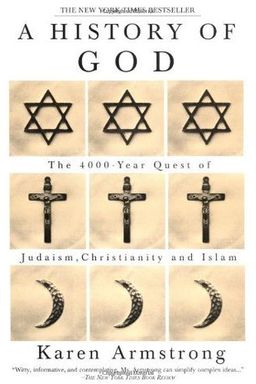
A History of God cover

A History of God

by Karen Armstrong

Karen Armstrong''s ''A History of God'' delves into the 4,000-year evolution of God in Judaism, Christianity, and Islam. This compelling narrative explores the historical, philosophical, and mystical shifts that have shaped our understanding of the divine across centuries.

The Human Search for the Sacred

Why do human beings invent gods, rituals, and sacred stories? Karen Armstrong’s grand narrative argues that religion arises not from ignorance but from a persistent experience of the numinous—the sense that life carries a mysterious, transcendent depth. Across millennia, people have shaped myths, symbols, doctrines and practices to engage this unseen dimension. Her account traces how humanity’s feeling for sanctity evolved—from Paleolithic rituals and Mesopotamian mythology through the prophets, Greek philosophy, Christianity, Islam and modern secular thought—to show that 'God' is not a static entity but a symbol of human moral and imaginative development.

Mythic beginnings and numinous consciousness

Armstrong begins with the feeling of awe that Rudolf Otto called the mysterium tremendum et fascinans. Paleolithic figures and early fertility goddesses like Inana and Isis reveal the psychological roots of religion: the instinct to dramatize life’s mystery through myth. Myths were never primitive science; they were participatory art forms that made cosmic forces approachable. The Babylonian Enuma Elish, with Marduk’s creation from chaos, dramatizes how order must be ritually reaffirmed—a pattern repeated in seasonal festivals and temple rites everywhere. You learn that religion began as performance and participation, not belief or dogma.

Monotheism and moral revolution

Out of Canaanite and Mesopotamian polytheism emerged Yahweh’s austere voice. Armstrong traces how Israel evolved from tribal loyalty to universal ethics, how the prophets turned religion into social conscience, and how covenant shifted piety from offering sacrifices to building justice. Amos and Isaiah declare that God demands righteousness for the poor rather than ritual pomp. This moral turn makes divine transcendence inseparable from human compassion—a theme echoed by later Axial Age contemporaries like the Buddha, Confucius and Plato, who each seek inner transformation over public cult.

Axial Age and interior discovery

Between 800 and 200 BCE, simultaneous insights arose across Eurasia: Brahman as ultimate reality in the Upanishads; the Buddha’s disciplined path to end suffering; Plato’s realm of eternal forms. Armstrong emphasizes that religion became introspective—turning from ritual performance to personal awakening. These spiritual technologies—meditation, contemplation, philosophy—later inform Jewish, Christian and Muslim mystics, proving that religion’s evolution is neither linear nor local but comparative and cumulative.

God in history: from incarnation to revelation

The story of Jesus, Paul and Muhammad further extends this trajectory. Jesus operates within prophetic Judaism yet radicalizes it into inner compassion and inclusive healing. Paul universalizes this message through participatory salvation (“in Christ”), while Islam retrieves Abrahamic monotheism with the Qur’anic emphasis on social justice and community ethics. For Armstrong, revelation always transforms human culture: it shifts imagination, builds community (the Church, the Ummah) and grounds morality in divine unity.

Reason, mysticism and modern crisis

As faith matured, it confronted philosophy and science. Armstrong’s chapters on Trinity, Falsafah, Kalam and mysticism show efforts to balance rational clarity with spiritual depth. When theologians turned God into a proveable object, Enlightenment skepticism erupted. Modernity then witnessed both negation (“God is dead,” Nietzsche) and reconstruction (Tillich’s Ground of Being, Process theology’s relational God). The book closes with the plea that future faith must recover mythic imagination and moral compassion rather than retreat into literalism or nihilism. Religion survives only when it helps you enact empathy and meaning, not when it offers explanation.

Core perspective

Across all epochs, Armstrong argues that 'God' functions as humanity’s metaphor for transcendence—a mirror of our evolving capacity for compassion, wonder and moral imagination. To understand religion is to trace how cultures have tried to keep this metaphor alive and ethical in ever-changing worlds.


From Myth to Morality

Armstrong shows religion’s earliest forms as participatory myth rather than blind belief. In Mesopotamia and Egypt, people dramatized cosmic order through ritual storytelling—Marduk slaying Tiamat or Isis restoring Osiris. Myths let communities feel divine creativity in daily life. These acts were not primitive explanations but emotional rehearsals for confronting chaos, mortality and renewal.

Transformation toward ethical monotheism

Israel’s leap was moral, not metaphysical. Yahweh evolves from a tribal deity (El) into a historical and ethical God. The prophets turn sacrifice into conscience; they insist that holiness is justice, not ritual. This concept—God revealed through compassion—becomes the foundation for later traditions, influencing Christianity’s love ethic and Islam’s social responsibility.

Ritual still necessary

Armstrong warns that ritual never disappeared. Even monotheism used symbolic acts—Passover, Eucharist, Hajj—to embody moral teaching. Myth thus evolves into liturgy, sustaining communal ethics. (Note: Mircea Eliade’s works complement this by explaining ritual as renewal, not superstition.)

Takeaway

Religion matures when mythic drama becomes ethical demand—when divine order is enacted as compassion among humans.


Axial Age and Inner Awakening

During the Axial Age (800–200 BCE), thinkers across Eurasia discovered a radically interior notion of the sacred. Armstrong aligns the Hebrew prophets with the Buddha, Confucius, Lao-Tzu, Plato, and the Upanishadic sages—all seeking transformation of consciousness rather than appeasement of gods.

India’s inward mysticism

The Upanishads teach that Brahman—the world’s essence—is identical with Atman, the inner self. Their parables dissolve separation between self and divine. The Buddha transforms the same insight into ethical therapy: suffering (dukkha) ends through mindfulness and compassion. Religion becomes practice, not orthodoxy.

Greek rational ascent

Plato’s forms and Aristotle’s Unmoved Mover outline philosophical routes to transcendence. For Armstrong, these rational paths complement Asia’s mystical ones—they turn faith into disciplined contemplation. The notion of 'logos' later influences Christianity’s theology and Islamic philosophy (see al-Farabi and Ibn Sina).

Shared insight

All Axial traditions discover that salvation or liberation lies in moral and mental transformation. Armstrong calls this the pivot of human spirituality—a lasting template for monotheistic ethics and mysticism.

Key point

The Axial Age redefines religion from cosmic performance to interior discipline, enabling future faiths to unite transcendence with personal awakening.


Incarnation, Revelation and Community

Armstrong connects Christianity and Islam as parallel responses to the prophetic and Axial legacy. Both envision God’s presence entering human history through embodied revelation and communal ethics.

Jesus and early Christianity

Jesus inherits Jewish prophetic themes: healing, compassion and inner Torah observance. Paul reinterprets this message cosmically—believers participate 'in Christ,' forming a moral community transcending ethnic boundaries. The later doctrine of Trinity arises to express how divine transcendence and immanence coexist within experience. Armstrong contrasts Eastern apophatic mysticism, which uses silence to express God’s mystery, with Western rationalism, which systematises divinity.

Muhammad and the Qur’an

Muhammad’s revelations at Hira recapture Abrahamic unity (tawhid) for a divided Arabia. The Qur’an is experienced sound—a communal recitation—linking divine word and social justice. Islam’s pillars transform spirituality into embodied ethics: prayer, fasting, almsgiving, pilgrimage. The Hijra inaugurates the ummah, a moral super-tribe built on egalitarian law. Gender and economic reforms embody divine compassion in social form.

Unifying thread

Both Christianity and Islam turn revelation into participatory community: salvation and submission are collective acts that translate transcendence into ethical life.


Reason, Philosophy and Faith

As civilizations stabilized, thinkers sought to make revelation coherent with logic. Armstrong’s chapters on Falsafah and Kalam trace Islam’s philosophical flowering, paralleled by Christian scholasticism and Jewish rational mysticism.

Islamic rationalism

Mutazilis defended free will and divine justice; Ibn Sina’s metaphysics defined God as Necessary Being and used emanation to explain creation; Ibn Rushd’s commentaries transmitted Aristotelian reason to Europe. Jewish philosophers like Maimonides reworked these insights through apophatic theology—knowing God by negation. These cross-cultural syntheses reveal an interfaith conversation about how to think rationally about divine mystery.

Mystical corrective

Armstrong stresses that rationalism always provokes a mystical reaction: al-Ghazzali abandons Falsafah for Sufism; Kabbalists in Safed respond to exile with mythic cosmology and tikkun (repair). Both movements show that human reason alone cannot sustain faith—it needs imagination and moral feeling to keep God alive.

Lesson

Religion flourishes when reason and mysticism cooperate—logic disciplines belief, but poetry and compassion give it life.


Mysticism and the Inner Light

Armstrong’s middle chapters show that mystics in every faith sought direct contact with the divine. Sufis, Kabbalists and Christian contemplatives turned faith into personal transformation through love, ecstasy and symbolic imagination.

Sufi insight

Figures like Rabiah and al-Hallaj speak of annihilation (fana) and subsistence (baqa) in God. Later synthesizers—al-Ghazzali, Ibn al-Arabi and Rumi—express this unity as oneness of being (wahdat al-wujud). Poetry, dance and remembrance (dhikr) become ways to dissolve ego. The mystical aim is not doctrinal precision but transformed consciousness.

Kabbalistic and Hasidic renewal

Jewish mysticism evolves from Luria’s cosmic myths—En Sof, sefiroth and tikkun—to Hasidism’s joyful devotion. The Baal Shem Tov democratizes Kabbalah: every act done with awareness can mend the world. Habad combines intellect and ecstasy, proving mysticism’s adaptability. Armstrong underscores that spiritual creativity often blooms from trauma—exile, persecution, or rationalist fatigue.

Essential insight

Mysticism revives the experiential heart of religion, ensuring that God remains an inner energy rather than an external ruler.


Reformation and the Age of Reason

Armstrong views the Reformation as both liberation and distortion. Luther and Calvin shattered medieval intermediaries, insisting on direct relation to God, yet their doctrines bred anxiety and division. Calvinism’s work ethic and election theology shaped modern bourgeois responsibility but also a harsher moral world. The Jesuits countered with disciplined spiritual exercises, seeking emotional balance.

Science and literalism

The post-Reformation era turned God into an object of proof. Newton’s mechanical cosmos and Descartes’ rational arguments made divinity testable, while biblical literalism (the Council of Trent) locked Christianity into conflict with scientific evidence. The same logic that proved God became the logic that disproved him.

Enlightenment alternatives

Pascal proposed emotional faith as wager; Spinoza reimagined God as nature; Deists and Methodists split between rational restraint and passionate revivalism. Armstrong observes that modernity fractured the sacred into multiple paths—some secular, some renewed.

Moral takeaway

When rational control replaces awe, faith grows brittle; yet reason remains vital when it protects religion from fanaticism.


Modern Crisis and Reimagined Divinity

In the modern world, religion faces both philosophical and ethical collapse. Enlightenment skepticism, scientific materialism, and historical catastrophes like Auschwitz forced theologians to reinvent or abandon God. Armstrong’s later chapters trace this crisis and the creative responses that followed.

Critical collapse

Feuerbach, Marx and Freud interpret God as projection; Nietzsche’s 'death of God' exposes spiritual emptiness. The Holocaust deepens theological despair; Jewish thinkers wrestle with divine impotence or hiddenness (tzimtzum renewed as myth of self-limited deity). Religion must now respond not merely to doubt but to moral horror.

Reconstruction and future hope

Modern theologians—Tillich, Rahner, Teilhard de Chardin—recast God as Ground of Being or evolutionary process. Jewish and Islamic reformers like Buber and Iqbal emphasize encounter and creativity. The 'future of God,' Armstrong concludes, depends on recovering mythic compassion without dogmatic literalism—making faith imaginative, ethical, and non-coercive.

Final reflection

The sacred endures only when it helps humanity make justice and wonder real. God’s survival lies not in proofs but in empathy, creativity and moral courage.

Dig Deeper

Get personalized prompts to apply these lessons to your life and deepen your understanding.

Go Deeper

Get the Full Experience

Download Insight Books for AI-powered reflections, quizzes, and more.