
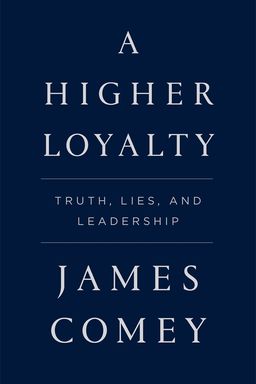
A Higher Loyalty cover

A Higher Loyalty

by James Comey

A Higher Loyalty offers an inside look at James Comey''s career, from prosecuting mobsters to battling presidential policies. Discover the vital traits of leadership-integrity, humor, and humility-as Comey shares lessons learned from a lifetime in public service and his fight for ethical governance.

Loyalty to Truth and Justice

How does a leader stay truthful when pressured to conform? In A Higher Loyalty, James Comey argues that genuine leadership demands allegiance to enduring values rather than personal power or partisan identity. Through the lens of his life—from a teenage trauma to prosecuting the Mafia, from confronting presidents to directing the FBI—Comey explores how integrity functions as an operating system for decisions, not as an ornament.

Framing the Central Question

Comey opens by asking a deceptively simple question: to whom do you owe loyalty? For him, ethical leadership means choosing a higher loyalty—to truth, justice, and institutional integrity—over loyalty to individuals or factions. He views this principle not as moral abstraction but as a daily test. In moments of pressure—whether from a president seeking personal fealty or from colleagues urging silence—you must decide which loyalty endures beyond careers or crises.

(Note: Comey’s argument parallels Reinhold Niebuhr’s ethical realism—Niebuhr taught that imperfect people must act justly despite uncertainty. Comey studied Niebuhr in college and later cited him often, making moral realism a foundation for his leadership.)

Formative Roots

The book traces where this moral compass began. As a teenager in Allendale, New Jersey, Comey survived an armed home invasion. That near-death experience made him acutely aware of life’s fragility and the importance of courage. Later, his shift from chemistry to law—shaped by studying Niebuhr—transformed that awareness into a drive for justice. Mentors like Judge John Walker, lawyer Richard Cates, and grocery manager Harry Howell modeled how kindness and high standards can coexist. Those figures taught him that integrity is practiced in small acts of fairness before it is tested in grand moments.

Lessons from Institutions

Comey’s career as a prosecutor illuminated how loyalty and lying coexist inside organizations. He learned from prosecuting the Mafia that insular codes of honor can mask systemic deceit. 'The Life begins with a lie,' he writes of La Cosa Nostra, describing rituals that glorified false notions of honor. These cases taught him that institutions corrupted by blind loyalty—to tribe, profit, or reputation—become morally inverted. The antidote is transparency, accountability, and what he calls the reservoir of trust: credibility built slowly through truthful conduct.

Leadership Through Crisis

Comey carries this ethic into moments of confrontation with power—from the hospital standoff over domestic surveillance to later clashes with presidents from different parties. In each, he insists that law must constrain authority. His fight against undue executive influence during the 'Stellar Wind' program reflected a higher loyalty to constitutional boundaries. Similarly, his choice to disclose politically sensitive information during the Clinton and Weiner investigations stemmed from concern for the Bureau’s credibility—even when disclosure carried personal and institutional costs.

Personal Loss and Meaning

The death of Comey’s newborn son, Collin, deepens this theme of moral resilience. His wife Patrice transforms grief into advocacy by championing universal screening for Group B strep, preventing other families’ tragedies. Their story illustrates how pain can become purpose—a recurring pattern throughout the book. Leadership, Comey suggests, is not stoic detachment but the capacity to find meaning even in loss.

Truth as the Oxygen of Institutions

Comey warns that lying—whether the easy lie of a public figure or the institutional lie of a compromised leader—drains the reservoir of public trust. The Martha Stewart case epitomizes this tension: prosecuting a beloved celebrity for lying preserved equality before the law. The decision symbolizes his broader principle that truthfulness cannot depend on popularity. Justice with favoritism ceases to be justice.

Listening and Culture-Building

When he leads the FBI, Comey applies lessons about listening from President Obama: real listening, not waiting-to-speak, creates trust. He redefines culture through small rituals—cafeteria conversations, humility-building questions, and field visits—to make frank dialogue possible. Diversity and inclusion become moral imperatives for broadening perspective and reducing blind spots.

The Higher Loyalty in Democratic Life

The book culminates in the confrontation with President Trump, where loyalty demands cross ethical lines. Comey’s refusal to swear personal fealty crystallizes his thesis: democratic institutions survive only when officials honor truth above political gain. His firing and aftermath—documentation, testimony, and the special counsel’s appointment—illustrate both the cost and necessity of safeguarding truth in governance.

Final Takeaway

A higher loyalty means defending the rule of law, truth-telling, and moral courage when conformity is safer. It is a loyalty not to power, but to principles that make justice possible.

For you as a reader, Comey’s memoir offers a template: ethical leadership fuses integrity, empathy, and self-scrutiny. It is a lifelong practice of choosing truth—especially when doing so costs you comfort or approval.


Formative Experiences and Moral Awakening

Comey’s ethical compass emerged from formative shocks. The trauma of a teenage home invasion revealed both fear and the will to survive. It gifted him a lifelong sensitivity to justice and human vulnerability. Later intellectual influences—particularly theologian Reinhold Niebuhr’s idea of striving for justice in an imperfect world—gave philosophical depth to that instinct. Together, personal experience and ideas forged the moral frame that guided his career.

Mentorship and Modeling

Comey’s mentors illustrated leadership as behavior rather than rhetoric. Judge John Walker taught composure and observation; Richard Cates showed how empathy and intelligence coexist in law; Harry Howell demonstrated discipline with decency. Watching them helped Comey see leadership as relational—a trust you earn through fairness, not domination.

The Character Arc

Comey’s acknowledgment of complicity in college bullying adds nuance. He learns firsthand that being a victim doesn’t prevent later wrongdoing. That humility inoculates him against self-righteousness. It teaches that ethical vigilance must be daily, not situational. By confessing his own failures, he invites you to accept imperfection as a teacher.

Turning Loss into Purpose

The loss of his infant son Collin becomes a turning point from grief to service. His wife Patrice transforms tragedy into health-policy activism, showing that meaning arises through helping others. Their experience reconnects private morality with public action, embodying Comey’s thesis: justice begins in empathy.

Leadership Lesson

A leader’s moral foundation grows from adversity, reflection, and witness. You build credibility not by preaching ethics, but by living through experiences that test your principles.


Truth versus the Easy Lie

The concept of truth anchors Comey’s philosophy. He warns that tolerating small falsities—like Martha Stewart’s obstruction during a minor financial case—breeds systemic dishonesty. In the justice system, one 'easy lie' corrodes the perception of fairness. His decision to prosecute celebrities underscores his belief that all citizens must face the same standards.

The Reservoir of Trust

Comey describes institutional credibility as a reservoir filled by generations of honest acts and drained by each deception. Leaders must guard this reservoir zealously. Whether confronting a false statement or resisting external pressure, consistency preserves faith in the institution. For Comey, integrity is inertia—one dishonest exception can reverse decades of trust-building.

The Broader Application

His analysis extends beyond law enforcement. When businesses, governments, or media normalize small lies, moral relativism replaces accountability. Truth thus becomes not merely moral but functional—it is the oxygen that keeps systems from suffocating under cynicism.

Key Principle

Ethical leadership demands defending honesty even when the falsehood looks harmless. Credibility once lost rarely returns.


Standing Up to Power

One of the book’s most dramatic sections recounts Comey’s defiance during the Bush administration’s secret surveillance dispute. Acting Attorney General at the time, he refused to reauthorize a program deemed unlawful. The confrontation at John Ashcroft’s hospital bed became a tableau of institutional courage—the Justice Department, represented by Comey and Robert Mueller, protected legality against executive pressure.

The Cost of Courage

Comey emphasizes that protecting truth requires personal risk. Defying the president may jeopardize career and comfort, but capitulation erodes democracy. The same logic guided later battles over interrogation policy, where legal offices recalibrated flawed 'enhanced techniques' opinions despite immense political heat.

Ethical Independence

Such episodes illustrate what Comey calls institutional reflex: when laws conflict with orders, leaders must act as guardians of principle, not as instruments of power. This independence sustains legitimacy. You learn that compliance without conscience turns institutions into servants of expedience.

Core Message

Moral strength in office means saying no when legality and conscience demand it, even if you stand alone.


Leading and Listening in the FBI

As director under President Obama, Comey attempts to translate moral ideas into cultural reforms. He introduces humility, listening, and diversity into an agency steeped in hierarchy. The lesson he borrows from Obama’s leadership style is transformative: listening with curiosity expands moral vision and improves judgment.

Culture Building

Comey crafts guiding principles—find joy, treat people respectfully, protect institutional trust, work hard, and keep balance. He visits every field office to demonstrate accessibility and rewrites the mission to 'protect the American people and uphold the Constitution.' Even symbolic acts—waiting in cafeteria lines, wearing rolled sleeves—cultivate equality. These gestures remind staff that authority and humility can coexist.

Listening as Leadership

Comey contrasts shallow 'Washington listening'—waiting for your turn to speak—with real listening that draws truth from others. By inviting dissent and flattening hierarchy, leaders uncover blind spots. This approach also supports diversity: embracing difference becomes a moral, not political, imperative.

Leadership Lesson

Listening with humility is an act of integrity; it signals that truth matters more than protocol or pride.


Integrity under Political Fire

The book’s closing chapters detail Comey’s role in the Clinton email and Weiner laptop cases, the Steele dossier briefing, and his tense interactions with Donald Trump. Each event becomes a stress test for his allegiance to institutional truth over political expedience.

Public Accountability

In the Clinton inquiry, Comey’s decision to speak publicly reflects his commitment to transparency. Though controversial, he believed candid explanation preserved the FBI’s legitimacy. The later Weiner episode forced a painful choice—speak or conceal—that he resolved by prioritizing institutional candor over political optics.

Boundaries of Loyalty

With Trump, Comey faced direct requests for personal loyalty. His refusal and subsequent firing illustrate the difference between serving the president and serving the truth. His meticulous documentation preserved accountability and prompted independent investigation into obstruction concerns.

The Greater Moral

In democratic institutions, independence is fragile. It survives only when leaders resist demands that compromise integrity. Comey’s struggle—half admired, half condemned—shows that truth cannot be borrowed from convenience; it must be lived at cost.

Ethical Truth

Public service means protecting the rule of law over loyalty to individuals. Institutional trust is a leader’s final inheritance.

Dig Deeper

Get personalized prompts to apply these lessons to your life and deepen your understanding.

Go Deeper

Get the Full Experience

Download Insight Books for AI-powered reflections, quizzes, and more.