
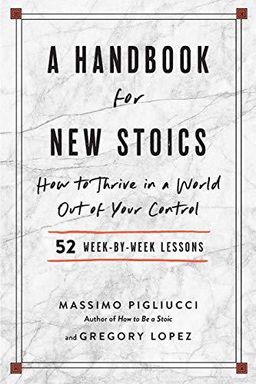
A Handbook for New Stoics cover

A Handbook for New Stoics

by Massimo Pigliucci, Gregory Lopez

A Handbook for New Stoics provides a practical guide to implementing Stoic philosophy in modern life. Through insightful exercises and teachings, it helps readers cultivate inner peace, resilience, and a virtuous character, offering time-tested wisdom for navigating today’s complexities.

Thrive in a World Out of Your Control: Stoicism for the Modern Age

What if you could face traffic jams, rude coworkers, or family conflicts with steady calm instead of frustration? In A Handbook for New Stoics, philosophers Massimo Pigliucci and Gregory Lopez propose that ancient Stoicism—an old Greco-Roman philosophy of self-mastery and emotional clarity—offers the most reliable path to well-being in a chaotic world. The book’s subtitle, “How to Thrive in a World Out of Your Control,” highlights its central promise: that you can cultivate lasting inner peace not by controlling what happens to you, but by managing how you respond.

Pigliucci and Lopez turn Stoicism from lofty theory into a practical method of living. Their structure—52 weekly lessons—mirrors how one might train the body with regular exercise. Each lesson blends ancient wisdom from philosophers like Epictetus, Seneca, and Marcus Aurelius with simple exercises, reflective journaling, and modern cognitive-behavioral insights. Over the course of a year, readers engage with Stoicism’s three foundational Disciplines—Desire, Action, and Assent—to build resilience, self-control, and wisdom.

The Problem: Betting Happiness on What You Can’t Control

The book opens with a fictionalized story of Mike at his 25-year college reunion, comparing himself unfavorably to old classmates—thinner, richer, happily married. Like Mike, most of us unconsciously wager our happiness on external outcomes: success, health, praise, or material comfort. The Stoics call this a losing bet. Pigliucci and Lopez point out that even when we manage to win—earning the promotion, buying the new car, or finding love—the pleasure fades rapidly. We return to craving something else, continuing the cycle of dissatisfaction.

The Stoic alternative is to focus on what can never be taken from you: your character and reasoned judgment. These alone are truly under your control, and when you align your desires and aversions with this truth, serenity naturally follows. The Stoics explain that all dissatisfaction arises from wanting things we can’t guarantee and fearing things that inevitably happen. Shift your desires inward, and you reclaim power over your peace of mind.

Stoicism in a Nutshell

Pigliucci and Lopez introduce Stoicism’s core tenets as a living philosophical system rather than a set of abstract doctrines. Three pillars organize the practice:

  • Living according to nature: This means understanding your human nature as a rational and social being. To flourish is to use reason to contribute positively to others—a view that contrasts sharply with modern self-help philosophies centered on personal gain.
  • The three disciplines: The Discipline of Desire governs what you want and avoid; the Discipline of Action guides how you behave toward others and fulfill your social roles; and the Discipline of Assent trains you to make accurate judgments about experiences and emotions.
  • The Dichotomy of Control: Perhaps Stoicism’s most famous lesson: Some things are within your control—your choices, beliefs, and reactions—while others are not. Mental peace comes from focusing only on what’s truly yours to direct.

From these principles flows a coherent vision of ethics and psychology. The Stoics saw reason as our guiding faculty, not to suppress emotions entirely, but to transform unhealthy impulses (pathē) into healthy, rational feelings. Emotions like anger or envy, they argued, stem from false judgments; remove those errors, and inner harmony naturally replaces turmoil. As neuroscientific research on cognitive behavioral therapy (CBT) confirms—CBT’s founders explicitly cited Stoicism—our suffering often arises not from events themselves but from our interpretation of them.

A Year of Practice: From Theory to Habit

To make Stoicism tangible, the authors transform its ideas into a curriculum of daily application. Each week begins with a real-world story, followed by a passage from an ancient Stoic text, an explanation, and a specific exercise. Readers are encouraged to journal, reflect, and practice. Over time, repetition transmutes understanding into habit—what the Stoics called “prohairesis,” the disciplined faculty of moral choice.

For example, early lessons ask readers to separate what is and isn’t in their control. Others propose “premeditation of adversity” (imagining potential misfortunes to reduce their sting), or “acting the opposite” of unhealthy impulses to weaken them—an idea that mirrors exposure therapy. Later, readers examine their social interactions, temper anger, and learn to question their first impressions. By Week 52, the final exercise is to apply the dichotomy of control from dawn to night—a full-circle return to Stoicism’s central insight.

A Lifelong Philosophy, Not a One-Year Fix

Pigliucci and Lopez conclude that Stoicism is not about becoming unfeeling or invulnerable; it’s about emotional freedom. When you master your desires and judgments, no external force can dictate your peace. The authors encourage readers to design their own Stoic curriculum beyond the book’s 52 weeks, tailoring exercises to their needs. Stoicism, like fitness, demands ongoing training—it’s a lifelong practice of becoming a bit wiser each day.

Ultimately, A Handbook for New Stoics is an invitation to reframe life itself as mental and moral training. Whatever fate throws your way—a delayed flight, a breakup, or even grief—you can respond with equanimity and compassion. The world may remain out of your control, but how you live within it never has to be.


The Discipline of Desire: What to Want and Avoid

Desire is where Stoic training begins because misplaced desire is the root of suffering. Epictetus, Seneca, and Pigliucci agree on this: serenity depends on realigning your will with reality. The Discipline of Desire teaches you to want only what is truly good (virtue) and to avoid only what is truly bad (vice). Everything else—money, reputation, beauty, health—is a preferred indifferent: nice if present, but not essential for happiness.

Separating the Controllable from the Uncontrollable

Week 1 begins with a crash course in Stoic logic: of all things in existence, some depend on us, and some do not. Our thoughts, intentions, and choices belong to us; health, fame, and fortune do not. Alice, a recurring example, worries over her upcoming performance review. She cannot dictate her boss’s mood, but she can control her preparation and her response. If she focuses on doing her duty well instead of obsessing over the verdict, she already wins, no matter the outcome.

This mindset forms the foundation for tranquility—ataraxia—the unshakable calm born from directing desire only where effort has meaning. Modern psychologists echo this logic: studies on “locus of control” show that people feel more resilient when they focus on internal rather than external control (a principle central to CBT).

Moderation and Minimalism

Among the seventeen weeks devoted to this discipline, Pigliucci and Lopez weave ancient ethics with everyday practice. They propose Musonius Rufus’s classic advice—“Eat not too much, or too fast”—as mindfulness training in moderation. Thomas the gourmand learns to notice his urges before indulging. Likewise, Romain learns to “put temptations out of sight,” echoing modern behavioral science on environmental triggers. Seneca’s guidance is strikingly relevant to habit psychology: willpower works best when aided by structure, not struggle.

Next comes minimalism. Seneca writes that too much wealth exposes us to fortune’s whims, like a giant whose armor leaves him vulnerable. By owning less, we suffer fewer losses when fortune turns. Decluttering, then, becomes philosophical—a way to free your mind. Takashi, the collector, discovers freedom when parting with unused possessions, much like modern minimalist movements inspired by Stoic simplicity (and even by Buddhist detachment).

Facing Impermanence and Death

Two of the most challenging exercises—“Remind yourself of impermanence” and “Contemplate death”—address our deepest aversions. Stoicism doesn’t shy away from mortality; it insists that accepting death enhances life. When Yu Yan buries her son, her grief is profound but endurable. Stoic reflection teaches that every bond, like every cup, is fragile. To love while remembering this truth deepens gratitude and tempers despair. Seneca advises: rehearse dying daily—not morbidly, but to live with urgency and gentleness.

Marcus Aurelius’s exercise to “meditate on others’ virtues” ends the section on a hopeful note. Instead of craving riches or comfort, one can desire to emulate goodness wherever seen—in a honest friend, a kind stranger, a courageous leader. What you admire, you can choose to practice. Desire, redirected from pleasure to virtue, transforms craving into character.


The Discipline of Action: How to Behave Wisely

If the Discipline of Desire trains your inner life, the Discipline of Action trains how you engage with others. As Epictetus said, “We were not made to be statues, but citizens.” Stoic ethics are profoundly social: your character exists to serve the greater good. Through eighteen weeks of practice, Pigliucci and Lopez translate ancient duty into modern humanity—how to choose your company, handle insults, and serve your community without burning out.

Act Intentionally, Not Impulsively

To “keep your peace of mind in mind,” as Epictetus recommends, means premeditating the day’s challenges. Ameerah, for instance, simulates how she’ll respond when someone cuts in front of her at the gym. By expecting annoyances, she prevents anger. This is premeditatio malorum applied to social life—a Stoic version of mental rehearsal that studies show reduces stress in athletes and medical professionals alike.

Seneca’s essay On the Shortness of Life reminds readers to “check off your days.” Liam, always busy, realizes that busyness isn’t virtue—it’s distraction. The Stoic prioritizes meaningful action, not endless motion. Planning each day as though it were your last clarifies what truly matters and trims the trivial.

Social Virtues and Emotional Mastery

The Discipline of Action shines when applied to relationships. Epictetus warns to “choose your company well,” because emotions are contagious. Surround yourself with those who share your striving for virtue. Then, “roll with insults” by meeting offense with humor or silence. Instead of retaliating, reply: “He didn’t know all my other faults!”—a witty disarmament Seneca himself used. Modern psychology confirms that reappraisal and humor dissolve anger faster than suppression or aggression.

When dealing with difficult people, Marcus Aurelius advises morning reflection: “Today I shall encounter the ungrateful, the selfish, the deceitful—but they act from ignorance of good and evil.” Remembering that wrongdoing stems from confusion, not malice, allows empathy. Pigliucci and Lopez encourage writing this daily mantra to replace frustration with composure—a practice central to building what Stoics call oikeiosis, the sense of kinship with humanity.

Turning Difficulty into Duty

Seneca’s metaphor of life as a gymnasium underlines the Stoic athlete’s mindset: hardships are weights that build moral muscle. Giovanni, recovering from divorce, reframes pain as training. “It doesn’t matter what you bear,” Seneca wrote, “but how you bear it.” This echoes modern resilience studies showing that reframing adversity as growth builds long-term psychological strength.

Stoicism also grounds civic engagement. Doing “whatever political good you can” means acting as fate permits—volunteering, advocating, or helping a neighbor—without anxiety over outcomes. Attach a “reserve clause” (“if nothing prevents me”) to your commitments, and you’ll act with purpose but without frustration. When paired with moderation and compassion, this discipline produces a calm, steady force for good in the world.


The Discipline of Assent: Mastering Your Judgment

The Stoic path culminates in the Discipline of Assent—the art of judging wisely. Emotions and actions arise not from the world itself, but from the meanings you assign it. Epictetus taught: “It is not things that upset us, but our opinions about things.” Pigliucci and Lopez dedicate the final seventeen weeks to helping readers see through cognitive illusions, counter anger and anxiety, and rebuild perception from the ground up.

Catching Impressions Before They Catch You

Every thought begins as an impression—“this is bad,” “that’s unfair,” “I need this.” The Stoic pause between impression and assent creates a space for freedom. Vasily, who struggles with anger, practices stating aloud: “This is just an impression, not at all what it seems.” The pause weakens impulse; the reflection restores reason. Ancient Stoics and modern CBT therapists alike teach this cognitive distancing technique to unhook from automatic thoughts.

Assenting Only to True Impressions

Marcus Aurelius called this “the grammar of assent.” When a thought arises—“I’ve been wronged”—you ask: is this truly bad, or just undesirable? Is it within my control? Most judgments fail these tests. Understanding this logic quiets passions. For example, when Tekanyo fumes over long waits at the doctor, he learns to reexamine assumptions: waiting isn’t an injustice; it’s neutral. By aligning judgments with reason, emotions stabilize.

Emotional Refinement: Anger, Fear, and Anxiety

The Stoics treat emotions as misfiring judgments that can be retrained. Anger, Seneca wrote, is “temporary madness.” Students progress from pause to analyze to counter using prepared maxims. “No man is hurt but by his own opinion,” says one. Repetition rewires instinct—the way modern neuroscientists describe building neural pathways for self-control. The same logic applies to anxiety: when Ava frets over her children’s safety, she grounds herself in the present moment, challenges her catastrophic thoughts, and asks—“Is this worry helping?”—mirroring CBT’s evidence testing.

Seeing Clearer, Living Calmer

As Marcus advised, learn to “decompose” externals: beauty becomes pigment and flesh, wealth plain metal, praise fleeting sound waves. By analyzing experiences into their components, desire loses its grip. The same technique applies to difficulties—break them into smaller parts, stay in the present, and they become bearable. Finally, Stoic mindfulness requires attending to two things constantly: rules (focus on what you control) and roles (act rationally within your duties). By practicing continuous awareness, you apply philosophy from dawn to night—Epictetus’s final challenge to the serious student.

The result is not emotional numbness but equanimity. Fear, envy, and rage lose their power; compassion and composure replace them. When your judgments align with nature and reason, you live wisely amidst chaos—exactly what Stoicism set out to achieve.


Designing Your Own Stoic Curriculum

Completing all fifty-two exercises does not make you a sage, and Pigliucci and Lopez don’t pretend it will. True Stoicism is lifetime practice, and the book ends by helping readers build their personal philosophy program. In modern psychological terms, this is self-directed behavior change guided by wisdom. In Stoic terms, it’s the transition from student (proficient) to practitioner.

Customize Your Training

Readers are invited to review all exercises—from moderating mealtime to catching impressions—and choose the ones that resonated most. Each is labeled by frequency: some should be done at set times (S), others when opportunity arises (O), and some as often as possible (C). This structure turns Stoicism into a modular training system rather than a rigid creed. Alice, for instance, keeps “acting the opposite of anxiety” and “evening reflection” as her core routines—practices that directly improve her daily life.

Progress, Not Perfection

Epictetus warned that philosophy must never be performative—it’s measured by how you behave when tested. Progress is cyclical: when you stumble, you practice again. The authors echo this humility by including self-rating quizzes for each discipline. Improvement, not infallibility, signals success. This aligns with the Stoic worldview that virtue is an ideal toward which we endlessly strive, not a trophy we win.

Integrating Theory and Community

The Epilogue expands Stoicism beyond personal practice to a global movement. Pigliucci lists modern translations, scholarly commentaries, and online Stoic communities like Stoicon and the Modern Stoicism Project. He also emphasizes reading ancient sources—Marcus’s Meditations, Seneca’s Letters, Epictetus’s Discourses—because practice without philosophy risks becoming “a bag of tricks.” Stoicism, after all, is a way of life founded on reasoned understanding, not self-help shortcuts.

Through reflection, repetition, and rational compassion, you continue molding your character. Whether you’re journaling privately or practicing with a group, the Stoic path is social and iterative. And as Pigliucci and Lopez affirm, mastering your mind is not about escaping the world—it’s about rejoining it, calmly and wisely.

Dig Deeper

Get personalized prompts to apply these lessons to your life and deepen your understanding.

Go Deeper

Get the Full Experience

Download Insight Books for AI-powered reflections, quizzes, and more.