
Idea 1
Love as the Hidden Architecture of the Mind
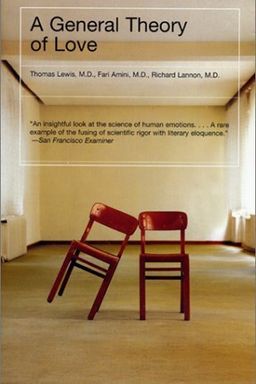
Why do you fall in love with some people and not others, and why can that love transform or torment you? A General Theory of Love by Thomas Lewis, Fari Amini, and Richard Lannon asks—and answers—this fundamental question by blending neuroscience, psychology, and poetry. The authors contend that love is not simply an emotion or a social construction but a biological force embedded deep in the mammalian brain. They argue that the roots of love, attachment, and emotional connection lie within our limbic system—the set of brain structures that governs feeling and human relatedness.
The book challenges conventional Western notions that reason is supreme and emotions are primitive remnants that must be tamed. Instead, it reveals that the heart’s logic has a kind of wisdom that cognition alone cannot grasp. Love, they insist, is the engine that regulates and heals the mind. Relationships are not mere psychological exchanges—they change the brain itself through chemistry, rhythm, and resonance. When relationships fail or are absent, we suffer ailments not just of spirit but of physiology.
The Collision of Science and Emotion
For centuries, emotions were dismissed as unruly forces to be conquered by rationality. Hippocrates correctly proposed that feelings originate in the brain centuries before modern science, but progress stalled until the late twentieth century. Freud’s psychoanalysis sought to map the unconscious but lacked biology; behaviorism tried to be purely scientific but erased emotion altogether. A General Theory of Love bridges this divide—it brings neuroscience and humanism together, reuniting the poetic with the empirical.
According to the authors, human emotional architecture operates according to natural laws as strict as gravity. Love and belonging are not metaphors—they represent neurophysiological realities that shape how we perceive and respond to the world. Our limbic system, evolved in mammals to support bonds between parents and offspring, is still the organ of attachment that makes our lives meaningful.
The Limbic Brain and the Laws of Connection
The authors introduce the concept of the “triune brain,” proposed by researcher Paul MacLean: three nested brains—the reptilian brain, the limbic brain, and the neocortex—each representing an evolutionary layer. The reptilian brain handles survival and bodily functions; the neocortex manages language and reasoning. The limbic brain, newly evolved in mammals, gives rise to emotion, empathy, and love. It is this middle brain that allows mammals to care for their young and form lasting social bonds. Our capacity for attachment is a biological breakthrough that made civilization possible.
Within this architecture, love is not abstract—it involves what the authors call “limbic resonance,” “limbic regulation,” and “limbic revision.” These processes define how people sense each other’s emotions, synchronize physiological rhythms, and even reshape each other’s neural patterns over time. That’s why a child calms to her parent’s touch, why being with someone you love steadies your heartbeat, and why long relationships can change who you are.
Why This Matters for You
Understanding love through science doesn’t make it any less mysterious—it makes it more astonishing. The authors show that relationships are not just emotional experiences but essential mechanisms for maintaining sanity. When culture denies or trivializes this truth, people suffer anxiety, depression, alienation, and violence. Love is not optional; it is the physiological glue that holds the human world together. Freud may have sought to explain neurosis through guilt and repression, but Lewis, Amini, and Lannon suggest that the true pathology is disconnection—the loss of limbic health that comes when relatedness is absent.
Across its sweeping chapters, the book moves from the poetic (“The Heart’s Castle”) to the scientific (“Kits, Cats, Sacks, and Uncertainty”), through explorations of brain structure, attachment, parenting, and psychotherapy. It reveals how love creates identity, shapes memory, and heals emotional wounds. It also warns of cultural blindness—how modern life, dominated by digital distraction, careerism, and individualism, undermines our biologically ingrained need for connection. In its final vision, science and art must cooperate to illuminate love’s mysteries, the way poetry expresses what data alone cannot capture.
In sum, A General Theory of Love is both scientific manifesto and love letter to humanity. It invites you to rethink everything from therapy to childhood to romance, showing that “the heart has its reasons”—and science is finally catching up. Love is not metaphorical or mystical; it is the invisible architecture of the self. When you understand the biology of love, you behold not a sentimental ideal but the very foundation of human existence.