
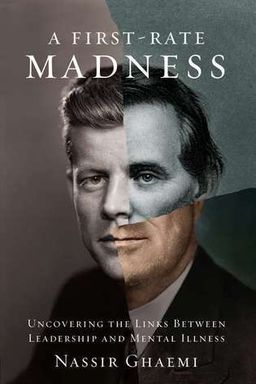
A First-Rate Madness cover

A First-Rate Madness

by Nassir Ghaemi

A First-Rate Madness reveals how mental illness has shaped some of history''s most iconic leaders. Nassir Ghaemi argues that conditions like depression and bipolar disorder can enhance leadership qualities such as empathy, creativity, and crisis management. This thought-provoking book challenges the stigma surrounding mental health, encouraging a reevaluation of what makes a great leader.

The Inverse Law of Sanity

Why do some leaders thrive in chaos while others collapse? Psychiatrist and historian Nassir Ghaemi confronts this paradox with what he calls the Inverse Law of Sanity: in normal times, mentally healthy leaders excel; in crises, leaders who carry certain forms of mental illness may outperform them. This claim runs through the book’s portraits of Lincoln, Churchill, Gandhi, King, Roosevelt, Kennedy, and others, and forms the lens through which Ghaemi rethinks the psychology of political greatness.

Ordinary times versus extraordinary crises

The Law rests on a simple contrast. When a society is stable, the skills of managerial normality—sociability, moderation, optimism—keep systems working. But when catastrophe erupts, those traits often mislead. Crises require realism, empathy, creative reframing, and resilience—qualities that, paradoxically, correlate with depressive, manic, or hyperthymic temperaments. As Ghaemi writes, mental abnormality can generate clarity precisely when illusions become dangerous.

Profiles that support the pattern

Across historical vignettes you see this dynamic repeatedly. Abraham Lincoln’s profound melancholy allowed sober judgment and compassion during Civil War tragedy. Winston Churchill’s depression—the infamous "Black Dog"—gave him grim realism about Hitler when others were appeasing. Depression sharpened moral empathy in Gandhi and Martin Luther King Jr., equipping them to turn suffering inward into nonviolent public power. Conversely, manic and hyperthymic energies drove William Tecumseh Sherman’s strategic breakthroughs and Ted Turner’s entrepreneurial revolutions. Franklin Roosevelt and John Kennedy’s high-energy temperaments, both tempered by chronic illness, illustrate resilience—the ability to rebound rather than break.

Psychiatric method as historical lens

To make this argument credible, Ghaemi borrows from clinical psychiatry. He uses four validators—symptoms, genetic history, illness course, and treatment response—to reconstruct plausible diagnoses posthumously. This method, rooted in empirical inference rather than speculation, anchors psychological history in observable evidence. It also acknowledges limitations: any retrospective diagnosis is probabilistic, not determinate. Still, converging documentation often clarifies behavior and decision-making far better than purely political analysis.

A probabilistic—not romantic—claim

Importantly, Ghaemi does not glorify mental illness. He insists it exacts real costs—suicidality, broken families, impulsive mistakes—and not all mentally ill leaders succeed. Hitler’s bipolar vulnerability combined with amphetamine addiction became a case study in catastrophe. Rather, the Inverse Law says that, on average, psychological difference raises the odds of crisis aptitude. This reframes how you think about leadership selection, stigma, and qualification criteria.

Key insight

When the world is calm, normality maintains balance. When the world convulses, abnormal minds—often forged by suffering—see clearly, act creatively, and endure. The traits that heal nations sometimes arise from the same pain that breaks individuals.

The book’s larger challenge

Ultimately, Ghaemi asks you to reconsider what sanity means. If societies reward homoclite normality, they may systematically disqualify those best prepared for existential crises. Understanding this law means accepting the uncomfortable truth that mental illness can coexist with moral insight and historical vision. This paradox—pain as precursor to wisdom—is the book’s haunting refrain.


Depression’s Realistic Vision

Depression isn’t merely a deficit of happiness; it’s sometimes an advantage in perception. Ghaemi introduces the concept of depressive realism: the observation that mildly or moderately depressed individuals often see reality more accurately than optimists do. In politics, where self-deception and overconfidence can prove fatal, such realism becomes a survival trait.

Clinical and cognitive foundation

Experiments by Alloy & Abramson (pressing buttons and judging light flashes) showed that nondepressed subjects overestimated their control over random events, while depressed subjects judged accurately. Shelley Taylor later demonstrated that most people maintain positive illusions for psychological protection—useful for daily life but dangerous when circumstances demand sober calculation. Depression, painful as it is, strips away illusion and forces hard truth.

From gloom to clarity in leadership

Lincoln and Churchill illustrate this phenomenon vividly. Lincoln’s melancholy helped him weigh the moral and logistical costs of war without rosy delusion; his second inaugural’s tone reveals deep empathy and tragic acceptance. Churchill’s persistent ‘Black Dog’ sensitized him to the Nazi peril during years of appeasement. Depressive realism made them cautious yet resolute—leaders who could face cruel reality without denial.

The Goldilocks principle

Ghaemi stresses moderation. Excessive illusion breeds disaster; excessive realism breeds despair. The balance, like Goldilocks’ porridge, lies between. A leader who integrates depressive insight without paralysis gains the clearest strategic vision. Such realism may look grim but saves nations from self-delusion.

Key insight

Depression’s realism counters optimism’s blindness. In moments when illusion kills, clarity—even painful clarity—becomes a moral asset.

Depressive realism doesn’t glorify suffering; it redefines the relationship between pain and truth. As Ghaemi suggests, humanity’s greatest acts of political courage often arise from minds pierced by sorrow rather than protected by cheer.


Mania’s Creative Force

If depression grants realism, mania grants invention. Ghaemi connects manic or hyperthymic temperaments to the bursts of creativity and courage that transform history. Manic cognition widens associative links, quickens thought, and breaks habitual frames—producing ideas ordinary minds would never risk or imagine.

Cognitive traits of mania

Mania includes decreased need for sleep, racing speech, and an unfiltered energy flow known as ‘flight of ideas.’ When contained within functional bounds, these traits yield divergent thinking and problem-finding—the talent to identify unseen possibilities rather than merely improve existing solutions.

Historical exemplars

Sherman reframed the Civil War from army-versus-army contests into psychological warfare—his March to the Sea was an act of inventive strategic violence born of manic intensity and integrative thought. Ted Turner’s hyperthymic drive built CNN not by outcompeting broadcasters but by redefining the medium itself. Roosevelt and Kennedy’s unyielding energy—marked by sociability, endurance, and humor—fit the hyperthymic temperament that converts adversity into opportunity.

The double edge

Mania breeds disruption but also risk. It can generate artistic or strategic breakthroughs—or reckless overreach. Hitler’s early manic charisma won crowds; later, under amphetamine abuse, it mutated into delusional rigidity. Thus the creative principle demands containment and awareness, not suppression.

Key insight

Manic drive expands the field of possibilities; depressive reflection chooses among them wisely. When balanced, these opposing forces yield visionary leadership.

Creativity, in Ghaemi’s view, emerges from the oscillation between pain and passion—between melancholic clarity and manic risk. The leaders who harness both write history’s most transformative chapters.


Empathy Through Suffering

Depression’s second gift, after realism, is empathy. Ghaemi ties the biology of affective empathy—mirror neurons, oxytocin pathways—to moral politics. Gandhi and Martin Luther King Jr. become case studies of leadership that transforms inner pain into outward compassion and strategic nonviolence.

Neural roots of empathy

Mirror neurons fire both when you act and when you see others act, allowing emotional simulation. Oxytocin systems deepen attachment. Depression enhances these emotional circuits by making inner suffering vivid—creating a neuropsychological predisposition to feel others’ pain sincerely.

Empathy as political strategy

Ghaemi shows Gandhi turning inner sorrow into public persuasion. His hunger strikes and willingness to suffer were designed to awaken his oppressors’ conscience. King translated this principle into ‘soul force’—nonviolent resistance that seeks to convert opponents rather than destroy them. Both illustrate how affective empathy becomes tactical power.

Costs and contradictions

Empathy can verge on naivety. Gandhi’s letters to Hitler and his despair at Partition’s violence show how boundless compassion sometimes fails politically. King’s late-career depression underscored how empathy burdens its carriers. Still, these men rendered moral insight into practical transformation—a testament to depression’s hidden utility.

Key insight

Suffering doesn’t just sensitize; it instructs. When a leader feels pain deeply, that pain becomes an instrument for moral imagination and social healing.

Empathy’s origin in depression reframes how you think about moral leadership: compassion isn’t weakness—it’s realism of the heart.


Resilience and Temperament

Not all strength is born from stability. Ghaemi’s discussion of resilience and temperamental extremes shows how enduring hardship or illness can steel the psyche. Rather than break a person, controlled adversity may inoculate against later trauma—a principle echoed in psychological studies of wartime soldiers and lifelong temperament research.

Temperament spectrum

Ghaemi distinguishes formal mental illness from enduring traits—dysthymia, cyclothymia, and hyperthymia. These chronic patterns shape how leaders experience stress. Hyperthymics like Roosevelt and Kennedy exhibit relentless energy and optimism; dysthymics offer cautious stability; cyclothymics fluctuate yet adaptively process change. These temperaments often run in families and appear biologically grounded.

Resilience as steeling effect

Ghaemi invokes wartime psychiatry: soldiers screened out for fragility suffered more breakdowns than those allowed to serve under support. Controlled exposure to challenge creates mental seasoning. Roosevelt’s polio reoriented his empathy and patience; Kennedy’s recurrent illness honed decisiveness under constant physical threat.

Psychological vaccine metaphor

Resilience functions like immune training: past illness can inoculate against later distress. Combined with humor and social support, it transforms vulnerability into competence. Bonanno’s taxonomy—chronic PTSD, delayed PTSD, recovery, resilience—shows most people actually endure severe events with minimal lasting damage if supported appropriately.

Key insight

Resilience doesn’t mean unbreakable hardness; it means adaptive flexibility built through suffering, connection, and temperament.

In Ghaemi’s model, endurance grows from exposure and reflection. A society obsessed with eliminating weakness may accidentally eliminate its capacity to recover.


Medicine and Madness

Medicine itself becomes a protagonist in Ghaemi’s history. Psychiatric drugs can transform weaknesses into strengths—or catastrophic liabilities. The contrasting stories of John F. Kennedy and Adolf Hitler illustrate the double-edged nature of treatment: pharmacology can stabilize illness or magnify insanity depending on governance and diagnosis.

Kennedy’s stabilization

Kennedy’s Addisonian disease made him dependent on steroids and hormonal agents. Early in his presidency, unregulated injections from Dr. Max Jacobsen likely impaired judgment, coinciding with the Bay of Pigs fiasco. Later, disciplined oversight by physicians Burkley, Travell, and Cohen corrected the regimen. Proper management, akin to clinical collaboration, transformed Kennedy’s condition into functional resilience—evident during the Cuban Missile Crisis.

Hitler’s pharmacological collapse

By contrast, Hitler’s bipolar disorder merged with amphetamine dependence under Dr. Theodor Morell. Daily intravenous injections of methamphetamine and other stimulants amplified manic highs into delusional extremes—paranoid micromanagement, refusal to retreat, explosive rage. The physician’s secrecy worsened destabilization; drugs became weapons of psychological destruction.

Medical governance as moral factor

Medication effects depend less on molecules than on oversight. Kennedy’s supervised treatment exemplifies ethical medicine; Hitler’s closed medical tyranny reveals disaster. Drug chemistry magnified underlying temperament—creative in one case, apocalyptic in another.

Key insight

Pharmacology amplifies character. Ethical control ensures healing; secrecy and misuse guarantee ruin.

For leaders, medical transparency isn’t a private affair—it’s a matter of collective safety. Treatment can make resilience possible, but without oversight, medicine becomes madness unleashed.


Normality and Moral Blindness

If abnormal minds can lead wisely, what about normal ones? Ghaemi examines the homoclite—the psychologically average, stable individual—and discovers that normality can hide moral danger. In steady times it excels; in moral crises it falters.

Homoclite conformity

Roy Grinker’s studies of mid‑century soldiers and executives reveal the archetype: well‑adjusted, socially compliant personalities who prosper in structured hierarchies. But those same traits—moderation, optimism, risk aversion—cripple moral imagination when unprecedented threats emerge.

Historical examples

Neville Chamberlain’s appeasement reflected administrative sanity and emotional steadiness—virtues misplaced in the face of Hitler’s radical evil. Likewise, bureaucratic officers in the Nazi hierarchy performed monstrous acts with psychological normality. Nuremberg evaluations found most high officials clinically average, not psychotic. Their evil was banal, routine, systemic, and chillingly sane.

Ethical implication

Moral catastrophe, Ghaemi argues, doesn’t require insanity. Ordinary people—when obeying ideology and authority—can perpetrate extraordinary crime. This insight reverses simplistic narratives: evil can be statistically normal. Leadership selection and citizen conscience must guard against this psychological complacency.

Key insight

Normality isn’t virtue. The same traits that preserve order can blind societies to emerging evil.

Recognizing the banality of evil extends the Inverse Law’s warning: pathological conformity can be deadlier than creative madness.


Stigma and the Leadership Paradox

Social stigma against mental illness distorts democratic choice. Ghaemi’s concluding argument makes stigma political: societies governed by fear of abnormality elect steady administrators and exclude potential crisis saviors. You see this paradox in history and modern politics alike.

The Eagleton warning

In 1972, Senator Thomas Eagleton’s past electroshock therapy destroyed his vice‑presidential bid within days. The episode exemplified how electability punishes disclosed illness even when treated and stable. Decades later, stigma persisted—candidates hide depression or mania fearing media judgment.

Why stigma harms public welfare

If society had excluded everyone with mental-health histories, it would have lost Lincoln, Churchill, Gandhi, and Roosevelt—all leaders who carried depressive or manic vulnerabilities but proved indispensable. The correlation between abnormal psychology and crisis competence, proven across the book, turns prejudice into national risk.

Moralizing and secrecy

Public moralism—obsession with sexual excess, substance use, or emotional instability—cripples rational evaluation of fitness. As Ghaemi notes, we tolerate physical illness but condemn psychological illness. Kennedy’s hidden steroid dependency and Clinton’s sexual scandals illustrate how society conflates private vice with medical vulnerability.

Key insight

Rejecting abnormality excludes realism, creativity, and resilience—the very triad that rescues societies in crisis.

Destigmatization isn’t charity—it’s pragmatic reform. Transparent medical oversight lets leaders manage illness responsibly, while secrecy and fear eliminate precisely those most capable of facing historical storms.


Psychological History and Its Limits

Ghaemi closes by defending psychological history as a disciplined method, not pseudoscience. Diagnosing historical figures demands restraint but adds explanatory depth. Mental illness provides causal texture to motives and decisions that pure political analysis cannot capture.

Four standards of evidence

Valid psychological history follows four anchors: symptoms observed in documents; family history suggesting genetic vulnerability; illness course revealing episodic pattern; and treatment response recording improvement or decline. When these converge, retrospective diagnosis becomes scientifically plausible.

Philosophical discipline

Ghaemi invokes David Hume’s caution about causality—probability, never certainty—and Wilhelm Dilthey’s hermeneutic principle that human sciences must combine explanation with understanding. This dual respect guards against pathologizing every behavior and also against denying illness where evidence supports it.

Purpose and impact

Psychological history, used carefully, deepens empathy and breaks stigma: it shows that mental illness has shaped leadership as much as ideology or economics. Recognizing its role doesn’t exonerate—Hitler remains morally responsible—but illuminates the biological and situational interplay that drives history.

Key insight

Historical psychology, done with scientific humility, transforms biography into moral and medical understanding.

In the end, Ghaemi’s approach reframes leadership as a human experiment where mind, illness, and history converge—and where acknowledging pain may be the first step toward collective wisdom.

Dig Deeper

Get personalized prompts to apply these lessons to your life and deepen your understanding.

Go Deeper

Get the Full Experience

Download Insight Books for AI-powered reflections, quizzes, and more.