
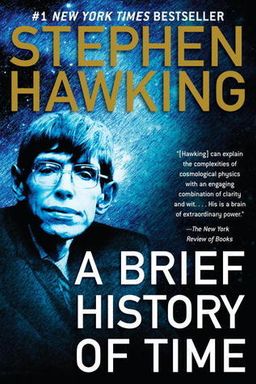
A Brief History of Time cover

A Brief History of Time

by Stephen Hawking

Stephen Hawking''s ''A Brief History of Time'' takes readers on a captivating journey through the universe''s origins and the fascinating concepts of modern physics. From the Big Bang to black holes, Hawking brilliantly simplifies complex theories, making them accessible to all. Discover the laws that govern our universe and transform your understanding of time and space.

Exploring the Universe: From Turtles to Time

How can you understand the vast universe that seems to stretch beyond imagination—and what place do you, a tiny speck of consciousness, occupy within it? In A Brief History of Time, physicist Stephen Hawking boldly argues that the universe operates according to discoverable, rational laws—and that humanity’s greatest achievement is the quest to understand them. Hawking contends that by tracing the history of physics—from ancient myths to the forefront of cosmology—we not only uncover how the universe began and how it might end, but we also approach the deepest philosophical question of all: Why does the universe exist, and why do we exist within it?

Published in 1988, the book became an international phenomenon because it explained some of the most profound scientific ideas—black holes, quantum mechanics, relativity, and the Big Bang—in language that ordinary readers could grasp. Yet Hawking’s ultimate goal was not merely to explain science but to illuminate our shared journey toward knowledge itself.

From Ancient Wonder to Modern Science

Hawking opens with a humorous anecdote: the “turtles all the way down” story. Long ago, people believed the Earth rested on the back of a giant tortoise, which stood on another tortoise, and so on. The tale humorously captures humanity’s desire to find ultimate foundations. In place of myth, Hawking invites us to trace how that drive evolved—from Aristotle’s spherical Earth, to Ptolemy’s geocentric model, to Copernicus’s sun-centered system, and finally to Newton’s law of gravitation, which transformed the heavens into a predictable machine.

Newton revealed that the same force pulling an apple to Earth governed the orbits of the planets. But his deterministic worldview—where, as Laplace later imagined, an infinitely intelligent being could predict every future event—was shattered in the twentieth century. Einstein showed that space and time were interwoven into a single four-dimensional fabric, warped by mass and energy. Later still, the discovery of quantum mechanics introduced uncertainty: nature itself seems to play dice.

Hawking’s Core Aim: Understanding the Universe’s Beginning and End

With this history as backdrop, Hawking explores humanity’s most daring questions: Did the universe have a beginning? Will it have an end? What happens inside black holes? And could we ever find a “theory of everything” that unites all the forces of nature? These questions thread through every chapter, linking the physics of the very small (quantum theory) with the physics of the very large (cosmology).

For Hawking, these questions are not purely scientific—they border on the philosophical and spiritual. Earlier ages sought divine answers to creation. Modern science, he suggests, offers a different kind of faith: belief in the intelligibility of the universe. Each discovery—Einstein’s relativity, quantum uncertainty, general relativity’s curved space-time, and the cosmic expansion observed by Hubble—pulls us closer to a single, elegant explanation of existence itself.

Bridging the Cosmic and the Human

What makes A Brief History of Time so compelling is that it links the grand cosmos to the human urge for meaning. Hawking writes with humor and humility about how science redefines ancient questions: where did we come from, and how might it all end? He describes how general relativity predicts the Big Bang and black holes—both singularities where the known laws of physics break down—and shows that quantum effects might eventually remove these singularities altogether.

By walking through concepts like the uncertainty principle, the expansion of the universe, and Hawking’s own work on black hole radiation, readers are led to a daring vision: a universe without boundaries, self-contained and governed entirely by rational laws. This vision does not necessarily exclude God but redefines divinity as the rational structure of the cosmos itself.

Why It Matters: Our Quest for the Ultimate Theory

Ultimately, Hawking positions science not as cold calculation but as humankind’s most profound expression of curiosity and wonder. By seeking a “grand unified theory,” we are, in a sense, seeking to understand “the mind of God”—a metaphor for ultimate comprehension of existence. From the geometry of space-time to the dance of quarks and photons, Hawking’s journey is both cosmic and personal. It invites you to see yourself as part of the same universe you’re trying to understand—a universe where asking why may be our greatest act of meaning.


Our Picture of the Universe

Hawking begins his exploration of cosmology with a stunning observation: every era has tried to explain the universe in terms it could understand. Ancient civilizations saw gods behind cosmic events; modern physics sees laws. The difference, he notes, is not in our curiosity but in our tools. Scientific inquiry replaces myth by asking questions that must be answered through observation and reasoning.

From Ptolemy to Newton: Order from the Heavens

Hawking traces how early thinkers shaped our image of the cosmos. Ptolemy placed Earth at the center, encircled by crystal spheres. Copernicus shattered this illusion, placing the sun in the middle. Galileo’s telescope gave direct visual proof by observing moons orbiting Jupiter, while Kepler refined the orbits into ellipses. When Newton formulated his law of universal gravitation, he united heaven and Earth under one principle: gravity.

This transformation had enormous philosophical consequences. It suggested that nature was governed by precise laws, not divine caprice. Yet Newton himself believed the universe required a divine hand to keep it stable—a belief later challenged by Einstein’s discovery that spacetime itself provides the stage for motion and gravity.

From Static to Expanding Cosmos

For centuries, both science and religion assumed the universe was eternal and unchanging. Yet in 1929, Edwin Hubble observed that galaxies were moving away from us—the universe was expanding. By rewinding this cosmic motion, astronomers concluded there must have been a beginning: the Big Bang.

This realization turned metaphysical questions into physical ones: If time began at the Big Bang, what came before? Could “before” even exist? Hawking highlights how this discovery transformed cosmology from speculative philosophy into a science grounded in measurement and mathematics. Suddenly, humanity could study the birth of the cosmos itself.

The Nature of Scientific Theories

Hawking emphasizes that scientific theories are models, not ultimate truths. A good theory, he says, must accurately describe observations using few assumptions and make clear predictions that can be falsified (an idea borrowed from philosopher Karl Popper). Theories evolve: Newton’s gave way to Einstein’s, which may someday yield to a quantum theory of gravity. Yet each success brings us closer to understanding the patterns behind the cosmos. Science, in this sense, is humanity’s most profound narrative—a rational myth replacing the tower of turtles with equations that actually predict eclipses, the Big Bang, and even the bending of light itself.


Space, Time, and Relativity

What is time? Can it ever flow differently for two people? And could the universe warp not just space but time itself? In one of his most lucid chapters, Hawking recounts how our understanding of reality changed with the discoveries of Galileo, Newton, and Einstein, revealing that space and time are woven together inextricably.

Galileo to Newton: Motion and Force

Galileo overturned Aristotle’s claim that heavier bodies fall faster than lighter ones, showing that acceleration depends not on mass but on gravity. Newton later unified these ideas into three laws of motion and added the law of universal gravitation. The world, he showed, is predictable—an orderly stage where forces play out geometrically.

Einstein’s Revolution: Space-Time and Light

Einstein shattered the notion of absolute space and time. His special theory of relativity declared that the speed of light is constant for all observers. Time itself slows down or speeds up depending on how fast you move or how strong gravity is. A clock in orbit ticks faster than one on Earth’s surface—a fact confirmed by precise satellite measurements (and used daily by GPS technology).

His general theory of relativity went further: gravity is not a force but a curvature of space-time caused by mass. Earth orbits the sun not because of an invisible pull, but because the sun bends space-time around it, guiding Earth’s motion like a marble rolling along a dimpled sheet.

The Consequences: From Twin Paradoxes to Black Holes

Relativity leads to mind-bending consequences. A traveler moving near light speed ages more slowly than a person at rest (the “twin paradox”). Clocks run slower near massive objects. And as space-time curves more steeply—such as near a colossal star—it can trap even light, leading to the formation of black holes. Einstein’s insight reimagined the universe not as a backdrop for events but as an active, dynamic fabric—all of existence woven from the same cosmic thread of space and time.


The Expanding Universe

If the universe is expanding, what is it expanding into? Hawking brings this profound question down to Earth by explaining how Edwin Hubble’s discovery of galactic redshifts proved that space itself is stretching—and that time, space, and matter were once compressed into a single origin called the Big Bang.

Hubble’s Revelation and Friedmann’s Vision

In 1929, Edwin Hubble measured that light from distant galaxies was red-shifted—their wavelengths stretched as they receded from us. This meant the universe was not static but expanding. Decades earlier, mathematician Alexander Friedmann had derived expanding-universe solutions from Einstein’s own equations, though Einstein had dismissed them. Only later did physicists accept that space could itself grow or contract.

Friedmann’s equations described three possibilities: a universe that expands forever, one that slows and recollapses, or one perfectly balanced at the critical rate. Hawking describes how measuring the universe’s density tells us which path we are on—and that dark matter and dark energy complicate any simple answer.

The Cosmic Microwave Background

The accidental detection of faint microwave radiation by Penzias and Wilson in 1965 confirmed a brilliant prediction by physicist George Gamow: the afterglow of the Big Bang. This radiation, uniform in every direction, revealed that the entire cosmos began from an unimaginably hot, dense state roughly 13–14 billion years ago. Small ripples in this background—detected later by the COBE satellite—represent the primordial “fingerprints of creation,” seeds that eventually grew into galaxies.

Beyond the Big Bang

The Big Bang also redefined philosophical questions about beginnings. If time itself began with the Big Bang, asking what happened “before” is meaningless—there was no “before.” Yet for Hawking, this raises a deeper mystery: could the universe have created itself according to natural laws without requiring a divine spark? In addressing this, he invites you to see cosmology as more than physics—it’s a way of studying existence itself, from the origin of matter to the ultimate fate of everything we know.


The Quantum Revolution and Uncertainty

When Newton dreamt of a clockwork universe, he imagined a cosmos fully predictable by precise laws. Then came Max Planck, Albert Einstein, and Werner Heisenberg, who revealed that certainty dissolves at the smallest scales. Their discoveries gave birth to quantum mechanics, and with it, a new image of reality—one ruled by probability rather than determinism.

Planck’s Quanta and Heisenberg’s Principle

To explain how hot objects emit light, Max Planck proposed in 1900 that energy comes in discrete packets, or quanta. A few decades later, Heisenberg formulated his uncertainty principle: the more precisely you measure a particle’s position, the less precisely you can know its momentum. This wasn’t a flaw in our instruments—it was nature’s fundamental rule.

Particles, Waves, and Probability

In the quantum world, matter behaves as both particle and wave. The famous double-slit experiment shows electrons interfering like ripples on water, even when fired one at a time. As Richard Feynman later described, each electron explores every possible path—a “sum over histories”—and the wave pattern we see reflects the probability of where it might appear.

This undermined Laplace’s dream of perfect prediction. Even with total knowledge, we can calculate only likelihoods, not certainties. Yet this probabilistic worldview powers every transistor, laser, and MRI machine. Hawking emphasizes that quantum theory, unsettling as it is, has become one of the most successful frameworks in science.

Quantum Worlds and Human Questions

Einstein resisted the idea, famously declaring, “God does not play dice.” But Hawking gently rebuts him: randomness, he says, might be the universe’s creative mechanism. The uncertainty principle may limit prediction—but it also allows freedom, fluctuation, and even existence itself. Quantum effects, as Hawking shows later, make black holes glow and may erase singularities, suggesting that uncertainty is not the enemy of order, but its origin.


Black Holes and Beyond

Few images in science capture the imagination like a black hole—a place where gravity is so intense that nothing, not even light, can escape. Hawking takes you deep into these cosmic abysses to reveal that black holes are not cosmic dead ends but windows into the fundamental nature of space, time, and information.

From Chandrasekhar to Hawking Radiation

Indian physicist Subrahmanyan Chandrasekhar discovered that stars above a certain mass (1.4 times that of the sun) cannot remain stable and must collapse under their own gravity. This idea, initially ridiculed by Arthur Eddington, later became the cornerstone of our understanding of black holes. When massive stars exhaust their fuel, their collapse warps space-time into a singularity hidden behind an event horizon.

Hawking’s own breakthrough came when he combined quantum mechanics with relativity. He predicted that black holes emit radiation due to virtual particles near the event horizon—a process now known as Hawking radiation. This means black holes can slowly evaporate, glowing faintly until they vanish in a final burst of energy.

Black Holes as Cosmic Laboratories

These discoveries turn black holes into testing grounds for the ultimate laws of physics. The “cosmic censorship hypothesis” proposes that singularities remain hidden, preserving predictability for the rest of the universe. But black holes also raise paradoxes: if information disappears inside them, does it violate quantum theory’s rule that information cannot be lost? Hawking’s evolving stance on this “information paradox” has sparked decades of debate and research into quantum gravity.

A Universe Without Borders

By studying black holes, Hawking found clues to the universe’s own boundaries—or lack thereof. Later chapters build toward his “no boundary” proposal: that the universe may be finite but unbounded, like the surface of a sphere with no edge. In this picture, black holes and the Big Bang mirror each other—each a moment where time, space, and the laws of physics merge into unity.


The Origin and Fate of the Universe

Where did the universe come from, and how will it end? For Hawking, these are not questions for theology alone but for physics. Combining general relativity and quantum mechanics, he suggests that the universe may have no singular beginning or end but might be finite and yet without boundaries—a concept that redefines creation itself.

A Universe with No Beginning

Hawking’s “no boundary proposal,” developed with James Hartle, envisions space-time as a four-dimensional surface without edges—akin to a globe where moving in any direction eventually loops back, but without a starting or ending point. Asking what came before the Big Bang, then, is like asking what lies north of the North Pole. Time itself was born with the universe.

By using imaginary time (a mathematical transformation that treats time as another dimension of space), Hawking shows how the universe might have smoothly emerged from quantum fluctuations without infinite density or divine intervention. This model offers a self-contained cosmos—no creator required, though not necessarily excluded.

Inflation and the Multiverse

To explain why the universe is so flat, uniform, and yet dotted with galaxies, Hawking draws on Alan Guth’s inflation theory. Moments after the Big Bang, the universe may have expanded exponentially, smoothing out irregularities while seeding the density fluctuations that formed stars and galaxies. Some interpretations suggest this process could spawn multiple universes—a “multiverse” where every physical possibility plays out somewhere.

Why the Universe Allows Life

Hawking also examines the anthropic principle—the idea that we observe a universe compatible with life because only such a universe allows observers to exist. The laws and constants of nature seem exquisitely fine-tuned to permit our presence. Whether by design, chance, or inevitability, he writes, it is this delicate balance that makes our inquiry possible. Thus, understanding the cosmos becomes not just a scientific act but a profound reflection on existence itself.


The Quest for a Unified Theory

Hawking’s final chapters move from description to aspiration: can we find one elegant theory that explains everything from the subatomic to the cosmic? He calls this the search for a “complete unified theory.” It’s the ultimate scientific quest—the Holy Grail of physics.

From Relativity to Quantum Gravity

Einstein’s general relativity describes the very large, while quantum mechanics governs the very small. The two, however, clash at singularities like black holes and the Big Bang. Uniting them requires a quantum theory of gravity. Early efforts, like supergravity, offered hope, but later theories—especially string theory—provided a more promising framework, portraying fundamental particles as tiny vibrating strings whose vibrations determine their type and force.

Dimensions Beyond the Visible

String theory predicts extra dimensions—up to ten or eleven—curled into microscopic scales. These hidden dimensions could unify the forces of nature. Later refinements, including ideas about branes (higher-dimensional membranes), have moved physics closer to a comprehensive “M-theory.” Yet Hawking admits that experimentation lags behind. For now, the ultimate theory remains tantalizingly out of reach.

Knowing the Mind of God

If such a theory were found, Hawking writes, it would not end science but transform it into philosophy—a way to understand existence itself. He asks: what breathes fire into the equations, making a universe for them to describe? That question—why there is something rather than nothing—lies beyond mathematics but at the heart of human curiosity. The true triumph of a unified theory, he concludes, would be nothing less than knowing “the mind of God.”

Dig Deeper

Get personalized prompts to apply these lessons to your life and deepen your understanding.

Go Deeper

Get the Full Experience

Download Insight Books for AI-powered reflections, quizzes, and more.