
Idea 1
Philosophy as a Guide to Living
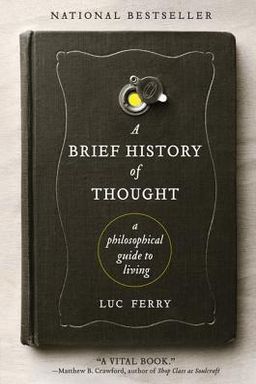
What if philosophy wasn’t just an academic discipline, but a map for living a wiser, freer life? In A Brief History of Thought: A Philosophical Guide to Living, Luc Ferry argues that philosophy is not about abstract doctrines but about transformation—about how humanity has sought salvation, meaning, and freedom without relying on divine intervention. He contends that philosophy’s history, when seen through this lens, becomes a series of answers to one urgent question: how can finite beings live fearlessly in the face of death?
Ferry’s book unfolds like a slow, profound conversation across centuries. He begins by defining philosophy not as mere critical reflection (as many modern teachers claim) but as a “doctrine of salvation without God.” Philosophy, he says, arose when human beings realized their mortality and tried to think their way toward serenity. Religion comforts through faith; philosophy seeks deliverance through understanding and lucidity. This is why, from the Stoics to Nietzsche to modern humanists, every great philosopher has tried to show how we can overcome fear—the fear of loss, of time, and of death.
The Journey from Religion to Humanism
Ferry organizes the story of philosophy into major epochs, each answering the question of salvation differently. Ancient philosophy, especially Stoicism, taught that we can find peace by aligning ourselves with nature’s rational order—the cosmos. Early Christians replaced reason with faith and humility, promising eternal life through love in God. Modern philosophy, beginning with Descartes, Copernicus, and Rousseau, shifted the focus to humanity itself, birthing humanism, where salvation lay in freedom, reason, and moral equality. Nietzsche later shattered this humanist optimism, declaring the “death of God” and challenging all higher ideals. Finally, contemporary philosophy, after Nietzsche’s “deconstruction,” faces the difficult task of rebuilding meaning in a world dominated by technology and global capitalism.
Philosophy’s Practical Promise
Why does this history matter to you? Because Ferry’s book is essentially a manual for living thoughtfully in modern times. He insists that philosophy has always aimed at one thing: to help us live without fear. The Stoics conquered anxiety through acceptance; the Christians replaced fear with love; and modern philosophers sought freedom through autonomy and knowledge. Today, when faith in God or in grand political ideologies has faded, Ferry sees in philosophy a way to rediscover meaning in ordinary life. Exploring these ideas grants not only intellectual clarity but emotional strength—the kind Aristotle, Kant, or Nietzsche meant when they spoke of character and virtue.
Three Dimensions of Wisdom
Ferry structures his argument around three dimensions that run through every philosophical era: theory (understanding the world), ethics (knowing how to act), and salvation or wisdom (learning how to live and die well). These dimensions mirror religion’s promises but replace revelation with reason. For example, understanding how nature works gives us perspective on fate, ethics helps us harmonize with others, and wisdom helps us conquer fear. Throughout history, philosophy has tried to weave these dimensions into a coherent vision of humanity’s place in the cosmos.
Why Ferry’s Vision Matters
In an age of distraction and consumerism, Ferry’s call to think philosophically is also a call to reclaim inner freedom. Just as Socrates said the unexamined life isn’t worth living, Ferry argues that the unreflected life—immersed in routine or ideology—leaves us unprepared for mortality, crisis, and love. By revisiting eternal questions—Why do we fear death? What gives life meaning? How do we become truly free?—Ferry transforms philosophy into a compass for modern life. You don’t need a degree to follow him, only curiosity and the willingness to look squarely at existence, as thinkers from Epicurus to Kant did before us. Through this narrative, you’ll see that philosophy isn’t about escaping life—it’s about embracing it with lucidity, courage, and compassion.