
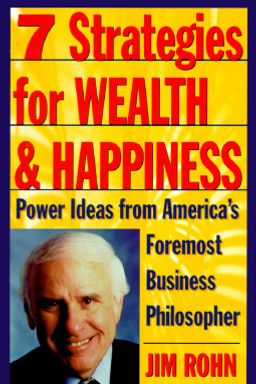
7 Strategies for Wealth & Happiness cover

7 Strategies for Wealth & Happiness

by Jim Rohn

Jim Rohn''s ''7 Strategies for Wealth & Happiness'' offers a profound approach to unlocking your potential through discipline and action. It emphasizes personal growth over quick riches, showing that true success comes from improving oneself and adopting a positive mindset. Discover how to transform your life with practical strategies for wealth, happiness, and fulfillment.

Building Wealth and Happiness Through Personal Development

What if wealth and happiness weren’t mysteries of luck or inheritance, but the natural result of mastering a few timeless principles? In 7 Strategies for Wealth and Happiness, America’s respected business philosopher Jim Rohn argues that personal success is not found in magic or fate—it’s found in disciplined self-development. According to Rohn, the good life is a byproduct of working harder on yourself than you do on your job. The bridge between who you are and who you want to be is discipline, and the road to lasting prosperity is paved with self-responsibility, clear goals, useful knowledge, and inspired living.

This book distills the fundamental laws of achievement into seven practical strategies: unleashing the power of goals, seeking knowledge, learning how to change, controlling finances, mastering time, surrounding yourself with winners, and learning the art of living well. These are not quick fixes; they’re guiding philosophies to be practiced over a lifetime. Rohn blends timeless wisdom, biblical insights, and personal anecdotes (including his own transformation after meeting his mentor, Earl Shoaff) to show that success is not what you get, but what you become through consistent growth and responsibility.

The Core Premise: Success Is an Inside Job

At its heart, Rohn’s philosophy is built on one axiom: to have more than you’ve got, become more than you are. Success doesn’t depend on the economy, the government, or even luck—it depends on who you are becoming. This view aligns with thinkers like Stephen Covey (The 7 Habits of Highly Effective People) and Napoleon Hill (Think and Grow Rich), who likewise teach that sustained external success stems from internal mastery.

Where many chase results, Rohn focuses on causes—the personal disciplines, philosophies, and habits that shape every result in your life. Wealth and happiness are simply two sides of the same coin, minted by character, drive, and self-control. As he puts it, “Success is no more than the natural consequence of consistently applying the fundamentals of success to life.”

The Transformative Power of Goals

Rohn begins with goals because they direct all other efforts. Without them, people drift through life on autopilot—working hard but without destination. He argues that the reason most people fail isn’t a lack of intelligence or effort; it’s a lack of clearly defined aims. His own turning point came when Shoaff guessed Rohn’s bank balance simply by asking if he had written goals—the answer was no. Rohn learned that dreams give life purpose, but goals give dreams structure. They transform vague hopes into magnetic forces that pull you forward, provided you define them vividly and align them with deep emotional reasons.

The Inner Work of Change and Growth

From discipline springs transformation. Rohn insists that you can’t expect life to change until you change yourself. Where most people look for external miracles, he looks inward: if you want a better harvest, improve the farmer. He divides personal growth into three dimensions—spiritual, physical, and mental—and recommends making gradual, consistent improvements in each. Change, he emphasizes, usually comes not in one glorious moment but through small, daily decisions that collectively pivot your life toward greatness.

From Earning to Managing: Financial Mastery

Rohn’s financial philosophy, grounded in simple wisdom, instructs that prosperity requires a solid plan, not just more income. His famous “70/30 Rule” advises living on 70% of your after-tax income, giving 10% to charity, investing 10% to create wealth, and saving 10% for security. This balance between generosity, enterprise, and prudence builds financial freedom over time. The remarkable lesson: the poor spend and save what’s left, while the rich save and invest first, then spend what remains.

Mastering Time, Associations, and Lifestyle

To live abundantly, you must master how you use time and choose associations. Rohn classifies people into Drifters, Nine-to-Fivers, Workaholics, and Enlightened Time Managers—the last being those who balance productivity with joy by working smarter, not longer. Likewise, he warns about the subtle power of influence: spend time with winners, not whiners. As he famously says, “Don’t send your ducks to eagle school.” The quality of people you associate with will elevate—or erode—your standards and results.

Finally, Rohn reminds readers that success without savor is emptiness. The seventh strategy, learning the art of living well, is about cultivating gratitude, generosity, and culture. It’s about savoring life—being a “two-quarter person” who tips liberally, praises others, and designs a rich lifestyle through appreciation, not extravagance. He reminds us: happiness is not an amount; it’s an attitude.

Why This Philosophy Matters

Rohn’s ideas matter because they reframe success from an external chase into an internal craft. The seven strategies are not techniques but guiding disciplines for a meaningful life. They help you escape mediocrity, take responsibility, and design your destiny. In an age of shortcuts and quick wealth schemes, Rohn’s voice endures because it argues for the slow, deliberate work of building character and competence—the only wealth that can’t be lost.

His message is both timeless and practical: learn a little, apply it often, and string small disciplines together until they create a masterpiece of life. In Rohn’s world, success isn’t something that happens to you—it’s something you become.


Unleashing the Power of Goals

Jim Rohn begins his journey to wealth and happiness by asking a deceptively simple question: Have you ever made a written list of your goals? When his mentor Earl Shoaff asked him this, Rohn hadn’t. Shoaff then guessed Rohn’s bank balance within a few hundred dollars, because as he explained, “Your bank balance will always be a reflection of your goals.” That moment turned Rohn’s life around and taught him the incredible pull that comes from having concrete, inspired objectives.

The Magnetism of Clear Goals

Rohn describes goals as magnets. They pull you toward the future you design, shaping how you think, talk, and act. Without goals, he says, people drift through life reacting to events instead of shaping them; with goals, your days gain direction and urgency. The first task is to transform vague dreams (“I want to be successful”) into vivid targets (“I want to earn $10,000 a month in sales by December 2025”). As Viktor Frankl noted in Man’s Search for Meaning, when you have a strong “why,” you can endure almost any “how.”

Reasons Before Methods

Rohn places enormous importance on having reasons. “Reasons come first; answers come second.” When your motivation burns bright enough, the methods will appear. He tells stories of people driven by love, recognition, or responsibility who achieved extraordinary results. A father working for his family’s future, a salesperson craving recognition, or a philanthropist yearning to give—all are fueled by reasons greater than money. Rohn’s own reason was deeply human: after failing to buy a two-dollar box of cookies from a Girl Scout, he felt so humiliated that he vowed never to be broke again. That “nitty-gritty reason,” small but powerful, fueled extraordinary achievement.

Writing and Structuring Goals

Goal-setting is not daydreaming; it’s structured design. Rohn advises writing fifty things you want in one to ten years, categorizing them by time (1, 3, 5, or 10 years), and selecting the four most important in each category. Then for each, describe what it is and why it matters. This process filters whims from true desires. As Rohn says, “What you want is powerful only if you have a good reason for wanting it.” He then recommends reviewing your goals weekly and revising as you evolve—because the purpose of goals is not just achievement, but growth.

From Dreams to Discipline

Goal losers often neglect small, consistent actions. Rohn calls discipline “the bridge between thought and accomplishment.” The small daily tasks—writing one letter, making one extra call—compile into momentum. Miss a day, and it feels harmless. Miss many, and you lose a year. He warns against procrastination: “If you don’t change your plan, the next five years will be the same as the last, except that you’ll be five years older.”

Rohn’s approach to goals isn’t just mechanical; it’s deeply psychological. By committing your dreams to paper, you give them power over your behavior. Your goals transform you long before you achieve them, because striving changes who you become in the process. “The real value in setting goals,” he says, “is not what you get, but what you become.”


Seeking Knowledge and Wisdom

In the second strategy, Rohn insists that success begins with the appetite for learning. You can’t grow your income without growing your mind. His mentor told him, “If you wish to be wealthy, study wealth. If you wish to be happy, study happiness.” Few people make these subjects a study—and that’s why most drift aimlessly. This echoes principles found in Hill’s Think and Grow Rich and Peter Drucker’s teachings on lifelong self-education: profession without education is stagnation.

The Treasure of Knowledge

Knowledge is a form of capital, Rohn teaches. He distinguishes knowledge acquisition into three methods: reflection, learning from others, and observation. Reflection turns everyday experience into wisdom; those who “get from the day” instead of merely “going through the day” can extract lessons from success and failure alike. Rohn encourages a daily and weekly habit of review—asking, “What worked? What didn’t? What do I need to change?”

Learning from Others

Rohn’s second method is learning through others’ lives. “You can learn from others’ examples—or their warnings,” he quips, referencing the Bible’s dual function as both. He recommends constant reading, especially biographies, success books, and spiritual wisdom. Like Charlie Munger’s “latticework of mental models,” Rohn sees books as leverage tools: small investments that yield lifelong insight. He also urges attending seminars, listening to audio programs, and even paying to take successful people to lunch to learn from their attitudes and stories.

The Discipline of Reading and Listening

Rohn himself built a vast library. He credits Think and Grow Rich for changing his thinking but warns against “mental candy.” Balance entertainment with education: “Miss a meal, but don’t miss your thirty minutes of reading.” Audio learning, he notes, turns unproductive time—like commuting—into a mobile classroom. He contrasts this with the average worker who says, “You work where I work, by the time you get home, it’s too late.” The difference between success and mediocrity often lies in what you do with those extra hours.

Investing in Knowledge

Finally, Rohn frames learning as an investment with three costs: money, time, and effort. The return is boundless, because every insight compounds. “Standard education will give you a standard income,” he says, but self-education creates the extraordinary. In other words, the wealthiest people aren’t those who earn the most—they’re those who learn the fastest and apply most consistently. For Rohn, wisdom is not a quest for facts but for usable truths that elevate your effectiveness and character.


Learning How to Change

The third strategy—learning to change—sits at the heart of Rohn’s personal philosophy. Your life improves only when you do. As he recalls, “Mr. Shoaff said, ‘If you want to be wealthy and happy, learn to work harder on yourself than you do on your job.’” This idea transformed Rohn’s thinking from chasing results to cultivating character. Change, he declares, is not something that happens to you but something you choose and create through disciplined growth.

Self-Development Over Circumstance

Rohn criticizes the habit of blaming external factors—government, taxes, prices—for personal stagnation. He tells how he once carried around a list of excuses for why he wasn’t successful until Shoaff said bluntly, “There’s only one thing missing from your list—you.” That realization marked his passage into maturity. Instead of waiting for seasons to change, he learned to change himself. Echoing the Stoic idea from Epictetus, Rohn reminds us: we can’t control what happens, but we can control who we become in response.

The Seasons of Life

To describe change, Rohn uses the metaphor of the four seasons. Winter is the time of struggle when you build strength and prepare. “Don’t wish it were easier,” he says, “wish you were better.” Spring is for taking advantage of opportunity—planting the seeds of enterprise. Summer is for protecting and nurturing those investments from weeds and pests. Fall is when you harvest—and accept full responsibility for your crop. The seasons never change, but you can. Life’s wisdom comes not from avoiding hardship but from mastering its cycles.

Developing Value Through Growth

Value, not time, determines success. Two people may work the same job, but the one who develops greater skill, character, and relationships brings more value—and earns more. Rohn insists that if your value increases, your income follows naturally. Like a craftsman sharpening tools, your main job is self-improvement. Develop stronger habits, a better handshake, deeper empathy, and higher consistency. “You can’t change the seasons, but you can change yourself,” he repeats. That’s the ultimate secret: every external improvement begins with an internal upgrade.


Controlling Your Finances with the 70/30 Rule

Rohn’s fourth strategy tackles one of life’s most emotional subjects: money. He urges readers to see finances as an extension of philosophy. “If you had a better plan, you’d have more money,” Shoaff once told him. The amount you earn matters less than how you allocate it. Financial freedom comes from organization and discipline, not income level. Rohn demystifies wealth with a simple, replicable formula—the 70/30 rule.

The 70/30 Rule Explained

After taxes, live on 70% of your income. The remaining 30% must be divided equally among three priorities: charity, investing, and saving. The first 10% goes to giving—to keep your heart open and to circulate prosperity. The second 10% goes to creating capital, used for business ventures or investments that generate more money. The final 10% goes to savings, for stability and peace of mind. With this model, even the smallest income can build future security.

Teaching Financial Wisdom Early

Rohn emphasizes teaching these principles early. He tells a vivid story about explaining capitalism to children through “bicycle economics”: a child should have one bike to ride and another to rent. This not only teaches enterprise but also introduces the importance of preserving “seed money” instead of “eating your seed corn.” Capital, he reminds, must be protected and planted. The same lesson applies to adults who must learn delayed gratification—foregoing impulse spending in favor of long-term gain.

Mindset and Attitude Toward Money

Perhaps the most radical part of Rohn’s financial philosophy is emotional. He recounts Shoaff’s advice: “Become a happy taxpayer.” Paying taxes, bills, and debts should be acts of joy, not resentment, because they signify participation in society and success in enterprise. If you resent paying, you reinforce scarcity; if you love to pay, you affirm abundance. This shift transforms stress into gratitude—one of Rohn’s deepest wealth secrets.

Ultimately, controlling your finances is not about math—it's about mindset. Rich people save and spend what’s left; poor people spend and save what’s left. The same dollars, different philosophy. As he sums up: “It’s not the amount that counts; it’s the plan that counts.”


Mastering Time and Productivity

Success, Rohn argues, is time made visible. Everyone gets the same 24 hours, but what you extract from those hours determines your destiny. His fifth strategy teaches that mastering time is not about clock control—it’s about life design. He often quoted author Arnold Bennett, who called time “the inexplicable raw material of everything.” Rohn builds on this notion by identifying four primary attitudes toward time.

Four Attitudes Toward Time

The Drifter ignores structure and lives reactively. The Nine-to-Fiver values routine and balance but rarely grows beyond comfort. The Workaholic glorifies effort but sacrifices health and relationships. Only the Enlightened Time Manager blends productivity with rhythm—working smart, delegating wisely, and reserving time for renewal. This fourth type, Rohn teaches, understands leverage: multiplying one’s time by developing systems and people.

Practical Principles: Running the Day

“Either you run the day, or the day runs you,” Rohn warns. To take charge, adopt tools that externalize thought: journals, project books, calendars, and game plans. He outlines four kinds of written thinking: a journal for ideas, a project book for organizing people or work, a detailed day-timer for daily and weekly goals, and a “game plan” that maps long-term projects. This is thinking on paper—because strategy, not speed, determines progress.

Boundaries and Focus

Rohn emphasizes the power of saying “no.” Overcommitment ruins productivity. Learn to decline gracefully: “No, I don’t think I can. But if that changes, I’ll let you know.” He encourages separation of work and rest: “When you work, work; when you play, play.” Half-working and half-playing cheats both experiences. He also emphasizes self-knowledge—discover your biological peak times, delegate your weaknesses, and concentrate your energy where it produces the highest return.

The Art of Planning

Finally, Rohn’s mantra: “Don’t start your day until it’s finished.” Plan before you begin. Then scale this principle: don’t start the week, month, or year until you’ve mapped it out. This conscious preparation transforms chaos into clarity. When each day is crafted with intention, life becomes a collection of “well-fashioned days”—small masterpieces that compound into legacy.


Surrounding Yourself with Winners

The sixth strategy, “Surround Yourself with Winners,” reminds you that success is contagious—but so is failure. Rohn’s mentor warned him, “Never underestimate the power of influence.” Like Jim Collins’s concept of “who before what” in Good to Great, Rohn insists that who you spend time with determines the trajectory of your life as much as what you do. Everything matters, he says: your friends shape your habits, conversations, and expectations.

Evaluating Your Associations

Rohn advises asking three questions: Who am I spending time with? What are they doing to me? Is this association okay with me? That analysis can reveal subtle negative influences you’ve tolerated. The wrong crowd can pull you off course one degree at a time until you find yourself far from your goals. His metaphor of the swallow who let the crow peck out its eye illustrates this: don’t let others destroy your vision.

Disassociation and Limited Association

When people in your life drain or distract you, limit their power over your time. If disassociation isn’t possible (as with coworkers or family), practice limited association—short, deliberate contact with clear boundaries. Rohn warns against “spending major time on minor people.” Sophisticated people allocate influence like investors allocate money—wisely and strategically.

Expanded Association

Next, seek expanded association with those who elevate you. “If you truly want success,” Shoaff told Rohn, “get around the right people—even if you have to plot and scheme to do it.” This might mean joining a chamber of commerce, volunteering, or paying for access to mentorship. Rohn himself downplayed wealth by parking his broken-down car a few blocks away when visiting successful people—but he still made the effort to learn from them. Associate with people of culture, wisdom, and ambition, because proximity reshapes possibility.

Just as you feed your body with food, Rohn says, feed your mind with thinkers. If you can’t meet great minds, read them—Aristotle, Lincoln, Churchill. Your associations, whether living or literary, determine the intellectual and moral climate of your life. The soil you grow in shapes your harvest.


The Art of Living Well

The final strategy brings the journey full circle: it’s not enough to be rich—you must be rich in spirit. After mastering goals, knowledge, change, money, time, and relationships, Rohn teaches the art of living well. “Don’t just learn how to earn; learn how to live,” Shoaff told him. True sophistication, Rohn argues, lies in generosity, appreciation, and the enjoyment of good things without guilt.

Becoming a “Two-Quarter Person”

Rohn’s story of the two-quarter tip illustrates mindset over money. When deciding whether to tip one or two quarters for a great shoeshine, he learned that giving more makes you feel prosperous all day. Generosity elevates self-perception and primes gratitude. This “two-quarter mentality” became a metaphor for living abundantly—doing a little more, giving a little extra, and thinking in terms of plenty rather than scarcity.

If You Want More, Appreciate More

Rohn advises savoring life modestly but intentionally: attend a theater instead of a movie, savor fine meals, travel, learn art, and experience music. It’s not about extravagance but enrichment—the deliberate cultivation of taste and awareness. “Be happy with what you have while pursuing what you want,” he teaches, echoing the Zen principle of simultaneous contentment and ambition. The art of lifestyle is learning to savor beauty now while creating a richer tomorrow.

Love, Friendship, and Generosity

No wealth surpasses love and friendship. Rohn views these as the balance to enterprise. Life without love, he says, is a mansion without warmth. Love must be protected “like a garden,” cultivated daily through care and imagination. And friendship—those who would “fly across the world to get you out of jail”—is priceless. A good life is not measured in possessions but in the people who would answer your call in crisis.

Ultimately, Rohn defines the good life as style over amount, quality over quantity. True wealth is having joy, generosity, and gratitude woven into your days. In his words, “The good life is not an amount; it’s an attitude.”

Dig Deeper

Get personalized prompts to apply these lessons to your life and deepen your understanding.

Go Deeper

Get the Full Experience

Download Insight Books for AI-powered reflections, quizzes, and more.