
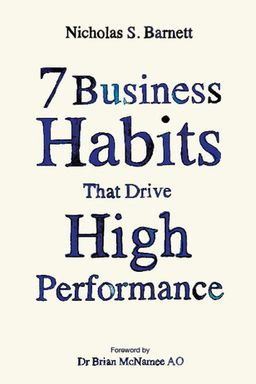
7 Business Habits That Drive High Performance cover

7 Business Habits That Drive High Performance

by Nicholas S Barnett

In ''7 Business Habits That Drive High Performance,'' Nicholas S Barnett reveals the key behaviors and organizational values that propel companies to excel. Learn how to transform your business activities to outpace competitors, engage employees, and foster customer loyalty for lasting success.

The 7 Habits That Build High-Performing Businesses

Have you ever wondered why some organizations consistently outperform their competitors year after year—while others struggle to stay afloat despite similar resources and opportunities? In 7 Business Habits That Drive High Performance, Nicholas S. Barnett argues that sustainable excellence doesn’t come from one-time programs, flashy strategies, or new technologies. Instead, it arises from small but powerful behavioral shifts embedded so deep in the organization’s culture that they become second nature. Barnett contends that the real differentiator between high and low performance lies in the habits an organization lives every day.

Drawing on research from over 100,000 employees across 200 companies, Barnett identifies seven interconnected habits that high-performing organizations embed into their DNA. These are not optional checkboxes or isolated techniques—they form an integrated system for creating inspired employees, loyal customers, and resilient systems. According to Barnett, high performance starts when leaders stop treating employees as expendable resources and begin leading with clarity, vision, and genuine care.

The Power of Organizational Habits

Barnett borrows from psychology to show how recurring organizational behaviors shape culture. Just as bad habits limit an individual’s success, poor organizational habits—like vague communication, lack of recognition, or ignoring employee input—cripple performance. Conversely, constructive habits cultivate engagement and consistency. The seven habits include: living an inspiring vision, communicating clear strategies and goals, developing people, recognizing contributions, genuinely caring for staff, listening and adapting to customers, and continually improving systems.

Organizations that live these habits deeply see employees move from compliance to commitment. They tap into what Barnett calls “extra discretionary effort”—the willingness of employees to go beyond their job descriptions because they’re emotionally invested in the mission. It’s the difference between people showing up to collect a paycheck versus coming to work to make a difference.

Ethical Leadership and Sustainable Success

A recurring theme is ethical leadership. Barnett warns against the self-serving mindset that led to corporate collapses like Enron and Lehman Brothers. He argues that companies derive their license to operate from society, not shareholders alone, and that boards must set a high moral tone. Ethical leadership, he says, naturally supports every habit—from articulating a worthy vision that transcends profit (Habit 1) to building transparent systems that serve both people and customers (Habit 7).

Barnett also promotes the role of boards and CEOs in shaping organizational culture rather than delegating it to HR departments. If the leadership team doesn’t model the habits, employees won’t adopt them. This insight echoes the thinking of leadership experts such as Ken Blanchard (The One Minute Manager) and Stephen Covey (The 7 Habits of Highly Effective People), both of whom emphasize alignment between words and actions.

High Performance Is Cumulative

Barnett emphasizes that high performance isn’t a single victory—it’s a compounding advantage built over time. If a company outperforms competitors by just 7% annually, it doubles in value within a decade. This growth, sustained through the seven habits, generates extra cash flow, lower turnover, better customer loyalty, and increased innovation. Importantly, this mindset reframes success from short-term cost-cutting to long-term capability building.

The research makes one message clear: you can’t cherry-pick habits and still expect sustainable success. Executives who try to use them as quick fixes or motivational fads will fail. The habits must be lived authentically and reinforced continually, through leadership behavior, systems, and daily routines. When embedded properly, they create cultures that attract talent, foster trust, and deliver impressive results year after year.

Why This Framework Matters

Barnett’s model matters because it bridges the gap between theory and practice. It’s not another abstract checklist but a data-backed framework that organizations can measure. You can literally benchmark how well your company lives each habit through surveys and follow-up actions. This measurable approach ties directly into performance outcomes, giving leaders tangible tools to shift culture.

Ultimately, 7 Business Habits That Drive High Performance is about realizing that excellence is not the result of heroic leadership or luck—it’s the predictable outcome of consistent behaviors practiced by everyone, every day. When you live all seven habits, success ceases to be episodic and becomes embedded into “the way we do things around here.”


Living an Inspiring Vision

Barnett begins by declaring that everything starts with an inspiring vision—the magnet that draws energy and alignment throughout the organization. He compares it to a compass leading a journey: it doesn’t just reveal direction, it provides meaning. The foundation of Habit 1 is emotional engagement. As Friedrich Nietzsche said, “He who has a why to live can bear almost any how.”

Creating Shared Purpose

A vision must belong to everyone, not just the CEO. One of Barnett’s examples describes a CEO who unilaterally announced a new vision with no consultation—only for the cynical employees to reject it. Contrast that with organizations that involve staff through surveys, workshops, and dialogue. These leaders build ownership and collective commitment. The power of shared purpose multiplies when employees see themselves as co-creators rather than passive recipients.

Connecting Hearts, Not Just Minds

Barnett warns against the purely rational approach. A spreadsheet can’t inspire loyalty. Great visions stir emotion—they make hearts beat faster. He tells the story of a global health organization that replaced the dry phrase “improve health” with “reduce needless suffering.” The shift invoked compassion rather than bureaucracy. Similarly, storytelling transforms abstract numbers into human connection. (Note: Daniel Pink’s Drive supports this idea, showing that purpose fuels motivation more than financial incentives.)

Making Vision a Way of Life

An inspiring vision can’t live on a poster. It must permeate meetings, decisions, and celebrations. Barnett insists leaders link every project back to the vision so employees can see how daily actions contribute to the larger mission. This alignment builds resilience—especially in tough times. One company facing global expansion used its “becoming a global leader” vision to rally through setbacks. The repeated reference to that shared goal turned obstacles into stepping stones.

Guarding Against Negativity

Vision is fragile. A single negative voice among leadership can fracture unity. Barnett calls this a “crack that becomes a chasm.” When leaders disagree publicly, employees lose trust fast. Thus, every senior executive must outwardly champion the vision, without sarcasm or ambiguity. Cultivating solidarity at the top ensures passion filters downward unbroken.

From Words to Action

The vision habit demands repetition and authenticity. When leaders live the vision through consistent words and deeds, employees follow suit. As Barnett summarizes: a clear, shared, emotionally resonant vision doesn’t merely guide performance—it electrifies it.


Communicating Clear Strategies and Goals

If vision is the destination, strategy and goals are the roadmap. Barnett likens them to the goalposts in Australian Rules football—without them, players wouldn’t know where to aim. Too many businesses operate without clarity, leaving employees confused and disengaged. Habit 2 urges leaders to set visible markers everyone can rally toward.

Strategy on a Single Page

Barnett criticizes bloated strategic plans that span hundreds of pages. He advises leaders to distill their strategies onto one page—succinct, visual, and actionable. The discipline of simplification forces clarity. If you can’t explain your strategy clearly, you don’t understand it deeply yet. He notes that in low-performing companies, only about one third of employees say they understand strategy; in high performers, that number nearly doubles.

Answering the Right Questions

A sound strategy answers key questions: How are we different from competitors? Why do customers choose us? What are our core competencies? How will we sustain advantage? Without clear differentiation, organizations just work harder instead of smarter. Barnett’s approach aligns with Michael Porter’s principle that strategy begins with unique positioning, not imitation.

Internal Communication Matters

Companies spend millions communicating externally to customers but mere pennies internally. Barnett argues that consistent internal communication—reinforcing vision, strategy, and goals—is the cornerstone of engagement. He recommends using stories, metaphors, and repetition to embed messaging. When extended leadership teams personalize strategy, using their own words, employees sense authenticity and alignment.

Taglines and Rallying Cries

Taglines like “Inspiring Change” (Insync Surveys) or “More Give, Less Take” (National Australia Bank) show how a few words can encapsulate purpose. But leaders must ensure slogans reflect integrity—Barnett reminds us how Essendon Football Club’s “Whatever it takes” backfired during doping scandals. Your rallying cry must embody genuine commitment.

Cascading Goals and Measuring Progress

Finally, Barnett champions cascading goals: linking organizational aims to team objectives and individual metrics. This alignment creates “line-of-sight”—everyone sees how their daily actions serve the bigger picture. Regular reviews and scorecards maintain accountability. He also encourages risk awareness and scenario planning to build resilience when the world shifts unexpectedly.

When employees know exactly what success looks like and how their work contributes, strategy stops being an abstract exercise—it becomes collective movement toward a shared triumph.


Develop, Recognize, and Care for Your People

Habits 3, 4, and 5 form what Barnett calls the “human core” of high performance: develop, recognize, and care. These habits transform workplaces from transactional to transformational. High-performing organizations view people not as costs but as assets whose potential is limitless if nurtured.

Habit 3: Develop Your People

Barnett uses orchestra conductor Benjamin Zander as a metaphor—the leader as “architect of possibility.” Great companies, he says, invest consistently in learning through mentoring, challenging assignments, and career paths. They focus not merely on technical skills but behavioral competencies—character, integrity, empathy—because most leadership failures stem from behavioral flaws, not competence gaps. The best leaders start by developing themselves. When they show a commitment to learning, their teams follow.

Habit 4: Go Out of Your Way to Recognize Your People

Recognition is the simplest, cheapest, and most powerful motivator—yet often neglected. Barnett urges leaders to thank people routinely and publicly. He cites an example where a CFO’s overtime contributions were rewarded with a surprise weekend at a retreat, a gesture remembered years later. Recognition builds emotional equity. It must be genuine and spontaneous, not mechanical. Organizations that institutionalize recognition ceremonies but neglect everyday gratitude miss the real point. (Ken Blanchard’s The One Minute Manager echoes this idea by recommending praise even when correcting mistakes.)

Habit 5: Genuinely Care for Your People

Care is the ultimate authenticity test. Employees have “bullshit detectors,” Barnett warns—they can tell whether concern is real or performative. Genuine care shows up in listening, fair treatment, psychological safety, support for work–life balance, and respectful handling of departures. He introduces the concept of the “psychological contract”—the unwritten emotional agreement between employer and employee. When leaders break it (through broken promises or disrespect), trust evaporates. High-performing companies honor that contract by proving their commitment daily through transparent communication and empathy.

Together, these three habits create a workforce that is not just skilled but spirited—a community where people grow, feel valued, and stay engaged through both triumphs and trials.


Listening to Customers and Improving Systems

Habits 6 and 7 shift focus outward—to customers and systems. Barnett shows that even the most motivated employees can’t save a company that fails to listen externally or operates with broken processes. These habits ensure the organization remains relevant, agile, and well-oiled.

Habit 6: Listen and Adapt to Customers

Barnett challenges the cliché that “customers first” inherently guarantees success. If employees are disengaged, customer service collapses. Thus, employee engagement must precede customer obsession. Once foundation is set, high-performing firms collect constant feedback—through Net Promoter Scores, loyalty metrics, and direct dialogues. They build relationships, not one-off transactions. He advises leaders to calculate customer lifetime value to grasp why retention matters more than acquisition. The best organizations move customers from satisfaction to loyalty and finally advocacy—when clients promote your brand voluntarily.

Habit 7: Continually Improve Systems

Flawed systems can undermine every other habit. Barnett quotes survey data showing that fewer than half of employees feel their computer systems work well. Improving systems isn’t just IT maintenance—it’s about enabling people to succeed. He uses Cirque du Soleil as a metaphor: harmony between people and systems produces magical performance. This involves aligning IT with business strategy, engaging end-users early, redesigning workflows, and maintaining robust support. Leaders must recognize legacy constraints but invest boldly in modern, integrated platforms before they fall behind competitors (as Kodak and Britannica once did).

Listening and adapting to external needs while ensuring internal efficiency complete the cycle. Together, these habits transform operational excellence into a sustainable advantage.


Leadership, Culture, and the Art of Embedding Change

Barnett concludes by focusing on leadership—the fuel that keeps all habits alive. He argues that culture mirrors leadership’s habits. If leaders blame employees for poor engagement, they’re missing the mirror. Changing organizational habits begins with changing leadership behaviors.

Walking the Talk

Authentic leaders act consistently, not selectively. They serve rather than command. Barnett admires chairpersons who view their role as supporting and developing CEOs—not controlling them. This servant mindset builds trust and cascades through the hierarchy. He emphasizes clarity and predictability of behavior: employees should never wonder which ‘version’ of the leader they’ll meet.

Embedding Habits as a Change Program

Barnett treats cultural transformation like a major project: measure current state, paint future state, build a compelling case, secure leadership commitment, allocate resources, execute, and measure again. He stresses using both left and right brain—rational arguments for change and emotional storytelling that touches hearts. Engage employees early, celebrate small wins, and persist for years until habits become “simply how we operate.”

Why Most Leaders Fail to Adopt the Habits

Despite clear benefits, many leaders chase quick fixes, fads, and short-term profits. Some have “hard heads and hard hearts,” unable to connect emotionally. Others lack conviction or are blinded by ego and greed. Authentic success demands humility and belief in human potential—the conviction that people can be developed, trusted, and inspired. Those beliefs separate true leaders from mere managers.

Ultimately, leadership is not delegated to HR or slogans—it’s practiced through daily example. When leaders model the seven habits with resilience and authenticity, they transform organizations into communities of purpose rather than machines of profit.

Dig Deeper

Get personalized prompts to apply these lessons to your life and deepen your understanding.

Go Deeper

Get the Full Experience

Download Insight Books for AI-powered reflections, quizzes, and more.