
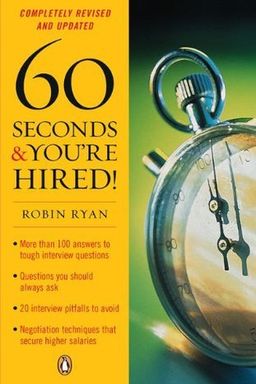
60 Seconds & You’re Hired! cover

60 Seconds & You’re Hired!

by Robin Ryan

60 Seconds & You''re Hired! by Robin Ryan is your ultimate guide to mastering job interviews. Discover how to captivate attention with concise answers, showcase your unique strengths, and ask impactful questions to secure your dream job. Gain practical insights to leave a lasting impression and navigate the competitive job market with confidence.

Mastering the 60-Second Interview Revolution

Have you ever walked out of an interview wondering why you didn’t get the job when you knew you were perfectly qualified? In 60 Seconds & You’re Hired!, career expert Robin Ryan argues that it’s not talent alone that wins positions—it’s how effectively you present that talent. Her central premise is strikingly simple: you have just sixty seconds to capture an employer’s attention and convince them you can do the job. Every word, gesture, and question counts. And in those first sixty seconds, you either secure your audience—or lose them forever.

Ryan contends that the modern hiring game operates on a sound-bite psychology. Employers, bombarded with applicants and pressed for time, decide within a minute whether they’re listening to someone worth hiring. The book teaches you to work within that compressed time frame by mastering two interconnected tools: the 5 Point Agenda (your personalized set of five strongest, most marketable skills) and the 60 Second Sell (a vivid pitch summarizing those strengths in one concise minute). These techniques form the backbone of the book’s approach—turning interviews from anxious interrogations into confident conversations focused on your value.

Why Sixty Seconds Matter

According to Ryan, employers tune out easily. She describes how interviewers, often distracted or fatigued after talking to multiple applicants, make sweeping judgments within seconds. In that brief window, your enthusiasm and clarity must cut through. She compares it to advertising—where 30- and 60-second commercials sell products by appealing to emotion, clarity, and relevance. Similarly, your presentation must convince employers you’re not only capable but motivated to deliver results quickly and effectively.

This focus on brevity and precision is what makes the book relevant in today’s information-saturated workplace. The goal is not to overwhelm employers with details, but to deliver precisely the points that prove you meet their needs. As Ryan reminds readers repeatedly, interviews are problem-solving exchanges, not autobiographical monologues. The employer’s real question isn’t “Who are you?” but “Can you solve my problem?”

A Blueprint for Influence

To help you prepare, Ryan breaks down the hiring process into concrete, repeatable strategies. The book covers how to structure your self-selling agenda, understand employers’ evolving needs, dress and behave professionally, handle difficult questions, negotiate the best salary, and close interviews effectively. It also explores how hiring trends have changed with globalization, technology, and shifting worker expectations, teaching you how to adapt to modern employer mindsets that prioritize flexibility, communication, and teamwork.

One of her central ideas—the ideal worker persona—reveals that employers no longer just desire experience; they value self-starters who continuously learn, adapt, and align their personal mission with organizational goals. That means your pitch must demonstrate not only expertise but attitude: you are the kind of worker who thrives in change and adds long-term value.

Why This Approach Matters

The beauty of the sixty-second method lies in its psychology. You’re not merely memorizing talking points; you’re packaging your value in an emotionally resonant way. Ryan’s techniques are grounded in her work as a career counselor and hiring consultant, drawing lessons from real clients who saved sinking interviews by deploying the 60 Second Sell. She shows how preparation and polish convert anxiety into composure. Each chapter translates abstract advice into tactical steps and examples—from executives negotiating raises to recent graduates landing their first positions through concise, practiced pitches.

Ultimately, this book isn’t just about interviews—it’s about reclaiming your professional confidence. It reframes job searching as a skill of strategic marketing: understanding what employers want, presenting your experience as their solution, and doing it all within a minute that truly counts. Like Dale Carnegie’s timeless emphasis on human connection (in How to Win Friends and Influence People), Ryan highlights that success comes from understanding others’ needs and connecting your story to their goals. The sixty seconds become your moment of clarity—a professional power tool that transforms interviews from luck-based to deliberate, persuasive opportunities.

Through examples, checklists, and dialogue templates, Ryan turns job hunting from guesswork into strategy. Whether you’re a nervous college graduate or a seasoned executive negotiating six figures, her message remains the same: when you know your worth, can express it powerfully and briefly, and aim for a genuine exchange of value, those sixty seconds can change your career.


Building Your 5 Point Agenda

Robin Ryan introduces the 5 Point Agenda as your personal framework for turning an interview from a random conversation into a strategic showcase of your strengths. It’s a preplanned list of five specific reasons why you’re the ideal candidate, customized for each employer. These five points become the spine of your conversation—the core themes you repeat through examples and answers.

Choosing Your Five Strengths

You start by analyzing your past roles and identifying what you do best. Ryan urges you to focus on measurable results and transferrable skills—things that demonstrate capability rather than titles or tasks. For instance, in her example of a chief financial officer candidate, the person lists tangible achievements such as taking a start-up manufacturer from zero to $38 million in eighteen months and hiring over 3,500 employees. Similarly, a new graduate can form a five-point list emphasizing technical skills, internships, and teamwork experience.

Adapting to the Employer’s Needs

The key isn’t to choose what flatters you—it’s to select what convinces them. As Ryan reminds readers, every job interview is a marketing conversation aimed at a specific audience. You must know not only what you bring but what they value. She advises digging deeply through company research and even calling insiders to uncover what matters most: innovation, leadership, process efficiency, or technical expertise. These clues help you shape your agenda to mirror their needs, not just your experience.

This strategic mirroring parallels modern branding logic (similar to Seth Godin’s advice in Linchpin): tailor your identity to fill the company’s gaps. When you align your five points to the organization’s mission, the employer feels understood—and that psychological connection wins interviews.

Repetition Builds Memory

Ryan emphasizes that repetition makes you memorable. After interviewing multiple people, employers often can’t recall who said what. But if every one of your answers ties back to your five agenda points, they remember. “You’ve got to teach them your brand,” she might say. Each example you share should reinforce one point—planning, leadership, communication, problem-solving, or technical acumen. The 5 Point Agenda keeps your messaging consistent while allowing flexibility to highlight different dimensions depending on the questions asked.

Turning Preparation into Confidence

This preparation does more than supply talking points—it builds poise. Knowing what to emphasize helps you answer questions calmly and concisely. It eliminates rambling and insecurity. Ryan’s clients, ranging from CFOs to engineers, used the 5 Point Agenda to redirect interviews when employers deviated off-topic or seemed disinterested, steering the conversation back to their strengths. For example, an engineer under pressure could recall his agenda point about supplier management and use a specific success story to demonstrate initiative.

In short, your 5 Point Agenda functions as both compass and shield. It guides your narrative so the employer sees you as solution-focused rather than self-focused. It also protects you from panic, because you always know what to say. And when you combine it with the 60 Second Sell—a crisp, one-minute summary linking all five points—you transform your qualifications into a persuasive, unforgettable message that keeps you top of mind long after the interview ends.


Perfecting Your 60 Second Sell

The 60 Second Sell brings your 5 Point Agenda to life. It’s your spoken elevator pitch—a brief, logical story that connects your five strengths into one powerful minute. Robin Ryan calls it your “verbal business card.” Instead of reciting your résumé, you articulate how your experience directly fulfills the company’s needs. The goal: grab attention, build credibility, and make the employer remember you as the candidate who can deliver results.

When and How to Use It

Ryan teaches you to open the interview with your Sell, often in response to that deceptively simple question, “Tell me about yourself.” This is the moment amateurs waste with personal stories, while prepared professionals use their Sell to control the conversation. Once memorized, your 60 Second Sell becomes your instant confidence anchor—you know exactly what to say to establish competence and enthusiasm. It’s equally effective at closing the interview, ensuring your message is the last thing the employer recalls.

For example, Ryan’s CFO client delivers a Sell emphasizing fifteen years of international financial experience, measurable growth results, and leadership over thousands of employees. The story is logical and numbers-driven, yet framed within enthusiasm: “I base my success on two abilities…” That human touch links achievement with attitude, which is exactly what employers crave.

The Psychology Behind the Sell

Why sixty seconds? Because it mirrors attention spans and builds trust fast. People are hardwired to respond positively to structured, enthusiastic communication. When you deliver a concise story filled with proof, emotion, and results, you communicate competence before the interviewer consciously evaluates you. Ryan notes that short answers project authority, while long ones sound uncertain. Therefore, being succinct is not just polite—it’s persuasive psychology.

From Words to Emotion

A strong Sell also captures feeling. Ryan encourages using vocal variety, confident body language, and eye contact to reinforce your message. Employers hire people they like, trust, and remember, so emotion matters as much as ideas. This is where preparation meets performance—your delivery underlines certainty. The Sell is not robotic; it’s lively and real, convincing the employer you genuinely want the job.

A Universal Strategy

The Sell works for novices and executives alike. Whether you’re answering “What are your strengths?” or “Why should I hire you?”, it structures your reply logically. Ryan provides varied examples—an event planner emphasizing computer expertise and multitasking, an engineer stressing problem-solving and teamwork—to show how customization drives impact. The technique even parallels pitches in creative fields or entrepreneurship (note: Daniel Pink’s To Sell is Human also highlights that modern success depends on storytelling).

Ultimately, mastering the 60 Second Sell turns any interview into your stage. You stand out by clarity, passion, and brevity—the essential traits of influence. Employers stop hearing another applicant and start seeing the perfect solution to their needs. In just a minute, you don’t merely introduce yourself—you convince them they’ve found the one.


Understanding Modern Hiring Trends

Ryan situates her interview techniques within a larger context of changing employer expectations. Chapter 4, “Hiring Trends,” examines how globalization, technology, and shifting worker values have redefined what ‘qualified’ means. Employers have evolved from seeking skill fillers to looking for growth partners—autonomous performers who align with a company’s future direction.

What Employers Want Today

Companies now prize adaptability, lifelong learning, and integrity as much as technical expertise. After decades of downsizing and scandals, reliability and ethical behavior have become top hiring priorities. Strong communication skills dominate hiring complaints: managers find that most candidates stumble through vague, inarticulate answers. Hence, Ryan’s techniques for structured, concise communication directly address this core weakness.

The Rise of the Ideal Worker Persona

Ryan introduces the term ideal worker persona—a composite of traits every employer wants. This persona learns fast, adapts easily, maintains strong work ethics, and continuously improves. To project this persona, she advises showing passion for your field, enthusiasm about growth, and commitment to productivity. Each trait signals long-term employability. She compares older workers’ perceived sluggishness and younger workers’ perceived entitlement, demonstrating how anyone can override stereotypes by embodying adaptability and professionalism.

Where Workers Want to Go

Ryan also observes that employees increasingly seek meaningful work—roles aligned with personal values and missions. This shift, mirrored in research from Drive by Daniel Pink, means job seekers should communicate passion and purpose during interviews. Employers respond favorably to candidates who want to contribute, not just collect paychecks.

For readers, this chapter reframes the interview: you’re not proving what you’ve done—you’re showing who you can become. Every response, every story should demonstrate how you exemplify the traits of the ideal worker persona. In a fast-changing world, the candidates who convey growth potential—those willing to evolve alongside their companies—are the ones who get hired.


Negotiating the Best Deal

You’ve convinced them you’re the right person; now comes the challenge of getting paid what you’re worth. Ryan’s chapter on negotiation is a masterclass in professional assertiveness—especially for women and underconfident candidates who tend to accept the first offer out of relief.

The Gender Gap in Negotiation

Ryan reveals that women often earn 20% less than men because they seldom negotiate. Through examples like Lora and Jack—where Jack negotiated $70,000 while Lora accepted $58,000—she shows that initial salaries compound into long-term inequality. Her message: negotiating isn’t aggressive; it’s professional. Reject the cultural conditioning of being polite and grateful—replace it with confident self-worth.

Preparation is Power

She outlines a step-by-step formula: assess the employer’s pay structure, evaluate job-market supply, and set a fair figure before your negotiation interview. Know what’s typical for your role and industry. Never demand; always ask with fairness and enthusiasm. Use facts and examples to make your request sensible and persuasive. Ryan points out that most employers have flexibility—they simply need justification to approve increases.

Ten Strategies for Success

Ryan lists ten negotiation strategies, from adopting a confident tone to getting everything in writing. Among them: stress value, remain quietly firm, negotiate perks if salary is capped, always get money upfront, and request employment letters to confirm all benefits. She calls cash “king”—reminding readers that future raises often vanish, but base salary always remains.

Learning from Real Stories

Ryan’s client success stories illustrate the payoff. Michael gained a $20,000 signing bonus by articulating his value; Jessica stayed silent after her counterpoint and received $6,000 more; and Bob negotiated extended vacation time at a rigid health-care facility. Each story reinforces that preparation and composure win even against bureaucratic employers.

Negotiation, in Ryan’s view, is not adversarial but collaborative. The employer seeks ideal talent; you want fair compensation. When approached with respect, clarity, and proof of worth, negotiation becomes a partnership in mutual success—not a conflict.


Answering Tough Interview Questions

Ryan’s longest and most practical chapter tackles 120 tough questions—from the classic “Tell me about yourself” to the trickier “Why were you fired?” Each answer demonstrates her golden rule: respond briefly (under sixty seconds), honestly, and strategically to reinforce your 5 Point Agenda.

Behavioral and Situational Techniques

Modern interviews increasingly rely on behavioral questions (“Give me an example of…”). Ryan insists that behavior predicts performance. She advises preparing short, detailed examples showing how you solved problems, led teams, or handled stress. Her structure resembles the STAR method (Situation, Task, Action, Result) but is simpler: tell the story, explain your actions, summarize the outcome—within sixty seconds.

Common Pitfalls and Clever Pivots

The book advises steering away from negatives. When asked about weaknesses, pick ones unrelated to job competence and spin them into positives (“I’m not mechanical, so when the copier breaks, don’t call me”). Humor, used lightly, disarms tension. When discussing tough experiences—like firings or gaps—always demonstrate growth and resolution. Ryan models empathy tempered with maturity, noting that employers want reliability and lessons learned, not excuses.

Translating Experience into Proof

She urges professionals to use quantifiable examples—percentages, budgets, timelines—to paint credibility. Even non-workers can cite volunteer achievements to prove competence. Ryan’s guidance draws from hundreds of client interviews, showing how brevity and story-based answers outperform vague chatter.

Ultimately, this chapter transforms interviews into strategic performances. Each question becomes an opportunity to sell your best points. You’re not guessing; you’re guiding. And by practicing concise, example-driven responses, you project confidence—a trait that, as every employer confirms, is as valuable as skill itself.


Avoiding Interview Pitfalls and Mastering Follow-Up

Success can hinge on small details. Ryan’s chapters on etiquette, pitfalls, and closing the interview remind you that perfect answers mean little if you commit rookie mistakes. These sections are about polish—the unseen behaviors that separate finalists from hires.

Avoid Common Errors

Ryan lists twenty errors that derail candidates, from being late to appearing desperate. Most errors stem from poor preparation or low confidence. Her corrective advice: arrive early, dress conservatively, research the company, listen more than you speak, and maintain enthusiasm. Eye contact and smiling convey confidence even when nerves strike. She reminds readers that most interviewers are untrained, so you must manage the conversation yourself.

The Power of Thank-You Notes

After the interview, handwritten thank-you notes create lasting impressions. Ryan discourages emails—too disposable—and champions personal cards mailed within 24 hours. This small act of professionalism communicates gratitude and persistence. Employers often tie-break between equally strong candidates based on who followed up thoughtfully.

Staying Viable After Rejection

Even if someone else is hired, Ryan advises continued follow-up. Roughly 15% of new hires fail quickly. By calling back politely, expressing ongoing interest, and asking about other opportunities, you can re-enter consideration. Her clients have landed dream jobs through this simple persistence—proof that humility and readiness open second chances.

Ryan’s approach to pitfalls and etiquette closes the full circle: from communication to professionalism to resilience. She teaches not only how to impress employers—but how to embody reliability and integrity after the interview ends. In her view, that unwavering commitment is what truly gets you hired—and keeps you employed.

Dig Deeper

Get personalized prompts to apply these lessons to your life and deepen your understanding.

Go Deeper

Get the Full Experience

Download Insight Books for AI-powered reflections, quizzes, and more.