
Idea 1
Think a Little, Change a Lot
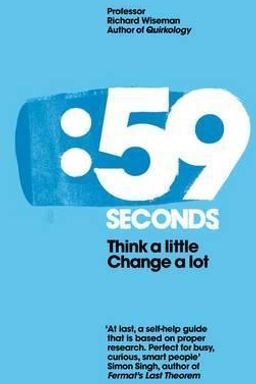
Have you ever wished you could change your life—be happier, more motivated, less stressed—without committing to months of therapy or years of self-help routines? In 59 Seconds: Think a Little, Change a Lot, psychologist Richard Wiseman argues that the secret to genuine, lasting self-improvement doesn't lie in wishful thinking or mystical visualization but in quick, scientifically proven actions that can transform your behavior and mindset in less than a minute. His core claim is radical yet empowering: small, evidence-based psychological techniques can create meaningful change far more effectively than traditional self-help clichés.
Wiseman’s premise emerged from a challenge given to him by a friend—Sophie—who asked if psychology had any real advice that could improve her life in about a minute. Searching through hundreds of academic studies, Wiseman discovered that psychologists worldwide had already found powerful ways to boost happiness, creativity, motivation, and relationships through micro-actions that take seconds. He then distilled those findings into a practical playbook of life-changing strategies.
Why Quick Fixes Work (When They’re Scientific)
Traditional self-help books often promote extensive daily rituals—visualize success, repeat affirmations, push away negative thoughts—but Wiseman reveals that many of these techniques backfire. Visualization, for example, can make you feel temporarily good but actually decreases performance by reducing preparation and focus. Suppressing negative thoughts makes them more intrusive (known as Wegner’s “white bear effect” from Harvard), while punching pillows to vent anger increases aggression.
In contrast, scientific psychology emphasizes “cognitive shortcuts” that can rewire thought and emotion by working with, not against, how the brain naturally processes experience. Wiseman draws on experiments like Ellen Langer’s nursing home study showing that giving elderly residents control over small things—a houseplant, for example—doubled survival rates. The takeaway: small doses of perceived control and mindful attention can transform well-being far more than abstract positive thinking ever could.
The Science of Rapid Change
Wiseman categorizes his findings across areas most people struggle with—happiness, motivation, persuasion, creativity, relationships, stress, decision making, and more. Each chapter offers evidence-based techniques that can be done quickly, such as writing about gratitude to boost happiness, mildly touching someone’s arm to improve persuasion, or imagining yourself studying (not just succeeding) to enhance motivation.
These exercises often involve subtle shifts in perspective—tiny physical gestures or reframing thoughts that set powerful psychological mechanisms in motion. For example, smiling for fifteen seconds triggers feedback loops that actually increase happiness, while writing affectionate notes reduces cholesterol and tension. They’re simple, but grounded in decades of research from top universities.
Beyond the Self-Help Myth
Wiseman also exposes the darker side of popular self-help culture—the false studies and myths that many gurus perpetuate. He debunks stories like the nonexistent Yale Goal Study, which claimed that students who wrote down goals became exponentially wealthier, and explains how unscientific advice often leaves people less confident and more frustrated. His message contrasts sharply with that of “The Secret” or traditional motivational seminars: real change comes from evidence, not ideology.
In place of magical thinking, Wiseman offers a toolkit built on behavioral science—each intervention small enough to try immediately but strong enough to produce lasting impact. Think of it as psychological precision engineering: knowing where to tap for transformation, rather than hammering away blindly at your problems.
Why It Matters
As Wiseman’s boiler-repair metaphor implies, effectiveness isn’t about effort but accuracy. You can spend years chasing happiness and success through misguided practices, or you can learn exactly where to apply your energy. His book bridges the gap between science and action, proving that psychological research can—and should—help ordinary people improve their daily lives.
Wiseman’s Central Promise
You don’t have to wait months for change. You can improve your happiness, motivation, relationships, and even health—starting with a single minute of well-directed action.
In the chapters that follow, Wiseman explores these techniques in detail—showing how gratitude rewires emotions, how posture shapes confidence, how small acts of kindness yield lasting joy, and how even writing your own eulogy can refocus your purpose. His research-driven approach turns self-development into something practical, measurable, and refreshingly human: a guide to thinking a little, and changing a lot.