
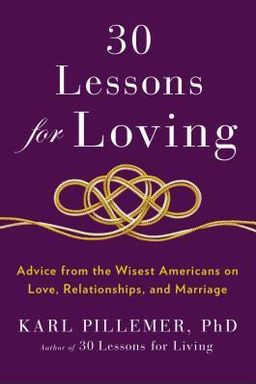
30 Lessons for Loving cover

30 Lessons for Loving

by Karl Pillemer

Discover the secrets to lasting love through the wisdom of elders. Karl Pillemer''s ''30 Lessons for Loving'' distills advice from those with decades of relationship experience. Learn how to communicate effectively, balance emotions with rationality, and keep romance alive, all while prioritizing your marriage for a strong, enduring partnership.

The Wisdom of Lifelong Love: Lessons from America’s Elders

How do people stay joyfully married for fifty, sixty, even seventy years? In 30 Lessons for Loving, Cornell gerontologist Karl Pillemer explores this question by doing something few marriage experts have done: he asks the oldest Americans—the men and women who have actually lived long, complex marriages—for their hard-won wisdom. Pillemer’s central argument is both simple and profound: the best advice about love comes not from psychologists or celebrities, but from lived experience. The elders he interviewed are the “experts,” and their lessons reveal that lasting love depends less on grand gestures and more on everyday habits of respect, communication, humor, and perseverance.

Drawing on over seven hundred interviews with individuals who have been married for decades, Pillemer offers thirty practical lessons that form a roadmap for finding, developing, and sustaining lifelong relationships. These lessons are grouped around four major stages of a relationship: choosing the right partner, learning to communicate, getting through life’s inevitable stresses, and keeping the spark alive well into older age. Finally, he adds a fifth chapter—a kind of capstone—on how to approach marriage itself as a lifelong discipline and commitment.

A Marriage Advice Project Rooted in Real Lives

Pillemer isn’t interested in abstract theories. His approach mirrors anthropological fieldwork: capturing the authentic voices of elders who have navigated love through wars, economic hardship, child-rearing, and aging. Their collective advice forms what he calls “the wisdom of crowds.” The book begins with the insight that no one can be absolutely certain that they’ve chosen the right partner—it’s always a gamble—but you can “even the odds” by asking the right questions early on. That means following your heart but also your head—balancing passion with practical judgment about compatibility, work ethic, financial responsibility, and shared values.

Love as Friendship and Discipline

One of the most striking findings is that the elders consistently define long love as friendship enriched by respect and compassion. Physical attraction matters, they insist, but friendship is what keeps a marriage alive after the initial spark fades. Think of Gladys Hunt at ninety-two, who admitted she first noticed her husband’s good looks but later cherished their companionship and shared interests as the foundation of sixty-four years of married life. In Pillemer’s view, falling in love is just the start—the transformative act is learning to be friends. This friendship grows through shared fun, an openness to each other’s interests, and tolerance for change over time.

Communication: The Lifeblood of Long Relationships

Across all interviews, one theme resounds: you have to talk. The “tough old guys”—veterans who rarely showed emotion in public—confess that learning to communicate saved their marriages. They describe how silence can breed resentment and how politeness, listening, and humor become survival tools. Pillemer builds an entire chapter around simple but powerful communication lessons: don’t assume your partner is a mind reader, mind your manners, pay attention to timing, and know when to pause an argument. In doing so, he reinforces principles that overlap with work by psychologist John Gottman, whose research identifies respect and humor as antidotes to marital decay.

Getting Through the Hard Parts

The elders remind us that “marriage is hard.” They’ve lived through “the middle-aged blur” of work stress, raising children, and endless chores. Their antidote is often startlingly pragmatic: make your home a haven from work pressures, treat in-laws kindly “without surrendering,” and divide chores by ability—assign tasks to the person who’s best at them, not according to gender roles. They also warn against three danger signs: violence, controlling behavior, and contempt, arguing that these are poisons no communication skills can fix. Crucially, they reveal their “trade secrets” for managing stress—hold regular meetings about money, seek social support, spend time with positive role models, and learn to “give it a rest.” As centenarian Charlotte Buchanan says, “Sometimes a problem will just disappear if you give it time.”

Keeping the Spark Alive

Perhaps the most inspiring section of the book deals with what younger couples fear most: how to keep love exciting for fifty years. The elders are reassuring. They still value physical intimacy and affection; they see a sexless older age as myth. More important, they redefine passion as an evolving intimacy—holding hands, laughter, shared adventures, forgiveness. They offer practical wisdom: “think small and positive,” “become friends,” “give up grudges,” “get help when you’re stuck,” and “lighten up.” Their humor, like Delores Neal’s tale of laughter during a messy airplane emergency, teaches that perspective matters more than perfection. Marriage thrives when you can still laugh together amid chaos.

Commitment as a Lifelong Discipline

In the final chapter, Pillemer distills all lessons into one overarching truth: lasting marriage is a discipline. It's an act of commitment practiced daily, not a static promise made once. Echoing Robert Browning’s line “Grow old along with me,” he shows that couples who endure do so by treating marriage as ongoing work—recommitting after every setback. From veterans to widowers to late-life newlyweds like Lucy Dale, ninety-four, who found love again and laughed that she was a “cougar,” the message is clear: love lasts when you choose to keep learning how to love. This perspective transforms marriage from a contract into a lifelong art of growth, humor, forgiveness, and joy.

Ultimately, 30 Lessons for Loving is not just a book about marriage—it’s a profound meditation on human connection. By looking at love through the long lens of a lifetime, Pillemer invites younger generations to adopt the elders’ worldview: that respect, patience, and humor outweigh convenience or passion alone. Listening to those who have walked the long road makes modern love feel less uncertain—and infinitely more hopeful.


Even the Odds When Choosing Love

When you’re deciding whom to marry, how can you know it’s right? The elders say, bluntly: you can’t. But you can even the odds. Pillemer’s first lesson from hundreds of marriages is that certainty is impossible—choosing a partner is always, as one woman said, “a gamble.” Yet most mistakes come not from fate, but from ignoring clear questions early on. Love is necessary, but not sufficient.

Heart Versus Head

The balance of heart and head anchors the elders’ advice. Following your heart ensures the presence of that intoxicating “in-love feeling”—the intuitive conviction that you have found the right person. This gut-level spark appears in nearly every story, from Delores Neal’s description of a magnetic connection to Eunice Schneider’s realization that leaving her boyfriend felt unbearable. “If you can’t imagine life without them,” she said, “you’ve got the clue.” But attraction alone isn’t enough. Elders insist that you must also follow your head through what Pillemer calls due diligence. Assess your partner’s work ethic, financial sense, and emotional maturity—qualities that predict stability when hormones fade. (Note: This echoes marriage researcher Judith Wallerstein’s claim that shared goals, not chemistry, sustain marriages over time.)

Three Tests of Practical Compatibility

Before saying “I do,” conduct three investigations: Will your partner be a good provider? Are they financially responsible? Will they be a good parent? Elders like Cecilia Fowler urge couples to look at work habits early—someone drifting between jobs may not change after marriage. Eric Goodman cautions about reckless debt, arguing that joined bank accounts demand trust as deep as love itself. And others like Nadine Perkins and Gertrude Bennett highlight frank talks about children long before commitment—whether you want them, how to discipline them, or how your childhood shapes those choices.

Values and Families

Pillemer adds that you don’t marry just a person—you marry their values, and often their family. Value clashes are “polar souls,” as Darren Freeman puts it—people whose lives constantly pull in opposite directions. Betrayal and conflict often arise not from love fading, but from mismatched core beliefs about work, money, or religion. Likewise, challenging in-laws can break marriages when they never accept a spouse. In contrast, those who align values and families find lasting peace. (Comparable insight: Gary Chapman’s The 5 Love Languages similarly stresses alignment of emotional values, not personality traits.)

The elders’ message boils down to deliberate selection: love deeply, but investigate wisely. Ask hard questions early. Don’t ignore warning signs like anger, violence, or contempt. Marriage may be a gamble—but smart players study the odds.


Communication: The Lifeblood of Marriage

If emotions are the heart of marriage, communication is its oxygen. Pillemer’s elders repeat the rule tirelessly: “You have to talk.” Talking prevents resentment, deepens understanding, and, as one veteran joked, keeps you from being “two dead ducks.” Communication failures, they warn, are the most common cause of divorce—and silence, not shouting, is the real killer.

No One Is a Mind Reader

One major obstacle is assumption. After years together, spouses believe they already know each other’s thoughts—but they inevitably misread them. Mavis Griswold’s husband learned this after decades: “Even though we’ve lived together all these years, please tell me exactly what you need. I’m not a mind reader.” Lucia and Stanley Waters solved this by turning communication into a disciplined habit—repeating back what they thought the other meant. “Nine out of ten times,” Lucia said, “I was wrong.” Their strategy mirrors therapist Harville Hendrix’s “mirroring” technique: repeating and clarifying before reacting.

Mind Your Manners

Respectful speech is another lost art. Pillemer highlights how politeness fades at home even though we use it with everyone else. His elders invoke the “please and thank you” rule—a kindergarten lesson most adults ignore. Janet Greene says, “You can’t treat your partner worse than you treat a friend.” Tracy Gibson adds, “Try always to be the nicest person you can be.” Small courtesies can defuse anger better than complex therapy techniques.

Timing and Patience

Knowing when to talk matters as much as what to say. Couples like Leona Stevenson learned to schedule arguments at the right hour—“no serious talks before my coffee,” she joked. Others used humor or rituals. May Powers and her husband stop mid-argument and say, “Let’s start again.” Some invented code words—“zoom out” or “zip it”—to pause a fight before it spirals. Even food helps: one pair defused tension by offering tea or a sandwich when hungry. Timing, humor, and nourishment—simple yet powerful ways to regain perspective.

Honesty with Tact

Finally, honesty keeps intimacy alive—but honesty must be gentle. Elders value truth on big issues but approve of discretion on small ones (“Do these pants make me look fat?” doesn’t require brutal realism). Trevor Garfield summarizes this balanced approach: “Be open and honest, but make sure you’re not afraid to talk about everything.”

The cumulative wisdom here is deceptively simple: talk often, listen actively, stay polite, and pick your timing. Communication isn’t a one-time skill; it’s a lifelong conversation. As Christy and Sean Wilkins—who remarried each other sixty-four years after divorcing—testify, “Don’t ever forget to communicate.”


Overcoming Stress Together

Marriage, say the elders, is “hard work.” It isn’t disappointment—it’s reality. From crying babies to demanding bosses to aging parents, stress infiltrates every stage of life. Pillemer’s third section, “Getting Through the Hard Parts,” collects practical wisdom for surviving these pressures with grace. These lessons turn ordinary resilience into marital longevity.

Children and Priorities

First and foremost: put your relationship before your children. This advice startled Pillemer—coming from grandparents raised in the most child-centered era of the 1950s—but it makes sense. “You don’t do your children much good if your marriage dries up,” says Neal Mitchell. A healthy partnership models love and respect better than overinvolvement in soccer schedules ever could. (Family researchers like John Gottman corroborate this: marital harmony predicts children’s emotional well-being more than parenting style.)

Home as a Safe Haven

The elders turn work-family stress into simple wisdom: don’t dump your bad day on your spouse. Merle Rowe warns that many people “dump” negativity where they feel safest—home. Instead, create what they call a “deflector shield,” keeping work stress outside your domestic circle. Rituals help: Phyllis Barton took showers each evening to “transition” from professional to family life, literally washing away the day so she could emerge as “Mommy.”

In-Laws and Boundaries

For in-law tension, the rule is solidarity with your spouse. “In a conflict between your spouse and your family, support your spouse,” elders insist. Present a united front, depersonalize criticism, and—when necessary—add physical distance. Gina McCoy and her husband solved toxic family interference by moving west, saying, “That’s how our marriage survived—we had to rely on each other.”

Dividing Labor Logically

Household chores cause chronic stress not because of dirt but because of symbolism: dishwashing becomes proof of love. The experts advise a businesslike approach—assign tasks to whoever is best suited, regardless of gender, and then step aside. Olive Warner and Sam Myers discovered peace once they divided duties by aptitude rather than tradition. “I like to cook, she hates it,” Sam said, “so why fight?” Respect each other’s domains and resist “gatekeeping,” or micromanaging housework, to keep resentment out of the sink.

Money: The Debt Trap

Financial stress devastates marriages more than any other factor. The elders’ antidote? Detest debt. Depression-era survivors like Evette Cope exhort, “Debt! You’ve got to hate it.” Save before buying, live below your means, and stop comparing yourself to others. When both partners anchor finances in discipline instead of envy, security—and peace—follow.

The common thread across these lessons is teamwork. Whether cleaning dishes or surviving layoffs, strong marriages share problems and victories. As Dennis Myers said after his daughter’s cancer: “You either deal with it as a team or you run.” Couples who choose teamwork don’t just survive stress—they grow stronger from it.


Keeping the Spark Alive for a Lifetime

Every generation asks the same anxious question: How can love stay exciting for forty or fifty years? The elders’ answer in Pillemer’s book is both comforting and energizing: the spark doesn’t vanish—it changes. The happiest couples redefine romance through friendship, humor, and adventure.

Think Small and Positive

Antoinette Watkins offers a jewel of advice: “Each morning, think, ‘What can I do to make his or her day a little happier?’” Small acts—a surprise coffee, doing a chore, giving a compliment—accumulate into lifelong warmth. Darren Freeman calls this “frequent small kindnesses,” not grand gestures. Others agree: take joy in daily appreciation rather than extravagant gifts. (Similar principle appears in Martin Seligman’s positive psychology—tiny positive interactions outbalance negative ones.)

Friendship and Fun

Friendship fuels passion. Couples like Winifred Austin and her husband revive youth through shared adventures: biking, concerts, laughing at their own silliness. In marriage, fun isn’t optional—it’s oxygen. Elders warn against letting chores smother play, urging spontaneous escapes: “Give yourselves permission to stop worrying and have fun.” Shared laughter, like Delores and Dave Neal’s cheerful pranks in their nineties, rekindles intimacy each day.

Lighten Up and Forgive

Forgiveness, the elders say, is like cleaning house daily. “Don’t go to bed angry,” they repeat—a cliché that hides deep wisdom. Grudges pile up into emotional clutter. Instead, practice quick apology and quicker forgiveness. As Cyril Hackett advises, “Be quick to apologize and quick to forgive.” Forgiveness resets the day, preserving calm amid inevitable human mistakes.

Adventure and Adaptation

To prevent boredom, embrace novelty: travel, volunteer, surprise your partner. Frederick Black urges couples to “find ways to make it fresh.” Margo Stiles’s playful spontaneity—like greeting her husband wrapped in a bow—shows how humor and unpredictability keep relationships passionate even in old age. Others suggest volunteering together; Herman and Annie Dawson taught inner-city children to read and found new purpose and connection through service.

Ultimately, the spark endures through perspective. As Mason Speare beautifully put it, “It’s less frenetic but much more profound.” The elders’ love is quieter, deeper—a steady flame instead of fireworks. Keeping the spark alive isn’t about resisting aging; it’s about growing into it, together.


Commitment: The Final Discipline of Love

In the final chapter, Pillemer delivers the most powerful—and perhaps most countercultural—lesson: treat marriage as a lifelong discipline. Commitment, the elders say, is what transforms love from emotion into character. It’s not about staying because it’s easy, but about choosing to stay when it’s hard.

Commitment Beyond Circumstance

Elders like Lai Lian and Ranjit Singh expressed this as a spiritual truth: marriage is “forever,” not a contract to exit when convenient. Lucy Dale, who stayed through decades of struggle before rediscovering happiness in late life, explained: “I invested too much to walk away.” For her, perseverance brought peace—a message that runs through every story. This discipline resembles the concept of lifelong practice in other arts—like meditation or music—where daily repetition refines mastery. (Note: Pillemer compares it to Peter Senge’s idea of disciplines as paths of continuous learning.)

Recommitment as Renewal

Commitment isn’t static; it’s practiced daily. Mae Powers jokes that she and her husband “got married many times”—each recommitment after a fight was conscious renewal. Sheldon Chapman echoes this: “Get that out of your head—you’re going to stay together and work it out.” Such constancy doesn’t trap partners—it frees them to grow, creating security that fosters self-discovery. Clark Hughes, a former priest turned husband, likens marriage to organic growth: “Every day adds on something and shapes you. I’ve become the real person I was meant to be.”

Love at Any Age

Perhaps most heartwarming is the elders’ proof that commitment leads to renewal even late in life. Lucy Dale, ninety-four, found a “fabulous boyfriend” after sixty years of marriage and laughed, “I’m what they call a cougar.” Her humor embodies resilience—the lifelong learner’s spirit. Commitment, by this view, isn’t confinement; it’s courage to love continuously, through loss and rebuilding.

When viewed through the elders’ lens, lasting marriage isn’t a static monument—it’s living art. The discipline of choosing love again and again transforms ordinary partners into lifelong companions. As Browning wrote—and as these couples prove—“Grow old along with me, the best is yet to be.”

Dig Deeper

Get personalized prompts to apply these lessons to your life and deepen your understanding.

Go Deeper

Get the Full Experience

Download Insight Books for AI-powered reflections, quizzes, and more.