
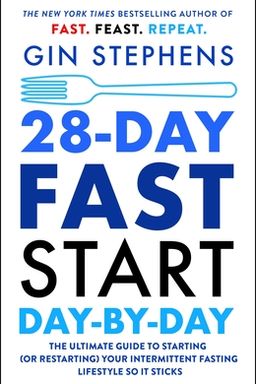
28-Day FAST Start Day-by-Day cover

28-Day FAST Start Day-by-Day

by Gin Stephens

28-Day FAST Start Day-by-Day offers a unique program to master intermittent fasting and form lasting habits. Through daily check-ins and strategic insights, readers can achieve sustainable health improvements and resilience over 28 transformative days.

Building a Lasting Intermittent Fasting Lifestyle

What if the key to transforming your health wasn’t eating less, but eating less often? In 28-Day Fast Start Day-by-Day, Gin Stephens—teacher turned bestselling author of Fast. Feast. Repeat.—argues that lasting wellness begins not with dieting, but with rhythm. This rhythm comes from learning the art of intermittent fasting (IF): deliberately alternating between periods of fasting and feasting.

Stephens contends that IF is not a diet—it’s a lifestyle shift rooted in science and mindset. Over twenty-eight days, she guides beginners and veterans alike through a structured system she calls the FAST Start: a step-by-step curriculum designed to make fasting a normal, enjoyable part of everyday life. The goal isn’t temporary weight loss; it’s metabolic freedom and the ability to trust your body again.

The Problem with Diet Brain

Stephens opens by acknowledging what nearly everyone has experienced: chronic dieting that never lasts. You count calories, buy shakes, follow complicated food rules, and still wind up feeling defeated. She calls this psychological trap diet brain—a mindset wired to chase numbers and quick fixes rather than real health. IF offers a way out. It rewires your body and mind so that hunger, satiety, and energy flow naturally again.

Unlike restrictive programs, IF doesn’t demand that you change what you eat immediately. Instead, it focuses on when you eat, allowing the body’s hormones and cellular machinery to recalibrate. You begin burning stored fat for fuel, lowering insulin, and cleansing yourself through a process called autophagy. By clearing old rules and rigid plans, you rediscover how to eat intuitively.

Making Fasting Doable

The FAST Start uses an educator’s logic—Stephens taught for twenty-eight years—to break fasting into a digestible, day-by-day curriculum. She acknowledges that her earlier book, Fast. Feast. Repeat., while foundational, can feel overwhelming for newcomers. This companion simplifies action: rather than absorbing every study and biochemical mechanism, you follow a daily plan that builds your fasting muscle gradually.

Her method revolves around four pillars, represented by the acronym FAST: Fast Clean, Adapt, Settle In, and Tweak. During Phase 1, you learn the rules of the clean fast—no flavors, no calories, just plain water, black coffee, or unflavored tea. Phase 2 helps your body adapt: tapping into stored fat rather than relying on quick energy. Phase 3 is about routine—settling into your window. Phase 4 empowers you to tweak timing and intensity until fasting feels effortless.

Why the 28 Days Matter

Stephens insists that these twenty-eight days are not about weight loss. The FAST Start is the training period—the time your body learns to switch from glucose to fat metabolism. This metabolic transition, often called the “flip,” takes patience. Some students adapt by week three; others need longer. She compares this adaptation to building endurance for a 5K: you wouldn’t sprint the race on your first day. Likewise, fasting is a gradual skill that requires time for cellular and hormonal recalibration.

“Fast. Feast. Repeat.”—it’s more than a mantra. Every clean fast is a reset button; every feast is nourishment; and every repetition strengthens your lifestyle.”

Mindset and Habit

By fusing daily journaling with motivation and science, Stephens turns fasting into habit formation. Drawing from James Clear’s Atomic Habits and Carol Dweck’s Mindset, she stresses that consistency—not perfection—is what reprograms your body. It’s normal to make mistakes or open your window early. What counts is not restarting endlessly, but never stopping. She repeats her golden rule: “Stop stopping.” Discipline replaces denial.

The culmination of the FAST Start—day 29—is reflection. Stephens directs readers to record photos, measurements, and lessons, not with the obsession of diet culture, but with the curiosity of a scientist studying oneself. You write a letter to your future self, commit to twelve more months of clean fasting, and trust in gradual transformation. These rituals solidify fasting as a lifelong identity: you are now an intermittent faster, not a dieter.

Why It Matters

In a world of fads and detoxes, Stephens offers something radical: simplicity and patience. She reframes fasting from something extreme into something natural—you already fast while you sleep; she just teaches you how to extend that healing period. The result is not starvation but liberation. By fasting clean and feasting joyfully, you restore metabolic flexibility, reduce inflammation, improve mental clarity, and rediscover joy in eating. You reprogram your body to thrive on its own wisdom, not food marketing or calorie math.

Ultimately, 28-Day Fast Start Day-by-Day is less about “doing a program” and more about becoming the kind of person who fasts comfortably and confidently for life. In Stephens’s world, the goal isn’t thinness—it’s freedom, balance, and trust. Through the FAST Start, you’ll create the habits, mindset, and biological foundation for a lifestyle that truly sticks.


The Clean Fast Rule

Gin Stephens draws a firm line in the sand: if you’re not fasting clean, you’re not fasting. She calls the clean fast the nonnegotiable foundation of success. Many failed IF attempts stem not from lack of discipline but from small mistakes that trigger insulin and hunger. The clean fast solves this by stripping fasting down to its biochemical core—allowing your body, not flavored beverages, to lead.

Understanding the Why

Every time your tongue tastes flavor—sweet, fruity, or creamy—your brain sends a signal to expect food. This triggers the cephalic phase insulin response (CPIR), a reflex that releases insulin even when no calories enter. Insulin, a storage hormone, halts fat burning. The goal of fasting is the opposite: low insulin that unlocks fat metabolism and cellular repair. So when you add cream, artificial sweeteners, or lemon to your morning coffee, your fast breaks invisibly.

Stephens’s approved list is simple: plain water, black coffee, plain tea, mineral or sparkling water—all unflavored. No additives, no taste enhancers. If it tastes like food, it acts like food. This clean boundary protects the hormonal integrity of fasting. (Dr. Jason Fung, author of The Obesity Code, reinforces the same principle, arguing that insulin—not calories—is the true gatekeeper of weight loss.)

Why So Many People Quit

Stephens tells countless stories of frustrated fasters who said IF “didn’t work.” When asked what they drank, they listed creamy coffee, flavored waters, diet sodas—each a hidden insulin trigger. Once they cleaned up their fast, everything changed: hunger dropped, energy soared, and results appeared. The clean fast isn’t a nuance; it’s transformative.

“The magic is in the clean fast.” That’s Stephens’s mantra. It’s where cravings fade and clarity grows.

Learning Through Experience

She uses everyday experiences from podcast guests to prove the point. One nurse named Renee Jocson had tried fasting for years but couldn’t lose weight while drinking butter coffee every morning. When she switched to true black coffee, fat loss began almost instantly, along with clear thinking and emotional calm. Stories like Renee’s shift the clean fast from a theoretical concept to lived transformation.

Stephens knows the transition may be hard—especially for coffee lovers. She encourages a “Clean Fast Challenge”: hold your nose and sip black coffee until your taste buds adapt, promising that most people adjust within days. The reward? Sustainable fasting that feels effortless, not an endless battle of willpower. You’ll learn that purity unlocks simplicity—and simplicity unlocks freedom.


Why Fasters Quit—and How to Persevere

Stephens admits she once was a chronic IF quitter. Between 2009 and 2014, she dabbled but couldn’t make fasting stick. The reason wasn’t lack of faith—it was lack of tools. When fasting felt hard, or results were slow, she gave up. That pattern is universal, so she created this book to stop the cycle. By understanding why fasters quit, you can protect yourself from discouragement before it arrives.

Common Reasons for Quitting

  • Unrealistic expectations: Thanks to flashy headlines promising “lose 20 pounds in two weeks,” new IFers expect rapid results. When their bodies don’t cooperate, they assume failure. Stephens reminds readers that fasting is a slow recalibration, not a sprint.
  • Emotional eating: Stress, loneliness, and exhaustion send people to food for comfort. Until you learn new coping strategies, these triggers sabotage consistency.
  • Life disruptions: Vacations, holidays, and social pressure make people think they fell “off the wagon.” Stephens reframes this—there is no wagon because fasting is a lifestyle, not a diet.
  • Following bad advice: Online influencers promote fasting teas, flavored drinks, or complicated rules that break the clean fast principle.

The Toddler Philosophy

One of Stephens’s most memorable metaphors compares fasters to toddlers learning to walk. “Fall down seven times, get up eight.” A baby doesn’t say, “Walking isn’t for me,” after falling once. Similarly, every fasting “fail” is just practice. Each restart strengthens resilience until fasting feels natural.

Community and Role Models

Stephens integrates stories of longtime fasters like Dr. Mark Mattson, the neuroscience expert from Johns Hopkins who has lived the fasting lifestyle since the 1980s. She also cites Dr. Gil Blander, an MIT scientist specializing in longevity who calls fasting “the best intervention we have to live longer.” (Context: Both researchers appear on her Intermittent Fasting Stories podcast.) Their authority reminds readers that what may seem extreme is, in fact, well-studied and sustainable.

By pairing scientific voices with everyday testimonies, Stephens reframes quitting from a moral failure into a misunderstanding. Quitting happens when you expect mastery before training. Fasting becomes simple once you realize struggle is part of adaptation. Stop starting over, she urges—just keep going.

“You can’t fail fasting—only pause and resume. Every fast begins fresh at sunrise.”


Autophagy: The Body’s Recycling Program

One of the most fascinating benefits Stephens highlights is autophagy, a natural process of cellular cleanup. The term literally means “self-eating.” Far from sounding grim, it represents the body’s innate ability to repair, renew, and recycle itself—turning biological trash into treasure.

How It Works

When food is scarce during a fast, your body improvises. Instead of panicking, it dismantles damaged cells, misfolded proteins, and worn-out components, then repurposes them for energy and growth. Stephens calls this the ultimate upcycling program. Just as teachers craft new creations from classroom junk, your body transforms biological waste into renewal.

Autophagy activates when insulin falls and protein intake pauses. Eating—even a bit of broth or collagen—halts the process. That’s why clean fasting matters: it gives autophagy uninterrupted hours to work.

Why You Want More of It

Stephens emphasizes that increased autophagy defends against aging, cancer, liver disease, and neurodegeneration. (Dr. Yoshinori Ohsumi received the 2016 Nobel Prize for discovering the mechanisms behind this process.) Fasting replicates the conditions that our ancestors faced naturally—periods of scarcity that kept cellular systems efficient. Modern constant grazing blocks this evolutionary rhythm.

“When you fast, your body looks around and says, ‘Time to tidy up.’” —Gin Stephens

Myth Busting

Contrary to internet claims, Stephens clarifies that autophagy doesn’t require multi-day fasts to occur. Once your body adapts, daily fasts of sixteen to twenty hours trigger meaningful recycling. Longer fasts amplify it, but aren’t essential. As she says, “Would nature design a cleanup system requiring survival fasts of 36 hours? Of course not.” Daily fasting keeps the body’s housekeeping regular—clean, not extreme.

Learning about autophagy reframes fasting from deprivation to repair. You’re not withholding food; you’re gifting your body rest. When understood this way, fasting transforms from a weight strategy into a longevity tool.


Metabolic Flexibility: Flipping the Switch

In one of the book’s most science-driven lessons, Stephens explains the metabolic switch—the moment your body transitions from burning glucose to burning fat and ketones for fuel. She calls this “Operation Glycogen Depletion.” Understanding this process helps fasters make sense of the adjustment phase and its temporary discomforts.

The Glycogen Tank Metaphor

Visualize your liver as a fuel tank storing glycogen, the body’s quick energy source. Early in your fasting journey, that tank is full. Each day of fasting you burn a little glycogen and refill it after eating—but never fully. Over time, as your fasts lengthen, glycogen gradually depletes until the body must access stored fat for energy. That’s when “the switch” flips.

Stephens uses this metaphor to demystify why fasting sometimes feels harder before it gets easier. When glycogen drops but fat metabolism hasn’t yet engaged, you feel sluggish, foggy, or “like moving through Jell-O.” She reassures readers this discomfort signals progress: your body is learning to fuel itself internally.

Metabolic Flexibility Defined

Once adapted, you achieve metabolic flexibility—the ability to shift smoothly between glucose and fat as needed. In this state, hunger stabilizes, cravings ease, and energy becomes consistent. Researchers like Dr. Benjamin Bikman (Why We Get Sick) view metabolic flexibility as the cornerstone of modern health, preventing insulin resistance, diabetes, Alzheimer’s, and more.

Stephens’s practical takeaway: Don’t rush adaptation. The FAST Start’s entire twenty-eight-day window exists so your body can learn this rhythm. Once fat burning becomes second nature, fasting feels less like effort and more like homeostasis—a state where health and weight balance naturally.


Food Freedom and Bio-Individuality

Stephens’s refreshing stance on food sets her apart from traditional diet experts. Instead of banning foods or prescribing macronutrient ratios, she encourages you to eat whatever you want—within reason. But her twist is subtle and profound: as your body heals, what you actually want will change.

Freedom, Not Frenzy

Early in her fasting journey, Stephens ate like a college freshman—junk food galore. Over time, though, her cravings evolved naturally toward real, nourishing foods. She realized fries from cheap oil hurt her stomach, while fresh meals made her feel vibrant. This shift, she explains, came not from rules but from awareness. Fasting heightens your body’s feedback—when you eat something unworthy, you notice instantly.

Bio-Individuality and Body Wisdom

Each body, Stephens emphasizes, has unique needs. Gut microbiomes, genetics, and lifestyle make uniform prescriptions useless. Some thrive on high-fat keto meals; others on high-carb vegan plates. Her mantra: “You could follow me everywhere, eat exactly what I eat, and get different results.” The goal is not compliance but curiosity—observe, experiment, tweak.

This principle mirrors Michael Pollan’s philosophy in The Omnivore’s Dilemma: eat real food, not too much, and mostly plants—but your “mostly” may differ. Stephens’s advice: let fasting clear the static, then listen to your body’s radio signal. When you trust it, your food choices naturally align with how you want to feel.


Mindset and Habit: Stop Stopping

Stephens devotes a crucial section to the mental game—without the right mindset, no lifestyle sticks. Borrowing lessons from psychologist Carol Dweck’s Mindset and James Clear’s Atomic Habits, she distinguishes two modes of thinking: fixed and growth. Dieters operate from fixed mindsets (“I always fail”), while successful fasters practice growth thinking (“I can learn and adapt”).

From Punishment to Curiosity

Rather than judging missteps, Stephens teaches reframing: every deviation is data. Did you open your window early? You learned something about stress or schedule. This growth mindset converts failure into feedback. Over time, consistency—not severity—builds mastery. Her favorite mantra captures this transformation succinctly: Stop stopping.

Habit Formation Science

Drawing from Clear’s 2009 research on habit formation, Stephens notes that new habits take 18–254 days, with 66 days as average. Perfection isn’t required—missing occasionally doesn’t break the chain. The secret is repetition and identity: act like a faster until you are one. Each clean fast strengthens your self-image as someone who honors their body’s rhythm. This identity shift turns discipline into second nature.

“The magic is in the repeat.” Stephens sees habit not as chains to bind you, but paths to freedom.

By focusing on mindset, Stephens ensures fasting becomes more than a method—it becomes self-respect in action. You no longer chase numbers but learn trust, patience, and self-leadership.


How to Define Success in Fasting

The book closes with a compassionate redefinition of success. Too often, people judge fasting by the scale. Stephens teaches that progress isn’t always visible and weight loss isn’t the only victory. You redefine “working” by focusing on internal and emotional signals: feeling good, sleeping better, gaining focus, or breaking diet brain. Those count more than pounds.

Beyond the Scale

Stephens calls these Non-Scale Victories (NSVs): steady energy, clearer skin, normalized blood sugar, improved labs, and peace with food. She celebrates fasters who report normal A1C levels or relief from autoimmune symptoms—proof that healing precedes visible change. The scale is data, not judgment.

Measuring Long-Term Wins

To track success consciously, Stephens introduces a journaling ritual at day 29. You weigh, measure, and photograph yourself—but only as benchmarks, not as verdicts. Then, you write a letter to your future self, envisioning your first “fast-iversary” after twelve months. This act turns intention into commitment. It’s the difference between trying and becoming.

Stephens reminds readers: if you feel better, IF is working. If your relationship with food improves, IF is working. If you’re healing, sleeping deeply, thinking clearly—then it’s working. Her humanistic lens reframes fasting from appearance to wellbeing. You aren’t chasing loss—you’re reclaiming life.

Dig Deeper

Get personalized prompts to apply these lessons to your life and deepen your understanding.

Go Deeper

Get the Full Experience

Download Insight Books for AI-powered reflections, quizzes, and more.