
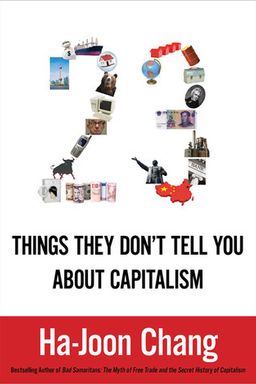
23 Things They Don’t Tell You About Capitalism cover

23 Things They Don’t Tell You About Capitalism

by Ha-Joon Chang

In ''23 Things They Don’t Tell You About Capitalism'', Ha-Joon Chang dismantles entrenched economic myths, revealing the shortcomings of free market capitalism. Offering alternative approaches, he empowers readers to envision a balanced, equitable future, challenging mainstream economic doctrines.

The Hidden Truths of Capitalism

Why do we assume that markets know best, that greed drives progress, and that inequality is simply the price of freedom? In 23 Things They Don’t Tell You About Capitalism, economist Ha-Joon Chang dismantles the comforting myths of free-market capitalism—arguing that what we’ve been told about how economies work is both incomplete and profoundly misleading. He invites you, the everyday citizen, to remove the rose-tinted ideological lenses that obscure capitalism’s real shape. The point isn’t to reject capitalism itself, but to reveal how it can—and must—be run differently.

Chang begins from the aftermath of the 2008 global financial crisis. Economists and politicians framed the meltdown as either a freak event or the unavoidable downside of an otherwise efficient system. But Chang contends that the crisis was no accident: it was the product of decades of free-market ideology unchallenged since the 1980s. He argues that most people, whether workers, voters, or consumers, have been conditioned to believe that less government, lower taxes, and unregulated markets bring efficiency and fairness. The evidence, however, shows the opposite: three decades of stagnating wages, rising debt, collapsing growth, and increasing instability—all rooted in blind faith toward self-correcting markets.

Exposing the Myths of the “Free Market”

At the book’s core is a challenge to the notion that markets operate independently of politics. Chang’s first assertion—“There is no such thing as a free market”—sets the tone. Markets, he insists, exist only within a framework of laws, norms, and regulations that determine what can be traded, who can trade, and under what conditions. From child labor bans to pollution limits and immigration controls, every rule shapes what counts as legitimate freedom. What we call a “free market” is simply one where particular political decisions are treated as invisible and natural. Unmasking this illusion allows readers to see that economic outcomes are political choices, not inevitabilities.

From there, Chang proceeds to expose 22 further “things” that challenge conventional economic wisdom. He argues, for example, that companies should not be run solely in the interest of their shareholders, since short-term profit maximization erodes investment and long-term productivity. He shows that most people in rich countries are paid more than they should be—their wages depend less on skill than on immigration politics that shield them from global competition. And he reminds us that the so-called post-industrial economy hasn’t replaced manufacturing at all; it has simply changed what we see as valuable labor, leaving many countries unprepared for industrial decline.

Free Markets Are Not Natural Laws—They’re Human Constructions

Capitalism, Chang emphasizes, is not a fixed entity but a spectrum of systems shaped by human decisions. The laissez-faire model popularized by Milton Friedman—self-correcting markets, minimal state, rational actors—is only one version. History reveals that rich nations, from nineteenth-century America to twentieth-century Japan and Korea, prospered through protectionism, state-led industrial policies, and strong public institutions. In other words, success came not from “free” markets but from managed capitalism. The irony, Chang notes, is that these same rich countries now tell developing nations to follow rules they themselves ignored when they were poor.

Capitalism’s Moral Dimension and Human Limits

Chang doesn’t paint capitalism as evil—he calls it humanity’s best economic invention so far—but argues that unrestrained markets deform moral values and human behavior. “Assume the worst about people and you get the worst,” he writes, illustrating how managerial practices that rely on distrust and endless efficiency metrics actually erode cooperation and innovation. Humans aren’t perfectly rational calculators; we operate with bounded rationality (a concept he borrows from Herbert Simon), limited by information, complexity, and cognition. When everything is left to individual optimization, we become blinded by short-term thinking—a danger most visible in the financial sector’s obsession with quarterly profits.

The Call for “Active Economic Citizenship”

Chang concludes his introduction with a rallying cry. Ordinary citizens don’t need to be trained economists to understand how capitalism works; they only need to recognize that economics is not physics but politics. Once you grasp that the economy’s rules are chosen, not inevitable, you can demand better ones. He calls this capacity “active economic citizenship”—the willingness to question policies, vote with informed judgment, and resist the passive belief that experts always know best. You don’t need to memorize formulas or predict interest rates, he insists. You only need to shed the illusion that markets naturally produce fairness.

Ultimately, 23 Things They Don’t Tell You About Capitalism is a conversation changer. It transforms economics into common sense: if capitalism is a human invention, then its outcomes—inequality, instability, or efficiency—are not destiny but design. Through 23 provocations, Ha-Joon Chang encourages you to think like an active citizen, not a passive consumer of economic dogma. And in doing so, he reminds us that rebuilding capitalism begins not in boardrooms or financial models, but in our collective imagination of what fairness and prosperity should mean.


There Is No Such Thing as a Free Market

Chang’s first principle strikes directly at the ideological heart of modern economics: the “free market” is an illusion. Every market, he insists, requires rules—laws defining property rights, contract terms, labor conditions, and acceptable products. What we consider “free” is simply the collection of rules we’ve stopped noticing. In the nineteenth century, for instance, advocates of laissez-faire protested child labor regulations in Britain as destructive interference. Today, that same policy seems like the bare minimum of civilization. Context changes, yet each generation treats its economic rules as natural.

Freedom Is Always Political, Not Economic

Every claim about market freedom, Chang explains, is really a political statement about whose freedom counts. The right of a factory owner to hire children conflicts with a child’s right to education and safety. Immigration controls restrict competition for native workers as much as rent controls restrict landlord earnings. To call one restriction “intervention” and another “normal” is arbitrary—it’s simply politics disguised as economics.

“Markets are like kung fu masters on piano wires.”

Chang uses this vivid metaphor to show how markets appear free only because their supporting regulations are invisible—like the wires holding an actor aloft. Once you notice the wires, the illusion vanishes.

The Myth of Objectivity in Economics

Economists often pretend that market boundaries can be scientifically defined, but Chang rejects that view. Deciding what counts as a legitimate transaction—whether to allow paid organ sales, sex work, or trade in carbon emissions—is moral and political, not technical. When policymakers argue that regulation “distorts” the market, they’re really defending a status quo that benefits particular groups. By exposing this myth, Chang reclaims economics as a human science concerned with justice, not natural law.

What Happens When We Forget Politics

Ignoring the political foundations of markets creates dangerous blindness. When President George W. Bush used $700 billion of taxpayer money to rescue failing banks in 2008, he described it not as socialism but as “necessary interference consistent with free enterprise.” To Chang, this doublespeak highlights the fragility of the free-market narrative: intervention is acceptable when it preserves elite interests but condemned when it protects ordinary people. Economists and politicians pretend that economics is neutral, but every economic rule is a choice about values—who wins, who loses, and what we call freedom.

By recognizing that markets are creations rather than forces of nature, you can start to question the moral assumptions hidden inside everyday policies. A market without rules isn’t freer—it’s simply ruled by money. Once you see that, you stop confusing deregulation with liberation.


Companies Shouldn’t Serve Only Shareholders

In his second revelation, Chang dismantles the dogma of “shareholder value maximization.” The faith that corporations flourish by serving shareholders alone, he argues, has hollowed out industrial strength and deepened inequality. The 1980s “shareholder revolution” turned managers into servants of quarterly returns. Instead of investing in technology, training, or jobs, they cut costs, slashed payrolls, and bought back their own shares to inflate stock prices. The result: fragile companies, falling productivity, and vast profits for top executives.

How Short-Term Thinking Destroyed Long-Term Growth

Using vivid examples, Chang compares General Motors, once the emblem of American industry, to Japan’s Toyota and Germany’s Volkswagen. GM, obsessed with pleasing shareholders, downsized relentlessly and refrained from reinvesting profits; Toyota, grounded in partnerships and long-term planning, invested heavily in process improvement and training. Productivity stagnation followed the shift to shareholder capitalism: per-capita growth in the US fell from 2.6% in the 1960s–70s to just 1.6% from 1990–2009.

The Mobility of Capital and the Myth of Ownership

Chang observes that shareholders—the supposed owners—are actually the least committed stakeholders. They can flee at a click, unlike workers or suppliers who depend on the firm for decades. This makes shareholder control economically irrational: those most likely to abandon the company have the most power to decide its direction. Limited liability, which caps shareholder risk, made such flight easy but also separated ownership from responsibility. (Karl Marx, ironically, defended limited liability as an engine of industrial progress, not as a moral principle.)

Is There an Alternative to Shareholder Capitalism?

Other rich nations, Chang notes, built mechanisms to curb the tyranny of the floating shareholder: Germany gave union representatives seats on boards; Sweden preserved family control with differential voting rights; Japan used cross-shareholding to discourage hostile takeovers. These models protected workers, suppliers, and communities while maintaining long-term stability. America and Britain, meanwhile, celebrated “lean” firms until 2008 proved how brittle they were.

Ha-Joon Chang recalls Jack Welch’s later admission—“Shareholder value is the dumbest idea in the world”—as poetic justice. Companies thrive not by enriching owners but by investing in future productivity. By redefining corporate purpose, you can align capitalism with sustainability rather than speculation.


Assume the Worst and Get the Worst

Adam Smith’s famous claim that self-interest makes the butcher, brewer, and baker serve society sounds elegant on paper—but as Chang observes, an economy built on distrust collapses under its own cynicism. The idea that people must be motivated only by greed has shaped everything from business management to government regulation. In Thing 5, Chang shows how this assumption has deformed workplaces and policymaking—and how assuming the best can, paradoxically, create better results.

Human Nature Under Capitalism

If everyone were a ruthless profit-seeker, our world would grind to a halt, Chang argues. Kobe Steel’s former manager once told him that even though executives understood only half of their projects, they approved most proposals because they trusted their engineers’ intentions. Without basic faith in others’ honesty and professionalism, bureaucracies—both corporate and state—could not function. Studies of worker behavior confirm this intuition: cooperation and pride in craftsmanship often raise productivity more than monetary incentives.

Trust as a Production Factor

Chang uses Japanese companies as case studies. Their production systems empower factory workers to halt the line or propose improvements. This trust unleashes initiative and mutual respect—what Western firms, obsessed with control and surveillance, struggle to replicate. Similarly, public officials can act effectively not by micromanaging market signals but by cultivating long-term relationships of trust. Economies that build social capital—norms of cooperation and reciprocity—are inherently more dynamic.

Morality Is Not an Illusion

Free-market economists explain moral behavior as self-interest disguised by invisible rewards and punishments—you don’t run off without paying the taxi driver only because you fear retaliation or damaged reputation. But most people simply believe dishonesty is wrong. Chang illustrates this with examples from tourists who aren’t cheated even when anonymity makes honesty irrational. If morality were just a market calculation, those acts wouldn’t exist. Markets rely on unwritten moral codes; once they destroy them with suspicion, efficiency vanishes.

“Assume the worst about people and you get the worst,” Chang concludes. Designing policies or workplaces based on distrust makes dishonesty the rational choice. Treat people as moral agents, and you’ll often discover they behave that way. It’s efficiency through empathy—a radical but deeply pragmatic idea.


Big Government Can Be Good

In sharp contrast to the stereotype of bureaucratic stagnation, Chang argues that big government often drives innovation and adaptability. Addressing Thing 21, he shows that welfare states—far from breeding laziness—empower individuals to take risks. When you know unemployment won’t destroy your life, you’re more likely to retrain, relocate, or experiment. The welfare state is, as he puts it, “the bankruptcy law for workers.”

Security as a Catalyst for Change

Korea’s obsession with medicine illustrates how insecurity stifles dynamism. After the 1997 crisis, mass layoffs made stable jobs scarce. Students flocked to careers promising lifetime stability—medicine, law—rather than science or entrepreneurship. A weak safety net, Chang explains, created risk aversion that misallocated talent. By contrast, Scandinavia’s strong welfare systems allow workers to adapt confidently to technological and industrial change.

The Welfare State as Economic Brake and Accelerator

Using data from the OECD, Chang shows that countries with larger welfare states—Sweden, Norway, Finland—grew as fast or faster than the US, disproving the myth that social safety nets weaken efficiency. Between 1990 and 2008, Finland and Norway’s per-capita income growth outpaced the US, demonstrating that public support can coexist with dynamism. People drive faster, he quips, precisely because cars have brakes; in the same way, societies innovate faster when failure doesn’t mean ruin.

Designing a Welfare State That Works

Effective welfare policies, Chang argues, aren’t about handouts but about second chances. High unemployment support, retraining programs, and health insurance give workers mobility. They also reduce political resistance to globalization: Europeans fear job losses less than Americans because their welfare systems cushion transitions. Big government, in this sense, expands choice. It’s not a security blanket—it’s an infrastructure for adaptability.

For Chang, dynamic capitalism requires compassion at its core. Market flexibility without human security creates paralysis; welfare with freedom creates resilience. A strong state doesn’t smother creativity—it makes it possible.


Finance Should Slow Down

Chang’s twenty-second insight reads like a warning flare from the wreckage of 2008: financial markets have become too efficient for their own good. Efficiency here means speed—the instant reallocations of capital chasing short-term gains. But when money moves faster than the real economy’s capacity to adjust, instability explodes. Iceland’s spectacular rise and fall, he writes, epitomizes the danger: a nation of 300,000 people built a banking sector ten times its GDP by deregulating finance in the 1990s. By 2008, all three major banks collapsed.

Liquidity and “Impatient Capital”

Finance is meant to help business: turn buildings and machines into liquid capital, fund expansion, and allocate risk. Yet liquidity makes investors flighty. Factory construction takes years; share trading takes seconds. This gap encourages impatience. Investors demand quick returns, forcing companies to cut long-term investments in innovation, training, and infrastructure. The pursuit of instant profit replaces sustained growth.

The Financialization Trap

By the 2000s, even industrial giants like GE and Ford made most profits from their financial arms. A superstructure of derivatives grew far above the real economy—mortgage-backed securities, CDOs, CDSs—each layer multiplying risk without new production. Chang compares this to building higher floors without widening the foundation. When one mortgage failed, entire towers toppled. Economist Warren Buffett presciently called derivatives “financial weapons of mass destruction.”

Making Finance Less “Efficient”

To heal capitalism, Chang advocates deliberate friction: transaction taxes (the Tobin Tax), restrictions on short-selling, limits on cross-border capital flows, and policies favoring “patient capital.” A slower financial sector would align better with the long cycles of real industries. Speed isn’t progress—it’s pressure, and unregulated velocity destroys the system that supports it.

The cure for crisis, Chang asserts, lies not in making markets smoother but rougher. Throw sand in the wheels. Let finance serve production, not dominate it. Only then can capitalism recover its balance between profit and purpose.


Good Policy Doesn’t Need Economists

Chang closes with irony worthy of a satirical economist: the world’s biggest economic miracles were engineered not by economists, but by lawyers, engineers, and bureaucrats who understood common sense better than theory. Japan’s economic bureaucracy was led by lawyers; Korea’s heavy-industry revolution by engineers; China’s planners by scientists. Their achievements—from Korea’s POSCO steel complex to Japan’s industrial ascendancy—were guided not by equations but pragmatic judgment, political vision, and learning-by-doing.

Why Expertise Isn’t Enough

Economics, Chang argues, is too often detached from reality. Economists, trained to believe in rational markets, saw the 2008 crash as impossible until it happened. When Queen Elizabeth asked, “How come nobody could foresee it?” academicians at the British Academy quietly admitted to “a failure of collective imagination.” For Chang, this confession proves that free-market economics thrives on blindness—it’s brilliant at modeling fantasy worlds but terrible at anticipating human chaos.

The Wrong Kind of Economics

Over the last 30 years, economic orthodoxy has justified policies that slowed growth, increased inequality, and triggered instability. Deregulation, austerity, and financial liberalization promised prosperity but delivered crises. Yet economists kept faith, mistaking ideological purity for evidence. Against this, Chang champions older thinkers—Keynes, Schumpeter, Hirschman—who understood capitalism as a system of innovation, uncertainty, and institutional design, not mere efficiency. These ideas fueled East Asia’s miracles and postwar Europe’s recovery, while free-market dogma led Latin America and Africa astray.

Economics as Common Sense

For Chang, “good economics” means ordinary reasoning applied to real problems. You don’t need math models to know that cutting education budgets hurts productivity or that speculative finance kills factories. Ninety-five percent of economics, he jokes, is common sense made complicated. Active citizenship—the willingness to question, demand evidence, and imagine alternatives—is more valuable than an advanced degree.

His final message is hopeful: capitalism doesn’t need better economists—it needs more sensible citizens. When the rules of economics are shaped by collective judgment instead of technocratic abstraction, capitalism can be rebuilt to serve society, not the reverse.

Dig Deeper

Get personalized prompts to apply these lessons to your life and deepen your understanding.

Go Deeper

Get the Full Experience

Download Insight Books for AI-powered reflections, quizzes, and more.