
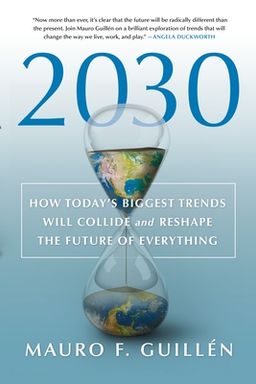
2030 cover

2030

by Mauro F Guillen

2030 provides a captivating glimpse into the next decade, analyzing how current trends in demographics, technology, and economics will shape our world. With insights on women''s rising wealth, aging consumers, and technological leaps, it prepares readers for transformative global changes.

Riding the Waves of 2030

What happens when global demography, technology, and climate converge in a single decade? The book argues that by 2030 you are living through an inflection point, a reordering of populations, markets, and mindsets that rivals the Industrial Revolution in scale and speed. The author contends that these forces—aging and youth booms, automation and AI, female-led wealth, climate stress, and digital networks—interact rather than act alone. To surf them successfully, you must think laterally, connecting dots across economics, technology, and social systems.

Demographic reshuffling

By 2030, fewer babies are born in rich countries while Africa and South Asia grow rapidly. This 'baby drought' shifts economic weight south and east. South Asia becomes the largest population region, Africa the second, while East Asia starts aging fast. As populations shift, fertility, education, and urbanization reshape who produces and who consumes. For businesses and governments, these population maps signal where future demand and labor come from—and where pension and healthcare pressures will explode.

Women, meanwhile, emerge as economic powerhouses. Rising education and inheritance reform accelerate their share of wealth from 15 percent in 2000 to a projected majority by 2030. Female preferences—security, education, and health spending—redirect capital flows toward human-centric industries. Simultaneously, global migrations create ‘brain circulation,’ moving talent, remittances, and ideas across borders, blurring the old borders of nation-state labor markets.

Technological acceleration

Alongside demography unfolds a ‘new Cambrian explosion’ of technology: automation, AI, 3‑D printing, nanotech, and blockchains. Each technology wave combines destruction and creation—destroying some jobs and industries while creating others. Manufacturing decentralizes through local 3‑D printing hubs; blockchain tokens transform trust and transaction systems; artificial intelligence challenges healthcare, logistics, and law. The author frames this as Schumpeterian creative destruction on fast forward, urging you to develop non‑routine cognitive and social skills—coordination, negotiation, and design—to thrive amid machine collaboration.

Platforms like Airbnb and Uber illustrate how network effects reshape not only industries but values: access replaces ownership, experience eclipses accumulation. This “sharing class” includes retirees earning through platforms and youth seeking flexibility. Yet it also exposes new inequalities as gig work blurs employment boundaries. At the same time, digital networks amplify social feedbacks, creating opportunities for scale and new exposure to regulation and political backlash.

Planetary and urban constraints

Urbanization concentrates energy and aspiration—but also risk. Cities occupy one percent of land yet produce more than half of emissions. Coastal megacities like Jakarta and New York face the literal rising tide of climate change. Rural to urban migration intensifies inequality and infrastructure pressure. The text warns that ‘cities drown first’ unless they adapt through incremental excellence—green roofs, stormwater infrastructure, behavioral nudges, and technology-guided design.

Africa’s agricultural and industrial rise anchors the other end of this story. With 500 million acres of undeveloped farmland and youthful demographics, the continent could feed itself and others with the right mix of tech, governance, and capital. Social entrepreneurs like Celestina Mumba and social enterprises like DADTCO embody how agricultural modernization fuels manufacturing and jobs. Mobile leapfrogging, from M‑Pesa payments to Loowatt waste-to-energy toilets, shows that innovation is local and lateral: simpler tools can outpace expensive legacy systems.

Minds, markets, and meaning

As material production evolves, consumption follows. By 2030, most middle-class consumers live in Asia and Africa. This 'new middle class' demands local flavors, mobile convenience, and environmentally sustainable goods. Aspirational branding in India or social‑status signals in China illustrate how cultures reframe prosperity. Meanwhile, aging societies in the West and East create ‘gray markets’—consumers over sixty with trillions in spending power, reshaping design, finance, and caregiving.

The final chapters weave these themes into a manual for resilience: understand your demographic context, invest in lateral innovation, and cultivate optimism toward change. The seven lateral habits—starting small, diversifying with purpose, preserving options, finding opportunity in scarcity—mirror design‑thinking and evolutionary adaptation principles. The author insists that uncertainty is permanent; mastery lies in riding demographic and technological waves with curiosity instead of fear.

Core message

You are not merely a spectator of global change—you are part of its circuitry. The choices you make about fertility, innovation, migration, and consumption compound into the world’s demographic, economic, and ecological future. To thrive, think laterally, act locally, and ride the currents of 2030 rather than resist them.


The Baby Drought and Demographic Realignment

Across continents, fertility decline is reshaping everything from labor markets to geopolitical influence. The 'baby drought' describes falling birthrates in rich nations and slower declines elsewhere. Education, urbanization, and lifestyle change drive this downward trend, while Africa remains the demographic exception with steady growth. By 2030, India leads global population; Africa’s youth bulge promises labor surpluses that may power its economic rise.

Causes and patterns

Women marry later, pursue careers, and have fewer children. Rising costs of housing and education reinforce this. Even policy incentives—cash rewards or vacations for births—barely alter long‑term choices. China’s one‑child policy is the cautionary tale: fertility had already dropped; the policy doubled down, aging the population and warping gender balance. Social adaptation, not compulsion, drives fertility behavior. (Note: demographers remind us that even small changes in fertility have exponential macro effects.)

Global consequences

Demography reshapes demand, capital, and power. By 2030, for every U.S. newborn, 4.4 are born in China and 10 in Africa. That shifts consumption east and south. Aging nations face pension shortfalls and tight labor markets; young nations face urban crowding and job scarcity. Immigration and 'brain circulation' connect these geographies, but even doubling migration barely delays aging trends. Businesses that ignore demographic arithmetic misread where future growth lies.

Adapting to the new age map

For you, demographic insight translates into strategy. Employers must plan for multigenerational and diverse workforces. Policymakers must redesign social insurance and healthcare for longevity. Individuals can align careers with expanding or contracting age cohorts—geriatric care in aging economies, education or construction in younger ones. The book reminds you that 'demography is not destiny, but it shapes destiny’s map.'


Technology’s Cambrian Explosion

Technology evolves faster than societies can absorb it. The author likens today’s age of AI, robotics, and digital fabrication to the Cambrian explosion, when life forms diversified explosively. Each innovation wave triggers creative destruction but also reinvention. From wristwatches to smartphones, every tool spawns its successor. AI now automates not only muscles but judgment, introducing ethical and economic dilemmas.

Automation and adaptation

Robotics is displacing routine manual work; algorithms cut into routine cognitive roles. Yet demand grows for social intelligence and adaptability. Studies by David J. Deming show social‑cognitive blending—teamwork, empathy, negotiation—gains value even as coding commodifies. Technological complementarity becomes the safe zone: working with machines, not against them. (In parallel, similar logic appears in Brynjolfsson’s work on the 'second machine age.')

Ethical frontiers

As autonomous systems make moral choices—self‑driving cars or surgical bots—the famous trolley problem turns digital. MIT’s Moral Machine found moral norms vary widely by culture; machines therefore need intentional ethical design. Technology’s limits are human, not mechanical: governance, law, and empathy now shape progress as much as code.

How to thrive

You should reskill continuously, coupling domain knowledge with creativity. View AI as an amplifier of human learning. In every past wave—from quartz watches to Swatch revival—adaptability distinguished survivors. The coming decade rewards curiosity, flexible thinking, and moral literacy as much as technical mastery.


The Gray and the New Middle Classes

Two consumer groups dominate the 2030 economy: older adults with accumulated wealth and emerging middle‑class families across Asia and Africa. At one end, aging populations in developed economies drive demand for health, safety, and leisure; at the other, aspirational youth in emerging markets redefine lifestyle and status. Understanding both is crucial to strategy.

The gray market’s surprise wealth

Globally more than 1.4 billion people will be over sixty by 2030, controlling up to $20 trillion in wealth. Seniors adopt digital tools far faster than stereotypes suggest: robots in Japan, voice companions like ElliQ in the U.S., and VR-based reminiscence therapy show technology’s role in emotional well‑being. Businesses that treat elders as active, stylish participants—not dependents—captivate this market.

The rise of the new middle class

Meanwhile the global middle class shifts eastward. Millennials in China, India, and Africa crave brands that convey progress and achievement, not mere affordability. Localization wins: Weber barbecues thrive by teaching Indian grilling culture while Tata’s 'world’s cheapest car' failed for signaling poverty. But environmental stress follows: planetary limits force innovation in resource efficiency and recycling. Winning firms must combine aspirational marketing with sustainable practice.

Takeaway

You face simultaneous abundance and scarcity—wealthy gray consumers and striving new middle classes. Strategy demands empathy for both: human‑centered design and respect for global diversity drive enduring profits.


Women and Global Transformation

Women’s economic ascent represents one of the century’s irreversible forces. By 2030, women may control most personal wealth, steering global capital toward security, education, and health. Their choices redefine economies and institutions, from investing styles to social entrepreneurship.

Education, wealth, and preferences

Education expansion creates not just equality but compounding economic influence. Women invest longer‑term, trade less frequently, and display steadier returns. They also prioritize family welfare, healthcare, and insurance—shifting demand structures. Financial products serving estate planning and fraud protection for widows and older women, such as Onist and EverSafe, typify this trend.

Entrepreneurship and policy

Female founders like Anu Acharya in India prove that innovation ecosystems depend on inclusion. Legal reforms on inheritance and property rights open capital access, while childcare and parental‑leave policies determine whether women stay in leadership tracks. Nations ignoring gender equity sacrifice growth and creativity. (World Bank studies now quantify GDP gains from gender equality.)

Why it matters

For you as investor or manager, designing for women’s needs is designing for the majority. From fintech to housing, female agency changes spending logic and social norms. Ignoring it is like ignoring half of the market—and half of innovation potential.


Migration, Labor, and Brain Circulation

Migration is the safety valve and growth engine of an aging world. Rather than a threat, immigrants fill labor shortages, drive research, and sustain fiscal stability. Data reveal that immigrants represent 28 percent of U.S. physicians and nearly a quarter of high‑tech founders. Their contributions in both low‑ and high‑skill sectors make them indispensable.

From brain drain to brain circulation

Entrepreneurs trained abroad increasingly invest back home—creating global feedback loops. Taiwanese and Korean innovators like Miin Wu and James Joo‑Jin Kim embody how diasporas export know‑how and import capital. The author redefines talent migration as network creation rather than loss.

Policy and perception

Public fear stems from loss‑aversion bias—overestimating short‑term costs. Evidence shows that younger migrants stabilize pensions and public finances. Modern immigration systems should be demand‑driven and qualification‑based, ensuring balance between opportunity and protection. For companies, recruitment pipelines tapping global talent are not acts of charity but competitive necessity.


Cities, Climate, and the Creative Divide

Cities concentrate creativity, capital, and risk. They are the laboratories of globalization—Dynamic yet divided. The book blends Richard Florida’s 'creative class' concept with climate realism: talent, tolerance, and technology drive prosperity, but inequality and environmental exposure determine survival.

Engines and inequities

Metropolises like Seattle or Singapore thrive on innovation ecosystems. Yet the same density spawns duality—creative professionals alongside marginalized workers. Policies addressing housing, transit, and inclusion decide whether cities reinforce or reduce inequality. Successful revivals—Pittsburgh post‑industry, Bilbao via culture, Chattanooga via broadband—combine vision with equity measures.

Climate frontlines

By 2030, urban exposure to floods, heat, and resource scarcity defines competitiveness. Simple interventions—green roofs, drainage upgrades, behavioral nudges in energy use—yield outsized benefits. Local innovation such as vertical farms or WaterWheel devices shows adaptive ingenuity. Leaders who protect the vulnerable while upgrading infrastructure turn cities into resilience hubs, not disaster zones.


Africa’s Agricultural Leapfrog

Africa stands at the frontier of demographic and resource potential. With vast arable land and mobile networks, it can bypass industrial stages that other regions took centuries to traverse. The continent’s growth story demonstrates that youth and land, not deficits, are its core assets.

From subsistence to scale

Cassava-led initiatives in Nigeria and Zambia show how better seeds, mechanization, and mobile processing transform livelihoods. DADTCO’s portable mills raise incomes by reducing post-harvest losses. Each innovation multiplies job chains—from machinery to transport and retail. These are platforms for industrialization, not mere agriculture upgrades.

Leapfrogging through tech

Mobile systems already reach farmers with payments, credit, and weather alerts, echoing Kenya’s M‑Pesa revolution. Like Loowatt’s toilet-to-energy network, such lateral problem‑solving replaces missing infrastructure with ingenuity. Africa’s advantage lies in modular innovation—smaller, adaptive systems rather than centralized megaprojects. When paired with governance and property rights, these can yield a trillion‑dollar sector by 2030.


Blockchain, 3‑D Printing, and the Future of Trust

Two frontier technologies—distributed ledgers and additive manufacturing—redefine how trust and production work. Both decentralize power: one across information networks, the other across physical supply chains. Together they threaten incumbents but democratize opportunity.

Blockchain’s reinvention of confidence

From Dalí’s signed checks to Satoshi’s code, the principle is the same: value comes from verified trust. Tokenization now tracks diamonds, bonds, and carbon credits, with smart contracts executing obligations automatically. Banks, lawyers, and accountants face transformation into oversight roles. Regulation and energy usage remain controversies, yet cross‑border payment trials and asset registries hint at mainstream adoption.

3‑D printing and nanotech’s local revolution

UPS’s print hubs and Branch Technologies’ freeform architecture reveal how production decouples from giant factories. AI‑guided 3‑D printing (Senvol) compresses prototyping cycles, while nanotech produces adaptive materials and targeted medicine. The environmental footprint shrinks—if consumption restraint matches efficiency gains. Policymakers must craft safety and export standards for locally produced goods to prevent decentralized risks (such as unregulated weapons).


Adaptive Mindsets for an Uncertain Century

The concluding section distills seven mental habits for surviving 2030’s turbulence. These are less about technology and more about thinking structure—lateral intelligence for complex change.

Seven lateral principles

  • Lose sight of the shore: Commit to transformation as Cortés did to exploration—burning the ships removes retreat temptations.
  • Diversify with purpose: Like Lego rediscovering its core through ideation with fans, expand from strengths, not panic.
  • Start small and iterate: Apple’s persistent “tweaking” shows that small, fast improvements beat static perfectionism.
  • Preserve options: Avoid irreversible bets; design escape routes and pivots.
  • Be optimistically experimental: Treat failure as data; courage breeds discovery.
  • Harness scarcity: Constraints, as on Rapa Nui, often trigger creativity—use them as innovation engines.
  • Surf the current: Identify major waves—demographics, tech, climate—and ride their momentum rather than resist them.

COVID‑19’s shock exemplifies these rules: it accelerated telework, telehealth, and automation, rewarding adaptive thinkers. The author concludes that resilience is built from mindset, not circumstance—you cannot predict every future, but you can prepare your responses.

Dig Deeper

Get personalized prompts to apply these lessons to your life and deepen your understanding.

Go Deeper

Get the Full Experience

Download Insight Books for AI-powered reflections, quizzes, and more.