
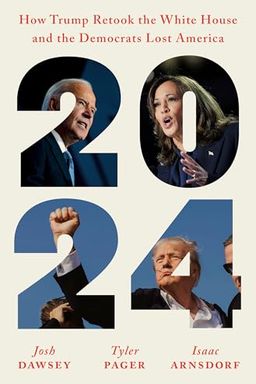
2024 cover

2024

by Josh Dawsey, Tyler Pager And Isaac Arnsdorf

Journalists from The Wall Street Journal, The New York Times and The Washington Post examine the most recent presidential election campaign.

Power from Peril

How does a campaign turn crisis into propulsion while a rival crumbles under similar pressure? This book argues that twenty-first-century American politics fuses law, media, money, security, and organization into one battlefield where shocks are not detours but fuel. The core claim: candidates who can convert institutional collisions—indictments, special counsels, assassination attempts, viral debates—into identity and momentum gain an asymmetric advantage, while those who treat shocks as exogenous nuisances get swamped by them.

You watch Donald Trump transform legal jeopardy and even physical danger into political power as his operation professionalizes under Susie Wiles, captures the RNC through Chris LaCivita, and weaponizes new coordination rules and outside money (via Charlie Spies, Turning Point Action, and Elon Musk–funded programs). You also watch Joe Biden’s divided structure and age vulnerability culminate in a June 27 CNN debate collapse, a polling freefall, and, ultimately, withdrawal—followed by Kamala Harris’s 107‑day sprint to build a nominee’s apparatus from the fragments of a sitting president’s campaign.

The Trump arc: legal peril into identity

The story starts, functionally, on August 8, 2022, when the FBI searched Mar‑a‑Lago. Trump takes that as existential escalation and, prodded by Steve Bannon and Boris Epshteyn, reframes it as proof of persecution. After Attorney General Merrick Garland appoints special counsel Jack Smith, every subpoena and arraignment becomes a televised rally—Miami motorcades, DC court scenes, and, later, a New York business‑records conviction that paradoxically consolidates Republican elites behind him. Donors who once hesitated—people in networks watched by figures like Paul Singer—and power brokers like Mitch McConnell read the tea leaves: his base isn’t flinching; backing him is the safer play.

The campaign reboot: from chaos to machine

Susie Wiles imposes scarce-resource discipline on a candidate who thrives on spectacle. She curates Trump’s environment, trims idle time, and pairs her quiet gatekeeping with LaCivita’s loud enforcement. That duo purges and retools the RNC, replaces diffuse turnout programs (e.g., scrapping “Bank Your Vote”), and builds Trump Force 47—a volunteer lattice that ladders neighbors into larger conversion lists. Their theory of the electorate flips conventional wisdom: don’t chase every swing group; restore 2016‑level male turnout and a narrow 11 percent slice with data‑heavy targeting.

The Democratic unraveling: one bad night becomes a system crash

Biden runs again because loyalty, incumbency, and 2022’s midterm over‑performance argue “he beat Trump; he can again.” Yet a White House–Wilmington split diffuses authority. The Penn Biden Center classified‑documents episode and a special counsel’s description of Biden as a “well‑meaning, elderly man with a poor memory” prime the public to judge not policy but stamina. The early CNN debate, thinly prepped, becomes a wipeout. Within hours, donors freeze, members of Congress and governors panic, and cultural validators like George Clooney call for a change. Pollsters Geoff Garin, Jef Pollock, and Molly Murphy deliver the brutal bottom line: there’s no path absent a messenger switch. Biden withdraws; the system lurches to Harris.

Security shock and the paranoia dividend

On July 13 in Butler, Pennsylvania, a shooter (Thomas Matthew Crooks) wounds Trump. Sympathy and money surge; so do armored vests, bulletproof glass, decoy flights, and indoor arenas. Secret Service director Kimberly Cheatle resigns under fire; the campaign openly clashes with the Service and even threatens to move the convention. Subsequent incidents—an alleged shooter at Trump’s golf course (Ryan Wesley Routh) and drones shadowing motorcades—cement a siege mentality and intensify logistics that trade spontaneity for survival. Danger becomes performance and protective rationale at once.

Media, platforms, and micro‑coalitions

As broadcast fragments, outside money and influencer ecosystems tilt persuasion. LaCivita’s shop slices an old Harris video into devastating micro‑cuts (“Kamala Is for They/Them”), while Musk‑funded super PACs deploy cheap, vertical videos and $50‑an‑hour field cadres at scale. “TikTok Jack” and viral clips push low‑propensity voters into the conversation. Meanwhile, the Republican convention in Milwaukee softens the platform’s abortion rhetoric, spotlights JD Vance to signal ideological realignment, and courts heterodox allies (RFK Jr., Musk) to broaden the tent—without alienating the base’s appetite for populism.

If you work in campaigns—or simply want to understand how they actually function—this book shows you how institutional collisions become levers. It’s a manual for converting shocks into strategy, a warning about brittle organizations, and a field guide to a politics where security perimeters, FEC rulings, and a single viral clip can matter more than a month of speeches. (Note: Readers of Timothy Snyder or Anne Applebaum will recognize the global populist pattern; what’s distinctive here is the American blend of legal theater, super PAC coordination, and platform‑driven microtargeting.)


Law as Accelerant

The book’s clearest through‑line is how legal jeopardy, reframed, becomes political validation. Trump treats every escalation—from the August 8, 2022 Mar‑a‑Lago search to Jack Smith’s special‑counsel indictments to a New York business‑records conviction—not as delegitimizing, but as narrative proof that elites fear the movement. You see an intentional script: “They’re coming for me because they’re coming for you.” That identity framing converts court days into campaign days, subpoenas into fundraisers, and arraignments into rally visuals.

From Mar‑a‑Lago to special counsel

Merrick Garland’s appointment of Jack Smith concentrates legal peril and media oxygen. Smith’s relentless posture guarantees recurring crescendos—Miami and DC courtroom scenes, filings, grand‑jury moves—that Trump’s team instantly recycles into spectacle. The choreography matters: motorcades, courthouse steps, Mar‑a‑Lago speeches the same night. The result is a compression of campaigning into episodic drama where Trump plays martyr‑in‑chief and asks supporters to demonstrate loyalty now (donate, volunteer, post) because the “system” just raised the stakes.

Elite consolidation under pressure

Indictments trigger a classic elite calculus. Governors, senators, and donors who once wavered measure the base’s ferocity and conclude that resisting Trump is riskier than rejoining him. Public defenses after the New York verdict, quick statements of support around arraignments, and eventually bigger checks at Mar‑a‑Lago reflect a feedback loop: the more legal peril he faces, the more party actors treat him as inevitable. (Note: This pattern resembles other populist contexts where prosecution hardens, not softens, insurgent legitimacy.)

Courtroom choreography as campaign craft

Trump’s team plans around legal calendars the way past campaigns planned bus tours. They design split‑screens (court in the morning, rally at night), time emails to filings, and pair legal defenders with political surrogates on cable. The message isn’t legal nuance; it’s moral urgency. You don’t need to win motions to win airtime. You need moments that bind identity and grievance—camera‑ready arrivals, a short statement, a call to arms—so the legal forum becomes an organizing hub.

Contrast case: Biden family liabilities

Hunter Biden’s gun and tax troubles operate in reverse. Instead of energizing, they distract and depress. The White House must juggle cooperation with DOJ, optics about independence, and genuine family pain. Courtroom details—texts, photos, ex‑partner testimony—invade public space, and a Delaware conviction months before Election Day locks in a hypocrisy/corruption storyline Republicans exploit. Meanwhile, the special counsel’s phrase describing Joe Biden as “a well‑meaning, elderly man with a poor memory” becomes a political cudgel the campaign struggles to blunt. The same legal machinery that lifts Trump’s identity drags Biden’s.

Why framing beats facts in high‑conflict politics

Legal outcomes don’t translate mechanically into votes; narratives do. Trump’s team centers meaning—persecution, movement, vengeance—over minutiae. Biden’s team, betting on norms and governing wins, underestimates how legal language and family saga amplify age and stamina doubts. For you, the practical lesson is stark: treat legal risk as a campaign line of effort, not an externality. Build playbooks for every filing, link surrogates to legal beats, and game out how opponents will weaponize phrasing. In a media environment that rewards emotion over detail, law is either accelerant or anesthetic; you choose which.


Building the MAGA Machine

Susie Wiles turns Trump’s volatility into an operational advantage. Her method is managerial minimalism with ruthless gatekeeping: control inputs, compress idle time, and curate spectacle. She brings in Chris LaCivita as the enforcer and Tim Saler and James Blair as data‑grounded tacticians. The result is a campaign both theatrical and disciplined—able to stage righteous chaos onstage while running clockwork backstage.

Gatekeeper and enforcer

Wiles is quiet steel. She decides who sees Trump, which memos land, and which events risk off‑message drift. LaCivita is shock and awe: purging disloyalists, forcing decisions, and projecting consequence. Together, they shift the campaign’s psychology from indulgence to intentionality—fewer free‑wheeling rope lines, more tightly scripted retail hits, and enough spectacle to feed the brand without letting chaos devour preparation. (Note: This pairing mirrors high‑performing startups where a product visionary pairs with a COO.)

RNC takeover as force multiplier

LaCivita’s purge at the RNC—scrapping “Bank Your Vote,” installing loyalists like James Blair—aligns the party apparatus with the campaign’s priorities. Control of the formal party gives leverage over voter files, messaging cadence, and resource timing. It also removes veto points. If the campaign wants an all‑in push on male turnout or a last‑minute microsegment blitz, it doesn’t need to negotiate with a semi‑independent party shop.

Data focus and Trump Force 47

Wiles, Blair, and Saler diagnose 2020 differently: the soft spot wasn’t women; it was men who defected to Biden. Instead of chasing every demographic, they target an 11 percent slice with individualized messaging and turnout nudges. Trump Force 47 operationalizes enthusiasm: volunteers get neighbor lists that expand with success, turning social energy into measurable conversions. It’s a systematized street‑level pyramid that replaces bloated field payrolls with social pressure and gamified referrals.

Super PAC coordination and unlimited fuel

After an FEC loosening, counsel Charlie Spies structures formal coordination lanes with outside groups. Turning Point Action and Musk‑funded America‑aligned PACs sync targeting and creative with the campaign. Money without federal limits bankrolls mail, vertical video, and high‑paid canvassing at broadcast‑beating costs. The trio of advantages—money, speed, and deniability—lets the official campaign stay lean while allied entities flood micro‑audiences in battlegrounds. (Critics see legal gray; the campaign sees modern efficiency.)

Prototype test: dismantling DeSantis

The system proves itself by unmaking Ron DeSantis. Donors and operatives manufacture him as the competent alternative; the Trump machine reduces him through low‑cost, high‑yield ridicule—“chocolate pudding fingers,” fleece vests in heat, Ozempic rumors—paired with tailored ads that fuse policy with awkwardness. The point isn’t literal truth; it’s to puncture charisma. DeSantis, strong on policy but brittle on vibe, takes the bait and looks smaller each time. Narrative beats nuance in a medium that rewards meme‑able moments over white papers.

The cohesion tax: the Lewandowski disruption

One personnel move nearly cracks the shell. Corey Lewandowski reenters as an auditor, demands financials, questions mail and commissions, and claims approval power. CFO Sean Dollman shares sensitive data; LaCivita scrambles to counter leaks (including a Daily Beast piece on compensation), and alliances fray (LaCivita labels a longtime ally “dead to me”). It’s a caution: even high‑functioning war rooms bleed momentum when chain of command blurs. If you hire a fixer, you risk breaking the culture you need to execute the fix.

For you, the lesson is dual: pair complementary leaders who can channel a volatile principal, and engineer institutions (the RNC, super PAC ties, volunteer ladders) that turn charisma into scalable turnout. Then defend cohesion as zealously as you defend message. The machine wins when its gears stay meshed.


Biden’s Age Trap

Joe Biden’s second run illustrates how incumbency can hide structural brittleness until one moment reveals it. The book shows why he ran—incumbent advantage, 2022 midterm validation, a record of governance on infrastructure and alliances—and how the campaign’s architecture (split between Wilmington and the White House) left it slow to adapt to a modern media test dominated by stamina, not statutes. Age becomes the lens through which every other story is seen.

Why he ran, and who said yes

Allies argue Biden is the single proven Trump stopper. Senior hands like Mike Donilon, Steve Ricchetti, and Anita Dunn see risk in an open primary and bet continuity beats turbulence. Loyalists read a shallow bench—no serious primary emerges after the midterms—and infer mandate. The team underestimates how incumbency obscures campaign‑mode demands: repetition, live endurance, and viral resiliency. Governing victories don’t automatically translate to performance credibility.

Structural drag and the salience of age

Two centers of gravity—Wilmington and the White House—produce mixed signals and slow cycles. Jen O’Malley Dillon migrates late; decision bottlenecks persist. The classified‑documents episode at the Penn Biden Center—and a special counsel’s phrase about a “well‑meaning, elderly man with a poor memory”—primes voters to filter every clip through a question about cognitive fitness. That’s a brutal filter in a campaign where short videos beat long arguments.

The debate bet and the wipeout

The team accepts an early CNN debate on June 27, hoping to seize initiative. Preparation is uneven; a protective communications posture leaves fewer stress‑tested reps. Onstage, Biden stumbles on numbers, mixes references, and misses counterpunches. Trump calls it a “knockout.” Within hours, donors freeze, governors and members ring alarms, and cultural megaphones like George Clooney go public. The spin—“slow start, stronger finish”—collapses under the weight of viral video.

Polling shock and the withdrawal

Pollsters Geoff Garin, Jef Pollock, and Molly Murphy bring the blunt truth: Biden now trails in every battleground and is slipping with young and Black voters. Their verdict—there is no path without a messenger change—concentrates minds. Senators warn that “the view through the windshield is the ground.” After days of counsel with Donilon, Ricchetti, and O’Malley Dillon, Biden chooses party viability over personal bid. The execution is rushed and revealing: staffers scramble to post the withdrawal letter (Parker Butler hits publish), donor pipelines reroute on the fly, and the brand pivots overnight.

What you learn about fragility

Campaigns are systems with hard dependencies—message, messenger, money, machinery. If the messenger can’t clear the live‑performance bar, the other pieces can’t compensate. The Biden saga teaches you to stress‑test your principal on unscripted stages early, to centralize authority before crises, and to plan succession pathways. In a politics where thirty seconds beats thirty months of governing, stamina is strategy.


Harris’s 107-Day Sprint

Kamala Harris inherits a party in shock and a clock with 107 days. The book gives you a crash course in mobilizing an operation under time compression: consolidate delegates fast, stand up money and message instantly, and retrofit a campaign built for an incumbent into one that can introduce a new nominee to low‑information voters—while still carrying the liabilities of the old administration.

Locking the nomination like a leadership race

Without time for primaries, Harris’s team treats the task like a delegate‑whip operation. David Huynh (“Delegate Dave”) maps state chairs and pledged delegates; calls fly to state leaders to secure procedural control. Within hours of Biden’s endorsement, state parties pivot. The strategic trade: speed over spectacle. Avoid a public brawl; bank legitimacy quietly and decisively.

Money, identity, and instant rebrand

Fundraising surges—$81 million in 24 hours—validating energy but creating compliance headaches. With no finalized FEC paperwork or even a logo, the team posts donation links immediately. Digital pros rebuild websites, email flows, and canvassing scripts on the fly. State chairs receive new marching orders as unions and grassroots channels get fresh copy. It’s agile and messy—necessary chaos to capture the moment.

Staffing and authority friction

Continuity cuts both ways. Many Biden staffers remain, ensuring infrastructure continuity but squeezing longtime Harris loyalists. A new leadership layer—David Plouffe, Jen O’Malley Dillon (continuing influence), Stephanie Cutter, and Michael Tyler/Brian Fallon–style strategic voices (the book cites Stewart, Cutter, Binder as part of the matrix)—competes with existing rhythms. Who owns message? Who approves creative? Culture can’t be remade overnight, and authenticity suffers when lines blur.

Speed versus authenticity

The team chooses consolidation over reinvention. That secures the nomination but leaves limited time to carve daylight between Harris and Biden on pain points like the economy or Gaza. Low‑information voters meet a candidate filtered through four years of vice‑presidential coverage, not a fresh introduction tour. The bet is that structural unity and Trump’s liabilities can outweigh the compression penalty.

What it teaches you

In crisis transitions, sequence is strategy. First lock power (delegates, state chairs), then light up revenue (small‑dollar surges, big‑donor pivots), then retrofit tools (data, scripts, merch), and only then expand narrative. Expect friction; plan authority charts in advance. Speed saves elections—but only if you can convert administrative control into persuasive identity before the clock runs out.


Security Politics After Butler

The July 13 attempt on Trump’s life in Butler, Pennsylvania, recasts the race around danger and resilience. Thomas Matthew Crooks’s shots leave Trump wounded, then bandaged at the convention stage—a potent image that fuses martyrdom and momentum. The aftermath is not just symbolic; it’s logistical, cultural, and political. You see how security becomes strategy.

Immediate fallout and sympathy surge

Money and messages flood in; rallies transform. The campaign slashes rope lines, adds bulletproof glass, outfits staff with armored‑vest protocols, and shifts to arenas and indoor venues where possible. Motorcades gain decoys; flight paths change last‑minute. The Secret Service’s posture hardens; so does public scrutiny of its lapses. Director Kimberly Cheatle resigns amid withering criticism.

Campaign–Secret Service friction

Operational demands collide with political needs. The campaign publicly threatens to move the convention to force resources and tactics. Disagreements over perimeters, roof coverage, and surveillance escalate. In an environment where one miss can be fatal, the campaign’s tolerance for uncertainty disappears. Private security consultations—Erik Prince’s name surfaces—reflect a broader search for redundancy and control.

Paranoia’s spread: drones, golf‑course gunman

After Butler, every anomaly is signal. The book recounts drones shadowing motorcades and a separate shooter at a golf course (Ryan Wesley Routh). Speculation about foreign involvement, including Iran, saturates briefings without resolution. You watch how persistent threat perception reshapes schedules, staff movement, and tolerance for spontaneity. Fear becomes operational doctrine.

The trade‑offs you don’t see on polls

Security eats time. Boarding procedures lengthen; photo‑ops shrink; informal voter contact evaporates. Media access narrows, cutting off serendipitous coverage that can humanize a candidate. Those losses rarely register in weekly tracking but change what kind of campaign you run: scripted, more remote, less tactile. At the same time, the martyr narrative deepens loyalty among believers and can attract sympathetic undecideds.

Why it matters

If danger becomes a candidate’s lived reality, managing danger becomes message. Trump’s bandaged‑ear convention entrance encapsulates that political theater. For your playbook, build security planning into narrative planning; assume that visible precautions will shape voter perceptions. Security is not just logistics; it’s a story you tell about stakes, sacrifice, and who is willing to take a bullet—literally or metaphorically—for the movement.


Convention and Coalition

The Milwaukee Republican National Convention is a controlled recalibration: soften where the party bleeds, signal new populist priorities, and showcase a ticket designed to expand the coalition without spooking the core. Platforms, vice‑presidential picks, and pageantry all work as coded messages about the future GOP.

Platform pragmatism, abortion ambiguity

Trump allies move the Platform Committee to avoid dogmatic traps. The abortion plank opposes “Late Term Abortion” but avoids a definitive week threshold while gesturing to a Fourteenth Amendment reading that “protects unborn life.” Activists can still read it as enabling a national ban; swing‑voter audiences can read moderation. It’s an exercise in studied vagueness that reduces attack surface while preserving ideological signals.

The Vance selection

JD Vance’s elevation marries loyalty with populist cred. He is the converted critic who validates Trump’s suzerainty, a Hillbilly Elegy author with Ivy credentials and non‑interventionist instincts on Ukraine. The personal theater—Trump having Vance’s seven‑year‑old son hear the VP announcement—underscores how Trump binds policy to storytelling. Vance signals an institutionalizing of anti‑establishment themes inside the GOP’s official ticket.

Pageantry, tone, and missed edits

The programming mixes old and new: union‑worker outreach and hip‑hop parodies alongside family boxes and gala donors; speakers from Ron DeSantis and Nikki Haley to Hulk Hogan. Trump’s ninety‑minute acceptance, solemn in parts after Butler, reverts to rally sprawl—what some aides see as a missed chance for a tightly cut unifier. Still, the show normalizes the ticket and signals breadth beyond doctrinaire conservatism.

Unconventional courtships

The campaign explores heterodox alliances—RFK Jr. flirtations, Elon Musk’s megaphone and money—to reach nontraditional voters. Conditions and egos complicate the deals, but the effort itself broadcasts an open‑architecture GOP willing to borrow validators from outside conservative media. That matters in a fragmented attention economy where borrowed audiences can swing micro‑margins.

Strategic meaning

Conventions are not just parties; they’re coalition blueprints. Milwaukee tells you where Trump’s GOP is headed: looser on trade orthodoxy, ambiguous on abortion to cut losses, and louder on working‑class populism. If you build platforms or pick running mates, think less about ideological checklists and more about the signals they send to persuadable but alienated voters.


Algorithms Over Airwaves

The book’s closing chapters map how persuasion now travels: short, segmented, and platform‑native—amplified by outside cash and influencer ecosystems. Broadcast still matters, but the edge lives in low‑cost verticals, micro‑cohorts, and “make the opponent’s words do the work” creatives. The Trump operation (and allied super PACs) embraces this shift with speed and volume.

Turn their voice against them

LaCivita’s team takes a 2019 Harris video from a transgender rights event and spins multiple targeted cuts—“Kamala Is for They/Them.” Because it’s Harris’s own voice, it outperforms fiction. Internal tests (Grow Progress, Harris analytics) show it among the worst‑performing counters for her team. Authenticity—however selective—beats constructed claims. If you can source attacks from the opponent’s archive, you cut through skepticism and platform filters.

Musk money and PAC agility

Elon Musk pumps more than $100 million into outside entities that fund cellular outreach, door‑knocking, and digital flood‑the‑zone strategies. Groups like Preserve America run cheap verticals and pay $50 an hour for knockers, delivering $11 CPMs where TV buys might fetch $70. Coordination lanes (thanks to FEC loosening and Charlie Spies’s legal engineering) let creative and data sync with the main campaign without formal budget caps.

Platform plays and influencer culture

“TikTok Jack” and a swarm of creators push millions of impressions among low‑propensity young men and nontraditional voters. Some content—like a controversial Arlington‑shot clip—backfires and still spreads. The system prizes volume, speed, and segmentation: micro‑ads crafted for Bernie‑leaning progressives, Muslims in Michigan, and Jews in Pennsylvania appear to “leak” accidentally, but in fact seed identity‑specific cues. The point is not universal persuasion; it’s tipping narrow margins in states decided by tens of thousands.

What this means for your playbook

If you still lead with TV, you lag. Build a creative factory that repurposes archived opponent content, composes vertical video first, and tests segmentation hypotheses daily. Fund influencers who already own trust with target cohorts. Measure in micro‑lifts, not blockbuster flips. And keep a crisis lane ready: in a world where a debate or a shooting can redraw the week, your digital machine must pivot in hours, not days. The campaigns that master algorithms over airwaves won’t just save money; they will buy decisive inches where races are lost or won.

Dig Deeper

Get personalized prompts to apply these lessons to your life and deepen your understanding.

Go Deeper

Get the Full Experience

Download Insight Books for AI-powered reflections, quizzes, and more.