
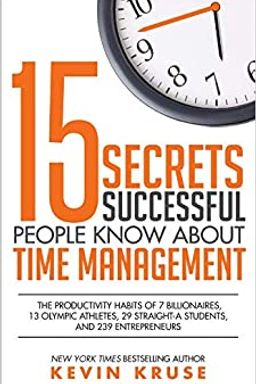
15 Secrets Successful People Know About Time Management cover

15 Secrets Successful People Know About Time Management

by Kevin Kruse

Discover the time management secrets of billionaires, Olympians, and top entrepreneurs. Learn practical strategies to maximize productivity, prioritize effectively, and maintain focus without stress, empowering you to achieve extraordinary results in both work and life.

Master Your Minutes: The Power of 1,440

Have you ever caught yourself saying, “I just don’t have enough time”? In 15 Secrets Successful People Know About Time Management, New York Times bestselling author Kevin Kruse flips that complaint on its head. Through interviews with billionaires, Olympic athletes, and high-performing entrepreneurs, he argues that the most productive people on Earth don’t manage time—they master their minutes. They see time as their most valuable and scarcest resource, and as he reminds readers, each of us has exactly the same 1,440 minutes every day. The secret lies not in working harder or faster, but in changing how you think about time entirely.

Kruse’s journey began with burnout—working eighty-hour weeks, racing through life without purpose, until nearly crashing his car from sleep deprivation. That wake-up call propelled him into studying how truly successful people worked and lived without being overwhelmed. What he discovered runs counter to common productivity advice: the wealthy and accomplished often reject to-do lists, avoid cluttered calendars, and refuse to say yes to most requests. Instead, they center their attention on priorities, consistent habits, and energy.

The Mindset Shift That Redefines Productivity

Kruse’s central idea is that time is not something you can manage—it’s something you can only invest. You cannot create more hours in the day, but you can decide how to allocate the minutes you’re given. This notion—each day as a finite account of 1,440 minutes—forces a radical clarity. While money lost can be earned back, relationships repaired, and health improved, time once spent is irretrievable. That understanding places every decision under a sharper lens: is this minute worth it?

Kruse recounts taping a large “1440” sign to his office door as a reminder of time’s preciousness. At first, employees thought it odd—even cold—but soon the number became contagious company shorthand. Before long, team members began saying, “I can’t waste 10 of my 1,440 on that.” This mental reframe became a cultural transformation—what Kruse calls living with intentional attention. (A similar principle surfaces in Greg McKeown’s Essentialism: success demands distinguishing the vital few from the trivial many.)

From Overwork to Purposeful Action

The book’s backbone is Kruse’s collection of “15 Secrets,” distilled from conversations with high achievers ranging from billionaire Mark Cuban to Olympic gold medalist Shannon Miller. Each secret provides a snapshot of how people who appear to have boundless schedules create space for what matters. They don’t fill every second; they instead protect their time.

For example, Kruse discovered that most successful individuals refuse to work from to-do lists. Instead, they live directly from their calendars, translating priorities into scheduled commitments. They also guard the first hours of their day—their “Magic Hours”—for deep, undistracted work. Time blocking, theming days like Twitter’s Jack Dorsey, and using clear “MITs” (Most Important Tasks) ensures that every minute aligns with purpose. This mirrors Cal Newport’s concept of deep work, where eliminating cognitive clutter leads to focus and results.

Energy Over Time: The True Currency of Performance

Kruse emphasizes that managing energy, not hours, is the ultimate key to high performance. Humans aren’t machines designed for nonstop output—we function best in rhythmic cycles of focus and rest. Drawing on research from Tony Schwartz’s The Energy Project, he explains that the most productive workers pulse between intense effort and deliberate renewal. High achievers cultivate energy through sleep, nutrition, exercise, and meaningful relationships. In other words, productivity isn’t about cramming more work into fewer minutes, but ensuring that those minutes are charged with vitality.

The result is a more humane definition of success—one that balances achievement with peace. Kruse himself, once stressed and divorced, now runs his businesses, writes books, spends time with family, and travels—all, he says, without feeling “crazy busy.” This transformation from overworked to purposeful is what 15 Secrets offers its readers: a roadmap for designing days that honor both productivity and presence.

What You’ll Learn Ahead

Throughout the book, Kruse reveals practical strategies anyone can apply: identifying your single Most Important Task each morning; working from your calendar rather than endless lists; conquering procrastination through “time travel” and accountability partners; leaving the office at 5 p.m. guilt-free; mastering email with his 3-2-1-Zero method; saying “no” to protect your mission; and recharging your energy to multiply your output. Each secret builds toward the final framework he calls the E‑3C System—energize, capture, calendar, and concentrate—a simple yet potent formula for exponential efficiency.

Ultimately, Kruse’s message is not about squeezing productivity from every second—it’s about living intentionally in the time you already have. When you start counting your day in 1,440 precious, nonrenewable minutes, you stop waiting to live and start mastering the moment. That shift, he insists, is where extreme productivity—and genuine fulfillment—begin.


Identify Your Most Important Task (MIT)

In Kruse’s framework, the cornerstone of daily productivity is the Most Important Task—or MIT. It’s a simple but powerful question: What one thing, if accomplished today, would make everything else easier or less necessary? The idea is not to create an endless string of priorities but to identify the single action with the highest leverage toward your long-term goals.

Finding Your “One Thing”

Kruse borrows from both Gary Keller’s The One Thing and management icons like Peter Drucker and Vince Lombardi, who preached “singleness of purpose.” The MIT approach forces you to clarify what truly matters rather than reacting to what seems urgent. Billionaire Mark Pincus, CEO of Zynga, famously spent over half of his work hours directly on product design—his MIT—while avoiding speaking gigs and side meetings that pulled him off mission.

Kruse shows how the same principle scales down: whether you’re a CEO, freelancer, or student, your MIT anchors your energy. For Olympian Briana Scurry, it was asking daily, “Will this activity help me win gold?” For business owners, it might mean focusing on client development instead of administrative minutiae.

Protecting the Golden Hours

Research from Duke University’s Dan Ariely found that most people’s peak cognitive functioning occurs in the first two hours after waking. Kruse urges readers to schedule their MIT during this window—what he calls the “Awesome Hours.” Entrepreneurs like Tom Ziglar and Christina Daves, he notes, guard early mornings for creative work long before checking email or social media. As productivity author Jonathan Milligan puts it, “Do creative work first. Reactive work second.”

In practice, this means resisting the dopamine hit of “busywork.” Avoid starting the day with low-value tasks like inbox clearing or administrative sorting. Those tasks create an illusion of progress while starving your main objectives. The first victory each morning—completing your MIT—creates momentum that carries through the day.

Translating Vision into Action

The MIT principle merges long-term strategy with short-term execution. Once you define your overarching life or business goals, you break them into quarterly and weekly outcomes, finally identifying the day’s one essential step. Kruse writes that this clarity protects you from drifting into others’ agendas. As he warns, “If you aren’t working on your goals, you’re working on someone else’s.”

Identifying your MIT doesn’t mean ignoring everything else—it means sequencing your attention. Kruse suggests writing your MIT each morning, scheduling it as a calendar appointment, and refusing to move on until it’s done. The satisfaction of completion not only raises productivity but, as his research found, correlates with heightened energy and happiness. In a world addicted to multitasking, focusing on one meaningful thing per day may be the most radical—and rewarding—choice you can make.


Live from Your Calendar, Not a To‑Do List

Kruse’s research revealed a shocking truth: traditional to‑do lists don’t work. They create anxiety rather than action. Most people scribble endless wish lists without clear scheduling—what he calls “nagging wish lists.” These lists blur the line between what’s important and what’s quick, so you end up extinguishing easy fires instead of advancing meaningful goals. Studies cited in the book show that 41% of to‑do items are never completed.

The Calendar Mindset

High performers, Kruse discovered, don’t manage from lists. They live from their calendars. As LinkedIn CEO Jeff Weiner and entrepreneur Chris Ducker both attest, “If it’s not scheduled, it doesn’t get done.” Each commitment—whether a meeting, exercise session, or writing sprint—is blocked on the calendar as an appointment with yourself. This technique, known as time blocking, turns intentions into non‑negotiable events.

Olympic gymnast Shannon Miller credits meticulous scheduling for her ability to balance school, training, and public appearances. Her calendar was “almost minute by minute.” Kruse emphasizes that you should treat these entries as sacred—no less important than a doctor’s appointment. When you guard your time this way, you shift from reacting to directing.

Designing the Ideal Week

Beyond daily time blocking, Kruse recommends architecting an “ideal week.” Identify recurring priorities—health, family, focus work—and allocate standing blocks. For example, mornings might reserve an hour for exercise; Mondays could be meeting days, Fridays devoted to reflection. Entrepreneurs like Dave Kerpen even streamline communication by offering a single weekly “office hour” window for external meetings, protecting focus the rest of the week.

Kruse also advises scheduling buffer time. Jeff Weiner purposely leaves 90‑minute gaps daily for thinking and context switching. These empty spaces absorb the unpredictable and prevent burnout.

From Chaos to Clarity

Transitioning from to‑do lists to calendar living offers psychological relief. Research on the Zeigarnik effect shows that unfinished tasks clutter your mind, creating intrusive thoughts. Yet Florida State University studies found that simply scheduling a specific plan eliminates this mental stress—even before completing the task. The discipline of calendaring therefore frees cognitive bandwidth.

To adopt this habit, start by reviewing your priorities weekly, block key tasks into time slots, color code by life domain if helpful, and treat each block as an unbreakable promise. When your week visibly reflects your values, Kruse writes, “you can see your life’s priorities simply by looking at your calendar.”


Defeat Procrastination by Beating Your Future Self

Procrastination, Kruse argues, isn’t laziness—it’s emotional mismanagement. We delay tasks not because we’re idle but because our present self prioritizes comfort over long‑term reward. Drawing on behavioral economics, he explains that humans are time‑inconsistent: what we plan to value tomorrow loses appeal when today arrives. The trick is learning to outsmart your future self.

The Time‑Travel Technique

Kruse’s favorite mental exercise is “Time Travel.” Envision your future self sabotaging your goals, then take preventive actions now. If your future self tends to skip morning workouts, lay out gym clothes beside your bed tonight. If you normally snack unhealthily, stock carrots instead of chips. One friend of Kruse’s even dumps salt on restaurant fries immediately so her future self can’t backtrack.

Rewire Motivation: Pain and Pleasure

Psychologist Tony Robbins teaches that all decisions hinge on avoiding pain or seeking pleasure; Kruse applies this to motivation. When tempted to procrastinate, visualize both the rewards of action and the costs of avoidance. For instance, he imagines the satisfaction of feeling strong after a workout versus the embarrassment of skipping it.

Accountability, Rewards, and “Good Enough”

Other tools include accountability partners—people whose disappointment you fear more than discomfort. Gamifying your habits through rewards (a good meal, leisure time) also nudges momentum. Conversely, apps like StickK let you wager money toward a cause you despise if you fail your goal—a clever form of punishment motivation. Kruse reminds us that perfectionism fuels procrastination. Adopt the mantra “good enough.” Publish the product, send the email, ship version 1.0. As he notes, “Shipped is better than perfect.”

Ultimately, overcoming delay is about constructing systems that align with human nature, not fight it. By predicting the temptations your future self will face, you gain back not just hours of lost work—but trust in your own reliability.


Say No to Gain Freedom

The simplest word in time management is the hardest to say: no. Kruse notes that every “yes” is a hidden “no” to something else—family time, rest, strategic thinking. Yet social conditioning drives us to please, agree, and overcommit. Drawing lessons from Warren Buffett, Steve Jobs, and Olympic athletes, Kruse shows that selective refusal is the multiplier of success.

The Cost of Every Yes

Kruse describes a revealing experiment he calls “Distant Elephants.” He once agreed months in advance to speak at a small college for free, only to later sacrifice lucrative opportunities and even miss his daughter’s play when the commitment arrived. “Small tasks in the distance look harmless,” he warns, “but when they arrive, they’re elephants.” Anticipate the true time and energy each yes demands—preparation, travel, follow‑up—and judge accordingly.

How Billionaires Guard Their Boundaries

Steve Jobs summarized Apple’s success as “saying no to a thousand things.” Warren Buffett echoed, “The difference between successful people and very successful people is that very successful people say no to almost everything.” Kruse extends this rule even to social requests: Facebook COO Sheryl Sandberg leaves at 5:30 p.m. daily for family dinner without guilt.

Scripts for Graceful Refusal

To ease readers’ discomfort, Kruse includes seven polite scripts. For instance: “Thanks for reaching out, but I’m under deadline right now and not taking new meetings.” Or, “My schedule is completely packed; can we connect via email instead?” Another tactic is offering distant availability—“My next open slot is five months out”—which filters only the truly committed. For professional requests, refer contacts to colleagues or resources that can help better than you.

Saying no consistently requires shifting identity from people‑pleaser to protector of priorities. As Olympian Sara Hendershot told Kruse, “Part of being an athlete is getting used to saying no.” In the same way, your success depends not on everything you do—but on everything you decline.


The E‑3C System: Energy, Capture, Calendar, Concentrate

After uncovering patterns across all fifteen secrets, Kruse distilled them into one integrated formula—the E‑3C System. It’s the framework that ties productivity, purpose, and peace together.

Energy: The Foundation

Productivity starts with physical and mental energy. You can’t create more hours, but you can increase stamina. Kruse encourages investment in sleep, nutrition, exercise, and morning rituals that prime your mind for performance. Author Shawn Stevenson (in Sleep Smarter) and Tony Schwartz echo this: energy, not time, is your true currency. Take breaks every 90 minutes to “pulse and pause.”

Capture: Externalize Your Brain

Next, capture everything. Like Richard Branson or Aristotle Onassis, Kruse carries a notebook everywhere to off‑load thoughts, tasks, and ideas. This reduces cognitive load and stress. Capture digitally if needed, but handwritten notes trigger better recall. Your notebook becomes an “external brain” to prevent missed commitments.

Calendar: The Operating System

Calendar everything—MITs, exercise, thinking time. Build theme days and recurring routines. Ensure activities reflect your values: health, relationships, mastery. Treat each block as non‑negotiable. As Kruse notes, “You can see your life’s priorities simply by looking at your calendar.”

Concentrate: Presence and Focus

Finally, dedicate focused attention free from distractions. Turn off notifications, mute devices, and work in defined sprints. The principle mirrors Cal Newport’s Deep Work: success depends on sustained concentration. When energy, capture, and calendar align, concentration follows naturally.

The E‑3C System is deceptively simple yet transformative—a repeatable rhythm that allows you to live deliberately, perform extraordinarily, and still make it home for dinner.

Dig Deeper

Get personalized prompts to apply these lessons to your life and deepen your understanding.

Go Deeper

Get the Full Experience

Download Insight Books for AI-powered reflections, quizzes, and more.