
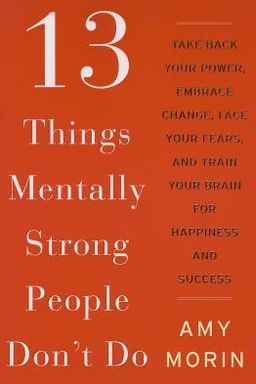
13 Things Mentally Strong People Don''t Do cover

13 Things Mentally Strong People Don''t Do

by Amy Morin

Amy Morin''s ''13 Things Mentally Strong People Don’t Do'' empowers you to harness mental resilience and thrive. Discover practical strategies to manage emotions, embrace change, and turn fears into opportunities for happiness and success.

Choosing Strength Over Self-Sabotage

Have you ever found yourself stuck in habits that keep you from feeling resilient—patterns like overthinking your mistakes, fearing change, or caring too much about what others think? In 13 Things Mentally Strong People Don’t Do, psychotherapist Amy Morin argues that mental weakness doesn’t come from external forces but from the self-defeating habits we internalize. She contends that genuine strength comes not from doing more but from refusing to do certain destructive things—habits that drain emotional energy and block growth.

Morin’s thesis is both simple and profound: if you want to build mental muscle, you must stop performing mental push-downs. Her book is not just about grit—it’s about avoiding thirteen behaviors that erode confidence, clarity, and calm. Each chapter focuses on an unhealthy pattern—like giving away your power, fearing change, resenting others’ success, or expecting immediate results—and replaces it with practical habits that foster mental resilience.

The Heart of Mental Strength

Morin begins with her own story of loss: she lost her mother, her husband died suddenly at twenty-six, and shortly after, her father-in-law was diagnosed with cancer. Instead of collapsing under grief, Morin realized that the only way forward was to stop doing what mentally weak people tend to do—wallow, control the uncontrollable, or give up too soon. She distilled her experiences and therapeutic knowledge into thirteen principles of emotional endurance. Her aim isn’t to deny pain but to respond differently when it arrives.

Mental strength, she writes, comes from the ability to manage thoughts, emotions, and behaviors with purpose instead of reaction. This balance, found through what psychologists call cognitive control, helps you choose rational actions in the face of emotional storms. People who are mentally strong may still feel sad, angry, or scared—but they don’t let those feelings dictate their choices.

Why Focusing on 'Don’ts' Works

Morin’s approach is intentionally counterintuitive. Instead of offering a list of positive habits (like thinking optimistically or staying motivated), she presents what not to do—because negative habits often undermine positive ones. Her metaphor is telling: you can go to the gym every day, but if you eat a dozen donuts on the way home, your progress stalls. In the same way, personal growth is impossible when emotional junk food—the bad habits of resentment, avoidance, and victimhood—fills your mental diet.

By removing these toxic behaviors, you clear space for healthier thoughts and actions. Mentally strong people don’t waste time feeling sorry for themselves, give away their power, or look for approval from everyone. Instead, they cultivate emotional boundaries, rational thinking, and patience for long-term change.

Why It Matters Today

Morin’s work resonates in a world obsessed with speed and perfection. According to her, our culture’s glorification of instant results and external validation fosters mental fragility. We chase happiness, demand comfort, and expect success overnight. But genuine resilience, she argues, comes from doing difficult things—experiencing discomfort, delaying gratification, and making hard choices that align with values even when emotions cry out for the easy way.

Through vivid case studies and real-life examples—like a man forgiving his assailant after paralysis, a teacher starting a cancer nonprofit after tragedy, or a business leader resisting people-pleasing—Morin shows how deliberately not doing something can transform lives. She blends therapeutic insight (drawing from cognitive behavioral therapy) with motivational storytelling, making self-improvement feel both scientific and human.

What You’ll Learn

In this summary, you’ll see how Morin’s thirteen principles unfold into everyday wisdom. You’ll discover why mentally strong people refuse to indulge in self-pity, how they maintain power through boundaries, and how they embrace—not fear—change. You’ll explore why successful people don’t dwell on the past, why they define success on their own terms, and why they never expect life’s rewards to be instant. Each concept builds toward a lifestyle that transforms adversity into strength.

Key Thought

Morin’s message is clear: mental strength isn’t about being tougher—it’s about being wiser. You can’t always choose your circumstances, but you can always choose how to think, feel, and act within them. The more disciplined you become with those choices, the freer you’ll be.

By the end of her book—and this summary—you’ll understand that mental strength is not about perfection or fearlessness. It’s about progress, patience, and persistence in the face of imperfection. Morin’s insights guide you to let go of self-defeating habits, embrace discomfort, and master the subtle art of choosing strength over suffering.


Stop Giving Away Your Power

Morin argues that every time you let someone else dictate your emotions, decisions, or sense of worth, you hand over your personal power. Whether it’s an overbearing boss, a critical parent, or a manipulative friend, giving others too much influence diminishes your autonomy. Her central message: mentally strong people guard their power like a treasure chest.

Recognizing Power Leaks

In the story of Lauren, who allowed her mother-in-law’s criticism to dominate her emotions, Morin shows how resentment and inaction give away control. Lauren’s days revolved around anger at Jackie’s comments—and her energy drained into complaints rather than solutions. Through therapy, Lauren learned to set firm boundaries, curbing visits and calmly enforcing respect. She reclaimed her home and peace of mind.

Each time you modify your behavior only to avoid disapproval, you surrender power. Morin likens this to letting others hold the remote control to your internal world. Reclaiming power means choosing deliberate responses, not automatic reactions fueled by guilt or fear.

Control Your Reactions, Not Others

The most empowering realization? You can’t control how others behave—but you can control your responses. Steven McDonald, a NYPD officer paralyzed after being shot, chose forgiveness over hatred. His story reveals strength in detachment: by refusing to nurture resentment, he kept his emotional power intact. (This echoes Viktor Frankl’s lesson in Man’s Search for Meaning—freedom stands in the space between stimulus and response.)

Language Shapes Power

Morin urges readers to reframe powerless phrases. Replace “My boss makes me so mad” with “I feel frustrated when my boss criticizes me.” The difference may sound subtle, but linguistic control rewires mental authority. You stop blaming emotions on others and start owning your choices.

Forgiveness Restores Autonomy

Choosing forgiveness doesn’t excuse others—it liberates you. Morin summarizes research showing that forgiveness lowers stress, blood pressure, and pain sensitivity. When you let go of grudges, you regain mental bandwidth. Oprah Winfrey’s rise from poverty and abuse to global influence epitomizes this approach: she defined her story and refused to let past cruelty dictate her worth.

Key Thought

You can’t be mentally strong if you’re emotionally enslaved to the approval or criticism of others. Power begins with the phrase, “I choose.”


Don’t Shy Away from Change

Change scares people more than failure. Morin explains that avoidance of change keeps life stuck in ruts of comfort, even when misery grows unbearable. Mentally strong people question that fear and learn to adapt deliberately, because resilience demands flexibility.

The Psychology of Change Avoidance

Richard’s story—an overweight man with diabetes—illustrates how fear of discomfort prevents transformation. He knew what to do: diet and exercise. But change meant surrendering convenience and pleasure. Through gradual goals (like trading cookies for carrots) and support systems, Richard learned patience and persistence. When his fear turned into confidence, his progress accelerated.

Stages of Change

Morin employs the five-stage model (Prochaska & DiClemente): precontemplation, contemplation, preparation, action, and maintenance. Each stage demands different mental muscles—from self-awareness to planning for relapse resistance. Richard’s journey shows how small wins foster readiness for bigger moves.

Facing Fear, Discomfort, and Loss

Change equals loss—and Morin dives into grief psychology to explain resistance. Tiffany, addicted to shopping, wasn’t just afraid of budgeting; she feared losing time with her friends, her identity as ‘the fun shopper.’ Only when she acknowledged the grief behind her spending could she redirect her habits. Andrew, the man afraid of new jobs, overcame stagnation once his fear of debt outweighed fear of new environments.

Embrace Transformation

Mary Deming’s story—a teacher who turned personal losses into a cancer charity—is Morin’s manifesto for proactive change. Pain became purpose when Mary founded Seymour Pink, raising hundreds of thousands for cancer research. Like Mother Teresa’s ripple metaphor, Morin argues that individual change multiplies collective impact.

Key Thought

Change always hurts, but stagnation kills. Always choose growth over sameness—the longer you wait, the harder it becomes.


Don’t Worry About Pleasing Everyone

Morin warns that people-pleasing isn’t kindness—it’s manipulation disguised as generosity. When your happiness depends on keeping everyone else happy, you lose authenticity, purpose, and peace. She teaches how mentally strong people value respect over approval.

Recognizing the Trap

Megan, a woman overwhelmed by endless obligations, realized that saying “yes” to others meant saying “no” to her husband and kids. Her identity as a helper masked a deeper need for validation. Once she learned to say “no” without guilt, her stress evaporated and her relationships improved.

Roots of People-Pleasing

Morin ties this habit to fear of rejection and learned childhood behaviors. Many pleasers grew up believing conflict equals danger. Religious misinterpretations compound this (“love your neighbor” doesn’t mean “neglect yourself”). True compassion, she argues, involves honesty—not perpetual sacrifice.

Consequences of Compliance

Pleasers lose sight of values. Bronnie Ware’s research with dying patients revealed that most regretted living to satisfy others instead of themselves—a poignant warning. Morin uses Angela’s story (a woman who tailored her personality for each date) to show how fake versions of ourselves destroy intimacy. Constant accommodation breeds resentment, not affection.

Building Assertive Confidence

Morin’s practical toolkit: define top five values, pause before saying yes, use short honest refusals, and practice confronting discomfort. Craigslist CEO Jim Buckmaster modeled this perfectly by ignoring critics and running his company by core principle, not popularity. Real integrity means sticking to your values despite dissatisfaction from others.

Key Thought

The need to please is the fear of rejection masquerading as kindness. Live by your values, not someone else’s expectations.


Don’t Feel the World Owes You Anything

Entitlement, Morin writes, is the modern plague: the belief that you deserve success or comfort simply because you’re special or suffered enough. Mentally strong people trade entitlement for humility and gratitude, recognizing that life isn’t fair—and doesn’t have to be—to be meaningful.

Entitlement vs. Effort

Lucas, an MBA graduate convinced he deserved promotions at his new job, embodied this mindset. His arrogance alienated coworkers and stalled his career. Morin helped him reframe entitlement into responsibility: he could learn from peers instead of dismissing them. When Lucas listened instead of lectured, respect followed naturally.

Cultural Roots

Morin draws from Jean Twenge’s Generation Me research, noting that inflated self-esteem, overindulgent parenting, and social media self-promotion breed entitlement. Constant affirmation (“You’re the best!”) teaches superiority without effort. The cure: let humility replace hype.

Focus on Giving, Not Taking

Sarah Robinson’s story—creating “Sarah’s House,” a shelter for cancer patients despite battling terminal illness—illustrates the antidote to entitlement. While others would ask “Why me?”, Sarah asked “How can I help?” Her gratitude and service show that contribution, not compensation, defines worth. (Comparable to Viktor Frankl’s logotherapy: meaning emerges through purposeful giving.)

Humility as Strength

The tale of Wilma Rudolph—overcoming polio to become an Olympic champion—embodies humbleness as empowerment. She never said life owed her recovery; she earned it through discipline. Morin concludes that entitlement blocks empathy, stagnates effort, and steals joy. Gratitude and service restore balance.

Key Thought

The world owes you nothing—but you owe the world your best. Entitlement divides; humility unites.


Don’t Fear Alone Time

Morin reframes solitude as strength, not isolation. In a world that glorifies constant connectivity, mentally strong people embrace alone time to restore clarity, creativity, and peace. The ability to be alone with your thoughts is a superpower in noisy times.

The Silence Crisis

Vanessa’s sleepless nights stemmed from overstimulation—always socializing and working without introspection. Morin advised journaling and meditation, which transformed Vanessa’s racing thoughts into reflection. Within weeks, calm replaced chaos. Studies Morin cites confirm that mindful solitude boosts empathy, productivity, and emotional regulation.

Rediscover Silence

Morin outlines simple habits: turn off screens, walk without music, journal daily. She explains the difference between loneliness and solitude—the former craves attention; the latter cultivates awareness. Mindfulness and meditation thicken brain regions linked to learning and peace. Dan Harris’s panic-attack story (10% Happier) reinforces how mindfulness saves sanity in high-stress careers.

Solitude and Growth

By scheduling a regular “date with yourself,” you practice independence from social validation. Whether through journaling or nature walks, time alone becomes your gym for mental muscle. Wim Hof’s meditative control over his body’s temperature exemplifies solitude’s power to transform physiology and emotion alike.

Key Thought

Solitude isn’t loneliness—it’s leadership. Silence lets you meet yourself, and that meeting is the foundation of mental strength.


Don’t Expect Immediate Results

In the final principle, Morin dismantles impatience. Mental strength isn’t built in a rush—it’s developed through consistent, gradual effort. People who expect immediate results undermine perseverance and turn progress into frustration.

The Impatience Epidemic

Marcy’s relentless pursuit of instant life fixes shows how speed culture poisons satisfaction. She wanted therapy, success, and happiness fast, but each shortcut failed. Only when she accepted slow progress did change stick. Morin compares this to fitness—the muscles don’t grow after one workout, only after daily discipline.

Delay Gratification

Research supports Marcy’s revelation: self-control predicts success better than IQ. Those who resist quick rewards gain wealth, health, and wisdom. Morin’s portrait of James Dyson—who spent five years refining a vacuum prototype—illustrates the victory of persistence over haste.

Sustainable Patience

Progress often hides behind frustration. Morin advises celebrating milestones, pacing your energy, and creating flexible expectations. Her insight: most goals fail not from lack of skill but lack of patience. Enduring discomfort is the price of transformation.

Key Thought

Quick success breeds shallow growth. Mental strength thrives in long timelines. Wait well, work wisely, and results will come.

Dig Deeper

Get personalized prompts to apply these lessons to your life and deepen your understanding.

Go Deeper

Get the Full Experience

Download Insight Books for AI-powered reflections, quizzes, and more.