
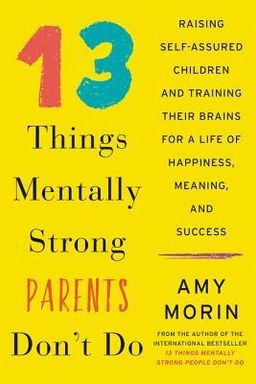
13 Things Mentally Strong Parents Don''t Do cover

13 Things Mentally Strong Parents Don''t Do

by Amy Morin

Amy Morin''s ''13 Things Mentally Strong Parents Don''t Do'' empowers parents to raise resilient, self-assured children. By avoiding common parenting pitfalls, you can foster mental strength, emotional intelligence, and responsibility in your children, preparing them for a successful future.

Raising Mentally Strong Children

How do you raise a child who can thrive in an uncertain world without collapsing under pressure or expecting rescue from every hardship? In her practical and research-based book, Amy Morin (known for 13 Things Mentally Strong People Don’t Do) argues that building mental strength in children requires parents to avoid the emotional traps that weaken resilience—overprotection, guilt, overindulgence, and perfectionism. Morin contends that the goal is not to create perfectly happy children but capable ones, able to tolerate discomfort, self-regulate, and handle life’s inevitable challenges.

Rather than teaching kids to fear pain or depend on others, you teach agency, accountability, and empathy. This mindset shift—from rescuing to coaching, from protecting to preparing—reshapes your daily parenting habits. In each chapter, Morin introduces families such as Cody, Brittany, and Kylie, whose struggles with victimhood, entitlement, and perfectionism reveal how parental emotions, not just rules, determine children’s long-term resilience.

Core Argument: Strength Grows Through Challenge

Morin’s central thesis is that mental strength is learned. When you shield children from hardship or take on their responsibilities, you accidentally send the message that they are incapable. Each chapter exposes a common trap—from guilt to fear to perfectionism—and offers corrective habits that reintroduce responsibility, limit-setting, and emotional autonomy. She emphasizes that growth requires discomfort, so your task is not to remove pain but to help your child handle it safely.

In this sense, the book builds on both psychological research (Seligman’s work on learned helplessness, the Stanford marshmallow experiments on self-control) and practical cognitive-behavioral tools (identifying “BLUE thoughts,” using exposure ladders for fear). It’s a parenting manual and a mindset re-education: your emotions as a parent—fear, guilt, pride—shape your child’s beliefs about control and competence.

The Role of Parental Emotions

Morin argues that the greatest obstacle to raising mentally strong kids isn’t a lack of love—it’s emotional mismanagement by parents themselves. Guilt leads to indulgence; fear produces overprotection; perfectionism breeds anxiety; and rescuing results in dependence. Each of these parental impulses stems from good intentions: you want your child to feel happy and safe. But when those emotions shape parenting decisions, they disable rather than empower your child.

For example, Joe’s guilt over his son Micah’s unhappiness led to overfeeding and health issues. Anna’s fear led to micromanaging her daughter Zoey’s life until Zoey lost independence. Nadine’s perfectionism pushed Kylie into emotional breakdowns over minor imperfections. In every case, the cure was not harsher control, but emotional recalibration—parents learning to tolerate their own discomfort as children face growth moments.

From Control to Coaching

Morin reframes parenting as coaching rather than control. A coach gives instruction, models skills, sets boundaries, and allows players to act and fail. You are a mentor, not a manager. Instead of making every decision or shielding your child from all missteps, you teach strategies—emotional labeling, problem-solving, perspective-taking—and then step back. This coaching approach shows up in tools such as “Grandma’s Rule” (“You can play after you finish your chores”) and “fear ladders” (breaking down anxiety-inducing tasks into manageable steps).

The benefit of this model is that it keeps you emotionally available while maintaining authority and structure. You don’t blame, lecture, or micromanage; you guide. This balance between warmth and boundaries—what developmental psychologists call authoritative parenting—fosters responsibility and confidence.

Cultural Commentary: The Trap of Victimhood and Overvaluation

Morin warns that today’s culture often rewards fragility and self-focus. In victimhood culture, grievances gain more attention than problem-solving, and social media magnifies comparison and emotional dependence. Similarly, overvaluing children—making them the center of a family—can produce entitlement and narcissism. The antidote is balance: love with limits, generosity with responsibility, and praise tied to effort and character rather than outcomes or uniqueness.

The stories of families like Carol and Tom, who re-centered their parenting around contribution and empathy rather than indulgence, highlight how children flourish when expected to give as well as receive. Responsibility, gratitude, and compassion work together to keep confidence grounded.

Building Blocks of Mental Strength

Across the book’s chapters, Morin maps a progression from self-awareness to self-regulation to responsibility:

  • Reject the victim mentality—teach agency and reframing.
  • Parent without guilt—lead with reason, not emotional relief.
  • Avoid overprotection—replace fear-based control with skill-based confidence.
  • Encourage responsibility through natural consequences and chores.
  • Let pain teach resilience—honor feelings without distortion.
  • Model emotional and ethical integrity—your consistency shapes theirs.

Morin’s consistent message is that strength is built in the small moments: when you resist rescuing, when you enforce a limit, when you allow a child to try, fail, and recover. The process requires patience and self-regulation from you first. As the author notes, mentally strong parents aren’t perfect—they just refuse to let emotion or convenience dictate their parenting.

Essential Takeaway

Raising a mentally strong child begins with being a mentally strong parent. Strength means saying no when guilt says yes, letting go when fear says protect, and coaching instead of controlling. Your composure and consistency become the blueprint your child uses for lifelong resilience.


Reject Victimhood and Foster Agency

Morin begins by dismantling the victim mentality that erodes children’s motivation. She uses Cody’s story—a boy with ADHD whose parents treated his diagnosis as a lifelong handicap—to illustrate how framing challenges as fate teaches helplessness. Instead of saying, “He can’t help it,” his parents later reframed ADHD as a challenge Cody could manage through strategies. That subtle change in narrative reignited his effort and confidence.

How Victimhood Forms and Spreads

Victimhood develops when families repeatedly interpret problems as things that happen “to us” rather than things we can influence. Sociological studies on “victimhood culture” show how online outrage or constant grievance-seeking turn powerlessness into a social currency. Leanne’s children, warned constantly that the world was “mean,” stopped seeking help and internalized passivity. Parents model this mindset through language—phrases like “Why does this always happen to us?” reinforce frailty rather than agency.

Reversing the Pattern

To reverse helplessness, Morin teaches “BLUE thoughts”—patterns of Blaming, Looking for bad news, Unhappy guessing, and Exaggerated negativity. When you hear your child catastrophizing (“I’ll never get this right”), guide them through reality-testing: Is this true? What can I control here? The replacement of distorted thoughts with specific actions (study differently, ask for help) retrains problem-centered thinking.

  • Model agency through your self-talk—replace “why me” with “what next.”
  • Start conversations with gratitude or positive moments before complaints.
  • Give choices early and use unstructured play to promote fairness negotiation.

Essential Message

Agency is learned, not inherited. Each time you help your child find a controllable action, you build the belief that circumstances can be influenced—not endured.


Parent Without Guilt or Indulgence

Guilt is an emotion with good intentions but poor judgment. Morin shows how parents like Joe use food, gifts, or rule-bending to soothe guilt, creating long-term harm. She distinguishes among appropriate guilt (a signal to repair), unnecessary guilt (feeling bad for the uncontrollable), and chronic guilt (an identity of inadequacy). The task is to discern which you feel—and act accordingly.

Breaking the Guilt Cycle

When guilt dictates decisions, you prioritize immediate emotional relief over the child’s actual needs. Joe apologized through snacks; parents under chronic guilt apologize through leniency or overinvolvement. Morin suggests a four-question framework: Did I cause harm? Can I change it? What action corrects it? Should I make amends? Only when guilt corresponds to a changeable harm should you act behaviorally; otherwise, reframe and forgive yourself.

Teaching Healthy Guilt to Children

Rather than shielding children from guilt, Morin encourages guiding them to use guilt constructively, like a moral compass. Use simple metaphors (“shoulder angel and devil”) to discuss inner guidance. Praise efforts to repair—returning a borrowed toy, saying sorry—but avoid “you’re bad” labels that create shame. Teens especially need boundaries against guilt-based manipulation (“I feel bad you’re upset, but this rule stands”).

In practice, embracing the “good enough parent” mindset (from Donald Winnicott) means accepting imperfection. Mistakes are data, not debts. When you model self-compassion, your child learns to handle rules and failure without resentment or emotional blackmail.


Balance Love With Limits and Authority

Morin’s midsection focuses on balance—between warmth and control, empathy and authority. In modern parenting, two distortions arise: overindulgence and permissiveness. Brittany, the “miracle child,” was adored without accountability; Clarissa controlled her parents through threats. Both demonstrate what happens when children misunderstand power dynamics. Love without boundaries breeds disrespect; lack of authority breeds chaos.

Dangers of Centering the Child

Brittany’s story shows that catering to a child’s every want undermines empathy. Sociological studies confirm that inflated praise fosters entitlement rather than motivation. To restore balance, parents must encourage contribution—chores, gratitude rituals, perspective-taking—so that children see themselves as part of a relational web, not the center of it.

Reclaiming Parental Authority

Clarissa’s manipulation through emotional threats reveals the high cost of power shifts. Morin advocates an authoritative model: firm rules paired with empathy. You define the family’s structure (“bedtime is 9 PM”) but allow limited choices within it. Avoid negotiations about nonnegotiable issues and use consistent consequences instead of verbal battles. This restores psychological safety—a clear hierarchy where everyone’s role is known and respected.

Key Point

Children thrive under leaders, not appeasers. The combination of structure, warmth, and consistency helps them respect others’ needs while trusting your guidance.


Transform Fear Into Courage and Competence

Parental fear, made worse by 24-hour news and social media, often masquerades as caution. Morin differentiates protective love from fear-based control. Anna’s strict routine, meant to ensure safety, instead stifled daughter Zoey’s growth. The antidote to fear is exposure paired with coaching—showing that discomfort is survivable.

Where Fear Comes From

Modern information overload heightens threat perception. Morin advises recalibrating risk by asking, “What are the actual odds, and what are the costs of prevention?” Avoidance may seem safer but breeds dependence. Teach safety skills—swimming, street awareness, communication—so your child learns capability, not fragility.

Fear Ladders and Realistic Assessment

A “fear ladder” introduces anxiety exposure gradually—a tool rooted in cognitive-behavioral therapy. If a child fears sleeping alone, you start with proximity and build toward independence. Teach children to differentiate real danger from discomfort: “Is this unsafe or just unfamiliar?” Such metacognition builds courage and reduces chronic anxiety.

Practical Wisdom

When you let experience, not avoidance, be the teacher, you raise children who handle uncertainty with reason instead of fear.


Let Pain and Mistakes Build Resilience

Morin reframes pain, loss, and mistakes as essential teachers. Shielding children from disappointment or failure, as in Julie’s attempt to hide her divorce pain or Addie’s mother’s secrecy about illness, only amplifies fear. The book’s mantra is that pain is information. When handled honestly and supported, discomfort becomes resilience training.

Let Experience Teach

Parents like Maria or Veronica learned that constant reminders or control destroyed initiative. Stepping back allowed kids like Taylor and Zack to fail safely—and then recover. Natural consequences (missing practice, forgetting homework) teach accountability far more effectively than lectures. The key is letting failure happen inside a scaffold of support.

Coaching Through Pain, Not Avoiding It

When a child faces grief or stress, resist the urge to soften every edge. Offer truth in age-appropriate doses and help them name feelings rather than escape them. Addie’s anxiety improved only when her mother explained what diabetes actually meant. Morin also models this with emotion coaching—labeling, validating, teaching coping tools (deep breathing, journaling, reframing).

Each resolved challenge adds a “coin” to the resilience piggy bank. By late adolescence, children who’ve practiced handling pain have both perspective and problem-solving stamina. Protect from trauma, not from trial.


Cultivate Responsibility and Persistence

Mental strength requires responsibility in both actions and effort. Morin shows that doing everything for your child—laundry, schoolwork, excuses—creates learned dependence. Chris, at twenty-five, still needed his parents because he’d never practiced accountability. The cure was clear expectations, chores, and natural consequences that tied results to behavior.

Natural Consequences as Teacher

Allowing reality to teach safely is powerful. If Zack forgets shoes for gym or fails a test, those outcomes speak louder than lectures. Your role is coach, not accomplice. Inconsistent enforcement or rescuing halts learning. Pair this with explicit instructions (“bed made, floor vacuumed, clothes in hamper”) so responsibility feels clear, not abstract.

From Shortcuts to Persistence

Parents often take shortcuts—giving in, completing chores, avoiding conflict—to reduce tension. But that models avoidance, not perseverance. Instead, Morin invites you to restore your child’s stamina through clear routines, small goals, and persistence tools. Use the “Batman effect” (pretend-play with a resilient alter ego) to enhance effort. Encourage delay of gratification and emphasize process over product.

Lesson

Responsibility and persistence are strengthened by consistency. The parent’s job is to make effort habitual—not to remove effort’s necessity.


Model Emotional Intelligence and Core Values

The final step in raising mentally strong kids is integrity—emotional, behavioral, and moral. Grace’s parents learned that rescuing her from every upset prevented emotional maturity. Similarly, Kyle’s parents learned that celebrating grades over honesty taught deceit. Children internalize what you model, not what you declare.

Teaching Emotional Ownership

Begin by teaching your child to identify feelings (“frustrated,” “nervous”) and manage them with calming tools. Validate emotion but not misconduct (“You can be angry, but not hit”). As children differentiate between internal states and external choices, they learn emotional independence. This moves them from seeking control over others to self-regulation.

Living Your Values

Morin urges families to articulate a short mission statement—what matters most. Discuss ethical dilemmas openly: loyalty versus honesty, comfort versus courage. Use praise aligned with values (kindness, persistence) instead of status metrics. When Kyle’s family prioritized integrity over GPA, he learned that self-worth comes from who you are, not what you score.

Conclusion

Emotional ownership and moral clarity turn strength into character. Mentally strong children grow into adults who contribute, empathize, and make ethical choices even when no one is watching.

Dig Deeper

Get personalized prompts to apply these lessons to your life and deepen your understanding.

Go Deeper

Get the Full Experience

Download Insight Books for AI-powered reflections, quizzes, and more.