
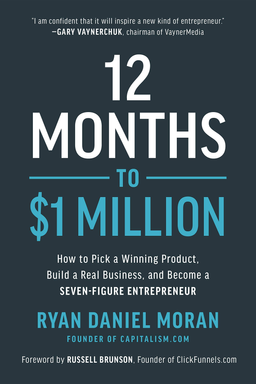
12 Months to $1 Million cover

12 Months to $1 Million

by Ryan Daniel Moran

Discover the roadmap to becoming a seven-figure entrepreneur with ''12 Months to $1 Million.'' This guide offers pragmatic strategies and wisdom for transforming your passion into a million-dollar business, focusing on understanding your audience, mastering funding, and scaling effectively.

The 12-Month Path to Freedom and a Million-Dollar Business

Have you ever wondered why some entrepreneurs build million-dollar businesses while most struggle for years without real traction? In 12 Months to $1 Million, Ryan Daniel Moran proposes a clear, practical, no-nonsense roadmap to turn entrepreneurial drive into measurable results. He argues that success isn’t about luck, capital, or chasing trends—it's about following a focused process built on mindset, audience, product, and execution. Moran’s bold promise: if you commit to his method, you can go from zero to a million-dollar business within one year.

At its core, the book is about freedom. Moran sees entrepreneurship as a life calling, not a quick hustle. He contends that true wealth comes from creating something valuable for others, nurturing it through disciplined action, and building systems that can live without you. The twelve-month transformation he lays out combines timeless entrepreneurial principles with tactical, step-by-step methods for modern online business—especially brand-based e-commerce via Amazon and social media.

The Formula for Your First Million

Moran breaks down what initially seems impossible into a simple formula. If you sell three to five products at an average price of $30, and each sells twenty-five to thirty units per day, you’re running a million-dollar business. Those numbers make entrepreneurship tangible. Gone is the overwhelming idea of scaling a huge company—replaced with realistic milestones and habits that compound over twelve months. He emphasizes that while this math looks easy, the journey requires perseverance, sacrifice, and a willingness to iterate through what he calls “The Grind.”

Freedom, Sacrifice, and The Entrepreneur’s Life Sentence

Before diving into tactics, Moran insists on understanding what entrepreneurship truly demands. Borrowing from Dan Sullivan’s idea that being an entrepreneur is “a life sentence,” he warns that starting a business means long hours, self-doubt, and emotional chaos—but also unmatched satisfaction. His own story of selling his fitness brand, Sheer Strength, for $10 million reveals freedom beyond money. For Moran, entrepreneurship is an adventure of transformation—where you become stronger, wiser, and more self-reliant. This emotional honesty aligns him with authors like Tim Ferriss (The 4-Hour Workweek) and Robert Kiyosaki (Rich Dad Poor Dad), who reframe financial freedom as self-determined living.

Why Now Is the Best Time in History

The opening chapters explain the unique landscape of opportunity in today’s digital economy. Tools like Amazon FBA, Shopify, Kickstarter, Facebook, and Instagram empower everyday creators to sell directly to customers, bypassing traditional gatekeepers. Moran shows how monopolies of distribution have collapsed—big brands can’t innovate fast enough—and small, nimble entrepreneurs are taking over markets. The examples of Suzy Batiz (Poo-Pourri), Peter Rahal (RXBAR), and Dave Asprey (Bulletproof Coffee) demonstrate that micro-brands with loyal audiences often outperform legacy corporations. Moran urges readers to think small first—serve a specific person with a specific problem—then let that niche snowball into mainstream success.

The Ten-Step Blueprint

Throughout the book, Moran structures the twelve-month journey around ten steps: choosing your customer, developing your first product, funding your business, stacking the deck (pre-launch marketing), launching, growing to twenty-five sales a day, building a brand, scaling to $100k per month, putting it all together, and finally, securing your big payday. Each step represents a stage of evolution—from figuring out who you serve to creating systems that serve you. He divides the year into three phases: The Grind (months one to four), The Growth (months five to nine), and The Gold (months ten to twelve). Most entrepreneurs fail in The Grind because they expect ease rather than endurance; Moran’s method is designed to push through that wall.

Mindset and the Power of Ownership

A recurring theme is psychological resilience. According to Moran, entrepreneurship begins with taking ownership—over your results, your circumstances, and your emotions. He shares a deeply personal story from his childhood about rejection and loneliness, showing how pain can become fuel for success. Entrepreneurs, he observes, often carry chips on their shoulders—they’re driven to prove something. The richest lesson: every setback is raw material for growth. This mindset mirrors Carol Dweck’s concept of “growth mindset”—and Moran reframes it with entrepreneurial grit: “No one is coming to save you; build something and save yourself.”

Business as a Human Game

Perhaps Moran’s most refreshing idea is that entrepreneurship isn’t a numbers game—it’s a people game. In his formula, metrics matter, but customer relationships matter more. Every purchase, review, and interaction can multiply your momentum exponentially. Businesses that treat customers as humans—not transactions—build brands with staying power. He equates good business with value creation rather than value extraction. “Stop thinking about how to get your slice of the pie,” he writes. “Start baking more pies.” Prosperity flows to those who create genuine value.

The Deeper Promise

While the title may sound like financial clickbait, Moran’s message runs deeper: building a million-dollar business is only the beginning. The real wealth lies in the person you become through the pursuit. At the end of the twelve months, you’ll not only understand business mechanics—you’ll stand as a self-sufficient creator who can repeat the process again and again. “Freedom isn’t free,” he reminds readers. “But it’s worth every ounce of work.” This book doesn’t promise ease; it promises transformation. Moran’s tone is both practical and philosophical, merging step-by-step tactics with the journey of becoming the hero of your own adventure.


Choose Your Customer First

Ryan Moran begins the first tangible step with a counterintuitive truth: your business doesn’t start with a product—it starts with a person. Too many entrepreneurs ask, “What should I sell?” when the right question is, “Who should I serve?” This shift from products to people turns hustlers into brand builders. Your million-dollar business begins when you clearly define your ideal customer and design everything—products, messaging, and community—around their needs and identity.

From Suzy Batiz to Poo-Pourri: The Power of Customer Identity

Moran illustrates this principle through Suzy Batiz’s story—the founder of Poo-Pourri. Batiz was bankrupt twice before discovering her breakthrough idea: a bathroom spray that eliminates odor before it starts. Her initial sales were slow, until she realized her true audience wasn’t men or households in general—it was women mortified by embarrassment. By aligning her brand with female empowerment and humor, she created viral success through a cheeky video (“You wouldn’t believe the motherload I just dropped!”). Batiz’s pivot transformed a novelty product into a multi-hundred-million-dollar brand. The lesson: when you know who you’re speaking to, everything clicks.

People Create Brands, Not Products

A brand, Moran asserts, is not a logo—it’s trust. It’s an expectation that the customer will be happy with their purchase. That trust forms when you create a suite of products serving the same person. Instead of chasing trends (fidget spinners, anyone?), you build longevity by developing items for one community. For example, if you target yoga enthusiasts, you could start with a mat, then add towels, blocks, and accessories—all delivering value along their journey. Moran and his partner Sean used this strategy for their first yoga brand, Zen Active, which began with a mat shaped by user feedback collected from real yoga practitioners at coffee shops and studios in Austin, Texas.

Scratch Your Own Itch

One of Moran’s favorite pieces of advice to new entrepreneurs is to start with what you know. The easiest person to serve is someone like yourself. He and his partner Matt created Sheer Strength because they personally wanted clean, effective supplements without the junk found in other products. Likewise, Hanny Sunarto built NeatPack travel bags after one broke on a trip—her engineering background helped her design a better version. The golden rule: if you experience the problem, you already understand the customer intimately.

Ask Foundational Questions

To nail this phase, Moran offers seven foundational questions: Who are you selling to? What products do they already buy? Which one can you improve or make special? What do they dislike about current options? Where do they congregate? How will you make predictable sales? What will products two, three, and four be? These questions move you from “idea” to structured business. Once answered, you’ll know how to design offerings that make sense together—and how to communicate directly to those most likely to care.

Key Takeaway

Every successful entrepreneur starts by serving a specific person, not everyone. Find that one customer whose identity, struggles, and goals you truly understand. Products will naturally follow.


Develop Your First Product

After identifying who you serve, the next challenge is bringing your idea to life. Developing your first product is where creativity meets testing. Moran insists you don’t need factories, designers, or huge investments—only focus, curiosity, and willingness to iterate. He encourages entrepreneurs to think of product creation as refinement, not invention. Success rarely comes from creating something entirely new but from solving existing frustrations for specific customers.

Start Small, Think Smart

Moran’s childhood story about dreaming of a “barking yo-yo” illustrates an early spark of entrepreneurial thinking—the imagination that anything can be built if you find the right supplier. When he and Sean built Zen Active, they used Alibaba to find manufacturers abroad, ordered inexpensive samples, and tweaked based on feedback. Field testing meant asking real yoga students what they disliked about their existing mats—things like thickness, texture, and strap durability. For $50 in sample orders, they created a mat superior to most on Amazon.

Refinement Over Perfection

Perfection paralysis kills progress. Moran urges entrepreneurs to launch before they feel ready. He cites Peter Diamandis’s quote: “If you’re not embarrassed by your first version, you’re moving too slow.” Your first iteration should test assumptions, not chase perfection. Freedom in business comes from shipping quickly and adjusting later. For example, Native Deodorant founder Moiz Ali began with a $500 prototype, sold small batches, gathered complaints, and refined his formula until reviews improved from 4 to 4.7 stars. Two years later, he sold his company to Procter & Gamble for $100 million.

Listen, Test, Repeat

According to Moran, a good product answers three questions: Did customers like it? Did they buy it again? Did they tell others? That’s why split testing and feedback loops matter. He shares how entrepreneur Travis Killian surveyed shoppers at malls to compare his product with competitors. Simple A/B testing—showing two options and asking “Which one do you prefer?”—unlocked design tweaks that doubled conversion rates. Moran recommends testing labels, packaging, and even product names this way. You learn more by listening to real people than by guessing in isolation.

Keep Inventory Simple and Manageable

Your goal is to prove concept fast, not manage warehouses. Moran suggests starting with between 100–500 units using contract manufacturers who allow small runs. Place your orders early to avoid running out of stock—“being out of inventory is like being out of business.” Once you have consistent sales, you can scale orders, negotiate better terms, and stabilize supply chains. His mantra: progress over perfection. A simple product, well communicated and refined by feedback, beats a complicated idea stuck in development.

Key Takeaway

Build fast and fix later. Launch scrappy, listen, refine, and repeat. Creativity in entrepreneurship isn’t invention—it’s iteration.


Fund Your Business Wisely

Money doesn’t make entrepreneurs—but it amplifies them. Moran teaches that funding a business is about resourcefulness, not riches. You don’t need venture capital or a trust fund to start. Most million-dollar brands begin with less than $10,000. The real challenge isn’t starting costs—it’s keeping inventory when growth accelerates. He gives clear rules on bootstrapping, raising capital, and using debt effectively.

Bootstrap Until You Prove Sales

Moran and his partner Matt funded Sheer Strength’s first order with just $600—100 units at $6 each. Once sales took off, they reinvested all profits into the next batch. This cycle of reinvestment built momentum without relying on outside money. He reinforces the principle that money follows movement. Don’t seek investors until your product is selling. The entrepreneurs investors love are already in motion, not those asking for rescue funding.

Know the Difference Between Good and Bad Debt

Not all debt is created equal. Moran calls debt an amplifier: good debt creates ROI; bad debt drains it. Borrowing to buy assets or inventory that predictably bring profit is smart. Borrowing for lifestyle inflation—cars or offices—is foolish. He quotes investor Daymond John’s advice: wait until you have predictable sales before borrowing. This philosophy echoes Robert Kiyosaki’s “good debt for productive assets.” Moran shares AJ Patel’s story—a young entrepreneur who launched a natural skincare line and used $40,000 in credit card debt to fund inventory. Because his sales were steady, he turned that debt into seven figures within thirteen months.

Get Access to $10,000 Early

Moran suggests securing access to at least $10,000—via savings, credit, or investors—to bridge inventory gaps once demand surges. You might never need it, but having that buffer keeps momentum alive when order cycles overlap. He emphasizes thinking like a producer—just as film producers raise funds and hire talent instead of writing scripts themselves, entrepreneurs orchestrate resources. You’re not borrowing to gamble, you’re borrowing to keep your gears turning.

Alternatives: Investors and Crowdfunding

If bootstrapping isn’t enough, Moran outlines two paths: raise capital through investors or crowdfund through platforms like Kickstarter. He explains how Sophie launched an eco-friendly lunchbox and raised $25,000 via Kickstarter using nothing but an iPhone video, ten supportive friends, and one Facebook group. Crowdfunding builds not just cash, but committed customers. To pitch investors, Moran stresses asking for advice, not money. “Here’s the momentum we have—how would you fund this if you were me?” opens doors faster than begging for checks.

Key Takeaway

You don’t need deep pockets to build a million-dollar business. Bootstrap first, borrow strategically, and remember—capital amplifies movement, not replaces it.


Stack the Deck Before You Launch

Launching a product isn’t about hoping for sales—it’s about engineering momentum. Moran’s “stack the deck” strategy ensures people are ready to buy the moment your product goes live. This pre-launch phase bridges the wait between ordering inventory and your first sale. Done right, it transforms anxiety into confidence.

Build Anticipation Like Big Brands

When Moran’s yoga mats were stuck in transit for eight weeks, he turned the delay into opportunity. He launched an “I Love Yoga” Facebook page and invited yoga fans to join the conversation. By sharing updates, photos, and product testing stories, he created emotional involvement. This built a small but responsive community of 3,000 followers—and when launch day came, they felt ownership. The result: fifty sales immediately, fifty more the next day, and momentum that snowballed into consistent growth.

The Formula for Guaranteed Sales

  • 1,000 followers who care about your topic
  • 10 personal contacts helping spread the word
  • 1 micro-influencer endorsing your launch

According to Moran, this mix often results in at least 100 sales on your first day—enough to hit customer traction quickly. Examples include Roxelle Cho’s Fused Hawaii swimwear and Jenna Zigler’s dry-eye remedy. Both sold out early because they nurtured a small, passionate audience and created emotional excitement around their mission.

Hot Lists and Early Engagement

Another key tool is the “hot list”—a private group of early buyers eager to purchase first. By posting limited-supply updates like “Comment ‘I want one’ to reserve,” Moran created urgency and belonging. These posts converted passive followers into committed customers. He also recommends moving hot leads to email lists or private groups to deepen engagement. It’s a psychological trigger: exclusivity drives purchase intent.

Social Proof and Emotional Connection

The pre-launch phase isn’t just marketing—it’s storytelling. Document your product creation, acknowledge imperfections, and share lessons. When customers witness your journey, they root for you. This approach blends Gary Vaynerchuk’s philosophy of “give, give, give, ask” with Moran’s idea that every entrepreneur must build empathy before asking for sales. Launching isn’t a transaction—it’s a relationship milestone.

Key Takeaway

Before your product goes live, build a community that’s ready to buy. Selling starts long before launch day—it begins with attention, trust, and anticipation.


Turn Early Sales into Momentum

Once you’ve launched, the real test begins: turning initial excitement into sustainable growth. Moran calls this phase “The Growth,” where the goal is twenty-five consistent sales per day. It’s the tipping point between hustling and owning a machine. Beyond marketing tricks, growth is about relentlessly serving customers and listening for feedback.

Every Sale Matters

Moran insists that early entrepreneurs personally connect with every buyer. Send thank-yous, reply to reviews, and celebrate customer wins. When he sold supplements at Sheer Strength, he called repeat buyers and asked what they loved or wanted improved. Those conversations revealed that business success is human-made—one conversation at a time. “Respond to every comment, screenshot every review, and celebrate every milestone,” he says. Each small act compounds into long-term loyalty.

The Review Machine

Consistency requires validation. Moran explains that around twenty-five reviews can double sales, and one hundred reviews solidify authority. Feedback is fuel. Treat reviews as relationships, not transactions. Instead of begging “Please review,” offer help first—“Did your order arrive on time?”—then follow with gratitude and a small gesture, like a coupon or credit. Customers respond favorably to generosity and authenticity. As Ryan puts it, “Always go for the give.”

Simplify When You Feel Stuck

It’s typical to plateau around ten sales per day. At this stage, Moran advises not to complicate things with new funnels or strategies—go smaller instead. Focus on one-to-one engagement. Ask yourself, “Who can I surprise today?” or “How can I make my next ten customers rave about me?” When you master micro-interactions, macro-success follows. This echoes Jeff Olson’s slight edge principle: small, consistent actions compound into extraordinary results.

Adapt, Advertise, and Serve

To scale past the hump, Moran suggests three levers: Amazon PPC ads, video marketing, and community re-engagement. Ads help visibility, videos humanize the brand, and communities reignite emotional connection. He tells the story of Marvin Lee, a nurse who turned a side hustle into a yoga recovery product. By messaging customers directly and refining his offer, Marvin built trust that outlasted copycats. The message: momentum comes from caring more than competitors.

Key Takeaway

When growth slows, don’t scale harder—serve deeper. Brands that listen win. Treat every sale as an opportunity to build a fan, not a transaction.


Build a Real Brand, Not Just Products

After reaching steady sales, Moran pivots from product-building to brand-building. A brand isn’t just what you sell—it’s what your customers believe about themselves because of you. A good product makes money; a good brand makes movements. When you create a portfolio that guides one type of customer through their journey, you move from small-time to scalable.

Why Second Products Matter

Your second product defines who you are as a company. Moran explains that once Sheer Strength hit twenty-five sales a day, launching product two didn’t split attention—it multiplied sales. Repeat buyers bought both products, bundles formed, and even Amazon’s algorithm began cross-promoting them. “Three to five products at twenty-five sales a day equals one million,” he reminds. Each new release boosts the others through reciprocity.

Become a Company with a Purpose

To avoid stagnation, define what your business stands for. Are you just selling coffee—or empowering high performers like Bulletproof? Are you just making journals—or helping people reach goals like BestSelf Co.? Moran urged Cathryn Lavery to shift from journaling to productivity, leading her company to expand into new tools and hit seven figures faster. Your brand must solve a deeper emotional or aspirational problem.

Competition and Collaboration

Instead of fearing imitation, embrace cooperative competition. Moran recalls Tom Bilyeu of Quest Nutrition, who said competitors are inevitable—your edge is staying one step ahead. Competition validates your market and spreads awareness. A rising tide raises all boats. Moran encourages partnerships with complementary brands, sharing audiences to multiply influence.

The Snowball of Trust

Brands thrive on trust. Each product release accelerates momentum, just like compounding interest. Repeat customers become evangelists, sharing word-of-mouth reviews that money can’t buy. That’s why Moran calls branding “Stage Three: The Gold.” It’s financial success wrapped in emotional connection—the moment when customers buy not just what you sell, but who you are.

Key Takeaway

A million-dollar business is built on trust across multiple products. Serve one person consistently, expand their options, and you’ll never run out of customers.


Scale, Sell, and Redefine Success

Reaching seven figures is impressive, but Moran reminds readers that money isn’t the finish line—it’s the beginning of new choices. Once your business makes around $100,000 per month, you stand at a crossroads: scale the company or sell it. Either path teaches you new dimensions of leadership, wealth, and meaning.

The $100k Per Month Milestone

At this level, Moran allows entrepreneurs to finally pay themselves. Until now, profits belong to the business; taking money too early starves growth. But crossing $100k monthly revenue proves sustainability. This milestone means your brand is a machine—predictable, profitable, and ready to run without you. Yet, ironically, that’s when most entrepreneurs feel lost, just as Moran did after his first million: “I expected colors to be brighter, but it was just a number.”

Deciding When to Sell

The best time to sell is when your systems are humming and buyers notice. Moran shares how Mark Sisson sold Primal Kitchen to Heinz for $200 million, proving small health brands can disrupt giants. When you negotiate, remember: you hold the cards. You’re the hot property at the party. He cautions against selling for vanity metrics or quick paydays. Ideal deals happen when you’ve built a strong foundation and want to scale further under new leadership.

Think Long-Term: Avoid the Big Company Trap

Many buyers of Moran’s own business tried to “professionalize” operations, hiring executives and ignoring customer engagement. Sales fell because they lost connection. “Big companies think too big,” Moran says. “Doing small things well disrupts old systems.” This insight echoes Jim Collins’s idea from Good to Great: greatness comes from disciplined focus, not bureaucracy.

Beyond Money: The Real Adventure

The final chapters turn reflective. After reaching eight figures, Moran found himself alone on a couch, realizing that financial success doesn’t guarantee happiness. Money magnifies who you already are—it doesn’t change you. He advises future millionaires to design their life with intention, defining what happiness actually looks like before chasing it. His closing message is powerful: entrepreneurship isn’t a destination but a lifelong adventure. The goal isn’t the million—it’s the freedom to keep creating.

Key Takeaway

Making money is easy; staying fulfilled is harder. Use your success to build purpose, relationships, and freedom—not just profits.

Dig Deeper

Get personalized prompts to apply these lessons to your life and deepen your understanding.

Go Deeper

Get the Full Experience

Download Insight Books for AI-powered reflections, quizzes, and more.